
Research article · 2025 · Full text
International Journal of Horticulture and Food ScienceRelating instrumental texture of cow curd with major milk constituents
Volume 7(2) · Pages 32–35 · DOI: 10.33545/26631067.2025.v7.i2a.264 ↗
Research areasFood Industry and Aquatic BiologyFreezing and Crystallization ProcessesAnimal Nutrition and Health
Abstract
Author-writtenThe relationship among fat, Solids not fat of cow curd with firmness and consistency attributes of textural parameters of curd was investigated at different degrees of its incubation and reported here. The fat (F%) and Solids not fat (SNF) content of fresh cow milk was adjusted to 9, 12, 15, 18, 21 and 24% using spray dried-skim milk powder. Cow curd was prepared from these milks with adjusted TS and were chilled to 5 °C. Firmness, consistency attributes of cow curd samples, measured by texture analyser, showed a general increasing trend with increasing % Fat and % Solids not fat in milk. Sensory scores were the highest at 15% TS. The % Fat and % Solids not fat content, Firmness, consistency attributes of texture were interdependent and instrumental texture parameters highly influenced the major milk constituents. By laboratory analysis of instrumental textural profile of cow curd in detail it was found that there exhibits a positive correlation between with consistency and firmness of cow curd with the fat (F %) and Solids not fat (SNF) content of fresh cow curd. Relationships were much better with increased fermentation temperature of 40ºC when compared to 37ºC of curd incubation.
Summary
Source-checkedPlain-language reading of the full paper, prepared with AI and checked against the text. Each point links to the authors' own words.
Why it matters
- Improving the production and marketing of curd in India is necessary to ensure a consistently high quality standard. View evidence ↗
- Texture, which includes properties like hardness and viscosity, is a fundamental determinant of quality for fermented dairy products. View evidence ↗
The question
- The study aimed to investigate how fat content, total solids, and incubation temperature affect the firmness and consistency of cow curd texture. View evidence ↗
What they did
- Fresh cow milk was adjusted to various fat and solids-not-fat (SNF) levels (9%, 12%, 15%, 18%, 21%, and 24%) using spray-dried skim milk powder. View evidence ↗
- A texture analyzer using the back extrusion method was employed to measure textural attributes, specifically firmness and stickiness. View evidence ↗
- The measurement process involved penetrating a probe 10 mm (20% compression) into the curd at a speed of 1.0 mm/s. View evidence ↗
- To ensure reliability, all textural measurements were performed in quadruplicate for each sample. View evidence ↗
What they found
- The highest sensory scores for the curd were observed at 15% total solids (TS). View evidence ↗
- Curd samples incubated at 40°C exhibited higher textural scores compared to those incubated at 37°C. View evidence ↗
- There is a direct positive correlation where increasing fat and SNF contents leads to increased firmness and consistency in the curd. View evidence ↗
What it means
- The authors conclude that firmness and consistency increase with higher fat and SNF content, and this relationship is more pronounced at a fermentation temperature of 40°C than at 37°C. View evidence ↗
Visual summary
1 visualsIllustrations explain the paper; they do not show study data.
Effect of Milk Constituents and Temperature on Curd Texture
AI-generated conceptual illustration (cow curd). It explains the idea and does not show study data.
View source evidence ↗Figures & tables
From the original paper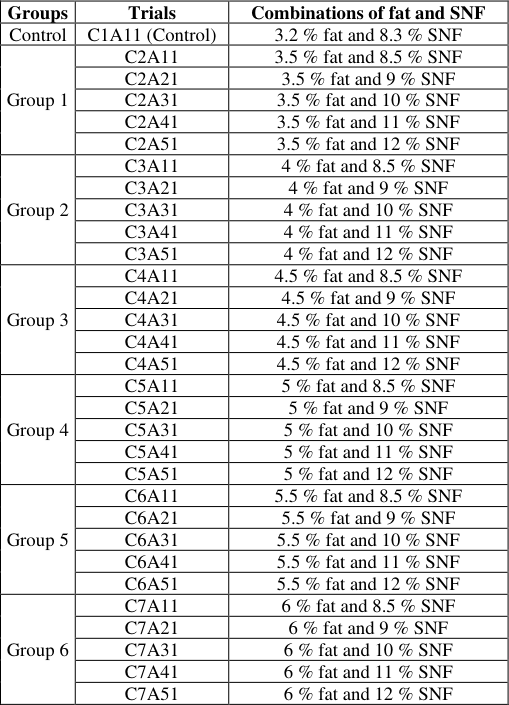 Table 1
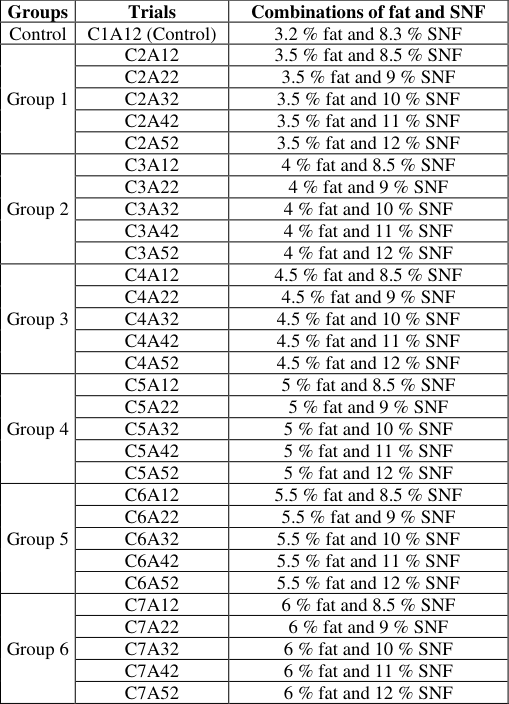 Table 2
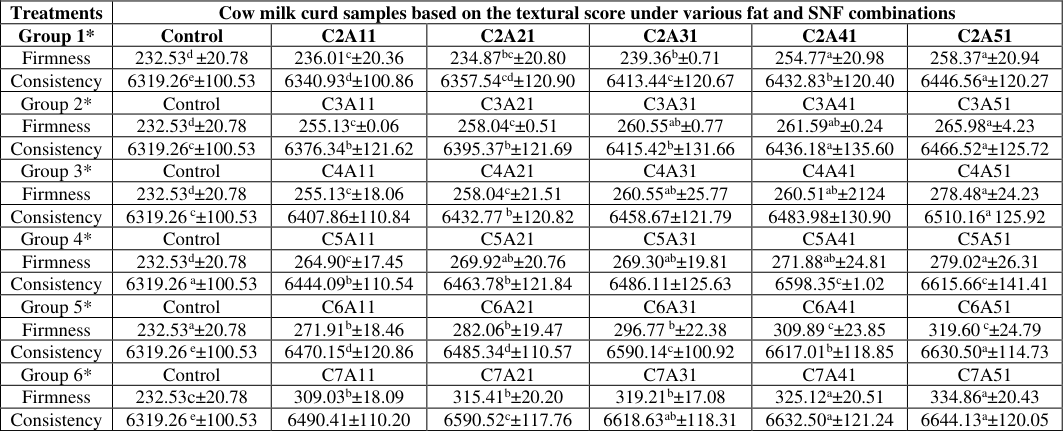 Table 3
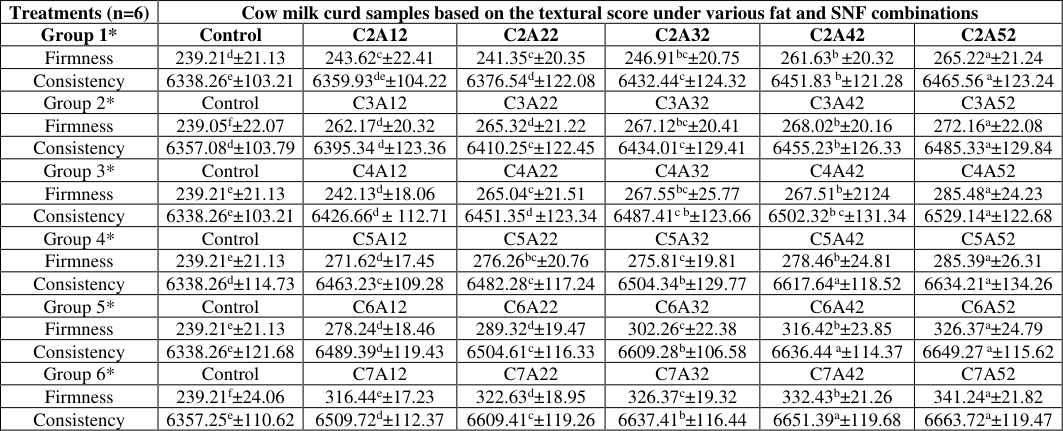 Table 4
Introduction
Firmness and consistency of cow curd samples of altered major milk constituents viz % fat and % Solids not fat were studied. Curd manufacture in India needs improvements in the existing methods of production and marketing so as to ensure a uniformly high standard in the quality of curd. The formulation of any step for improving the production of curd should however be based on a proper appreciation of the factors which go to determine the quality of curd, such as the types of organisms associated with curd produced in different parts of the country and their characteristics, influence of climatic and seasonal variations, quality of milk used and method of manufacture, about which there is very little information available. Texture is a collective term and comprises physical properties of the product, such as hardness, adhesiveness, viscosity, and springiness. They are all derived from the structural elements and can be perceptible by human senses. Consequently, texture is one of the basic quality determinator of fermented dairy products. Instrumental texture analysis, coming from penetrometric methods, is one of the main methods for texture determination of set-yoghurts. (Escher F, 1993; Benezech, 1994) [4,1] This research enlightens about the relationship between percent of fat content and percent of total solids in milk, incubation temperature for curd with its firmness and consistency attributes of cow curd texture.
Materials and methods
Fresh cow milk was obtained from farm and skim milk powder with 5 percent moisture and 95 percent solubility were used in this study. Major milk constituents was adjusted to contain the desired fat and SNF levels using the Pearson square method.
Textural analysis of cow curd
Back extrusion method using a texture analyser was used to find the textural attributes such as firmness and stickiness (M/s Scientific and Digital Systems, Delhi). For determining the textural attributes, the pasteurized and cooled curd was filled up to 5 cm in a sterilized glass beaker (10 cm height and 6 cm diameter) and tempered at 25 °C for 2 h prior to analysis. The probe was penetrated up to 10 mm (20 percent compression) into the curd at a crosshead speed of 1.0 mm/s. The probe displaced the material by compression followed by back extrusion so that the fluid flow upward through the concentric annular space. From the resulting force-time curves, firmness, i.e., the force for compression, stickiness, i.e., the negative peak force during withdrawal, work of shear and work of adhesion were calculated using the Texture Exponent System software supplied by the manufacturer along with the instrument. All measurements were done in quadruplicate per sample. Distance (10 mm) during which it senses a resistance force that is directly proportional to the firmness of the set curd.
The resistance offered by the curd samples to the probe during the penetration was measured as the firmness (g) of the curd. The area under the positive peak of the curve was measured as the consistency (g-sec) of the curd and the area under the negative peak was measured as the viscosity index (g-sec) of the curd. The viscosity index i.e. the area of the negative peak is the reflection of the total work done by the probe during its withdrawal from the curd during the test (Sfakianakis and Tzia, 2014; Bourne, 2002) [11,2] . Texture Measurement Textural attributes such as firmness and consistency were determined by back extrusion method using a texture analyser. For determining the textural attributes, the pasteurized and cooled curd mix was filled (∼125 mL) up to 5 cm in a pre-sterilized glass beaker (10 cm height and 6 cm diameter) and incubation was carried out at different temperature. The beakers were tempered at 25 °C for 2 h prior to analysis. The probe (A/BE 35) was penetrated up to 10 mm (20% compression) into the set cow curd at a crosshead speed of 1.0 mm/s. The probe displaced the material by compression followed by back extrusion, so that the fluid flowed upward through the concentric annular space. From the resulting force-time curves, firmness, i.e., the force for compression, consistency, i.e., the negative peak force during withdrawal, work of shear and work of adhesion were calculated using the Texture Expert Exceed software (version 2.55) supplied by the manufacturer along with the instrument. All measurements were done in quadruplicate per sample. Effect of major milk components Fat and Solids Not fat under altered combinations as given in table 1 and 2 were prepared using Pearson square method. Mistry and Hassan (1992) [7] reported that the firmness (as determined by a penetrometer) of non-fat yoghurt fortified with either non-fat dry milk (NDM) or high milk protein powder (HMPP) increased as compared with the unfortified one. Similar pattern was observed with the consistency, i.e., the negative peak force obtained during the withdrawal of the probe, among the three treatments. The increased consistency could be due to increased lactose content resulted from increased mean solids not fat (MSNF) content.
| Groups | Trials | Combinations of fat and SNF |
|---|---|---|
| Control | C1A11 (Control) | 3.2 % fat and 8.3 % SNF |
| Group 1 | C2A11 | 3.5 % fat and 8.5 % SNF |
| C2A21 | 3.5 % fat and 9 % SNF | |
| C2A31 | 3.5 % fat and 10 % SNF | |
| C2A41 | 3.5 % fat and 11 % SNF | |
| C2A51 | 3.5 % fat and 12 % SNF | |
| Group 2 | C3A11 | 4 % fat and 8.5 % SNF |
| C3A21 | 4 % fat and 9 % SNF | |
| C3A31 | 4 % fat and 10 % SNF | |
| C3A41 | 4 % fat and 11 % SNF | |
| C3A51 | 4 % fat and 12 % SNF | |
| Group 3 | C4A11 | 4.5 % fat and 8.5 % SNF |
| C4A21 | 4.5 % fat and 9 % SNF | |
| C4A31 | 4.5 % fat and 10 % SNF | |
| C4A41 | 4.5 % fat and 11 % SNF | |
| C4A51 | 4.5 % fat and 12 % SNF | |
| Group 4 | C5A11 | 5 % fat and 8.5 % SNF |
| C5A21 | 5 % fat and 9 % SNF | |
| C5A31 | 5 % fat and 10 % SNF | |
| C5A41 | 5 % fat and 11 % SNF | |
| C5A51 | 5 % fat and 12 % SNF | |
| Group 5 | C6A11 | 5.5 % fat and 8.5 % SNF |
| C6A21 | 5.5 % fat and 9 % SNF | |
| C6A31 | 5.5 % fat and 10 % SNF | |
| C6A41 | 5.5 % fat and 11 % SNF | |
| C6A51 | 5.5 % fat and 12 % SNF | |
| Group 6 | C7A11 | 6 % fat and 8.5 % SNF |
| C7A21 | 6 % fat and 9 % SNF | |
| C7A31 | 6 % fat and 10 % SNF | |
| C7A41 | 6 % fat and 11 % SNF | |
| C7A51 | 6 % fat and 12 % SNF |
Table text extracted from the original PDF; superscript letters are shown inline. The original table image is below.
View original table image
Results
Alterations were made in the major milk constituents of cow curd milk ie, Fat and solids not fat and analysis were related with texture profile of the best combination of fat and SNF for cow milk curd was carried out based on the sensory and textural properties. Firmness value, i.e., the peak force obtained during penetration of the probe revealed that increase of fat from 3-2% and SNF from 8.3 (Group 1) to Fat 6%; SNF 12% (Group 6) at incubation temperature of 37˚C has increased the cow curd firmness value from 232.53 ±20.78 to 334.86 ±20.43 and cohesiveness value from 6319.26±100.53 to 6644.13±120.05 respectively. Similarly cow curd prepared at incubation temperature of 40˚C Firmness value probe revealed that increase of fat from 3-2% and SNF from 8.3 (Group 1) to Fat 6%; SNF 12% (Group 6) at incubation temperature of 40˚C has increased the cow curd firmness value from 239.21 ±21.13 to 341.24±21.82 and cohesiveness value from 6338.26±103.21 to 6663.72±119.47 respectively. The textural qualities of the cow milk curd samples incubated at 37ºC and 40ºC are presented in Tables 3 and4.
As the fat and SNF contents of the milk increased, there was a corresponding increase in the firmness and consistency of the curd samples. Hence, based on the textural qualities the clear-cut conclusion about the fact that increase in fat and SNF will positively increase the firmness and consistency of cow.
Discussion
The data pertaining to the textural scores of the cow milk curd samples prepared with various combinations of fat and SNF and with incubation temperature of 37ºC and 40ºC is presented in Table 3 and4. The values of all measured texture parameters, namely firmness, and consistency were significantly different and increased in the following order of increase in fat and Solids not fat content. Such differences could be attributable to the varying content of total solids and total fat in cow milk, and also to the incubation temperature underwent. Moreover, further differences were found by Vlahopoulou et al. (1994) [12] for yoghurt gels. A looser consistency has been ascribed to the gel from cow milk curd with lower total solids, despite the lower total protein content in the milk. In this study, cow curd samples samples were incubated at 37 °C and 40C under different trails. These observations are similar to observations of Lee and Lucey (2004) [5] , they observed that the lower fermentation temperature allows more interaction and cross-links within proteins in the gel leading to the formation of a network that is homogenous in structure. In this experiment, the Curd samples incubated at 40 °C a higher textural scores than the other curd samples incubated at 37 °C. This observation correlates with the observation of Lee and Lucey (2004) [5] who had analyzed that yogurt gels incubated at 40 °C exhibited more obviously branched and homogeneous interconnected protein networks, and the gels networks underwent less obvious structural changes during fermentation, compared with yogurt gels made at 45.7 °C. Our findings also correlated with the findings of Nguyen et al., (2014) [8] who had stated that yoghurt produced from a faster fermentation at 43 °C was firmer with a more porous microstructure that exhibited a higher degree of syneresis.
| Treatments | Cow milk curd samples based on the textural score under various fat and SNF combinations | — | — | — | — | — |
|---|---|---|---|---|---|---|
| Group 1* | Control | C2A11 | C2A21 | C2A31 | C2A41 | C2A51 |
| Firmness | 232.53d ±20.78 | 236.01c±20.36 | 234.87bc±20.80 | 239.36b±0.71 | 254.77a±20.98 | 258.37a±20.94 |
| Consistency | 6319.26e±100.53 | 6340.93d±100.86 | 6357.54cd±120.90 | 6413.44c±120.67 | 6432.83b±120.40 | 6446.56a±120.27 |
| Group 2* | Control | C3A11 | C3A21 | C3A31 | C3A41 | C3A51 |
| Firmness | 232.53d±20.78 | 255.13c±0.06 | 258.04c±0.51 | 260.55ab±0.77 | 261.59ab±0.24 | 265.98a±4.23 |
| Consistency | 6319.26c±100.53 | 6376.34b±121.62 | 6395.37b±121.69 | 6415.42b±131.66 | 6436.18a±135.60 | 6466.52a±125.72 |
| Group 3* | Control | C4A11 | C4A21 | C4A31 | C4A41 | C4A51 |
| Firmness | 232.53d±20.78 | 255.13c±18.06 | 258.04c±21.51 | 260.55ab±25.77 | 260.51ab±2124 | 278.48a±24.23 |
| Consistency | 6319.26 c±100.53 | 6407.86±110.84 | 6432.77 b±120.82 | 6458.67±121.79 | 6483.98±130.90 | 6510.16a 125.92 |
| Group 4* | Control | C5A11 | C5A21 | C5A31 | C5A41 | C5A51 |
| Firmness | 232.53d±20.78 | 264.90c±17.45 | 269.92ab±20.76 | 269.30ab±19.81 | 271.88ab±24.81 | 279.02a±26.31 |
| Consistency | 6319.26 a±100.53 | 6444.09b±110.54 | 6463.78b±121.84 | 6486.11±125.63 | 6598.35c±1.02 | 6615.66c±141.41 |
| Group 5* | Control | C6A11 | C6A21 | C6A31 | C6A41 | C6A51 |
| Firmness | 232.53a±20.78 | 271.91b±18.46 | 282.06b±19.47 | 296.77 b±22.38 | 309.89 c±23.85 | 319.60 c±24.79 |
| Consistency | 6319.26 e±100.53 | 6470.15d±120.86 | 6485.34d±110.57 | 6590.14c±100.92 | 6617.01b±118.85 | 6630.50a±114.73 |
| Group 6* | Control | C7A11 | C7A21 | C7A31 | C7A41 | C7A51 |
| Firmness | 232.53c±20.78 | 309.03b±18.09 | 315.41b±20.20 | 319.21b±17.08 | 325.12a±20.51 | 334.86a±20.43 |
| Consistency | 6319.26 e±100.53 | 6490.41±110.20 | 6590.52c±117.76 | 6618.63ab±118.31 | 6632.50a±121.24 | 6644.13a±120.05 |
Table text extracted from the original PDF; superscript letters are shown inline. The original table image is below.
View original table image
Conclusion
Cow milk curd is a popular fermented dairy product of India having moderate to high fat and high total solids content. Firmness and consistency increases with increase in the content of Fat and SNF of cow milk. Relationship between cow curd Firmness and consistency with increase in ratio of major milk constituents were much better with increased fermentation temperature of 40ºC when compared to 37ºC of curd incubation.
Acknowledgement
AcknowledgementsAuthors sincerely thank Tamil Nadu Veterinary and Animal Sciences University for providing necessary facilities to carry out this research work.
Figures and tables from the paper
| Groups | Trials | Combinations of fat and SNF |
|---|---|---|
| Control | C1A12 (Control) | 3.2 % fat and 8.3 % SNF |
| Group 1 | C2A12 | 3.5 % fat and 8.5 % SNF |
| C2A22 | 3.5 % fat and 9 % SNF | |
| C2A32 | 3.5 % fat and 10 % SNF | |
| C2A42 | 3.5 % fat and 11 % SNF | |
| C2A52 | 3.5 % fat and 12 % SNF | |
| Group 2 | C3A12 | 4 % fat and 8.5 % SNF |
| C3A22 | 4 % fat and 9 % SNF | |
| C3A32 | 4 % fat and 10 % SNF | |
| C3A42 | 4 % fat and 11 % SNF | |
| C3A52 | 4 % fat and 12 % SNF | |
| Group 3 | C4A12 | 4.5 % fat and 8.5 % SNF |
| C4A22 | 4.5 % fat and 9 % SNF | |
| C4A32 | 4.5 % fat and 10 % SNF | |
| C4A42 | 4.5 % fat and 11 % SNF | |
| C4A52 | 4.5 % fat and 12 % SNF | |
| Group 4 | C5A12 | 5 % fat and 8.5 % SNF |
| C5A22 | 5 % fat and 9 % SNF | |
| C5A32 | 5 % fat and 10 % SNF | |
| C5A42 | 5 % fat and 11 % SNF | |
| C5A52 | 5 % fat and 12 % SNF | |
| Group 5 | C6A12 | 5.5 % fat and 8.5 % SNF |
| C6A22 | 5.5 % fat and 9 % SNF | |
| C6A32 | 5.5 % fat and 10 % SNF | |
| C6A42 | 5.5 % fat and 11 % SNF | |
| C6A52 | 5.5 % fat and 12 % SNF | |
| Group 6 | C7A12 | 6 % fat and 8.5 % SNF |
| C7A22 | 6 % fat and 9 % SNF | |
| C7A32 | 6 % fat and 10 % SNF | |
| C7A42 | 6 % fat and 11 % SNF | |
| C7A52 | 6 % fat and 12 % SNF |
Table text extracted from the original PDF; superscript letters are shown inline. The original table image is below.
View original table image
| Treatments (n=6) | Cow milk curd samples based on the textural score under various fat and SNF combinations | — | — | — | — | — |
|---|---|---|---|---|---|---|
| Group 1* | Control | C2A12 | C2A22 | C2A32 | C2A42 | C2A52 |
| Firmness | 239.21d±21.13 | 243.62c±22.41 | 241.35c±20.35 | 246.91bc±20.75 | 261.63b ±20.32 | 265.22a±21.24 |
| Consistency | 6338.26e±103.21 | 6359.93de±104.22 | 6376.54d±122.08 | 6432.44c±124.32 | 6451.83 b±121.28 | 6465.56 a±123.24 |
| Group 2* | Control | C3A12 | C3A22 | C3A32 | C3A42 | C3A52 |
| Firmness | 239.05f±22.07 | 262.17d±20.32 | 265.32d±21.22 | 267.12bc±20.41 | 268.02b±20.16 | 272.16a±22.08 |
| Consistency | 6357.08d±103.79 | 6395.34 d±123.36 | 6410.25c±122.45 | 6434.01c±129.41 | 6455.23b±126.33 | 6485.33a±129.84 |
| Group 3* | Control | C4A12 | C4A22 | C4A32 | C4A42 | C4A52 |
| Firmness | 239.21e±21.13 | 242.13d±18.06 | 265.04c±21.51 | 267.55bc±25.77 | 267.51b±2124 | 285.48a±24.23 |
| Consistency | 6338.26e±103.21 | 6426.66d ± 112.71 | 6451.35d ±123.34 | 6487.41c b±123.66 | 6502.32b c±131.34 | 6529.14a±122.68 |
| Group 4* | Control | C5A12 | C5A22 | C5A32 | C5A42 | C5A52 |
| Firmness | 239.21e±21.13 | 271.62d±17.45 | 276.26bc±20.76 | 275.81c±19.81 | 278.46b±24.81 | 285.39a±26.31 |
| Consistency | 6338.26d±114.73 | 6463.23c±109.28 | 6482.28c±117.24 | 6504.34b±129.77 | 6617.64a±118.52 | 6634.21a±134.26 |
| Group 5* | Control | C6A12 | C6A22 | C6A32 | C6A42 | C6A52 |
| Firmness | 239.21e±21.13 | 278.24d±18.46 | 289.32d±19.47 | 302.26c±22.38 | 316.42b±23.85 | 326.37a±24.79 |
| Consistency | 6338.26e±121.68 | 6489.39d±119.43 | 6504.61c±116.33 | 6609.28b±106.58 | 6636.44 a±114.37 | 6649.27 a±115.62 |
| Group 6* | Control | C7A12 | C7A22 | C7A32 | C7A42 | C7A52 |
| Firmness | 239.21f±24.06 | 316.44e±17.23 | 322.63d±18.95 | 326.37c±19.32 | 332.43b±21.26 | 341.24a±21.82 |
| Consistency | 6357.25e±110.62 | 6509.72d±112.37 | 6609.41c±119.26 | 6637.41b±116.44 | 6651.39a±119.68 | 6663.72a±119.47 |
Table text extracted from the original PDF; superscript letters are shown inline. The original table image is below.
View original table image
References
9 in the original paper- Benezech T, Maingonnat JF. Characterization of the rheological properties of yoghurt -a review. J Food Eng. 1994;21:447-472.
- Domagala J, Sady M, Grega T, Bonczar G. The influence of storage time on rheological properties and texture of yoghurts with the addition of oatmaltodextrin as the fat substitute. Int J Food Prop. 2005;8:439-448.
- Lucey JA. Formation and physical properties of milk protein gels. J Dairy Sci. 2002;85:281-294.
- Mistry VV, Hassan HN. Manufacture of non-fat yogurt from a high milk protein powder. J Dairy Sci. 1992;75:947-957.
- Nguyen HTH, Ong L, Lefevre C, Kentish SE, Gras SL. The effect of fermentation temperature on the microstructure, physicochemical and rheological properties of probiotic buffalo yoghurt. Food Bioprocess Technol. 2014;7:2538-2548.
- Paul S, Paul P, Rao KJ, Pagote CN. Correlations among instrumental textural characteristics, sensory score and solids content of dahi-An Indian fermented milk product. Int J Food Ferment Technol. 2016;6(2):337349.
- Salvador A, Fiszman SM. Textural and sensory characteristics of whole and skimmed flavoured settype yoghurt during long storage. J Dairy Sci. 2004;87(12):4033-4041.
- Sfakianakis P, Tzia C. Conventional and innovative processing of milk for yogurt manufacture; development of texture and flavor: a review. Foods (Basel). 2014;3(1):176-193.
- Vlahopoulou J, Bell AE, Wilbey A. Starter culture effects on caprine yoghurt fermentation. J Soc Dairy Technol. 1994;47(4):121-123.