Breadcrumbing is accounting as a new concept in the modern relationship paradigm. Breadcrumbing is a form of emotional abuse as it involves controlling the other person and manipulating them. Antisocial personality disorder is mainly characterized by irresponsible behavior or impulsive attitude. Breadcrumbing leads to lowering the self-esteem of individuals and thus influencing their relationships. As individuals with antisocial personality disorder get breadcrumbed in their relationships, they exhibit anger and struggle with trust issues. The present study aims to measure the influence of breadcrumbing on antisocial personality disorder in adolescents. The Sample comprises 60 adults (aged 18 – 25 years). In this study, the primary data is collected using two different tools consisting of the Breadcrumbing in Affective-Sexual Relationships (BREAD-ASR) Questionnaire and the Antisocial Personality Disorder Test. The collected data is coded, scored, and exported to SPSS for analysis. For statistical analysis Mean, Standard Deviation, and Correlation were done. Hence, it can be concluded that there is a significant relationship between breadcrumbs and antisocial personality disorder in adolescents.
Summary
Source-checked
Plain-language reading of the full paper, prepared with AI and checked against the text. Each point links to the authors' own words.
1Why it matters
Breadcrumbing is a modern relationship concept characterized as a form of emotional abuse involving manipulation and control of another person. View evidence ↗
Antisocial personality disorder (ASPD) is primarily defined by impulsive attitudes and irresponsible behavior. View evidence ↗
The development of antisocial attitudes and behaviors is identified as one of the damaging consequences of breadcrumbing in adolescents. View evidence ↗
2The question
The study aims to measure how breadcrumbing influences antisocial personality disorder in adolescents. View evidence ↗
3What they did
Data was collected using two tools: the Breadcrumbing in Affective-Sexual Relationships (BREAD-ASR) Questionnaire and the Antisocial Personality Disorder Test. View evidence ↗
The researchers analyzed the data using mean, standard deviation, and correlation. View evidence ↗
4What they found
T-test analysis showed that t-values for both groups (3.7616 for victims and 7.0253 for normal persons) exceeded the critical DF values at 0.05 (1.699) and 0.01 (2.462). View evidence ↗
The study found a strong positive correlation between breadcrumbing and the formation of antisocial personality disorder across the participant group. View evidence ↗
5What it means
The authors conclude that breadcrumbing has a strong influence on the development of antisocial personality disorders. View evidence ↗
The authors state that the sample size of 60 participants is not representative of the broader population experiencing breadcrumbing. View evidence ↗
Visual summary
3 visuals
Illustrations explain the paper; charts are replotted from the paper's own table values.
In recent years, it has been identified that dating is becoming more ambiguous. It is regarded more as a way to know each other than a personal relationship. The increasing popularity of dating applications among young people is making ways to develop bonds. Breadcrumbing is a serious concern identified among young people as it is responsible for having a significant impact on both the victim and the perpetrator. Lack of commitment and severe uncertainty within the relationship are responsible for corroding confidence. Difficulties in trusting another person lead to hindrances in the formation of a healthy relationship. One of the damaging consequences of this breadcrumbing identified among adolescents are development of antisocial behavior and attitude. The present study aims to analyze the influence of breadcrumbing and its role in the development of antisocial personality disorders identified among adults.
Concept of Breadcrumbing and Anti-social Personality Disorder
In a relationship, breadcrumbing is a cruel act as it leaves the victim feeling emotionally drained. The perpetrator offers only minimum affection and never promises real commitment. This treatment not only ruins the emotional aspect of the victim but also has a long lasting negative consequence over the psyche of the victim (Rhee et al., 2021) [12] . In order to restore emotional balance, it is important to identify breadcrumbing. One of the important signs of antisocial personality disorder (ASPD) is that severity varies on the basis of occasion and situation. Being breadcrumbed in a relationship often leads to making the person emotionally unavailable (Mukherjee, 2024) [11] Lack of attention and engaged in breadcrumbed behaviors led to developing antisocial traits. Development of antisocial tendencies further becomes the reason for low life satisfaction and feeling of loneliness. People experiencing breadcrumbs often feel helpless and fail to trust within relationships. Breadcrumbing is an emerging concern identified among young adults where avoidance in a relationship are identified. As breadcrumbing is responsible for creating distance within familial and social relationships, it changes the normal behavioral approach.
Impact of breadcrumbing on relationships
Breadcrumbing is posing as a form of subtle manipulation within relationships. Dating forms an initial stage in the process of establishing romantic ties. One of the prominent consequences of breadcrumbing is that it creates emotional disturbance in the psyche of victims. Research emphasized that breadcrumbing involves repeated tossing out within a dating behavior where a person is hanged in a relationship. Incorporation of tools such as "BREAD-ASR" helps in screening for "breadcrumbing" perpetration (Khattar et al., 2023) [7][8] . This tool utilization focused examination of experiences of a victim of breadcrumbing. Association between breadcrumbing and antisocial behavior are responsible for provocation of negative social consequences. One of the prominent characteristics of breadcrumbing victims is facing issues in communication. As online relationships are developing, breakup strategies such as ghosting are coming into account. Experiencing breadcrumbing in a relationship leads to generation of negative perspectives in future relationships. Key themes of breadcrumbing are flirtatiousness and avoidance of intimate relationships. Victims often fail to identify gaps within relationships and this results in living in that relationship for a long time. Perpetrator invests less in the romantic relationship, on the contrary the victim fails to suspect the real intention of the partners. Research identified that cyber dating is responsible for online bullying and leading to aggressive behavior (Biolcati et al., 2021) [3] . It is identified that behaviors such as abruptly stopping messages, punishing partners by giving silent behavior marks early onset of breadcrumbing within a relationship.
Factors responsible for development of Antisocial Personality Disorder among Adolescents
Experiences in life accounts as a predominant factor in terms of determining social behavior. In modern dating dynamics, relevance of media use is responsible for altering the definition of relationship. Study suggested that victims of breadcrumbing show signs of poor self-confidence and emotional instability (Khattar et al., 2023) [7][8] . It is inferred that breadcrumbing is associated with poor self-esteem, poor socio-economic environment within the family. When an adolescent is exposed to negative situations in life for a prolonged period of life, it leads to triggering of traits of antisocial personality. Poor family environment is also responsible for deteriorating emotional values and beliefs. In many cases, family conditions result in the development of trust issues in the spectrum of relationships. The current landscape of dating shares light on different features in terms of one night stands, long-distance relationships and infidelity which are deteriorating the definition of relationship (Frank et al., 2021) [5] . It is identified that a range of constraints are responsible for the occurrence of relationship failure. Problems in terms of familial relationship create complications within personality traits. Casual dating leads to romantic deception and is a significant factor for breaking trust of victims. This factor accounts as a probable cause of creation of antisocial behavior among adolescents. As adolescents are failing to determine the aspect of a relationship, it is leading to destruction of the narrative of relationships. Studies reflect that in the digital era, occurrence of flirtation without any follow up message is responsible for terminating relationships at an early stage. Technology generated communication is responsible for creation of fake connections (Daraj et al., 2023) [4] . Adolescents who fall victim to breadcrumbing are responsible for sudden disengagement in future relationships. Continuation of such habits lead to unexplained withdrawal from intimate relationships.
Ways Breadcrumbing and Antisocial Personality Disorder are Interrupting Perception of Modern Relationships
Antisocial personality disorder (ASPD) shows signs of reckless behavior in social context. Presence of any form of personality disorders such as antisocial personality disorder (ASPD) are responsible for negatively influencing social life and personal relationships (Bertolín-guillén, 2023) [2] . It is assessed that random and irregular intervals within a relationship are responsible for intoxicating modern relationships. Little connection with the other person within the relationship is responsible for failing the whole process. Studies mentioned the negative consequence of poor interaction of biological and genetic factors responsible for developing antisocial personality disorder (ASPD) within an individual (Moselli et al., 2023) [10] . It has been processed that unstable interpersonal relationships are responsible for creation of identity disturbance in an adolescent. The selected study further emphasized on the prevalence of antisocial traits among females in comparison to males (Moselli et al., 2023) [10] . Aggressive attitude, anger and conduct disorder are some characteristics identified within modern relationships. This is because of poor understanding and lack of coordination identified among male and females in a relationship. An adolescent with antisocial personality disorder often tends to have poor relationships with family. Also, they face trouble in dating and fear getting into a long term relationship. Studies identified that adolescents suffering from antisocial personality disorder often result in blaming each other within a family (Kiani & Ziaeirad, 2020) [9] . It is assessed that commitment of anti-social behaviors are responsible for facing rejection within friends, family and even from strangers. Overall, it is assessed that facing trouble in past relationships are responsible for hampering interpersonal relationships.
Strategies to Mitigate Risks associated with Breadcrumbing and Antisocial Personality Disorder
Antisocial syndrome are identified predominantly among relationship abusers. Studies identified that antisocial tendencies are comparatively high in people who show signs of aggression (Ahmad & Mazlan, 2024) [1] . Inclusion of effective preventive strategies such as identification and comparison of antisocial personality traits can help in taking controlling measures. As adolescents facing unstable relationships like breadcrumbing can show severe forms of aggression even in family context. One of the effective strategies to mitigate this risk is focusing on lowering the verbal and physical aggression rate. Incorporation of antisocial personality disorder measuring scale can shed light on scales in relation to antisocial tendency. Studies emphasized the impact of betrayal on development of antisocial personality traits (Yalch et al., 2021) [15] . It is inferred that traumatic experience in a relationship is responsible for increasing violent and criminal behavior. Effective strategies in terms of practicing self-care and mindfulness helps in mitigating risks in this regard.
Antisocial behaviors are associated with impulsivity and irresponsibility (Friedman et al., 2021) [6] . Varied measures of behaviors such as deviant behaviors, clinical disorders are responsible for constructing conduct disorder. It is essential to evaluate core personality traits as it can help in identifying ways to mitigate risks associated with antisocial behavior and bread crumbing. Exclusion: The study excluded following criteria: Excluded the adults who are falls above or under of the age group between 18 to 25 Excluded the other factors like OCD, Phobia, wellbeing, body image problem.
Methodology
Methodology
Research And Sample Design:
The study is descriptive in nature.
Tool Used: For the study both Breadcrumbing in Affective-Sexual Relationships (Bread-ASR) and Antisocial Personality Disorder Test are used. Breadcrumbing in Affective-Sexual Relationships (Bread-ASR) -It is a standardized scale that measures a participant's breadcrumbing. The scale is of 16-item.
(Khattar et al., 2023) [7][8] Antisocial Personality Disorder Test -It assess the cognitive beliefs and emotional preferences in order to evaluate antisocial attitudes. This scale was developed by Padilla-Walker & Jensen (2016). This scales contains 40 items, and it also included sub-scale i.e. Physical aggression, Lack of empathy, Absence of prosocial standards, Lack of guilt or remorse, Incapacity for mutually intimate relationships, Risk-taking, Egocentrism, Manipulativeness. (Skowroński, 2023) [14] .
Procedure: The study uses data collected using the Antisocial Personality Disorder Scale and BREAD ASR scale. The information has been collected using the questionnaire distributed among 60 participants. At first, rapport was established with the participant. Then two questionnaires were presented. The first was the BREAD ASR questionnaire where the subject was instructed to carefully read the question before proceeding with the answer. The second was the anti-social personality scale where the subjects were instructed to fill in answers according to which statement they resonate most. The subjects are asked to report in case of any difficulty.
Calculations are done after collecting information. In 1the Anti-Social Personality Disorder Scale, it has been identified that there are 60 adult participants. The mean of victim of breadcrumbing using this scale is 143.7333333. And the standard deviation calculated is 3.310727947. The mean calculated in normal person is 51.23333333. The standard deviation calculated is 2.762848771. 1 and2, it is convenient to consider that the chance of occurrence of anti-social personality disorder is a high probability for people with a breadcrumbing background. The current study found a significant positive correlation with the scores, which was expected at the beginning of the research.
The current study produced a significant finding which included T-test analysis that produced a significant positive correlation. Therefore, it is identified that there is a strong relationship between breadcrumbs and the occurrence of antisocial personality disorder.
There are certain limitations in this study. The sample size of the current study (N=60) is not representative of the wider population facing breadcrumb in relationships.
Conclusion
The impact of breadcrumbing faced in relationships is responsible for influencing the personality traits of the victim. It is essential to clearly define the position and situation of individuals involved in a relationship. It is convenient to regard that there is an association between breadcrumb and anti-social personality disorder. It is concluded from the analysis that the strong positive correlation value identified in the context of total participants suggested the strong influence of breadcrumbs in developing anti-social personality disorders.
Figures and tables from the paper
Table 1. Mean and Standard Deviation Score using Bread-ASR
—
N
Mean
SD
Victim of Breadcrumbing
30
69.8
2.644447664
Normal Person
30
23.63333333
2.157318472
Table text extracted from the original PDF; superscript letters are shown inline. The original table image is below.
Ahmad A, Mazlan NH. The prevalence of borderline personality disorder, antisocial tendencies, and aggression among male and female inmates. Malaysian Journal of Forensic Sciences. 2024;5(2):31-38.
Bertolín-Guillén JM. Seduction: Psychology and Psychopathology. 2023.
Biolcati R, Pupi V, Mancini G. Cyber dating abuse and ghosting behaviors: Personality and gender roles in romantic relationships. Current Issues in Personality Psychology. 2022;10(3):240.
Daraj LR, Buhejji MR, Perlmutter G, Jahrami H, Seeman MV. Ghosting: Abandonment in the digital era. Encyclopedia. 2023;4(1):36-45.
Frank L, Klincewicz M. The moral rights and wrongs of online dating and hook-ups. In: The Oxford Handbook of Digital Ethics. Oxford University Press; 2021. p. C12-S1.


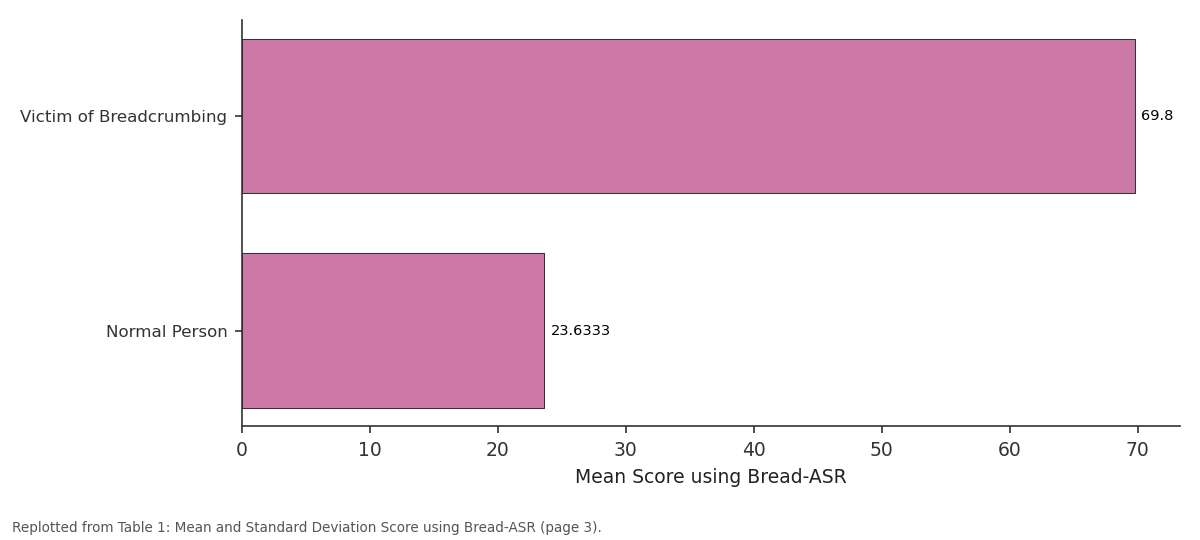
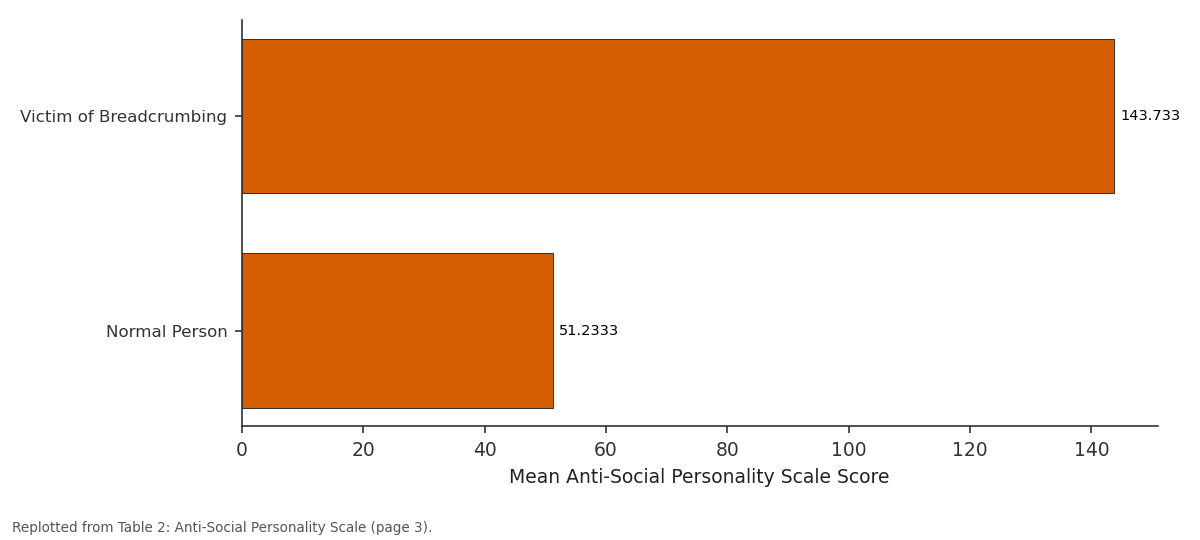
 Table 1
 Table 2
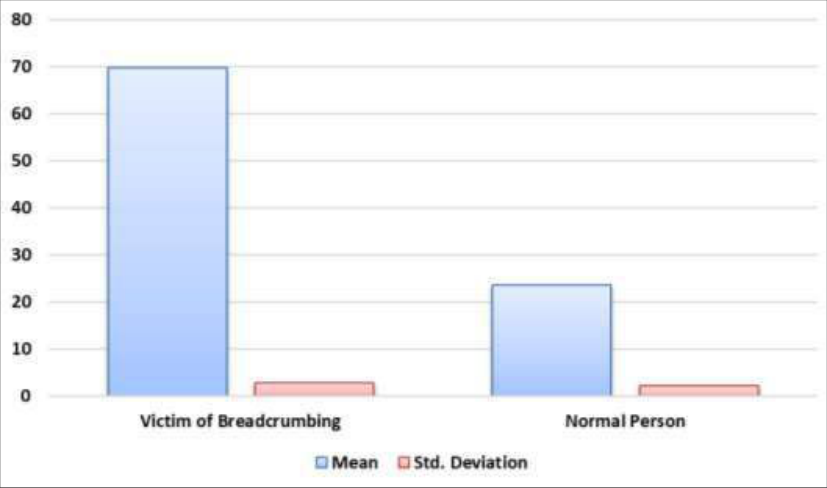 Figure 1
 Table 3
 Table 4
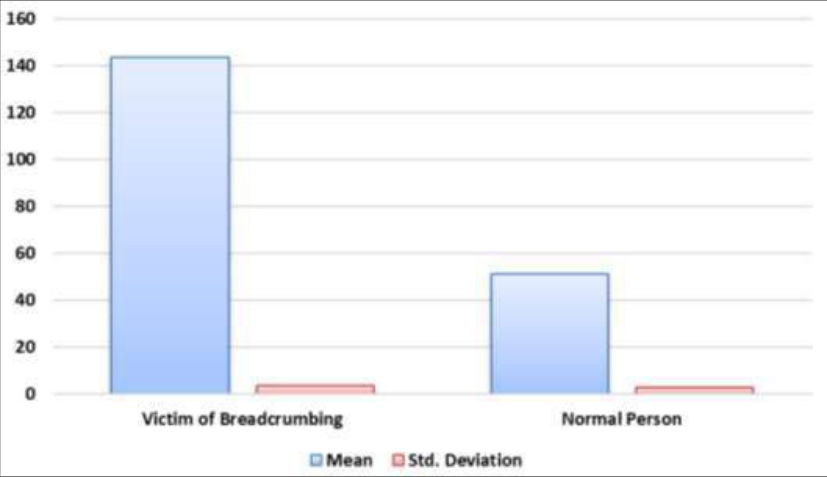 Figure 2