
Research article · 2025 · Full text
International Journal of Veterinary Sciences and Animal HusbandryAzolla supplementation in diet contributes to improved body weight gain and egg production in backyard poultry
Volume 10(2) · Pages 83–85 · DOI: 10.22271/veterinary.2025.v10.i2b.2054 ↗
Research areasBiological Control of Invasive SpeciesMoringa oleifera research and applicationsEssential Oils and Antimicrobial Activity
Abstract
Author-writtenThe study was conducted in 10 tribal villages of Parvathipuram-Manyam district to assess the effect of supplementing Azolla in backyard poultry feed, during the period of November 2022 to December 2023. Twenty backyard poultry units rearing native variety of chicken were selected and divided into two groups viz; control and treatment, with each unit comprising of around 30 birds. Out of twenty locations ten were kept as control where there was no dietary azolla supplementation to poultry and for treatment group azolla was supplemented at rate of 50 per cent on wet weight basis. Average body weight at 16th and 20th weeks of age and average annual egg production were recorded. The study revealed that mean average body weight of birds during 16th week and 20th weeks were significantly higher in azolla supplemented groups as compared to farmer’s practice of feeding grain ration. Also, the average annual egg production in azolla fed birds increased significantly (P value ˂0.01) with a production of 88.1±7.38 eggs/year as compared to control flock where it was 78.6±4.27 eggs/year. The results indicated that supplementing azolla in backyard poultry feed as a secondary protein source can help to improve the body weight gain and egg production of birds.
Summary
Source-checkedPlain-language reading of the full paper, prepared with AI and checked against the text. Each point links to the authors' own words.
Why it matters
- Backyard poultry rearing serves as a traditional supplementary source of income and livelihood for tribal farmers in the Parvathipuram Manyam district of India. View evidence ↗
- Poultry farmers in this region face economic challenges due to constraints such as poor weight gain and low egg production. View evidence ↗
- Feed costs account for 65-70% of total production costs in poultry farming, making the development of low-cost, local feed formulations important. View evidence ↗
The question
- The study aimed to evaluate the effects of using Azolla as a supplementary protein source for backyard poultry in the upland tribal mandals of Parvathipuram Manyam district. View evidence ↗
What they did
- The study was conducted from November 2022 to December 2023, measuring average annual egg production and average body weight at 16 and 20 weeks of age. View evidence ↗
- Data was collected from a minimum of 30 birds of the same age within each poultry unit. View evidence ↗
What they found
- At 16 weeks of age, birds in the Azolla-supplemented group had significantly higher mean average body weights in 8 out of 10 trial locations compared to those fed a standard grain ration. View evidence ↗
- Annual egg production was significantly higher in the Azolla-fed group (88.1±7.38 eggs/year) compared to the control group (78.6±4.27 eggs/year), with a P value < 0.01. View evidence ↗
What it means
- The authors conclude that using Azolla as a protein supplement can reduce production costs for backyard poultry rearing. View evidence ↗
- The authors recommend incorporating Azolla in either fresh or dried form into poultry feed to economically improve meat and egg production. View evidence ↗
Visual summary
2 visualsIllustrations explain the paper; charts are replotted from the paper's own table values.
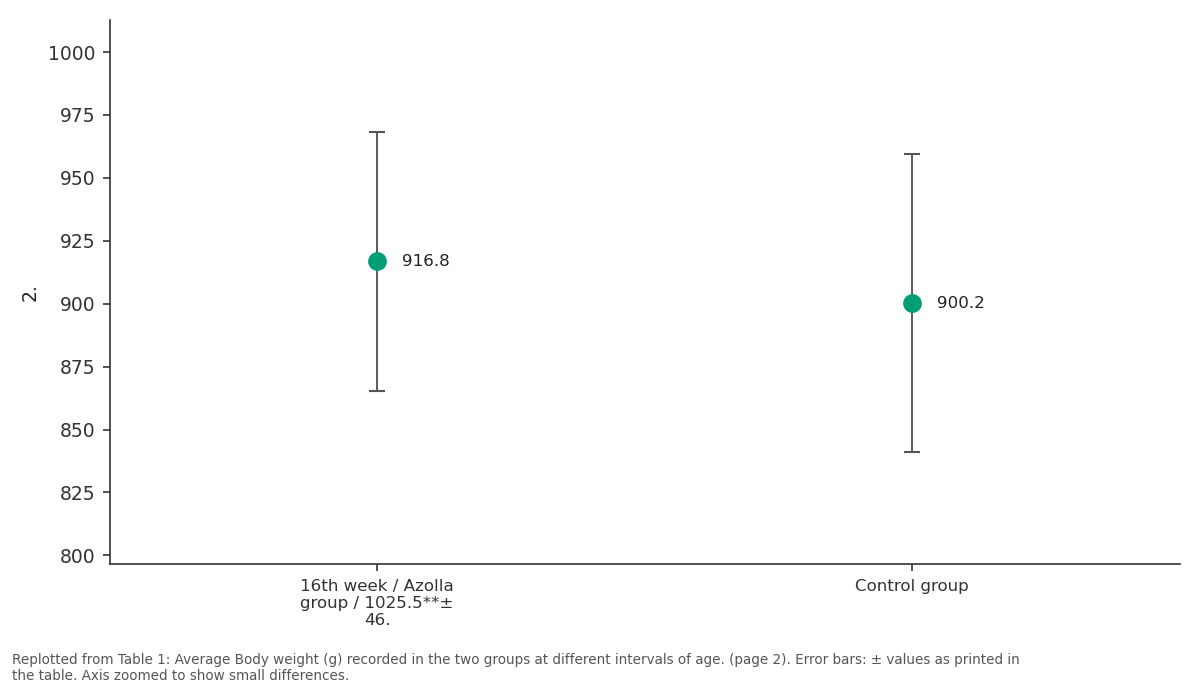
2.: 16th week / Azolla... vs Control group
Replotted from Table 1 (page 2) of the original paper. Every bar is the paper's own table value.
View source evidence ↗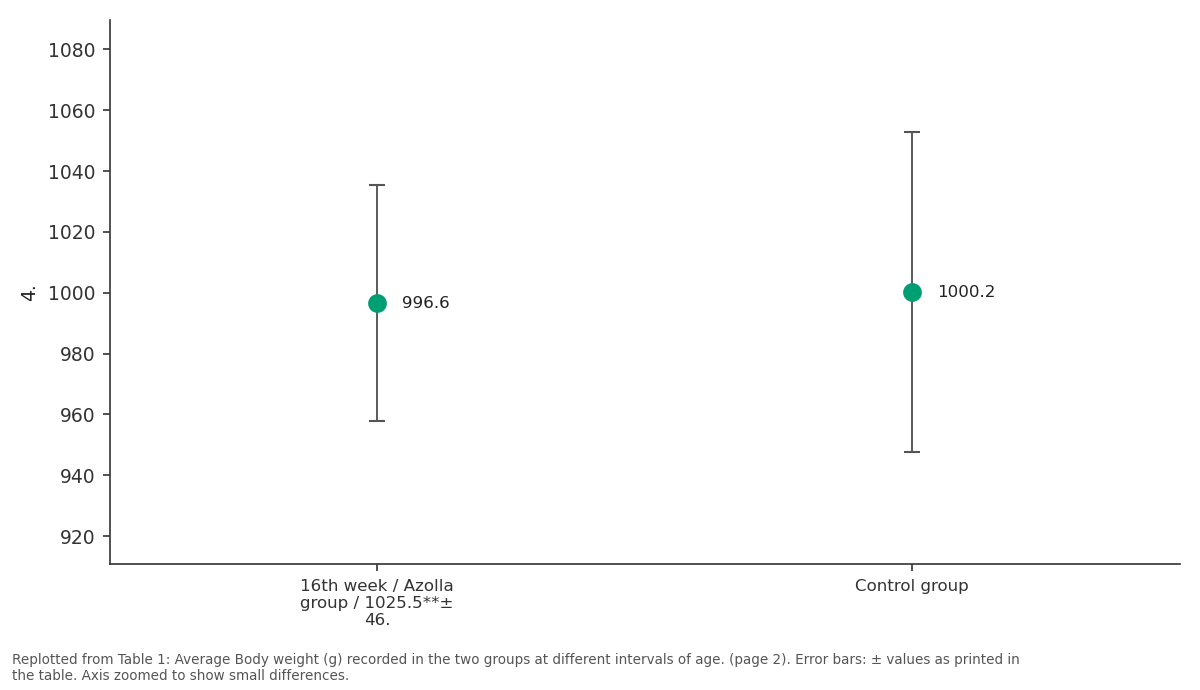
4.: 16th week / Azolla... vs Control group
Replotted from Table 1 (page 2) of the original paper. Every bar is the paper's own table value.
View source evidence ↗Figures & tables
From the original paper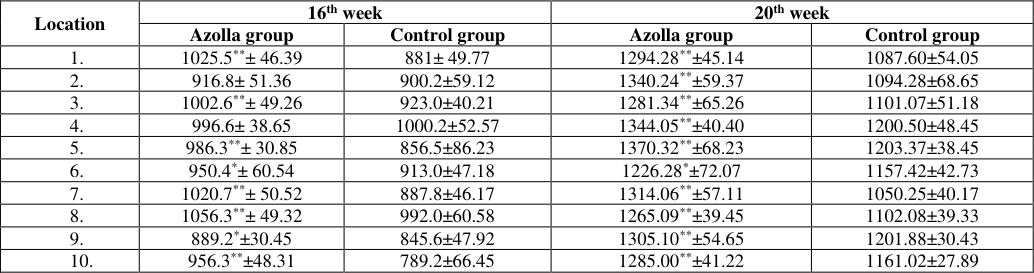 Table 1
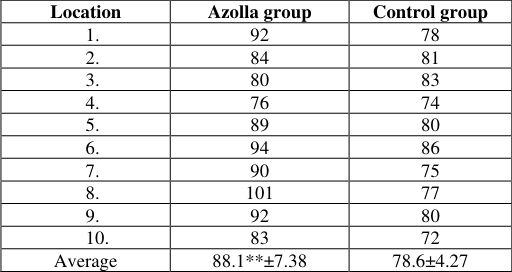 Table 2
Introduction
Livestock and poultry farming are major contributors to the Indian economy and these enterprises are gaining preference due to its potential to contribute to sustainable livelihood and socio-economic equality of rural families [1] . Backyard poultry rearing is a traditional supplementary livelihood activity of tribal farmers of Parvathipuram Manyam district of Andhra Pradesh, India. In majority of the household, there will be a unit of minimum ten poultry birds and have been reared for both egg and meat purpose which ensures nutritional security to the tribal population. Though the practice of poultry rearing is followed here erstwhile, low egg production, poor weight gain, incidence of various diseases and higher mortality rates remained as constraints which cause economic backlash to poultry farmers. To curb the problem of poor egg production in desi birds, improved poultry varieties like Rajasri, Gramapriya, Vanaraja etc were introduced in this region [2] . In poultry farming 65-70 per cent of total cost of production accounts for feed cost, hence lowcost feed formulation by using locally available feeds should be considered. The incorporation of nonconventional feed or feeds of plants origin in poultry diet can mitigate the production cost and can improve the productive and economic performance of poultry birds [3] . Azolla pinnata is a free-floating aquatic fern of the family Azollaceae which is rich in protein, minerals, vitamins etc. and is a well identified unconventional feed and protein supplement for animals like ruminants, pigs, poultry and fish [4] . Azolla has good potential to proliferate without inorganic nitrogen fertilization and has high rate of growth in water. The most important characteristic is its symbiotic relationship with the nitrogen-fixing blue-green algae (Cyanobacterium) Anabaena azollae, which contributes to the protein richness of Azolla. It naturally grows in drains, ponds, rivers, canals, rice fields, water bodies and soggy lands in humid regions with temperature range of 15-35 °C.
Azolla has been utilized as biofertilizer and green manure in enriching rice crop by virtue of its nitrogen fixing abilities. The utilization of Azolla as an unconventional feed ingredient for poultry feeding had been proven with beneficial effects like improved bodyweight gain [7] . Supplementing azolla in poultry feed helps in imparting rich yellow colour to egg yolk due to the presence of carotene pigment [6] . The poultry farmers of this region mainly rely on grain feeding, rice in particular, to meet the additional nutrient requirements in free range system of rearing birds. In view of this, the present study was undertaken to assess the effect of feeding. Azolla as a supplementary protein source to backyard poultry in the upland tribal mandals of Parvathipuram Manyam district, Andra Pradesh, India.
Materials and Methods 1. Study area and study design
The present study was conducted at farmer's fields in ten selected villages of Kurupam, Gummalakshmipuram and Parvathipuram mandals of Parvathipuram Manyam district. Twenty backyard poultry units rearing native varieties of chicken were selected for the trial, two from each village. The feeding practices of the poultry farmers in all locations were more or less similar. Almost 60% of their dietary requirement of the birds will be met by scavenging through fields. Additionally, the farmers feed rice grains, maize and bran to the birds. Before the start of intervention, the selected farmers were given training on preparation of Azolla beds, azolla cultivation and incorporation of azolla in poultry diet. The trial was conducted for a period of one year from November 2022 to December 2023 and parameters recorded were average body weight at 16 th and 20 th weeks of age and average annual egg production. Out of twenty locations ten were kept as control where there was no dietary azolla supplementation to poultry and for treatment group azolla was supplemented at rate of 50 per cent on wet weight basis. From each unit data pertaining to a minimum of 30 birds belonging to same age were recorded. Male and female birds were present in almost equal ratio.
Azolla cultivation and dietary supplementation
Azolla seedlings grown at Krishi Vigyan Kendra (KVK), Rastakuntubai were distributed to the selected farmers along with 8 x 4 x 1 ft sized azolla growing beds. To meet the daily requirement of azolla, farmers also prepared additional beds using tarpolene sheets on leveled land preferably at shady area in their fields. Beds were filled uniformly with sieved soil mixed with cow dung before adding water and azolla seedlings were placed. After inoculation of culture, the Azolla beds were covered with a shade net to ensure optimum growth. Under ample environment azolla would multiply in 15-20 days to cover the entire bed. Azolla was harvested daily using strainers and was washed thoroughly to remove the dung smell before feeding to the birds. Azolla was supplemented along with concentrate feed comprising of rice, maize and bran, at rate of 50 per cent on wet weight basis viz; for 50 gm feed 50 gm azolla was mixed and fed the birds daily.
Statistical analysis
The data on body weight and egg production were recorded. Statistical analysis was done as per Snedecor and Cochran (1994) [8] . Results are expressed as Mean ± standard deviation. The means were compared between the treated and control groups using unpaired T test.
Results and Discussion
Our study revealed that out of 10 trial locations, the mean average body weight of birds during 16 th week was significantly higher in azolla supplemented group in 8 locations, as compared to farmer's practice of feeding grain ration. Whereas in 20 th week the body weights recorded in azolla group were significantly higher than the control population in all 10 locations (Table 1). Bidya Shankar et al., (2018) [9] conducted a similar trial in Sheikhpura district of Bihar wherein backyard poultry birds were fed with fresh azolla at the rate of 100 g per day per bird for 16 weeks. Their results indicated a 161.85 g increase in mean bodyweight of birds fed with azolla than the farmer's practice which is in agreement with the present study. Another study conducted by Surender Singh et al., (2023) [7] showed an improved weight gain at 20 weeks of age in Rhode Island Red (RIR) birds supplemented with azolla in their basal feed in backyard system of rearing. Similar results of gain in the body weight was found in the Azolla supplemented group of backyard poultry bird by Sujatha et al., (2013) [10] Pilla et al., (2002) [11] suggested that gain in the body weight in azolla fed birds may be attributed to rich nutrient contents of azolla particularly protein.
| Location | 16th week | — | 20th week | — |
|---|---|---|---|---|
| Azolla group | Control group | Azolla group | Control group | |
| 1. | 1025.5**± 46.39 | 881± 49.77 | 1294.28**±45.14 | 1087.60±54.05 |
| 2. | 916.8± 51.36 | 900.2±59.12 | 1340.24**±59.37 | 1094.28±68.65 |
| 3. | 1002.6**± 49.26 | 923.0±40.21 | 1281.34**±65.26 | 1101.07±51.18 |
| 4. | 996.6± 38.65 | 1000.2±52.57 | 1344.05**±40.40 | 1200.50±48.45 |
| 5. | 986.3**± 30.85 | 856.5±86.23 | 1370.32**±68.23 | 1203.37±38.45 |
| 6. | 950.4*± 60.54 | 913.0±47.18 | 1226.28*±72.07 | 1157.42±42.73 |
| 7. | 1020.7**± 50.52 | 887.8±46.17 | 1314.06**±57.11 | 1050.25±40.17 |
| 8. | 1056.3**± 49.32 | 992.0±60.58 | 1265.09**±39.45 | 1102.08±39.33 |
| 9. | 889.2*±30.45 | 845.6±47.92 | 1305.10**±54.65 | 1201.88±30.43 |
| 10. | 956.3**±48.31 | 789.2±66.45 | 1285.00**±41.22 | 1161.02±27.89 |
Table text extracted from the original PDF; superscript letters are shown inline. The original table image is below.
View original table image
Conclusion
Backyard poultry rearing is an integral part of tribal economy and also has an inevitable role in nutritional security, in Parvathipuram Manyam district. The results of present study pave a way to decrease the cost of production in backyard poultry rearing by utilizing azolla as a rich protein supplement in poultry ration. Azolla production can be done through minimum cost by the farmers and it has a good potential to incorporate in poultry feed either in fresh or dried form for economic production of meat and egg.
Acknowledgement
AcknowledgmentThe authors are grateful to ICAR ATARI Zone-X and Acharya NG Ranga Agricultural University, Guntur, A.P. for providing the financial assistance and logistic support to conduct the experiment.
Figures and tables from the paper
| Location | Azolla group | Control group |
|---|---|---|
| 1. | 92 | 78 |
| 2. | 84 | 81 |
| 3. | 80 | 83 |
| 4. | 76 | 74 |
| 5. | 89 | 80 |
| 6. | 94 | 86 |
| 7. | 90 | 75 |
| 8. | 101 | 77 |
| 9. | 92 | 80 |
| 10. | 83 | 72 |
| Average | 88.1**±7.38 | 78.6±4.27 |
Table text extracted from the original PDF; superscript letters are shown inline. The original table image is below.
View original table image
References
10 in the original paper- Jadhav S, Pattar J. Azolla: Nutritionally rich nonconventional feed for backyard poultry farming. Journal of Experimental Agriculture International. 2024;46(5):459-462. Article no. JEAI.114865.
- Anu G, Patro TSSK, Amrutha Veena G, Sreenivasa Raju S, Umajyothi Y, Sravanthi S, et al. Impact of deworming and schedule-wise Newcastle disease vaccination in reducing mortality and improving body weight of backyard poultry in tribal mandals of Parvathipuram Manyam District of Andhra Pradesh, India. Frontiers in Crop Improvement. 2023;11(Special Issue-VI):28052808.
- Abeke FO, Ogundipe SO, Sekoni AA, Adeyinka IA, Oni OO. Effect of dietary levels of cooked Lablab purpureus beans on the performance of broiler chickens. American Journal of Food Technology. 2008;3(1):42-49.
- Patil M, Kumar P, Ubhale P. Effect of Azolla feeding as a supplement on milk yield and reproductive parameters. Indian Veterinary Journal. 2013;90(10):99-100.
- Subudhi BPR, Singh PK. Nutritive value of water fern Azolla pinnata for chicks. Poultry Science. 1978;57:378380.
- Swain BK, Naik PK, Beura CK. Nutritive value of Azolla as poultry feed-a review. Indian Journal of Animal Nutrition. 2022;39(1):1-11.
- Singh S, Singh N, Proch A, Khan N. Influence of supplementing fresh Azolla caroliniana on the growth rate of Rhode Island Red (RIR) chicks reared under backyard poultry farming. The Pharma Innovation Journal. 2023;SP-12(9):1970-1973.
- Sinha BS, Kumar S, Choudhary GK. Use of fresh Azolla as dietary supplementation in backyard poultry. International Journal of Current Microbiology and Applied Sciences. 2018;Special Issue-7:1358-1361.
- Sujatha T, Udhayakumari D, Kundu A, Jeyakumar S, Sundar J, Kundu MS. Utilization of raw Azolla as a natural feed additive for sustainable production in Nicobari fowl. Animal Science Reporter. 2013;7:146152.
- Pillai PK, Premlatha S, Rajamony S. Azolla-a sustainable feed substitute for livestock. LEISA India. 2002;4(1):15-16.