
Research article · 2024 · Full text
International Journal of Biology SciencesImidachloprid and chloropyrifos pesticides impact on some anti-oxidant enzymes of earthworm, Eisenia fetida in semi-arid tropical regions of Medak district
Volume 6(2) · Pages 254–256 · DOI: 10.33545/26649926.2024.v6.i2d.291 ↗
Research areasInvertebrate Taxonomy and EcologyInsect Utilization and Effects
Abstract
Author-writtenThe present study found that worms, Eisenia fetida exposed to imidachloprid and chloropyrifos pesticides showed elevated levels of Superoxide Dismutase (SOD) and catalase, which prevent oxidative damage. Elevated levels of SOD activity levels were 36.08, 31.24 were observed in worms exposed to imidachloprid and chloropyrifos respectively, it was be 28.74 units/mg proteins in the control Catalase “enzyme activity in the control worm”, E. fetida, was 25.71 units/mg proteins; 31.42 and 28.91 from pesticide exposed worms. Glutathione peroxidase enzyme activities of 13.24 and 11.51 μmoles of formazan liberated/mg protein/hour, while the control worm had enzyme activities of 6.9 μmoles of formazan liberated/mg protein/hour.
Summary
Source-checkedPlain-language reading of the full paper, prepared with AI and checked against the text. Each point links to the authors' own words.
Why it matters
- Earthworms serve multiple critical roles in soil ecosystems, acting as biofertilizers, composting agents, and soil aerators. View evidence ↗
- The toxicity of heavy metals and pesticides to earthworms can lead to an imbalance in the ecological system. View evidence ↗
The question
- The study aimed to evaluate how the pesticides imidachloprid and chlorpyrifos affect specific antioxidant enzymes (GPx, SOD, CAT, and AChE) in the earthworm species Eisenia fetida. View evidence ↗
What they did
- Before testing, worms were acclimated for seven days in a laboratory setting using a growth medium consisting of red soil, leaves, a 1:1 mix of cow dung and soft soil, and dried grass. View evidence ↗
- Earthworms underwent a one-day depuration process on moist filter paper to clear their gut contents before enzyme extraction. View evidence ↗
- Enzyme extraction involved homogenizing 1 gram of gut-cleared worm using specific phosphate buffers tailored to the pH requirements of SOD, Catalase, and POD. View evidence ↗
- The study's antioxidant activity measurements were reported as mean ± standard deviation with a sample size of n=3. View evidence ↗
What they found
- Superoxide Dismutase (SOD) activity increased in pesticide-exposed worms (36.08 units/mg for imidachloprid and 31.24 units/mg for chloropyrifos) compared to the control (28.74 units/mg). View evidence ↗
- Catalase activity was higher in worms treated with imidachloprid (31.42 units/mg) and chloropyrifos (28.91 units/mg) than in the control group (25.71 units/mg). View evidence ↗
- Glutathione peroxidase activity increased to 13.24 and 11.51 μmoles of formazan liberated/mg protein/hour for imidachloprid and chloropyrifos respectively, compared to 6.9 in the control. View evidence ↗
- The increase in catalase activity for imidachloprid (12.44%) and chloropyrifos (22.20%) was found to be statistically significant (p<0.01). View evidence ↗
- The study observed a statistically significant increase in SOD activity (8.69%) and SOD rate (25%) with a p-value < 0.05. View evidence ↗
What it means
- The authors conclude that exposure to imidachloprid and chloropyrifos elevates SOD and catalase levels, which serves to prevent oxidative damage in the worms. View evidence ↗
- The authors state that the increase in soil-specific antioxidant enzyme expression allows Eisenia fetida to survive stressful pesticide exposure. View evidence ↗
Visual summary
3 visualsIllustrations explain the paper; charts are replotted from the paper's own table values.
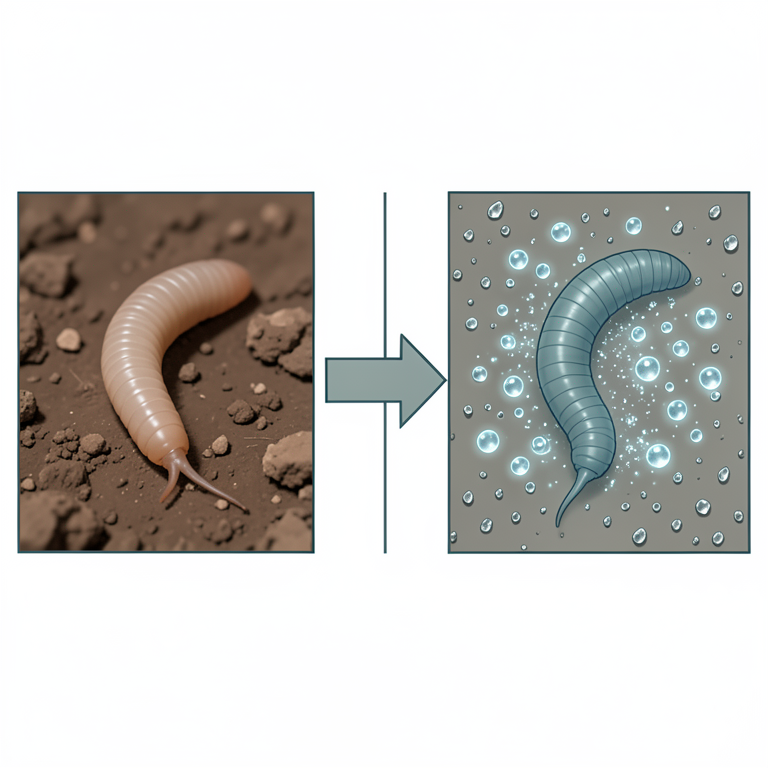
Pesticide Impact on Enzyme Levels
AI-generated conceptual illustration (Eisenia fetida earthworms in soil). It explains the idea and does not show study data.
View source evidence ↗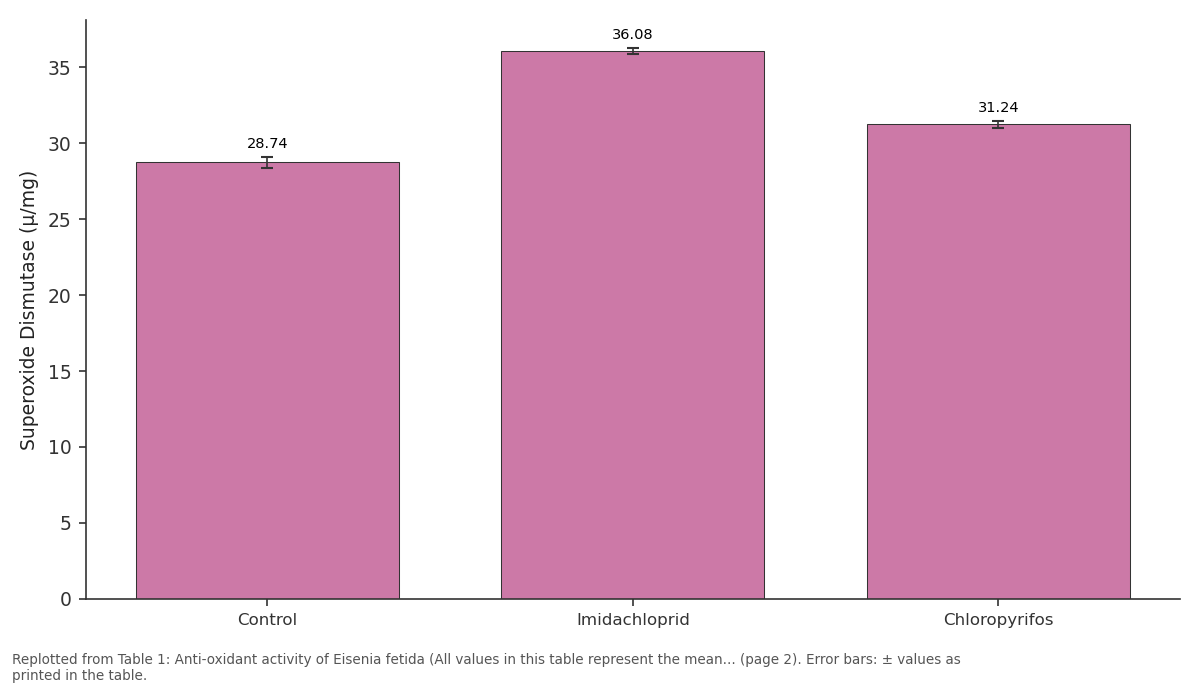
Superoxide Dismutase (µ/mg): Control vs Imidachloprid vs Chloropyrifos
Replotted from Table 1 (page 2) of the original paper. Every bar is the paper's own table value.
View source evidence ↗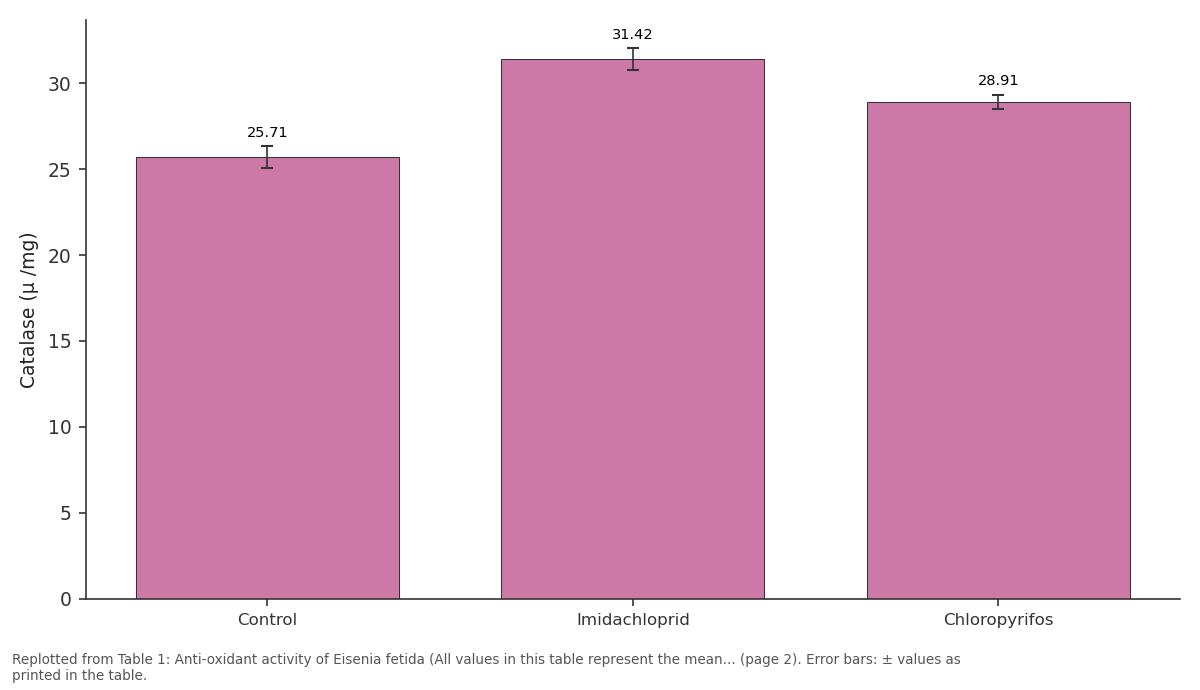
Catalase (µ /mg): Control vs Imidachloprid vs Chloropyrifos
Replotted from Table 1 (page 2) of the original paper. Every bar is the paper's own table value.
View source evidence ↗Figures & tables
From the original paper Table 1
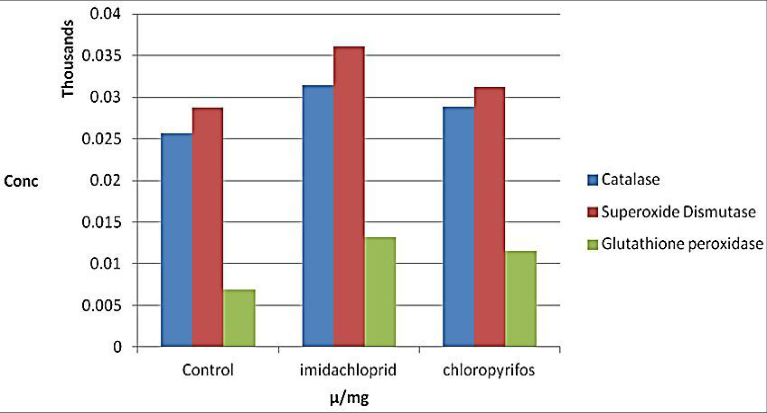 Figure 1
Introduction
The soil is a complex ecosystem having different organisms, humus, organic matter, enzymes, minerals, and nutrients. Earthworms are used as a biological agent, aerator, moisture retainer, plough, and crusher in addition to being biofertilizers and composting agents (Eguchi et al., 1995) [1] . According to Dash and Senapathi (1986) [2] , earthworms are so crucial that vermin casting has significantly increased agricultural yields while using relatively little pesticide and virtually no chemical fertilizer. Vishwanathan, 1997; 1993) [3] . An ecological imbalance may result from pesticide and heavy metal toxicity to earthworms' natural habitat (Laird and Kroger, 1981) [4] . Earthworms have an "antioxidant defense system" that guards them against lipid peroxidation under adverse circumstances. Various "important enzymatic scavengers of the Superoxide (O2-) and Hydroxide (OH -)" ions exist," such as Glutathione Peroxidase (GPx), Catalase (CAT), and Superoxide Dismutase (SOD)". By blocking the production of hydroxyl free radicals, these enzymes function as scavengers, protecting the components of cells from damage caused by oxidation (Scott et al., 1991) [5] . In agro-ecosystems, earthworms are important biotic resources with enormous potential. Earthworms are soil engineers. Earthworms serve as an ecosystem's secondary decomposer "(Eisenhauer & Eisenhauer, 2020) [6] . For an ecosystem to be sustainable, its biodiversity must be well-balanced and flourishing (Prakash and Srivastava, 2019)" [7] . Earthworms can recycle agricultural waste, which addresses many of our concerning problems with solid waste management and water contamination (Gupta et al., 2019) [8] . Their coelomic cavity is filled with fluid and contains a huge number of coelomocytes, plasma, and a watery matrix. These cells are crucial to the development of innate immunity. The coelomic fluid carries out physiological functions and keeps the moisture content stable (Griffith et al., 2019) [9] . Pesticides can have an impact on the Earthworms and other non-target soil species seriously "harm the ecosystem (Reinecke and Reinecke, 2007)" [10] . There may be a chance that these pesticides will reach higher trophic levels because" amphibians (Lescure, 1966) [11] , reptiles (Catling and Freedman, 1980)" [12] , "birds (Harlin, 1977) [13] , and mammals".
Eisenia fetida extract contains" antioxidant enzymes such as glutathione peroxidase", catalase, and sodium dismutase.
Antioxidants prevent oxidation, preserving metabolic processes. Free radicals can be produced by an oxidation reaction. These free radicals can damage cells by initiating chain reactions.
Materials and Methods
The goal of this study was to determine imidachloprid and chlorpyrifos impact on antioxidant enzymes such as Glutathione Peroxidase (GPx), Sodium Dismutase (SOD), Catalase (CAT), and Acetyl Cholinesterase (AChE) from Eisenia fetida. They stop biological tissues from oxidizing and scavenge free radicals. Other variables, like as oxygen availability and nutritional state, also affect the catalytic activity 14 [1] . Prior to testing, these worms were housed in feed boxes with four-inch layers of clean red soil at the bottom (base soil), a thin layer of leaves, sixteen inches of meshed cow dung mixed with soft soil in a 1:1 ratio, and a thin layer of dried grass on top (growth medium) for seven days in a lab setting. The feed boxes were covered with wet gunny bags.
Preparing the sample Making an enzyme extract
To allow their gut contents to be depurated, earthworms were kept in petri dishes on moist filter paper for a whole day. 50 mM phosphate buffer (pH 7.2) for SOD, "50 mM phosphate buffer (pH 7.4) for Catalase, and" 100 mM phosphate buffer (pH 6.0) for POD were used to homogenize 1 gm of gut-cleared earthworm in a pre-chilled mortar and pestle (Plate 2). The homogenate was centrifuged for 10 minutes at 4 °C at 10,000 rpm, and the enzyme activity assay was performed using the supernatant. Super-Oxide Dismutase Assay: "2.5 ml of phosphate buffer, 0.1 ml EDTA, 0.1 ml methionine, 0.1 ml NBT, 0.1 ml riboflavin, and 0.1 ml enzyme extract" were all included in the 3 ml assay mixture. After adding riboflavin last, the tubes were shook and exposed to 4000 lx fluorescent lights. After letting the reaction run for twenty minutes, the lights were turned out and a black cloth was placed over the tubes. The reaction mixture's absorbance was then measured at 560 nm." The amount of enzyme needed to produce a 50% inhibition of the NBT photo-reduction rate was known as one unit of SOD activity (U), and" the results were expressed as U mg-1 protein.
"Where, V= Rate of assay reaction in absence of SOD v= Rate of assay reaction in presence of SOD"
Catalase assay: 50 μl of enzyme extract and 0.55 ml of phosphate buffer were added to 0.4 ml of H2O2. After carefully mixing the concoction, it was incubated for one minute 3.0 ml of potassium dichromate: acetic acid in a 1:3 ratio was then added to it following incubation. The control tube, which contained 0.6 ml of buffer and 0.4 ml of H2O2 devoid of enzyme, was placed in a boiling water bath for 10 minutes. After cooling, the absorbance was measured at 570 nm using acetic acid and dichromate as a blank. The quantity of H2O2 can be computed by deducting the absorbance of the samples from that of the control. The quantity of enzyme needed to consume one μmoL of H2O2
U mg-1 protein is known as one CAT enzyme unit.
Glutathione peroxidase assay 2.15 milliliters of phosphate buffer were pipetted into a cuvette. 0.1 ml of enzyme extract and 0. Superoxide dismutase transforms super oxides into peroxides (O-2 to H2O2) shortly after reactive oxygen species (ROS) are produced. Worms treated to imidachloprid and chloropyrifos showed elevated SOD activity levels of 36.08 and 31.24, respectively. The control worm, E. fetida, had superoxide dismutase activity of 28.74 units/mg proteins. There was a statistically significant increase of 8.69% in superoxide dismutase activity and a 25% increase in superoxide dismutase rate (p<0.05).
Catalase hydrolyzes H2O2 and prevents oxidative damage at the cellular level." The current study found that elevated" SOD activity in turn induces enhanced Catalase activity"". It was discovered that "the enzyme activity in the control worm, E. fetida", was 25.71 units/mg proteins; 31.42 and 28.91 from the treated worms. A 12.44% and 22.20% increase in catalase activity was observed for imidachloprid and chloropyrifos respectively and it was statistically significant (p<0.01).
Glutathione peroxidase" protects the biological system from oxidative stress by converting H2O2 into water. The worms exposed to imidachloprid and chloropyrifos had enzyme activities of 13.24 and 11.51" μmoles of formazan liberated/mg protein/hour", while the control worm had enzyme activities of 6.9 "μmoles of formazan liberated/mg protein/hour". detoxifying capacity is allowed it to survive. The current study's findings showed a rise in the levels of antioxidant enzyme expression. The imidachloprid and chloropyrifos increased SOD and catalase levels sandalio [16] ." These antioxidant enzymes scavenge Reactive Oxygen Species (ROS) and free radicals".
Conclusions
The study found that worms exposed to imidachloprid and chloropyrifos showed elevated levels of Superoxide Dismutase (SOD) and catalase, which help prevent oxidative damage. Elevated SOD activity increased catalase activity, while glutathione peroxidase activity increased. Earthworms can adapt to stressful situations, and the physical and chemical characteristics of soil affect survival, growth, and reproduction. The study also found that soilspecific antioxidant enzyme expression increased, allowing Eisenia fetida to survive. These enzymes help scavenge reactive oxygen species and free radicals.
Figures and tables from the paper
| Enzyme | Control | Imidachloprid | Chloropyrifos |
|---|---|---|---|
| AChE | 0.015±0.05 | 0.034±0.04 | 0.021±0.02 |
| Catalase (µ /mg) | 25.71±0.64 | 31.42±0.64 | 28.91±0.43 |
| Superoxide Dismutase (µ/mg) | 28.74±0.35 | 36.08±0.21 | 31.24±0.24 |
| Glutathione peroxidase (mg/100 gm) | 6.9±0.64 | 13.24±0.24 | 11.51±0.18 |
Table text extracted from the original PDF; superscript letters are shown inline. The original table image is below.
View original table image
References
16 in the original paper- Eguchi S, Hatano R, Sakuma T. Toshio effect of earthworms on the decomposition of soil organic matter. Nippon Dojo-Hiryogaku Zasshi. 1995;66(2):165-167.
- Dash MC, Senapathi BK. National Seminar on Organic Waste Utilize, Vermi Comp. Part-13, Proceedings. 1986:157-177.
- Vishwanathan R. Physiological basis of assessment of ecotoxicology of pesticides to soil organisms. Chemosphere. 1997;35(1/2):323-334.
- Laird JM, Kroger M. Earthworms. CRC Crit Rev Environ Control. 1981;11:189-218.
- Scott MD, Lubin BH, Zuo L, Kuypers FA. Erythrocyte defense against hydrogen peroxide: preeminent importance of catalase. J Lab Clin Med. 1991;118(1):716.
- Eisenhauer N, Eisenhauer E. The "Intestines of the Soil": The Taxonomic and Functional Diversity of Earthworms -A review for young ecologists. 2020. Available from: https://doi.org/10.32942/osf.io/tfm5y
- Prakash S, Srivastava S. Impact of climate change on biodiversity: An overview. Int. J Biol Innov. 2019;1(2):60-65. DOI: https://doi.org/10.46505/IJBI.2019.1205
- Gupta C, Prakash D, Gupta S, Nazareno MA. Role of vermicomposting in agricultural waste management. In: Sustainable Green Technologies for Environmental Management. 2019:8295. Available from: https://doi.org/10.1007/978-981-13-2772-81-85
- Griffith CM, Thai AC, Larive CK. Metabolic markers of chlorothalonil exposure in earthworms, coelomic fluid, and coelomocytes. Sci Total Environ. 2019;681:435-443. Available from: https://doi.org/10.1016/j.scitotenv.2019.04.312
- Reinecke SA, Reinecke AJ. The impact of organophosphate pesticides in orchards on earthworms in the Western Cape, South Africa. Ecotoxicol Environ Saf. 2007;66:244-251.
- Lescure JL. The food of common toad Bufo bufo. Vie Milien. 1966;15:757-764.
- Catling PM, Freedman B. Food and feeding behavior of sympatric snakes at Amherstburg, Ontario. Con Fld Nat. 1980;94:28-33.
- Harlin J. Comparison of diets of the black bird and the starling. Zool Listy. 1977;26:45-56.
- Saint-Denis M, Labrot F, Narbonne JF, Ribera D. Glutathione, glutathione-related enzymes, and catalase activities in the earthworm Eisenia fetida andrei. Arch Environ Contam Toxicol. 1998;35:602-614.
- Maity S, Roy S, Chaudhury S, Bhattacharya S. Antioxidant responses of the earthworm Lampito mauritii exposed to Pb and Zn contaminated soil. Environ Pollut. 2008;151:1-7.
- Sandalio LM, Dalurzo HC, Gómez M, Romero-Puertas MC, del Rio LA. Cadmium induces changes in the growth and oxidative metabolism of pea plants. J Exp Bot. 2001;52:2115-2126.