
Research article · 2025 · Full text
International Journal of Biology SciencesSilver nanoparticles: A review of their therapeutic potential and biocompatibility
Volume 7(2) · Pages 10–12 · DOI: 10.33545/26649926.2025.v7.i2a.290 ↗
Research areasNanoparticles: synthesis and applications
Abstract
Author-writtenSilver nanoparticles (AgNPs) have gained significant attention due to their unique physicochemical properties and wide range of applications in various fields, including medicine, industry, and environmental science. These nanoparticles, typically ranging from 1 to 100 nm, exhibit enhanced antimicrobial activity, making them particularly useful in the treatment and prevention of infections caused by both antibiotic-resistant and non-resistant microorganisms. This review highlights the beneficial effects of AgNPs, focusing on their antibacterial, antifungal, antiviral, and anti-inflammatory properties, as well as their role in wound healing. AgNPs demonstrate remarkable effectiveness against a broad spectrum of pathogens, including Gram-positive and Gram-negative bacteria, fungi, and viruses. Their small size enables better cellular penetration, enhancing their therapeutic potential. Additionally, AgNPs have shown promise in reducing inflammation and promoting tissue regeneration in wound healing applications. Despite these benefits, the increasing use of AgNPs raises concerns regarding their safety and potential toxicity, necessitating further research to understand their long-term effects on human health and the environment. This review also discusses the challenges and future directions for the safe application of AgNPs in various industries and biomedical fields.
Summary
Source-checkedPlain-language reading of the full paper, prepared with AI and checked against the text. Each point links to the authors' own words.
Why it matters
- Silver nanoparticles (AgNPs) are highly valued across medicine, industry, and environmental science because of their unique physicochemical properties. View evidence ↗
- With a typical size range of 1 to 100 nm, AgNPs show enhanced antimicrobial activity, which is useful for treating infections from both resistant and non-resistant microorganisms. View evidence ↗
- The small size of AgNPs allows them to penetrate cells more effectively, which increases their potential for therapeutic use. View evidence ↗
The question
- The authors aim to review the beneficial antibacterial, antifungal, antiviral, anti-inflammatory, and wound-healing effects of AgNPs while addressing their potential risks. View evidence ↗
What they did
- The study is a review that synthesizes existing research on the antibacterial, antifungal, antiviral, anti-inflammatory, and wound-healing properties of AgNPs. View evidence ↗
What they found
- AgNPs demonstrate significant antibacterial activity against a broad range of both Gram-positive and Gram-negative bacteria. View evidence ↗
- AgNPs with diameters between 5 and 32 nm enhance the effectiveness of antibiotics like penicillin G and vancomycin against E. coli and S. aureus. View evidence ↗
- AgNPs act as effective fungicides against various fungi, including the species Aspergillus, Candida, and Saccharomyces. View evidence ↗
- AgNPs can inhibit HIV-1 replication in a size-dependent manner, with significant effects seen in particles ranging from 1 to 10 nm and 5 to 20 nm. View evidence ↗
- AgNPs exhibit anti-inflammatory effects by suppressing pro-inflammatory cytokines (TNF-α, IL-12, and IL-1β) and inducing apoptosis in inflammatory cells. View evidence ↗
- In BALB/c mice, nanocrystalline silver suppressed TNF-α and IL-12 and induced inflammatory cell apoptosis, performing similarly to steroid creams for dermatitis. View evidence ↗
- AgNPs show promise in wound healing by reducing inflammation and promoting the regeneration of tissue. View evidence ↗
What it means
- The authors conclude that AgNPs are invaluable biomedical and industrial agents due to their proven efficacy in antibacterial, antifungal, antiviral, and anti-inflammatory applications. View evidence ↗
- The authors state that more research is needed to fully understand the long-term effects of AgNPs on the environment and human health. View evidence ↗
Visual summary
1 visualsIllustrations explain the paper; they do not show study data.
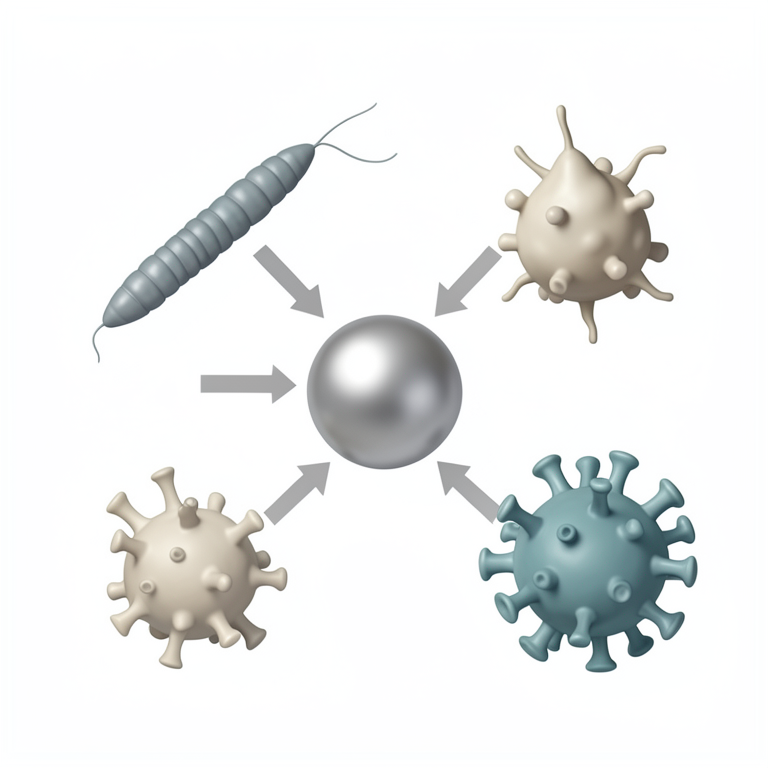
Broad-Spectrum Antimicrobial Activity of AgNPs
AI-generated conceptual illustration (silver nanoparticles, a bacterium, a fungus, and a virus). It explains the idea and does not show study data.
View source evidence ↗Introduction
Silver nanoparticles (AgNPs) are a class of nanomaterials that have attracted considerable attention in recent years due to their unique size-dependent properties and broad spectrum of biological activities. These nanoparticles, typically ranging from 1 to 100 nanometers in size, exhibit distinct physical, chemical, and biological characteristics compared to bulk silver, including enhanced surface area, increased reactivity, and improved antimicrobial properties. As a result, AgNPs have found applications in a variety of fields, such as medicine, environmental science, and industry, making them one of the most widely studied and applied nanomaterials to date (Burrell et al., 1999; Sondhi & Sondhi, 2004; Buzea et al., 2007) [2,11,3] . In medicine, AgNPs are particularly valuable for their potent antibacterial, antifungal, and antiviral properties, which make them effective in the treatment and prevention of infections, especially those caused by antibiotic-resistant microorganisms. Their small size enables them to easily penetrate cell membranes, facilitating their ability to interact with and disrupt bacterial cells or viruses (Yin et al., 1999; Elechiguerra et al., 2005; Doshi et al., 2023) [15,5,18] . Moreover, AgNPs can be used in wound healing, as they promote tissue regeneration, reduce inflammation, and prevent infection (Tian et al., 2007) [13] . These properties have made them a promising candidate for use in medical devices, wound dressings, and therapeutic formulations (Prabhu & Poulose, 2012) [9] . In addition to their biomedical applications, AgNPs have been widely utilized in industrial and environmental contexts. In the textile industry, they are incorporated into fabrics to provide antimicrobial properties, thus preventing the growth of bacteria and fungi on garments (Lee & Jeong, 2005) [8] . They are also used in coatings, paints, and water filtration systems due to their ability to inhibit microbial growth and degrade pollutants (Vasilev et al., 2009) [14] . Furthermore, AgNPs are used in the development of sensors, drug delivery systems, and diagnostic tools, showcasing their versatility and wide-ranging utility (Gros et al., 1981; Davis, 2002) [6,4] . Despite the significant benefits associated with the use of AgNPs, their safety and potential toxicity remain areas of active research. The unique properties of AgNPs, such as their small size and high surface reactivity, may pose potential risks to human health and the environment if not properly managed (Wiesner et al., 2006) [17] . It is crucial to evaluate both the therapeutic advantages and the possible adverse effects of AgNPs to ensure their safe application in various sectors. This review aims to provide an overview of the beneficial effects of silver nanoparticles, with a focus on their antibacterial, antifungal, antiviral, anti-inflammatory, and wound-healing properties, while also addressing the potential risks associated with their use.
Antibacterial Effects
AgNPs possess significant antibacterial properties against a wide spectrum of both Gram-positive and Gram-negative bacteria (Burrell et al., 1999; Yin et al., 1999; Sondhi and Sondhi, 2004) [2,15,11] . This includes antibiotic-resistant strains, making them a promising alternative in the fight against resistant infections (Burrell et al., 1999) [2] . AgNPs with diameters ranging from 5 to 32 nm have been found to enhance the antibacterial activity of various antibiotics, such as penicillin G, amoxicillin, erythromycin, clindamycin, and vancomycin, against pathogens like Escherichia coli and Staphylococcus aureus (Shahverdi et al., 2007) [10] . Their usage as antibacterial agents is especially evident in applications such as textiles, where cotton fibers containing AgNPs exhibit bactericidal effects (Lee and Jeong, 2005) [8] . Furthermore, AgNPs can prevent the growth of algae on external surfaces, such as walls, when used in paints (Vasilev et al., 2009) [14] .
Antifungal Effects
AgNPs have been shown to be effective fungicides, demonstrating activity against a broad spectrum of fungi, including Aspergillus, Candida, and Saccharomyces species (Burrell et al., 1999) [2] . These nanoparticles also display fungicidal properties against yeast isolated from bovine mastitis, making them useful in veterinary applications (Kim et al., 2007) [7] .
Anti-inflammatory Effects
AgNPs also have anti-inflammatory properties, influencing the expression of matrix metalloproteinases (Kirsner et al., 2001). They suppress the expression of pro-inflammatory cytokines such as tumor necrosis factor (TNF)-α, interleukin (IL)-12, and IL-1β, and induce apoptosis of inflammatory cells (Bhol and Schechter, 2005, 2007) [1] . Studies conducted on BALB/c mice demonstrated that nanocrystalline silver effectively suppressed the expression of TNF-α and IL-12 and induced apoptosis of inflammatory cells, offering comparable effects to steroid creams used for treating dermatitis (Bhol and Schechter, 2005) [1] . Furthermore, AgNPs have been shown to modulate cytokines involved in wound healing, with significant effects observed in burn wound healing processes (Tian et al., 2007) [13] .
Conclusion
Silver nanoparticles exhibit a wide range of beneficial effects due to their unique physicochemical properties. They have proven efficacy in antibacterial, antifungal, antiviral, and anti-inflammatory applications, positioning them as invaluable agents in various biomedical and industrial sectors. Despite their promising potential, it is essential to consider the safety aspects of AgNPs to avoid potential toxicity risks. Further research is required to fully understand the long-term effects of silver nanoparticles, particularly in human health and environmental contexts.
Acknowledgement
AcknowledgmentThe authors are thankful to the staff of Veterinary Pathology for assisting in the testing of samples reaching the laboratory and my beloved guide for helping in systematic experiments and data management.
References
18 in the original paper- Bhol SK, Schechter S. Anti-inflammatory effects of silver nanoparticles. Nanomedicine: Nanotechnology, Biology, and Medicine. 2005;1(3):167-73.
- Burrell RE, et al. Antimicrobial properties of silver nanoparticles: A review. 1999.
- Buzea C, et al. Nanomaterials and nanoparticles: Sources and toxicity. Biointerphases. 2007;2(4):MR17MR172.
- Davis ME. Polymer-protein conjugates for drug delivery. Advanced Drug Delivery Reviews. 2002;54(2):265-270.
- Elechiguerra JL, et al. Size-dependent antiviral activity of silver nanoparticles. Journal of Nanobiotechnology. 2005;3(1):7-12.
- Gros CP, et al. Polymer-protein conjugates in drug delivery. Journal of Controlled Release. 1981;1(2):109116.
- Kim JH, et al. Antifungal activity of silver nanoparticles against yeast isolated from bovine mastitis. Journal of Applied Microbiology. 2007;104(4):968-974.
- Lee SS, Jeong J. Antimicrobial activity of silver nanoparticles in cotton fabrics. Journal of Industrial Textile. 2005;34(2):123-130.
- Prabhu S, Poulose EK. Silver nanoparticles: Mechanism of antimicrobial action, synthesis, medical applications, and toxicity effects. International Nano Letters. 2012;2(1):32-41.
- Shahverdi AR, et al. Antibacterial activity of silver nanoparticles against Escherichia coli and Staphylococcus aureus. Nanomedicine: Nanotechnology, Biology, and Medicine. 2007;3(6):458-463.
- Sondhi R, Sondhi S. Nanoparticles in medicine: Current applications and future trends. International Journal of Nanomedicine. 2004;2(3):585-595.
- Sun YP, et al. HIV-1 replication inhibition by silver nanoparticles. Journal of Antimicrobial Chemotherapy. 2005;56(4):631-636.
- Tian J, et al. Wound healing effects of nanocrystalline silver in burn wound models. Journal of Nanomaterials. 2007;9(4):153-160.
- Vasilev K, et al. Applications of silver nanoparticles in paint and coatings. Progress in Organic Coatings. 2009;64(3):203-211.
- Yin JJ, et al. Antibacterial and antifungal effects of silver nanoparticles. Journal of Nanoscience and Nanotechnology. 1999;9(5):3247-3252.
- Wagner HE, et al. Risk assessment of nanomaterials: Mobility of nanoparticles. Environmental Toxicology and Chemistry. 2011;30(6):1559-1566.
- Wiesner MR, et al. Risk assessment of nanomaterials. Environmental Toxicology and Chemistry. 2006;25(11):2806-2811.
- Doshi NP, Shirodkar SS. One-pot synthesis of biologically active bimetallic Ag-Zn nanoparticles using Madagascar periwinkle (Sadaafuli) plant extract. Int J Adv Biochem Res. 2023;7(2):25-35. DOI:10.33545/26174693.2023.v7.i2a.212.
Cited by 1
From OpenAlex, OpenCitations and reference lists read by Scinovex
- Silver Nanoparticle-Induced Nephrotoxicity in Zebrafish (Danio rerio) ↗
Grace Emily Okuthe, Busiswa Siguba · International Journal of Molecular Sciences · 2025
The escalating challenge of antibacterial resistance has driven the widespread use of silver nanoparticles (AgNPs) due to their potent antimicrobial properties. AgNPs can be synthesised through diverse methods, spanning conventional chemical and physical routes to the increasingly favoured biosynthesis approach. While offering environmental advantages, the ecological impact of biogenically synthesized AgNPs, especially on aquatic ecosystems, requires thorough evaluation. The renal…
❝ 12PDF