
Research article · 2025 · Full text
International Journal of Agriculture and Food ScienceEffect of Carica Papaya leaf powder supplementation on growth performance and survival rate of Labeo Catla (Worms, 2023)
Volume 7(2) · Pages 84–88 · DOI: 10.33545/2664844x.2025.v7.i2b.282 ↗
Research areasPapaya Research and ApplicationsFood and Agricultural SciencesAquatic life and conservation
Abstract
Author-writtenThe study investigated the effects of dietary Carica papaya leaf powder (PLP) on the growth, survival, and feed efficiency of Labeo Catla fry over a 60-day experimental period. Five dietary treatments were formulated, incorporating PLP at inclusion levels of 0% (control), 2.5%, 5%, 7.5%, and 10%, with all diets maintaining a consistent protein content of 30%. Growth parameters, including mean weight gain, specific growth rate (SGR), survival rate, feed conversion ratio (FCR), and protein efficiency ratio (PER), were evaluated. The results demonstrated that the treatment with 7.5% PLP (T3) exhibited the highest mean weight gain (2.263±0.145 g), SGR (3.225±0.099%/day) and survival rate (97.500±2.887%), while achieving the lowest FCR (1.923±0.043) and the highest PER (1.734±0.039). These findings indicate that PLP enhances protein digestion and nutrient absorption, likely due to bioactive compounds such as papain. However, higher inclusion levels (>7.5%) showed diminishing returns, possibly due to anti-nutritional factors like alkaloids and saponins. The study highlights the potential of PLP as a natural growth promoter and survival enhancer for Labeo Catla, emphasizing the need for species-specific dietary formulations. The results suggest that a 7.5% inclusion level is optimal for this species.
Summary
Source-checkedPlain-language reading of the full paper, prepared with AI and checked against the text. Each point links to the authors' own words.
Why it matters
- Labeo Catla is an economically important freshwater fish in India, valued for its rapid growth and high consumer demand. View evidence ↗
- The productivity of Labeo Catla in aquaculture is often hindered by suboptimal growth rates and disease outbreaks. View evidence ↗
- Carica papaya leaves contain bioactive compounds like papain, phenolics, and flavonoids that may boost immunity and provide antimicrobial and antioxidant effects. View evidence ↗
The question
- The study aimed to evaluate how supplementing the diet of Labeo Catla fry with Carica papaya leaf powder (PLP) affects their growth, survival, and feed efficiency over 60 days. View evidence ↗
What they did
- The experiment used a completely randomized design with five treatments and four replications in 56-liter rectangular tanks. View evidence ↗
- Five diets were tested with PLP inclusion levels of 0% (control), 2.5%, 5%, 7.5%, and 10%, all maintaining a constant 30% protein content. View evidence ↗
- Growth was monitored every two weeks over the 60-day period by measuring average weights with an electronic balance. View evidence ↗
- Water quality, including pH, temperature, alkalinity, and dissolved oxygen, was assessed weekly. View evidence ↗
What they found
- The specific growth rate (SGR) peaked in the T3 group at 3.225±0.099%/day, whereas the control group (T0) was the lowest at 2.109±0.065%/day. View evidence ↗
- The survival rate was highest in the T3 group (97.500±2.887%) and lowest in the control group (78.750±4.787%). View evidence ↗
- Feed efficiency was best in the T3 group, which had the lowest Feed Conversion Ratio (FCR) of 1.923±0.043, compared to the control's highest FCR of 3.003±0.211. View evidence ↗
- The Protein Efficiency Ratio (PER) was highest in the T3 group (1.734±0.039) and lowest in the control group (1.114±0.080). View evidence ↗
- Including PLP at levels higher than 7.5% (T4) led to diminishing returns, which the authors attribute to anti-nutritional factors such as saponins and alkaloids. View evidence ↗
What it means
- The authors conclude that a 7.5% inclusion level of papaya leaf powder is optimal for promoting growth and survival in Labeo Catla. View evidence ↗
- The authors recommend further research to create species-specific dietary formulations to maximize efficiency while minimizing anti-nutritional risks. View evidence ↗
Visual summary
3 visualsIllustrations explain the paper; charts are replotted from the paper's own table values.
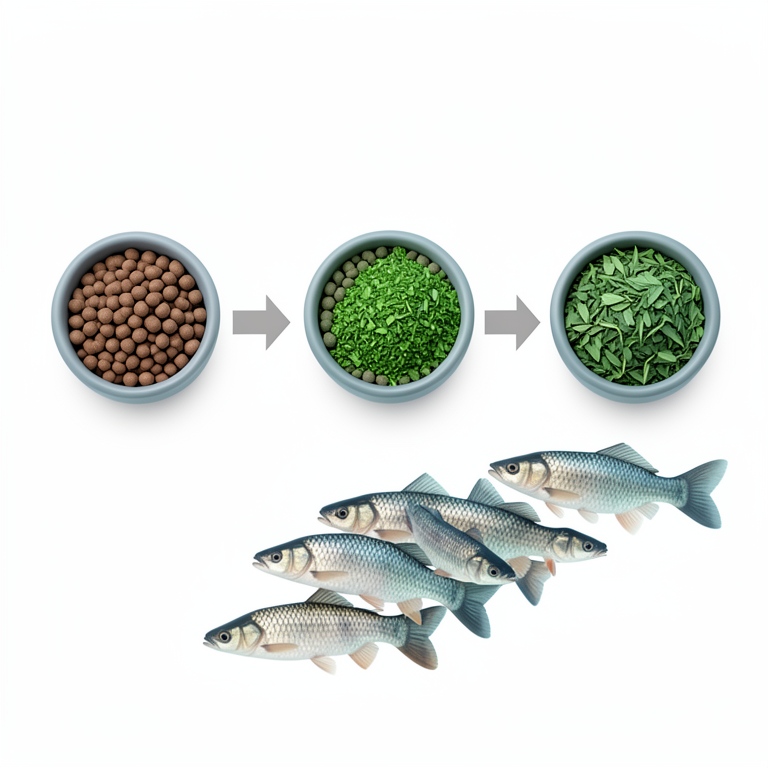
Experimental Diet Setup
AI-generated conceptual illustration (Labeo catla fish fry and Carica papaya leaves). It explains the idea and does not show study data.
View source evidence ↗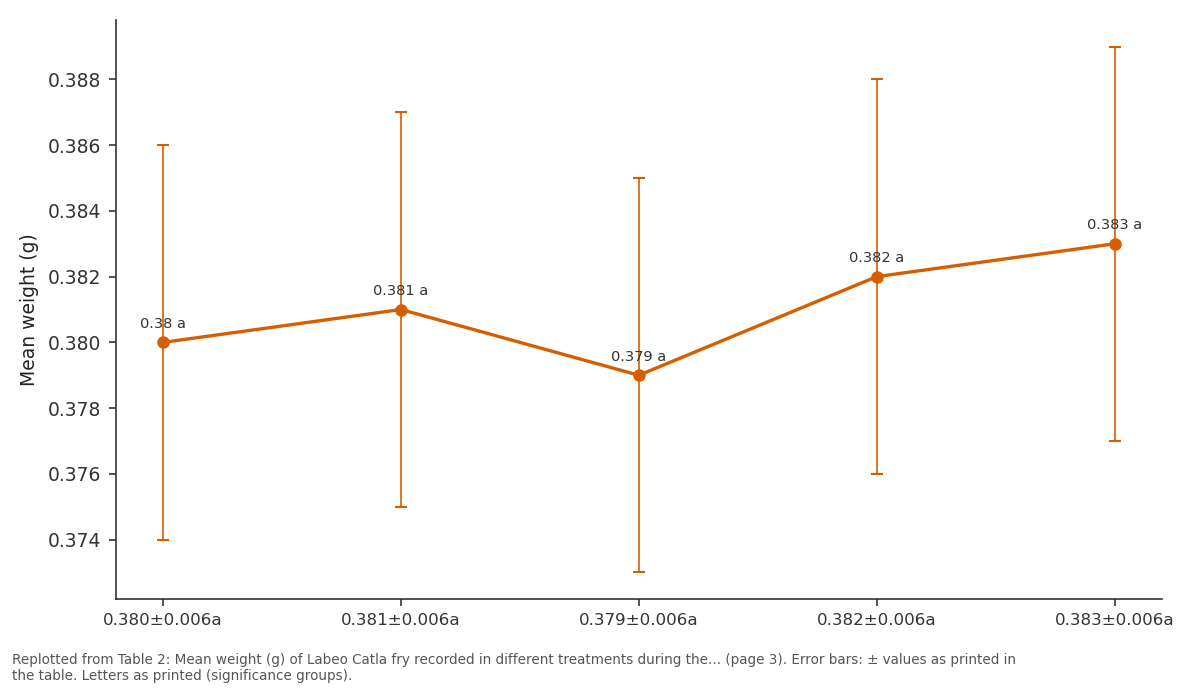
Experimental Period / Initial: 0.380±0.006a vs 0.381±0.006a vs 0.379±0.006a vs 0.382±0.006a vs 0.383±0.006a
Replotted from Table 2 (page 3) of the original paper. Every bar is the paper's own table value.
View source evidence ↗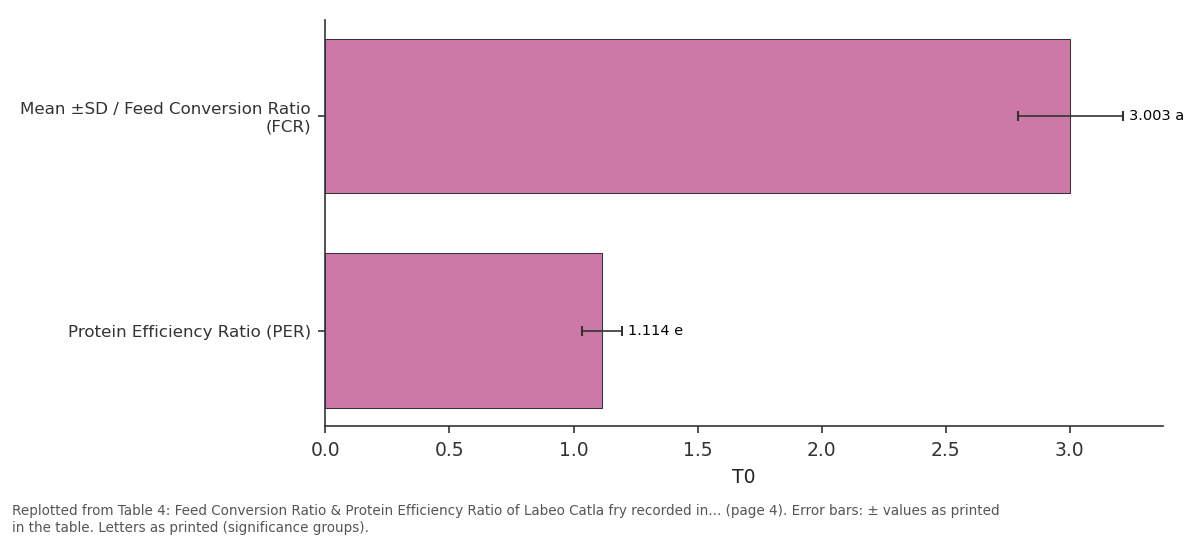
T0: Mean ±SD / Feed... vs Protein Efficiency...
Replotted from Table 4 (page 4) of the original paper. Every bar is the paper's own table value.
View source evidence ↗Figures & tables
From the original paper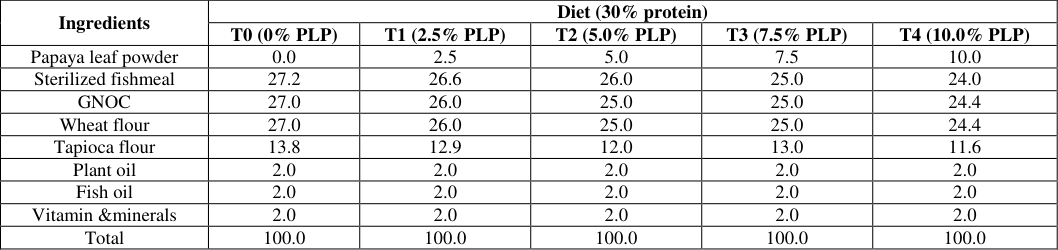 Table 1
 Table 2
 Table 3
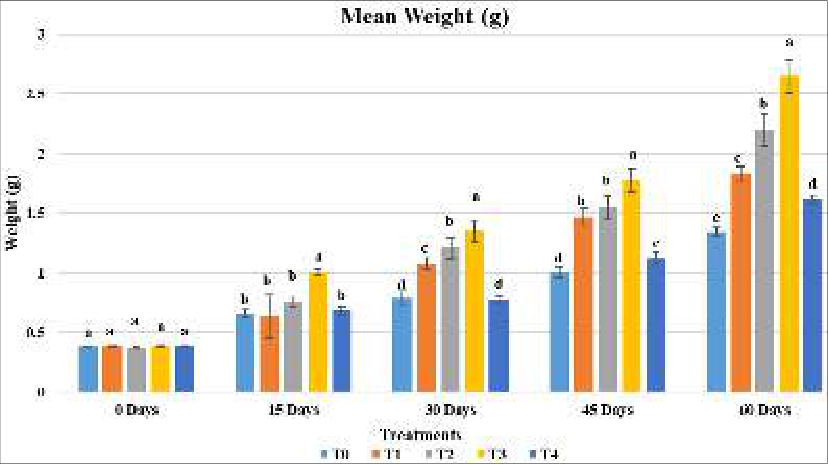 Figure 1
 Table 4
Introduction
The growing global demand for fish as a vital source of protein and essential nutrients has intensified the pursuit of sustainable and efficient aquaculture practices. Among various strategies to enhance aquaculture outcomes, dietary interventions using natural supplements have garnered significant interest. Labeo Catla, a freshwater fish species of considerable economic significance in India, plays a crucial role in aquaculture due to its rapid growth and strong consumer demand (Mohanty et al., 2013) [13] . During 2022-23, India's total fish production was recorded at 17.545 million tonnes, with major carp accounting for approximately 6.736 million tonnes (DOF, 2023). Despite its importance, challenges such as disease outbreaks and suboptimal growth rates often limit its potential in aquaculture systems, underscoring the need for innovative approaches to improve fish health and overall productivity (Walker & Winton, 2010; Bondad-Reantaso et al., 2005) [22,23] . A promising approach to enhancing fish growth, health, and survival in aquaculture involves the use of bioactive compounds derived from plants. Among these, Carica papaya has gained attention for its wide range of bioactive properties, making it a natural alternative for promoting fish health and alleviating the impacts of disease and stress (Boshra & Tajul, 2013; Aravind et al., 2013) [4,2] . The leaves of the papaya plant contain bioactive components such as papain, flavonoids, and phenolics, which possess antioxidant, antimicrobial, and immune-boosting properties. These attributes hold potential for improving growth and survival rates in aquaculture species (Seigler et al., 2002; Citarasu et al., 1999) [6] . Papain, a proteolytic enzyme found in papaya, plays a particularly important role in enhancing protein digestion, which can significantly improve the growth performance of fish (Hitesh et al., 2012) [9] .
Materials and Methods
An experiment was conducted to evaluate the effects of Carica papaya leaf powder on the growth and survival of Labeo Catla fry. Rectangular tanks with a capacity of 56 liters were thoroughly cleaned, sun-dried, and arranged in a completely randomized design, comprising five treatments and four replications. The dietary treatments included a control (0% papaya leaf powder) and diets with papaya leaf powder at inclusion levels of 2.5%, 5%, 7.5%, and 10%, all formulated to maintain a protein content of 30%. Fish growth was monitored biweekly over 60-day period using an electronic balance, and average weights were calculated for analysis. Daily observations were made to assess survival, health status, and behavioral patterns. Survival rates were recorded every two weeks and again at the conclusion of the experiment.
Experimental Diet Preparation
The experimental feed formulation was designed using the Pearson square method to maintain a consistent protein level of 30% across all diets. Five different experimental diets (T0 to T4) were created, incorporating Carica papaya leaf powder at varying concentrations of 0% (control), 2.5%, 5%, 7.5%, and 10%. Ingredients were precisely measured and mixed with water, followed by thermal processing at 121°C under 15 lbs of pressure for 15 minutes. After cooling, vitamins, minerals, and papaya leaf powder were added to the mixture and thoroughly blended. The feed was then pelletized using a mechanical pelletizer to form uniform pellets, which were sun-dried for 2-3 days until the moisture content fell below 12%. The dried pellets were stored in airtight containers. Nutritional analysis confirmed that the protein content remained consistent at 30% across all experimental diets.
Assessment of Growth, Survival and Feed Efficiency
Every two weeks, all the fish in each treatment group were counted and weighed to assess their growth performance, feed efficiency, and survival rate. Prior to weighing, the fish were fasted overnight. The following formulas were used to determine growth parameters and feed utilization throughout the experiment.
Parameters Growth Parameters
The following growth parameters were determined using the provided formula.
Mean Weight Gain=Final Average Body Weight-Initial Average Body Weight
Mean Weight Gain=Final Average Body Weight-Initial Average Body Weight
Mean Weight Gain
The mean weight gain was computed utilizing the subsequent formula: "Mean Weight Gain = " Final Weight (g)-Initial Weight (g) Specific Growth Rate (SGR) SGR was computed following the methodology outlined by Manivannan and Saravanan (2012) using the provided formula.
Survival Rate: The survival rate of Labeo Catla fry was computed utilizing the provided formula.
Feed Conversion Ratio (FCR)
FCR was determined in accordance with the methodology described by Manivannan and Saravanan (2012), utilizing the formula provided.
Protein Efficiency Ratio
The PER calculation followed the formula provided by Nalawade & Bhilave (2011).
Analysis of Water Quality Parameters
Water quality parameters such as temperature, pH, dissolved oxygen, and alkalinity were methodically assessed on a weekly basis throughout the entire duration of the experiment.
Results
The experiment's data regarding the impact of Papaya leaf powder (Carica papaya) in the diet of Labeo Catla fry over a 60-day experimental period is outlined below. The results encompass the mean weight (MW), specific growth rate (SGR), survival rate, feed conversion ratio (FCR) and International Journal of Agriculture and Food Science https://www.agriculturaljournals.com protein efficiency ratio (PER) observed across all five treatment groups at the end of the experiment.
Growth performance
The mean weight of L. catla fry was monitored every 15 days over a 60-day experimental period for each treatment group, as detailed in Table 2 and illustrated graphically in Figure 1. At the start of the experiment, the initial mean weights of the fry were recorded as 0.380±0.006 g, 0.381±0.006 g, 0.379± 0.006 g, 0.382± 0.006 g, and 0.383±0.006 g for treatments T0, T1, T2, T3, and T4, respectively. By the conclusion of the study, the final mean weights had increased to 1.346±0.036 g, 1.832±0.057 g, 2.198±0.132 g, 2.644±0.144 g, and 1.614±0.037 g for the respective treatments. Statistical analysis conducted at the end of the 60-day period indicated a significant difference (p<0.05) in mean weights across the treatment groups. The highest mean weight was observed in the T3 group (2.644±0.144 g), while the lowest was recorded in the T0 group (1.346±0.036 g). The research assessed the impact of various treatments (T0, T1, T2, T3, and T4) on mean weight gain, survival and specific growth rate over a span of 60 days as detailed in Table 3. Among all treatments, T3 exhibited the highest mean weight gain at 2.263±0.145 g, with T2, T1, T4, and T0 following in descending order (1.819±0.126 g, 1.451±0.052 g, 1.231±0.031 g, and 0.966±0.040 g, respectively). The specific growth rate (SGR) was also greatest in T3, reaching 3.225±0.099, followed by T2 (2.929±0.076), T1 (2.619±0.031), T4 (2.399±0.018), and T0 (2.109±0.065). In terms of survival rates, T3 again led with 97.500±2.887%, ahead of T2 (88.750±6.292%), T1 (86.250±4.787%), T4 (81.250±6.292%), and T0 (78.750±4.787%). Collectively, T3 outperformed all other treatments across every measured parameter, highlighting its effectiveness in promoting growth and ensuring survival
| Treatment | Mean ±SD | — | — |
|---|---|---|---|
| Mean weight gain (g) | Specific growth rate (SGR) | Survival Rate (%) | |
| T0 | 0.966±0.040e | 2.109±0.065e | 78.750±4.787c |
| T1 | 1.451±0.052c | 2.619±0.031c | 86.250±4.787bc |
| T2 | 1.819±0.126b | 2.929±0.076b | 88.750±6.292b |
| T3 | 2.263±0.145a | 3.225±0.099a | 97.500±2.887a |
| T4 | 1.231±0.031d | 2.399±0.018d | 81.250±6.292bc |
Table text extracted from the original PDF; superscript letters are shown inline. The original table image is below.
View original table image
| Treatment | Experimental Period | — | — | — | — |
|---|---|---|---|---|---|
| Initial | 15th DAY | 30th DAY | 45th DAY | 60th DAY | |
| T0 | 0.380±0.006a | 0.659±0.028b | 0.784±0.063d | 1.005±0.046d | 1.346±0.036e |
| T1 | 0.381±0.006a | 0.635±0.181b | 1.078±0.048c | 1.469±0.066b | 1.832±0.057c |
| T2 | 0.379±0.006a | 0.753±0.039b | 1.209±0.091b | 1.547±0.100b | 2.198±0.132b |
| T3 | 0.382±0.006a | 1.003±0.029a | 1.350±0.091a | 1.773±0.098a | 2.644±0.144a |
| T4 | 0.383±0.006a | 0.682±0.030b | 0.776±0.032d | 1.119±0.050c | 1.614±0.037d |
Table text extracted from the original PDF; superscript letters are shown inline. The original table image is below.
View original table image
Discussion
The present study investigated the effects of incorporating Papaya leaf powder into the diet of Labeo Catla, revealing significant improvements in growth performance, survival rates, and feed utilization. Treatment T3, which included 7.5% Carica papaya leaf powder, demonstrated the highest mean weight, mean weight gain, and specific growth rate (SGR), underscoring its potential as an effective dietary supplement for this species. These findings align with previous research highlighting the growth-enhancing properties of Papaya leaf powder in various fish species, although optimal inclusion levels appear to vary depending on the species. For instance, Simanjuntak et al. (2022) [20] reported that a 2% inclusion of Papaya leaf powder significantly improved growth metrics in Nile tilapia, while Firdaus and Mukti (2021) [8] observed similar benefits in catfish (Clarias sp.) with a 2.5% inclusion level. Likewise, Mic Salomiya et al.
(2023) [12] noted enhanced growth in rohu (Labeo rohita) when fed a diet containing 10% Papaya leaf meal. These variations suggest that different species may require tailored dietary formulations to achieve optimal growth outcomes. In the case of Labeo Catla, the higher inclusion level of 7.5% appears necessary to maximize growth performance, likely due to species-specific differences in nutrient metabolism and enzyme activity. The growth-promoting effects of Papaya leaf powder can be attributed to its bioactive compounds, including protease, chymopapain, and papain, which facilitate protein digestion by breaking down complex proteins into absorbable amino acids (Alorkpa et al., 2016) [1] . Singh et al. (2011) [21] reported that Papaya leaves contain approximately 5.3% papain, a proteolytic enzyme known to enhance protein utilization efficiency. This enzymatic activity likely contributed to the improved Feed Conversion Ratio (FCR) and Protein Efficiency Ratio (PER) observed in the current study, as supported by earlier findings from Citarasu (2010) [5] , Rinna Hamlin et al. (2013) [16] , and Safrida et al. (2020) [18] . However, discrepancies in results across studies, such as those reported by Simanjuntak et al. (2012) and Mic Salomiya et al. (2023) [12] , may stem from differences in preparation methods, leaf maturity, or the specific part of the leaf used (Dinajpur, 2023).
In terms of survival rates, the current study found that a 7.5% inclusion of Papaya leaf powder improved fish viability. This contrasts with earlier studies, where lower inclusion levels (e.g., 2-4.5%) were deemed optimal for enhancing survival in Nile tilapia (Simanjuntak et al., 2022;
Munguti et al., 2014) [20] and catfish (Firdaus and Mukti, 2021) [8] . Conversely, Kasiati et al. (2016) [10] and Rosmawaty et al. (2016) [17] reported adverse effects at higher inclusion levels, attributing these outcomes to the presence of anti-nutritional factors such as alkaloids and saponins, which may negatively impact fish health when present in excessive amounts. This highlights the importance of balancing dietary supplementation to avoid potential drawbacks.
The findings of this study emphasize the dual role of Papaya leaf powder as both a growth promoter and a survival enhancer, albeit with species-specific variations in optimal inclusion levels. For Labeo Catla, a higher inclusion level of 7.5% appears to be beneficial, whereas other species like Nile tilapia and catfish respond better to lower concentrations (2-4.5%). These variations underscore the need for further research to refine dietary formulations for different aquaculture species, ensuring maximum growth, survival, and feed efficiency while minimizing the risks associated with anti-nutritional factors.
The study demonstrates that incorporating 7.5% Papaya leaf powder into the diet of Labeo Catla significantly enhances growth performance, survival rates, and feed utilization. These effects are likely due to bioactive compounds like papain, which improve protein digestion and nutrient absorption. However, optimal inclusion levels vary across fish species, with lower concentrations (2-4.5%) being effective for Nile tilapia and catfish, while higher levels benefit Labeo Catla. The presence of anti-nutritional factors such as alkaloids and saponins at elevated doses may negatively impact survival, emphasizing the need for species-specific dietary formulations. Tailored approaches are essential to maximize growth and health outcomes in aquaculture.
Figures and tables from the paper
| Ingredients | Diet (30% protein) | — | — | — | — |
|---|---|---|---|---|---|
| T0 (0% PLP) | T1 (2.5% PLP) | T2 (5.0% PLP) | T3 (7.5% PLP) | T4 (10.0% PLP) | |
| Papaya leaf powder | 0.0 | 2.5 | 5.0 | 7.5 | 10.0 |
| Sterilized fishmeal | 27.2 | 26.6 | 26.0 | 25.0 | 24.0 |
| GNOC | 27.0 | 26.0 | 25.0 | 25.0 | 24.4 |
| Wheat flour | 27.0 | 26.0 | 25.0 | 25.0 | 24.4 |
| Tapioca flour | 13.8 | 12.9 | 12.0 | 13.0 | 11.6 |
| Plant oil | 2.0 | 2.0 | 2.0 | 2.0 | 2.0 |
| Fish oil | 2.0 | 2.0 | 2.0 | 2.0 | 2.0 |
| Vitamin &minerals | 2.0 | 2.0 | 2.0 | 2.0 | 2.0 |
| Total | 100.0 | 100.0 | 100.0 | 100.0 | 100.0 |
Table text extracted from the original PDF; superscript letters are shown inline. The original table image is below.
View original table image
| Treatment | Mean ±SD | — |
|---|---|---|
| Feed Conversion Ratio (FCR) | Protein Efficiency Ratio (PER) | |
| T0 | 3.003±0.211a | 1.114±0.080e |
| T1 | 2.367±0.062c | 1.409±0.037c |
| T2 | 2.117±and 0.012d | 1.575±0.009b |
| T3 | 1.923±0.043e | 1.734±0.039a |
| T4 | 2.553±0.142b | 1.309±0.073d |
Table text extracted from the original PDF; superscript letters are shown inline. The original table image is below.
View original table image
References
23 in the original paper- Alorkpa EJ, Boadi NO, Badu M, Saah SA. Phytochemical screening, antimicrobial and antioxidant properties of assorted Carica papaya leaves in Ghana. 2016.
- Aravind G, Bhowmik D, Duraivel S, Harish G. Traditional and medicinal uses of Carica papaya. J Med Plants Stud. 2013;1(1):7-15.
- Bondad-Reantaso MG, Subasinghe RP, Arthur JR, Ogawa K, Chinabut S, Adlard R, Tan Z, Shariff M. Disease and health management in Asian aquaculture. Vet Parasitol. 2005;132(3-4):249-272.
- Boshra V, Tajul AY. Papaya-an innovative raw material for food and pharmaceutical processing industry. Health Environ J. 2013;4(1):68-75.
- Citarasu T. Herbal biomedicines: a new opportunity for aquaculture industry. Aquac Int. 2010;18(3):403-414.
- Citarasu T, Jayarani TV, Babu MM, Marian MP. Use of herbal bio-medicinal products in aquaculture of shrimp. In: Aqua-Terr Annual Symposium; 1999. p. 78-85.
- Department of Fisheries, Ministry of Fisheries, Animal Husbandry & Dairying. Handbook on Fisheries statistics 2023. Government of India. 296p. Available from: https://dof.gov.in/sites/default/files/202403/handbook_sp.pdf.
- Firdaus MSI, Mukti RC. Utilization of papaya leaves (Carica papaya) in feed on growth of catfish (Clarias sp.) in Muara Enim, South Sumatera. IJOTA (Indonesian J Trop Aquat). 2021;4(1):50-56.
- Hitesh P, Manojbhai NB, Mayuri AB, Ashvinkumar DD, Kiranben VD. Extraction and application of papain enzyme on degradation of drug. Int J Pharm Biol Sci. 2012;2(3):113-115.
- Kasiati E, Koniyo Y, Juliana J. Pengaruh Perendaman Larutan Daun Pepaya (Carica papaya) terhadap Sintasan Benih Ikan Nila (Oreochromis niloticus) yang Terinfeksi Parasit Trichodina sp. The NIKe J. 2016;4(2).
- Manivannan A, Saravanan TS. Impact of formulated protein diets on growth of the Indian Major Carp, Labeo rohita (Hamilton). Fish Aquacult J. 2012;57(4):123-132.
- Mic Salomiya A, Jenifer JS, Ajitha R, Dobina Sherin D, Sahaya Shalu S. Effect of dietary supplementation of papaya leaf on growth and feeding bioenergetics of Indian major carp, Labeo rohita. Int J Fish Aquat Stud. 2023;11(2):101-105.
- Mohanty BP, Banerjee S, Bhattacharjee S, Mitra T, Purohit GK, Sharma AP, Karunkaran D, Mohanty S. Muscle proteomics of the Indian major carp catla (Catla catla, Hamilton). J Proteomics Bioinform. 2013;6:252263.
- Munguti JM, Ogello EO, Liti D, Waidbacher H, Straif M, Zollitsch W. Effects of pure and crude papain on the utilization and digestibility of diets containing hydrolysed feather meal by Nile tilapia (Oreochromis niloticus L.). 2014.
- Nalawade VB, Bhilave MP. Protein efficiency ratio (PER) and gross food conversion efficiency (GFCE) of freshwater fish Labeo rohita fed on formulated feed. The Bioscan. 2011;6(2):301-303.
- Rinna Hamlin S, Jansi M, Vasudhevan I. Effect of dietary Spirulina platensis on feeding parameters of blue gourami, Trichogaster trichopterus. Int J Res Fish Aquacult. 2013;3(3):103-106.
- Rosmawaty R, Liviawaty E. Pemanfaatan Ekstrak Kulit Jengkol Dalam Pakan Ikan Untuk Meningkatkan Imunitas Benih Gurame (Osphronemus gouramy) Terhadap Infeksi Bakteri Aeromonas hydrophila. J Perikanan Kelautan. 2016;7(1).
- Safrida S, Noviasyah N, Khairil K. Effects of Moringa oleifera Leaves Powder in Fish Feed Toward Growth Rate and Health of Colossoma macropomum. Biosaintifika: J Biol Biol Educ. 2020;12(2):186-191.
- Seigler DS, Pauli GF, Nahrstedt A, Leen R. Cyanogenic allosides and glucosides from Passiflora edulis and Carica papaya. Phytochemistry. 2002;60(8):873-882.
- Simanjuntak RF, Husni S, Cahyadi J. Bioenrichment of papaya leaf meal (Carica papaya) with different feed formulation to increase Nile tilapia (Oreochromis niloticus) growth. In: IOP Conference Series: Earth and Environmental Science; 2022. p. 012089.
- Singh P, Maqsood S, Samoon MH, Phulia V, Danish M, Chalal RS. Exogenous supplementation of papain as growth promoter in diet of fingerlings of Cyprinus carpio. Int Aquat Res. 2011;3(1):1.
- Walker PJ, Winton JR. Emerging viral diseases of fish and shrimp. Vet Res. 2010;41(6).
- WoRMS. World Register of Marine Species. Available from: https://www.marinespecies.org at VLIZ. Accessed 2024-02-22.