
Research article · 2025 · Full text
International Journal of Agriculture and Food ScienceThe effect of excess green feeding on fat percentage and udder health in dairy cows
Volume 7(2) · Pages 94–96 · DOI: 10.33545/2664844x.2025.v7.i2b.284 ↗
Research areasEffects of Environmental Stressors on Livestock
Abstract
Author-writtenGreen fodder is a crucial dietary component for dairy cows, supplying essential nutrients that support milk production and overall health. However, excessive feeding of green forage can cause imbalances in nutrient intake, negatively affecting milk composition particularly fat percentage and increasing the risk of udder health issues, such as mastitis. This study investigates the impact of excess green feeding on milk fat percentage and udder health, with the aim of providing evidence-based recommendations for optimizing green fodder inclusion in dairy diets to enhance milk quality and maintain udder health.
Summary
Source-checkedPlain-language reading of the full paper, prepared with AI and checked against the text. Each point links to the authors' own words.
Why it matters
- Green fodder is an essential part of dairy cow diets because it provides nutrients necessary for overall health and milk production. View evidence ↗
- Feeding too much green forage can lead to nutrient imbalances, which may lower milk fat percentage and increase the risk of udder health problems like mastitis. View evidence ↗
- The high moisture levels in excessive green forage can alter metabolic functions and rumen fermentation, impacting the cow's immune response to pathogens and the composition of the milk. View evidence ↗
The question
- The study aims to investigate how excess green feeding affects udder health and milk fat percentage to provide recommendations for optimizing fodder inclusion. View evidence ↗
What they did
- The research was a controlled study involving 100 lactating Holstein Friesian cows conducted over a period of six months. View evidence ↗
- Cows were split into a control group receiving a balanced diet and a test group receiving a diet where 70% was green fodder, which exceeds recommended levels. View evidence ↗
- Researchers used a milkPro Ultrasonic Analyser for weekly milk fat analysis and performed bi-weekly evaluations of clinical mastitis and somatic cell count (SCC) to assess udder health. View evidence ↗
What they found
- The test group experienced a significant decrease in milk fat percentage (3.2%) compared to the control group (3.8%). View evidence ↗
- The test group had a higher average somatic cell count (450,000 cells/mL) than the control group (250,000 cells/mL), which indicates a higher prevalence of mastitis. View evidence ↗
- There was a 20% higher incidence of mastitis in the test group, which the authors linked to fecal contamination and wetter bedding causing poor hygiene. View evidence ↗
What it means
- The authors conclude that excessive green feeding harms udder health and milk fat percentage by increasing susceptibility to mastitis and altering rumen fermentation. View evidence ↗
- To mitigate negative effects on milk fat synthesis and rumen health, the authors recommend a balanced diet that includes silage and hay as dry matter sources. View evidence ↗
Visual summary
1 visualsIllustrations explain the paper; they do not show study data.
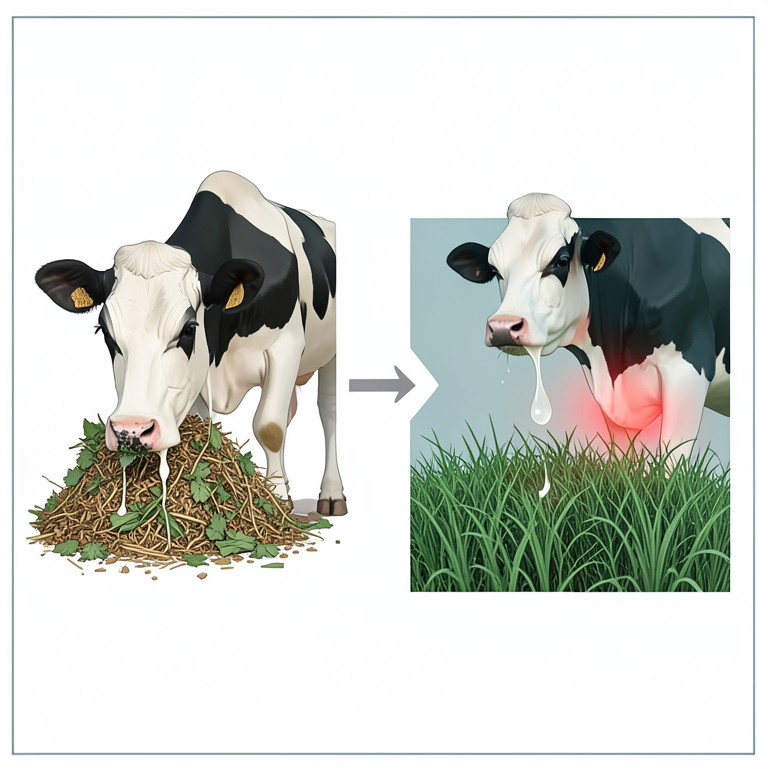
Comparison of Diet and Health Outcomes
AI-generated conceptual illustration (dairy cows). It explains the idea and does not show study data.
View source evidence ↗Figures & tables
From the original paper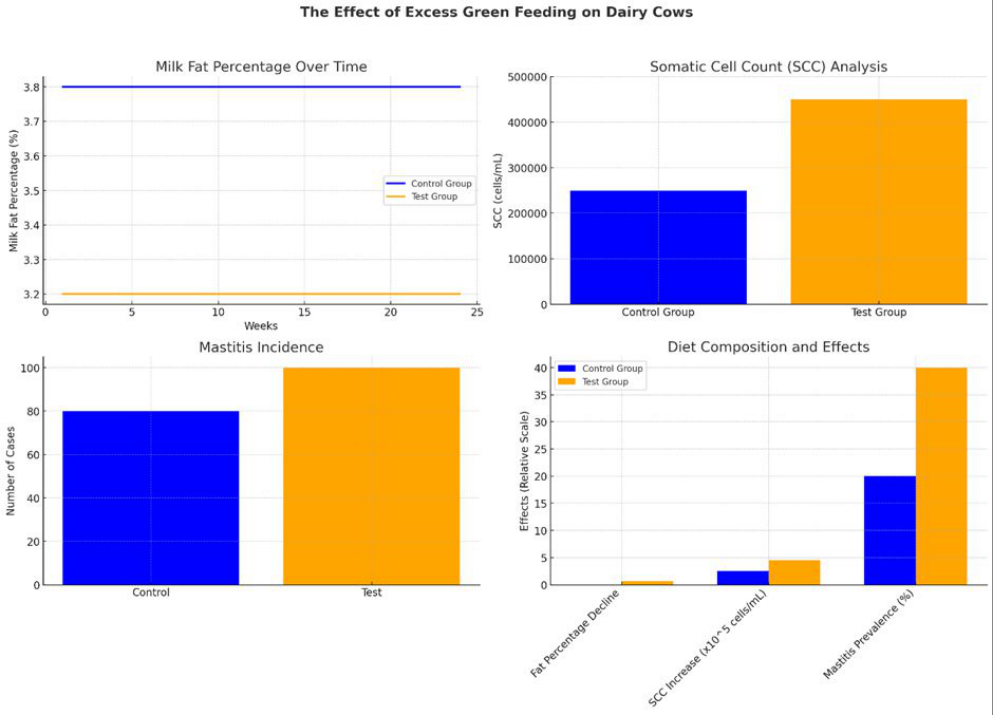 Figure 1
Introduction
Green fodder is rich in fiber, moisture, and nutrients, making it an integral part of dairy cow diets (Elgersma, 2015) [5] . While moderate green fodder feeding supports optimal milk production, over-reliance on it can disrupt nutrient balance, leading to decreased milk fat content and compromised udder health. The high moisture content of excess green forage may influence rumen fermentation patterns and systemic metabolic functions, thereby affecting both milk composition and the immune response to udder pathogens (Negussie et al., 2013) [8] . This study explores the dual impact of excess green feeding on milk fat percentage and udder health, aiming to provide practical guidelines for dairy farmers.
Milk Fat Percentage: Importance and Regulation 2.1 Role of Fat in Milk Quality
Milk fat significantly contributes to the nutritional and sensory qualities of dairy products, influencing market value and consumer acceptance. Its concentration is influenced by genetic, environmental, and dietary factors (Berry et al., 2007) [2] . Dietary interventions, such as excessive green fodder feeding, can dilute the energy density of the diet, altering the volatile fatty acid (VFA) profile in the rumen, which in turn impacts milk fat synthesis.
Mechanisms Affecting Milk Fat Percentage Excess green feeding impacts milk fat percentage through several mechanisms:
Reduced Fibber Intake: High green fodder diets often displace fibrous dry matter, leading to lower rumen pH and decreased acetate production, a key precursor for milk fat synthesis. Increased Moisture Content: High-moisture diets reduce energy density, causing energy deficits that suppress milk fat output (Bostanova et al., 2021) [3] .
Udder Health and Excess Green Feeding 3.1 Impact on Mastitis Risk
Excessive green feeding can predispose cows to subacute ruminal acidosis (SARA), a metabolic disorder that impairs immune function and increases susceptibility to mastitis (Salama et al., 2003) [9] . Altered rumen fermentation can lead to systemic inflammation, further compromising udder defenses.
Moisture and Hygiene
High-moisture feces associated with green fodder diets can create unhygienic conditions, promoting bacterial growth on the udder and increasing mastitis risk.
Methodology 4.1 Study Design
A controlled study was conducted on 100 lactating Holstein Friesian cows over six months. The cows were divided into two groups: a control group fed a balanced diet with controlled green fodder levels and a test group fed a diet comprising 70% green fodder, exceeding recommended levels. Milk fat percentage was analyzed weekly using a milkPro Ultrasonic Analyser, and udder health was assessed bi-weekly through somatic cell count (SCC) and clinical mastitis evaluations. This study aimed to investigate the impact of a high green fodder diet on milk fat content and udder health in lactating cows.
Results and Discussion
Results and Discussion
Effect on Milk Fat Percentage
Cows in the test group showed a significant decline in milk fat percentage (3.2%) compared to the control group (3.8%).
The reduction was attributed to lower acetate production and disrupted lipid metabolism, consistent with findings by Hashemzadeh-Cigari et al. (2014) [6] and Alyousef et al.
Effect on Udder Health
Somatic Cell Count: The test group had an average SCC of 450,000 cells/mL, higher than the control group's 250,000 cells/mL, indicating increased mastitis prevalence (Chandra et al., 2015) [4] . Clinical Mastitis: A 20% higher incidence of mastitis was observed in the test group, linked to poor hygiene due to wetter bedding and fecal contamination.
Fig 1:
The effects of excess green feeding on dairy cows through four distinct graphs. Each graph highlights key metrics such as milk fat percentage, somatic cell count (SCC), mastitis incidence, and the diet composition effects
Practical Implications 6.1 Optimizing Green Fodder Feeding
A balanced approach that includes dry matter sources like hay and silage can mitigate the adverse effects of excessive green fodder on rumen health and milk fat synthesis.
Hygiene and Udder Care
Implementing strict hygiene protocols, such as regular cleaning of udders and bedding, is essential to prevent mastitis in cows fed high-moisture diets (McCarthy et al., 2007) [7] .
Monitoring and Intervention
Regular monitoring of milk composition and SCC allows for early detection of dietary imbalances and udder health issues, enabling timely management interventions.
Conclusion
Excessive green feeding negatively impacts both milk fat percentage and udder health in dairy cows, primarily through altered rumen fermentation patterns and increased mastitis susceptibility. A balanced diet, proper hygiene management, and regular health monitoring are critical for maintaining high milk quality and ensuring udder health. These findings highlight the need for tailored feeding strategies to optimize dairy productivity and farm profitability.
Figures and tables from the paper
References
9 in the original paper- Alyousef YM, et al. Influence of functional feed supplements on milk production efficiency and udder health. Sustainability. 2022;14(14):8444.
- Berry DP, et al. Effect of strain of Holstein-Friesian and feed system on udder health and milking characteristics. Livest Sci. 2007;107(1):10-20.
- Bostanova S, et al. Indicators of full value feeding rations for dairy cows. Braz J Biol. 2021.
- Chandra G, et al. Effect of vitamin E and zinc supplementation on milk composition and udder health. Indian J Anim Nutr Feed Technol. 2015;15(1):75-80.
- Elgersma A. Grazing increases the unsaturated fatty acid concentration of milk from grass-fed cows. Eur J Lipid Sci Technol. 2015;117(10):1555-69.
- Cigari HF, et al. Effects of herbal supplementation on udder health in Holstein cows. J Dairy Sci. 2014;97(7):4110-9.
- McCarthy S, et al. The impact of feed system on udder health and milk yield. Livest Sci. 2007;112(2-3):13343.
- Negussie E, et al. Genetic associations of fat-protein ratio with udder health in Nordic Red cattle. J Dairy Sci. 2013;96(12):7654-65.
- Salama AAK, et al. Dietary zinc-methionine supplementation and udder health. J Dairy Res. 2003;70(1):9-17.