
Research article · 2025 · Full text
International Journal of Veterinary Sciences and Animal HusbandryEffect of supplementing concentrate feed to ewes in late pregnancy and creep feed supplementation to lambs on their growth
Volume 10(2) · Pages 34–36 · DOI: 10.22271/veterinary.2025.v10.i2a.2047 ↗
Research areasLivestock Management and Performance ImprovementAnimal Nutrition and Health
Abstract
Author-writtenThe present study was conducted with an objective to measure the beneficial effects on supplementing the concentrate feed (18% CP) during last trimester of gestation and creep feed (16% CP) to lambs. A total of 24 ewes (25±1.4 kg) which were in their last trimester of gestation were selected and randomly allotted to two groups (control and treatment group) of 12 each. The ewes in treatment group were supplied with 250g of concentrate feed per day throughout the last trimester of gestation and continued till weaning period and the lambs born to treatment group were supplemented with creep feed @50g/day for first 15 days and then increased to 75g/day for next 15 days and afterwards with 100g/day for next 15 days. Supplementation of concentrate feed during last trimester of gestation has a profound effect on body weight gain of ewes (6.5±1.5 Vs 4.9±0.9 kg)which in turn affected the birth weight of lambs in a positive way (3.3±0.2 Vs 2.2±0.2 kg). Along with this, the occurrence of ROP and dystocia has drastically reduced in the treatment group by 25% and 16.7%, respectively. Further, supplementation of creep feed to lambs from young age (i.e., 15 days of age) has a profound effect on bodyweight gain (10.4±0.5 Vs 6.8±2.9 kg). This study proved that additional supplementation of concentrate feed to pregnant ewes and creep feed to lambs has a combined effect in acquiring higher body weight of lambs which in turn has a positive effect on benefit cost ratio of sheep farm.
Summary
Source-checkedPlain-language reading of the full paper, prepared with AI and checked against the text. Each point links to the authors' own words.
Why it matters
- The economic efficiency of a sheep flock is determined by its reproductive performance and the growth rate of the lambs. View evidence ↗
- The nutritional status of a ewe during late gestation directly correlates with fetal growth and the ewe's lactation performance, both of which influence the lamb's growth rate. View evidence ↗
- Insufficient nutrient supplementation during gestation can lead to low milk yield and pregnancy toxemia in ewes, as well as low birth weight, slow growth, and compromised immunity in lambs. View evidence ↗
The question
- The study aimed to measure the beneficial effects of supplementing ewes with 18% CP concentrate feed during the last trimester of gestation and providing 16% CP creep feed to lambs. View evidence ↗
What they did
- The study used 24 Nellore Jodipi ewes (2-3 years old, weighing 25±1.4 kg) in their last trimester of gestation, randomly divided into a control group and a treatment group of 12 animals each. View evidence ↗
- Ewes in the treatment group received 18% CP concentrate feed during their last month of gestation, continuing until the weaning period ended. View evidence ↗
- Lambs in the treatment group were given creep feed starting at 50g/day for the first 15 days, increasing to 75g/day for the next 15 days, and then to 100g/day for the following 15 days. View evidence ↗
- Researchers recorded the body weights of ewes at the start, after lambing, and at the end of the trial, and recorded lamb weights at birth and at 3 months of age. View evidence ↗
What they found
- Ewes in the treatment group showed a higher weight gain during the experimental period (2.6±0.2 kg) compared to the control group (1.5±0.1 kg). View evidence ↗
- Lambs born to the treatment group had a higher birth weight (3.3±0.2 kg) than those in the control group (2.2±0.2 kg). View evidence ↗
- The treatment group experienced significantly lower rates of dystocia (16.7% vs 41.7%) and retention of placenta (ROP) (8.3% vs 25%) compared to the control group. View evidence ↗
- Lambs receiving creep feed supplementation gained more weight (10.4±0.5 kg) than those in the control group (6.8±2.9 kg). View evidence ↗
- Lamb mortality was lower in the treatment group (8.3%) compared to the control group (33.3%). View evidence ↗
- The treatment group achieved a higher net income per animal (4499 Rs. vs 2153 Rs.) and a better benefit-cost (B:C) ratio (4.2 vs 3.3) than the control group. View evidence ↗
What it means
- The authors conclude that supplementing ewes in late gestation and lambs before weaning positively impacts lamb growth and early-stage immunity. View evidence ↗
Visual summary
3 visualsIllustrations explain the paper; charts are replotted from the paper's own table values.
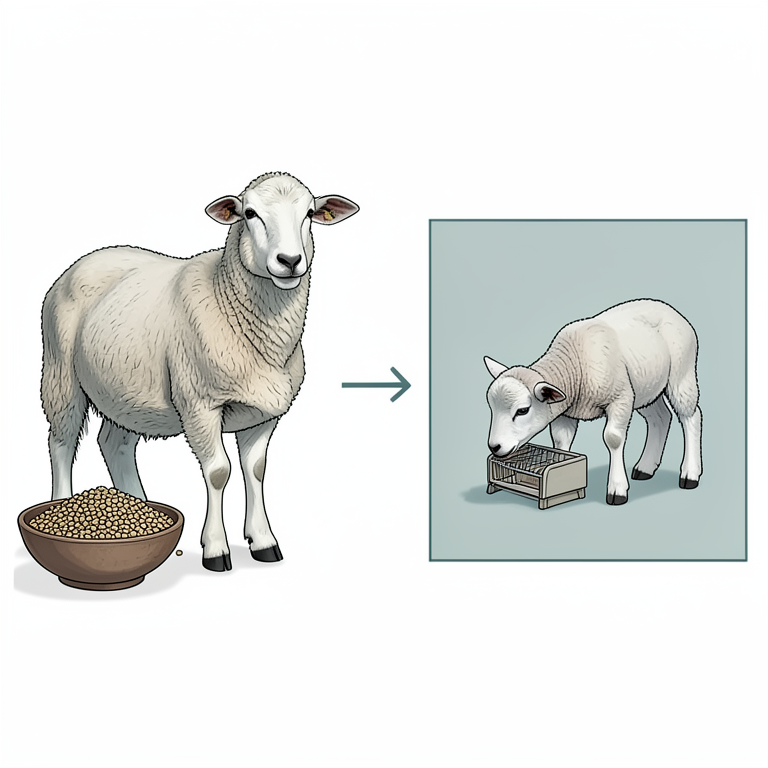
Supplementation Timeline
AI-generated conceptual illustration (pregnant ewes and young lambs). It explains the idea and does not show study data.
View source evidence ↗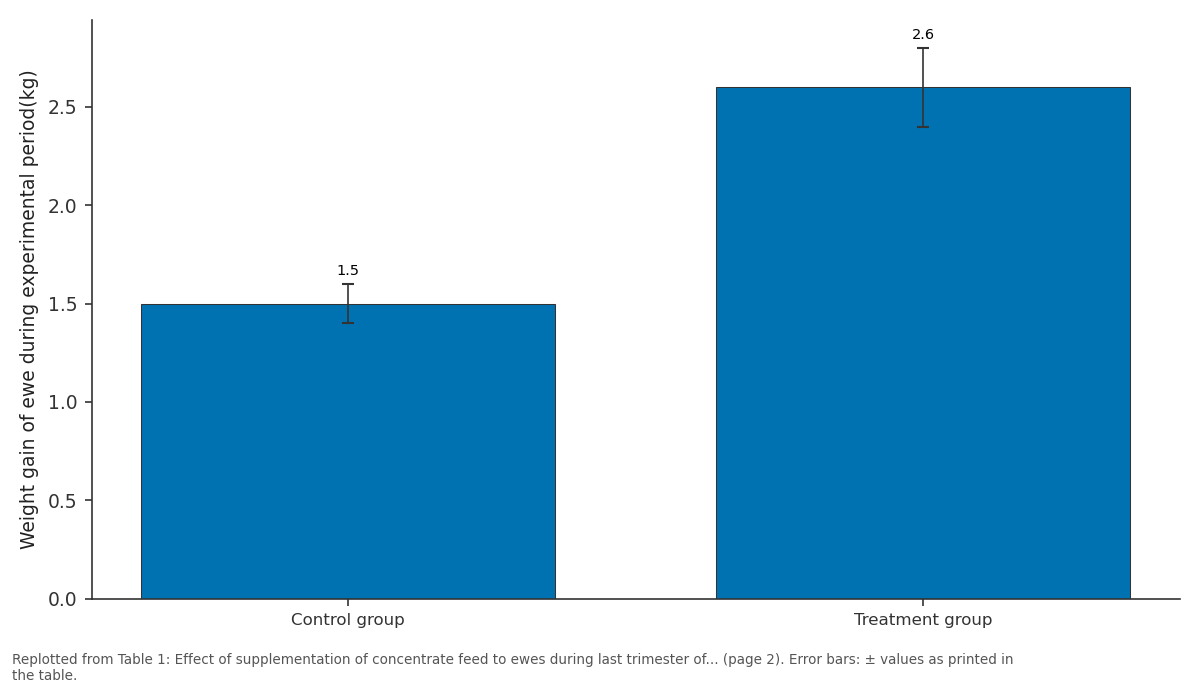
Weight gain of ewe during experimental...: Control group vs Treatment group
Replotted from Table 1 (page 2) of the original paper. Every bar is the paper's own table value.
View source evidence ↗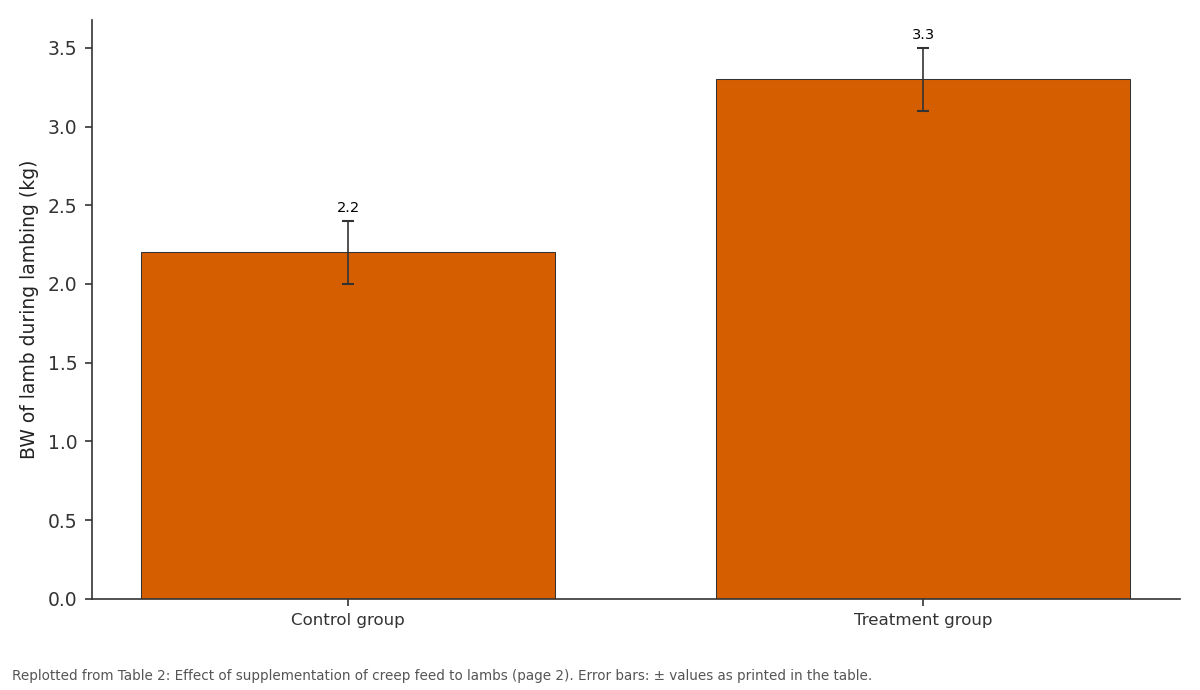
BW of lamb during lambing (kg): Control group vs Treatment group
Replotted from Table 2 (page 2) of the original paper. Every bar is the paper's own table value.
View source evidence ↗Figures & tables
From the original paper Table 1
 Table 2
 Table 3
Introduction
As the flock economical efficiency was determined by its reproductive performance and lamb growth rate (Notter, 2012) [5] , shepherds need to concentrate in this area to maximize the output of the flock within the confines of a cost effective, practical and adequate feeding program (Rook, 2000) [6] . When compared to reproductive efficiency, it is easy to intervene in terms of lamb growth rate as it can be easily achieved by showing some concern to the lamb before its birth i.e., taking care of lamb within the womb itself as there productive efficiency (prolificacy) is mainly associated with genetic factors (Rook, 2000) [6] and to the ewe in its late gestation as late gestational nutritional status directly correlated with the fetal growth and the lactation performance of the ewe which in turn affects the lamb growth rate (Wang et al. 2023) [10] . The principal factor which affects the birth weight of lamb and growth rate of lamb after birth is the nutritional status of the ewe during its pregnancy (Gardner et al. 2007) [2] . Inadequacy of nutrient supplementation during gestational period effects both ewe and lamb health in terms of low milk yield, increasing the chances of incidence of pregnancy toxemia (Rook, 2000) [6] and low lamb birth weight, low growth rate, compromising immunity function of lambs, respectively. In developing countries such as India, shepherds follow extensive system of rearing, allowing the sheep to solely graze for a period of 8 hours/day without concentrate mixture. Even though it is satisfying the hunger of the animal, the nutritional availability to the animal in terms of quality was being compromised. Pregnant ewes require 50% over and above of the maintenance requirement of normal ewe (Melanie, 2022) [11] , which cannot be met through only grazing demanding additional supplementation of nutrients in their late gestation either through concentrate feed or grazing or feeding of high-quality legumes. Here, most of the cultivable land was occupied by either agricultural or horticultural crops sparing a little for fodder cultivation which in turn mostly utilized for dairy cattle as this place is one of the dominant habitats of dairy animal compromising available nutritionally qualitative grazing land for sheep. Hence, the present study was conducted to enlighten the shepherds in the way to provide sheep with balanced nutrition at least in utmost nutritionally critical period their physiological life.
Materials and Methods
The present study was conducted at shepherd's farms of Annamayya district of Andhra Pradesh under the leadership of Krishi Vigyan Kendra, Kalikiri of ANGRAU. 24 Nellore Jodipi ewes (2-3 years old having body weight 25±1.4 kg) were selected which are in their last trimester of gestation and randomly allotted to two groups (control and treatment groups) with 12 animals of each. All the 24 animals were allowed for grazing for 8 hours per day and the treatment group was supplemented with concentrate feed (Bharamatiagro ltd) with 18% CP in the shed during their last month of gestation and continued till weaning period was completed. After lambing, the lambs born to treatment group animals were supplied with creep feed (which was formulated by the shepherd by mixing 50 parts of ground maize, 24 parts of rice bran, and 25 parts of ground nut cake and 1part of mineral mixture). The lambs were supplied with creep feed @50g/day for first 15 days and then increased to 75g/day for next 15 days and afterwards with 100g/day for next 15 days.During the trial period, body weights of sheep at the initial stages of trial, after lambing and at the end of trail and that of lambs at lambing time and at 3 months of age were recorded.
Statistical Analysis
Data obtained were subjected to one-way analysis of variance and the treatment means were ranked using Duncan's multiple range test with a significance at p<0.05 (Duncan,1955). All the statistical procedures followed were in accordance with Snedecor and Cochran (1994) [9] and conducted in SPSS (V.23.0).
Results and Discussion
The effect of supplementation of concentrate feed to ewes was presented in Table 1. The supplementation of concentrate feed during last trimester of gestation has a profound effect on body weight gain of ewes which in turn affected the birth weight of lambs in a positive way which was in synchronization with the statement given by Scales et al., (1986) [8] and Rook (2000) [6] . These results were also supported by attaining healthy and more survived lambs at birth with additional effect on improved BCS and nutritional status of ewe which assisted in minimizing the chances of dystocia which may occur due to nutritional imbalance (Guard, 1999, Garden et al. 2007) [3,2] by 25% in treatment group when compared to control group as dystocia was one of the reasons for lamb mortality (Rook, 2000) [6] which may be predisposed due to imbalanced nutrition of ewe in late gestation. Whereas the occurrence of ROP (retention of placenta) has also decreased by 16.7% in the treatment group. Effect of supplementation of creep feed to lambs from the age of 15 days has presented in the Table 2. Supplementing of creep feed at the early age (2 weeks) has a very profound effect on bodyweight gain which can be achieved due to augmented rumen development with the help of propionic acid and butyric acid which can enhance the development of rumen papillae results in efficient utilization of nutrients (Mentschel et al. 2001) [4] . Low mortality rate (8.3% in treatment group whereas 33.3% in control group) was also observed in the treatment group because of combined effect of higher lamb birth weight, better nutritional status of ewe (Scales et al. 1986; Rook, 2000) [6,8] . Effect of supplementing concentrate feed to ewes in late pregnancy and creep feed supplementation to lambs from young age was presented in Table 3. Even though the total cost of maintenance and production were almost 1.7 times higher in treatment group, net income earned was 2.2 times higher within in the particular period (i.e., 100 days of trial) due to getting healthy lambs, early returns due to faster growth rate than in that of control group. And it was also observed that the appearance of lambs in treatment group is good because of shiny and healthy hair coat which may be due to balanced nutrition of both ewes and lambs at their critical period of physiological life.
| Parameter | Control group | Treatment group |
|---|---|---|
| Total cost of maintenance & production (Rs./animal) | 650 | 1068 |
| Total income (Rs./animal) | 2803 | 5567 |
| Net income (Rs./animal) | 2153 | 4499 |
| B:C ratio (per animal) | 3.3 | 4.2 |
Table text extracted from the original PDF; superscript letters are shown inline. The original table image is below.
View original table image
| Parameter | Control group | Treatment group |
|---|---|---|
| BW of lamb during lambing (kg) | 2.2±0.2 | 3.3±0.2 |
| BW of lamb at 3 months stage(kg) | 8.7±3.7 | 13.6±0.6 |
| Weight gain of lambs (kg) | 6.8±2.9 | 10.4±0.5 |
| Lamb mortality % | 33.3 | 8.3 |
Table text extracted from the original PDF; superscript letters are shown inline. The original table image is below.
View original table image
| Parameter | Control group | Treatment group |
|---|---|---|
| B.W of sheep at initial stage of trail (kg) | 25.1±1.4 | 24.9±1.5 |
| B.W of sheep after 25 days of feeding concentrate feed (kg) | 26.6±1.5 | 27.5±1.7 |
| Weight gain of ewe during experimental period(kg) | 1.5±0.1 | 2.6±0.2 |
| Dystocia (%) | 41.7 | 16.7 |
| ROP (%) | 25 | 8.3 |
Table text extracted from the original PDF; superscript letters are shown inline. The original table image is below.
View original table image
Conclusion
Supplementation of concentrate feed to sheep during their last trimester of gestation and supplementation of creep feed to lambs before weaning period has a positive effect on growth of lambs and their immunity status during their early stages of growth period.
References
11 in the original paper- Duncan DB. Multiple range and multiple F tests. Biometrics. 1955;11(1):1-42.
- Gardner DS, Buttery PJ, Daniel Z, Symonds ME. Factors affecting birth weight in sheep: maternal environment. Reproduction. 2007;133(1):297-307.
- Guard C. Retained placenta: causes and treatments. Adv Dairy Technol. 1999;11:81.
- Mentschel J, Leiser R, Mülling C, Pfarrer C, Claus R. Butyric acid stimulates rumen mucosa development in the calf mainly by a reduction of apoptosis. Arch Anim Nutr. 2001;55(2):85-102.
- Notter DR. Genetic improvement of reproductive efficiency of sheep and goats. Anim Reprod Sci. 2012;130(3-4):147-151.
- Rook JS. Pregnancy toxemia of ewes, does, and beef cows. Vet Clin North Am Food Anim Pract. 2000;16(2):293-317.
- IBM Corp. IBM SPSS Statistics for Windows, version 23.0. Armonk, NY: IBM Corporation; 2015.
- Scales GH, Burton RN, Moss RA. Lamb mortality, birthweight, and nutrition in late pregnancy. N Z J Agric Res. 1986;29(1):75-82.
- Snedecor GW, Cochran WG. Statistical methods. 8th ed. New Delhi: Affiliated East West Press; 1994. p. 14671473.
- Wang X, Wang Y, Wang Q, Dai C, Li J, Huang P, Yang H. Effect of dietary protein on growth performance, and serum biochemical index in late pregnant Hu ewes and their offspring. Anim Biotechnol. 2023;34(2):97-105.
- Melanie M, Miranti M, Kasmara H, Malini DM, Husodo T, Panatarani C, Joni IM, Hermawan W. Nanotechnology-based bioactive antifeedant for plant protection. Nanomaterials. 2022 Feb 14;12(4):630.