
Research article · 2025 · Full text
International Journal of Geography Geology and EnvironmentApplication of artificial neural network algorithm-based machine learning and artificial intelligence techniques for predicting evaporation from historical weather data
Volume 7(1) · Pages 29–33 · DOI: 10.22271/27067483.2025.v7.i1a.326 ↗
Research areasHydrological Forecasting Using AIMeteorological Phenomena and SimulationsAir Quality Monitoring and Forecasting
Abstract
Author-writtenThe utilization of neural networks and machine learning techniques has revolutionized evaporation predictions from historical weather data. Researchers employ deep learning methodologies to create models that not only capture complex meteorological patterns but also enhance forecasting accuracy. Innovations like the Meteorological Information Service Decision Support System utilize predictive algorithms to optimize energy management and operational decisions in wind power forecasting, showing promising outcomes. Advanced surrogate models, including convolutional encoder-decoder networks and spatial-temporal graph neural networks, accurately simulate intricate hydrological processes to improve groundwater level predictions under data constraints. These advancements underscore the transformative impact of artificial intelligence in environmental modeling and resource management, opening avenues for practical applications. The integration of artificial neural networks and machine learning in evaporation forecasting signifies significant progress with implications for future research and practical implementation. Models such as the Meteorological Information Service Decision Support System enhance energy management by predicting factors affecting evaporation rates, aiding decision-making processes. Machine learning's effectiveness in various fields, including drug supply chain management, sets the stage for interdisciplinary applications using similar predictive parameters. Future research should concentrate on refining models for enhanced accuracy and real-time data integration to advance water resource management and climate response strategies crucial for addressing global environmental changes.
Summary
Source-checkedPlain-language reading of the full paper, prepared with AI and checked against the text. Each point links to the authors' own words.
Why it matters
- Predicting evaporation is essential for managing water resources, supporting agriculture, and modeling the climate. View evidence ↗
- Conventional modeling methods are often insufficient because they cannot capture the complex, non-linear relationships found in weather data. View evidence ↗
- Specific traditional tools, such as the Penman–Monteith equation, may underestimate actual evapotranspiration, which can result in inefficient water usage. View evidence ↗
The question
- The objective of this study is to evaluate how effective modern AI, machine learning, and artificial neural network methodologies are at predicting evaporation rates. View evidence ↗
What they did
- The analyzed methodologies utilize large volumes of historical weather data to identify complex patterns and correlations. View evidence ↗
- The review discusses the use of various algorithms, including fully-connected neural networks (FCNN), Long Short-Term Memory (LSTM), and eXtreme Gradient Boosting (XGBoost), to improve prediction accuracy. View evidence ↗
- Different neural network architectures are used for specific tasks: FNNs for function approximation, RNNs for time-series forecasting, and CNNs for spatial data analysis. View evidence ↗
What they found
- Deep learning strategies and machine learning techniques generally produce lower errors in meteorological contexts than conventional methods. View evidence ↗
- Interpretable models using real-time IoT climate data have achieved significant accuracy in predicting daily evaporation, with R² values reaching up to 0.85. View evidence ↗
- Supervised learning is effective for making accurate predictions by utilizing labeled datasets to establish input-output relationships. View evidence ↗
- Machine learning models have proven effective in predicting drought levels (which relate to evaporation) using 90 days of public meteorological data. View evidence ↗
What it means
- The authors conclude that integrating ANN, ML, and AI for evaporation prediction is a major advancement for agricultural practices and environmental modeling. View evidence ↗
- The authors recommend that future research focus on increasing model accuracy and integrating real-time data to improve climate response and water management. View evidence ↗
- The authors note that achieving uniform predictive accuracy across different indicators remains a challenge. View evidence ↗
Visual summary
1 visualsIllustrations explain the paper; they do not show study data.
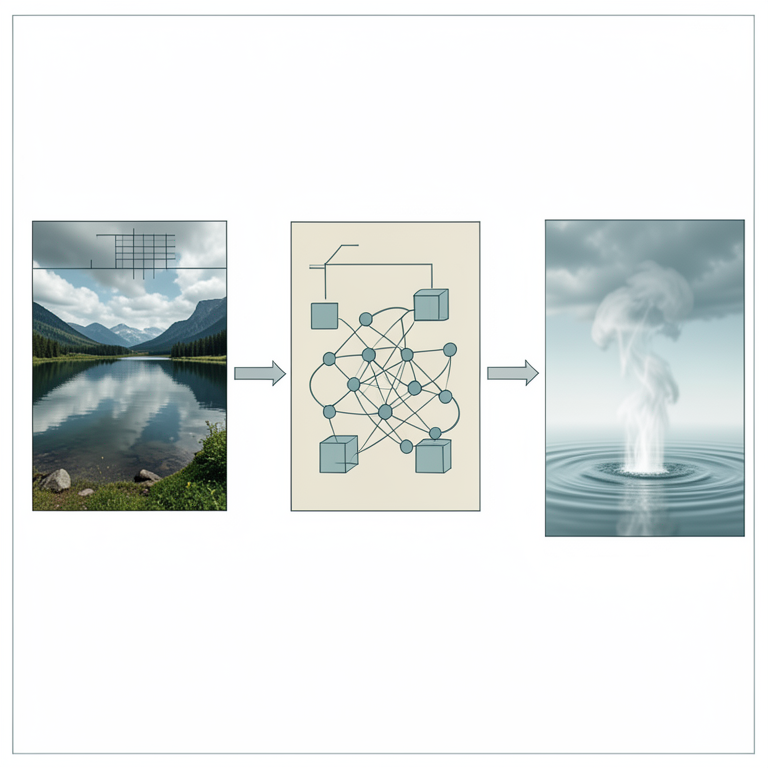
Neural Network Architectures for Weather Data
AI-generated conceptual illustration (Atmospheric water evaporation from a natural landscape). It explains the idea and does not show study data.
View source evidence ↗Introduction
The study of evaporation is crucial for various applications, including water resource management, agriculture, and climate modeling. Given the increasing challenges posed by climate change and the need for sustainable water use, enhancing the accuracy of evaporation predictions has become imperative. Traditional modeling techniques often fall short in capturing the complex, nonlinear relationships inherent in weather data, leading to inadequate forecasting capabilities. In this context, the advent of Artificial Neural Networks (ANN), Machine Learning (ML), and Artificial Intelligence (AI) methods presents a transformative opportunity. These technologies leverage vast amounts of historical weather data to uncover intricate patterns and correlations that would otherwise remain obscured. By integrating these advanced computational techniques, the potential to improve evaporation predictions significantly increases, ultimately contributing to better resource management strategies and informing policy decisions. Thus, this study aims to explore and evaluate the effectiveness of these modern methodologies in predicting evaporation rates.
Definition of key terms: Artificial neural networks, machine learning, and artificial intelligence
To understand the application of various computational techniques in predicting evaporation from historical weather data, one must first define key terms such as Artificial Neural Networks (ANNs), Machine Learning (ML), and Artificial Intelligence (AI). ANNs are computational models inspired by the human brains architecture, designed to recognize patterns and make predictions based on input data. ML, a subset of AI, refers to algorithms that enable computers to learn from and improve upon data without explicit programming, emphasizing their adaptability in complex tasks like weather prediction. In recent years, ML techniques have gained prominence in forecasting processes, particularly in drought prediction, due to their ability to handle vast datasets and uncover intricate relationships among variables (Bashir et al., 2021) [4] . Additionally, AI encompasses a broader range of computational methods that aim to automate decisionmaking, enhancing data-driven approaches to model phenomena such as evaporation and climate patterns (Arefev et al., 2024) [3] .
Importance of evaporation prediction in environmental science and agriculture
The ability to accurately predict evaporation is critical in both environmental science and agriculture, as it plays a significant role in water resource management and agricultural sustainability. Effective evaporation models inform irrigation planning, which is especially crucial in regions facing water scarcity. Recent studies highlight the limitations of traditional methods like the Penman-Monteith equation, which can underestimate actual evapotranspiration (ETr) under certain conditions, leading to inefficient water use (Evett et al., 2023) [8] . Innovative approaches integrating artificial intelligence and machine learning have emerged as powerful tools to enhance evaporation predictions. These techniques harness vast datasets, including soil moisture sensors and weather data, optimizing irrigation practices and reducing water wastage (Baskar M et al., 2023) [5] . By ensuring more precise evaporation modeling, these technologies not only help in resource conservation but also contribute to the overall resilience of agricultural systems against climatic extremes, ultimately fostering sustainable practices in agriculture and environmental management.
Overview of the role of historical weather data in predictive modeling
Historical weather data serves as a foundational element in predictive modeling, particularly in the context of evaporation forecasting. By providing insights into past climate behaviors, these data sets enable the development of models that can anticipate future trends and patterns, which is increasingly vital in the face of climate change. As temperatures rise and water scarcity becomes a pressing concern in arid and semi-arid regions, the ability to predict evaporation rates can significantly impact agricultural practices and resource management. For instance, innovative techniques such as multivariate decision trees and artificial neural networks can utilize this historical data to enhance forecasting accuracy, leading to improved outcomes in precision agriculture (Bueno-Crespo et al., 2022) [7] . Furthermore, methods like the Moving Average-Probabilistic Regression Filtering highlight the importance of preprocessing historical data to optimize predictive performance, underscoring its critical role in effective rainfall prediction and watershed management (Ramaswamy et al., 2022) [13] .
Theoretical foundations of artificial neural networks
The theoretical foundations of artificial neural networks (ANNs) are pivotal for advancing predictive models, particularly in the context of evaporation forecasting from historical weather data. ANNs, inspired by biological neural networks, consist of interconnected nodes or neurons that process information through weighted connections, allowing the system to learn complex patterns within datasets. By employing algorithms like fully-connected neural networks (FCNN) and advanced techniques such as Long Short-Term Memory (LSTM) and eXtreme Gradient Boosting (XGBoost), researchers can significantly enhance the accuracy of predictions (cite7). This integration of Machine Learning (ML) methods provides a robust framework for analyzing temporal weather data, thus facilitating better decision-making in energy management and other applications. Moreover, endeavors that showcase the capabilities of artificial intelligence illuminate its potential to tackle pressing societal challenges by deriving actionable insights from large-scale data. Hence, the theoretical underpinnings of ANNs are instrumental in shaping effective predictive models for evaporation.
Structure and functioning of artificial neural networks
Artificial neural networks (ANNs) serve as pivotal tools in machine learning and artificial intelligence, particularly when applied to complex phenomena such as predicting evaporation from historical weather data. The structure of ANNs is inspired by the human brain, consisting of interconnected nodes, or neurons, organized in layers: an input layer, one or more hidden layers, and an output layer. Each connection between neurons is weighted, allowing the network to learn from the data through adjustments during training. This adaptability enables ANNs to capture intricate patterns and non-linear relationships inherent in meteorological data, which is essential for accurate evaporation predictions. Research has demonstrated that leveraging deep learning architectures within ANNs can enhance predictive accuracy by effectively modeling varying weather conditions, including extreme events, thereby offering substantial improvements over traditional forecasting methods (Srivastava et al. 2023) [14] . Consequently, understanding the functioning of ANNs is crucial for optimizing their application in environmental sciences (Ansari MSA et al., 2023) [11] .
Types of neural networks used in predictive modeling
In the realm of predictive modeling, various types of neural networks have gained prominence, particularly in the context of environmental data analysis. Feedforward Neural Networks (FNNs) are frequently employed for their simplicity and effectiveness in approximating complex functions, making them suitable for predicting evaporation rates from historical weather data. Additionally, Recurrent Neural Networks (RNNs) excel in time-series forecasting, as they consider the sequential nature of data, further enhancing the accuracy of predictions by integrating past evaporation patterns. Convolutional Neural Networks (CNNs) are also emerging as valuable tools for processing spatial data, enabling researchers to analyze geographical variations in evaporation rates more effectively. The application of these neural network architectures is critical in optimizing water resource management, especially in agriculture, where efficient use of water is paramount (Bueno-Crespo et al., 2022) [7] . Moreover, the integration of AI techniques promotes a data-driven approach to tackle pressing environmental challenges, aligning with sustainable development goals (Muhebwa et al., 2024) [12] .
Advantages of using neural networks for evaporation prediction
The application of neural networks in evaporation prediction presents various advantages that enhance the accuracy and reliability of forecasts derived from historical weather data. One significant benefit lies in the neural networks ability to model complex, non-linear relationships among the meteorological variables that influence evaporation rates, which traditional linear models often overlook. This capability allows for robust predictions that adapt to diverse climatic conditions, accommodating factors such as temperature, humidity, solar radiation, and wind speed. Recent research indicates that machine learning techniques, particularly deep learning strategies, deliver lower errors compared to conventional methods, affirming their efficacy in meteorological contexts (Bello et al., 2020) [6] . Furthermore, neural networks can efficiently process large datasets, optimizing their performance through learning algorithms tailored to improve accuracy (Abdullahi et al., 2021) [1] . Thus, implementing neural networks for evaporation prediction not only broadens analytical frameworks but also enhances decision-making in water resource management and agricultural planning.
Machine learning techniques in evaporation prediction:
The application of machine learning techniques in evaporation prediction has become increasingly essential, particularly in the context of climate change and its associated implications for water resources. By leveraging historical weather data, researchers can utilize sophisticated models such as Artificial Neural Networks (ANNs) to forecast evaporation rates with significant accuracy. As highlighted, the use of interpretable machine learning approaches, including multivariate decision trees, facilitates the daily prediction of evaporation, thereby aiding farmers in managing scarce water resources more sustainably in arid regions (Bueno-Crespo et al., 2022) [7] . Furthermore, studies show that machine learning models outperform traditional forecasting methods by adapting to various input features such as temperature, humidity, and wind speed (Bello et al., 2020) [6] . This adaptability not only enhances prediction accuracy but also supports precision agriculture, revealing the critical role machine learning techniques play in optimizing agricultural practices amid changing climatic conditions.
Overview of machine learning algorithms applicable to weather data
The integration of machine learning algorithms into meteorological applications has revolutionized the accuracy of weather predictions. These algorithms, including decision trees, support vector machines, and neural networks, have demonstrated significant efficacy in processing vast datasets comprising historical weather conditions. For instance, machine learning techniques enable the classification and prediction of complex climatic events such as rainfall, which is critical for hydrological management and agricultural planning (Ramaswamy et al., 2022) [13] . Additionally, advanced models like those utilizing Long Short-Term Memory (LSTM) and eXtreme Gradient Boosting (XGBoost) further enhance predictive capabilities by capturing temporal dependencies within weather phenomena (Yang et al., 2022) [16] . The ability of these algorithms to optimize data utilization not only supports more informed decision-making in energy management but also contributes to mitigating the effects of climate change through improved environmental forecasting. Thus, machine learning serves as an essential tool in harnessing weather data effectively for various applications, particularly in predicting evaporation outcomes.
Comparison of supervised and unsupervised learning methods
The differentiation between supervised and unsupervised learning methods significantly impacts the application of artificial intelligence techniques in predicting evaporation from historical weather data. Supervised learning, characterized by the use of labeled datasets, allows algorithms to learn from existing data and make accurate predictions based on input-output relationships. This method has shown considerable success in related studies, where machine learning models like support vector machines are employed to predict climate-related phenomena, demonstrating their reliance on historical data for nuanced predictions (Abdullahi et al., 2021) [1] . Conversely, unsupervised learning identifies patterns in unlabelled datasets, enabling the detection of hidden structures without prior training. This approach is advantageous in scenarios where labeled data is scarce or costly to obtain. The synergy of both techniques can be instrumental in enhancing prediction accuracy, as observed in various applications that integrate machine learning with real-world data considerations (Abdurachman et al., 2023) [2] . An informed comparison of these methods is vital for optimizing predictions in environmental contexts.
Case studies showcasing successful machine learning applications in evaporation prediction
Recent case studies exemplify the successful application of machine learning (ML) techniques in the prediction of evaporation, highlighting the capabilities of these advanced computational methods. For instance, a study utilizing various ML models demonstrated their effectiveness in predicting drought levels, which is directly related to evaporation rates, by analyzing 90 days of meteorological data from public datasets. The results illustrated the challenges inherent in achieving uniform predictive accuracy across different indicators, thereby establishing a benchmark for further research in this area (Jiang et al., 2021) [9] . Additionally, integrating ML with meteorological information systems has shown promise in optimizing wind power forecasting, which relies on accurate predictions of weather conditions, including evaporation (Yang et al., 2022) [16] . These applications underscore the versatility of ML techniques in environmental science, confirming their potential to improve water management practices and enhance the accuracy of evaporation predictions derived from historical weather data.
Integration of artificial intelligence in weather data analysis:
The integration of Artificial Intelligence (AI) into weather data analysis represents a transformative advancement in how meteorological phenomena, particularly evaporation, are predicted. Employing techniques such as Artificial Neural Networks (ANN) and machine learning, researchers can analyze vast datasets to derive actionable insights for agricultural practices. For instance, the utilization of IoT infrastructures to gather realtime climate data enables the development of interpretable models that predict daily evaporation rates with significant accuracy, reaching an R² value of up to 0.85, as demonstrated in recent studies (Bueno-Crespo et al., 2022) [7] . Additionally, advanced algorithms for preprocessing, like the Moving Average-Probabilistic Regression Filtering, help to refine historical weather data to enhance predictions related to rainfall, which directly influences evaporation forecasts (Ramaswamy et al., 2022) [13] . This synergy between AI technologies and meteorological research not only augments predictive capabilities but also supports sustainable water resource management, essential for agriculture in increasingly variable climates.
Role of AI in enhancing data processing and analysis
In the context of predicting evaporation from historical weather data, the role of artificial intelligence (AI) in enhancing data processing and analysis is pivotal. By employing advanced techniques such as artificial neural networks and machine learning algorithms, researchers can efficiently handle vast datasets that comprise numerous weather parameters. For instance, the application of statistical methods in rainfall prediction highlights how machine learning can optimize data preprocessing, thereby improving the accuracy of subsequent analyses (Ramaswamy et al., 2022) [13] . Moreover, AI frameworks, like those integrating meteorological information for energy management, demonstrate the potential of machine learning algorithms to deliver accurate predictive insights, as seen in wind power forecasting applications (Yang et al., 2022) [16] . These innovations not only streamline data processing workflows but also enable more precise predictions, ultimately providing critical support for decision-making in environmental management and climate adaptation strategies. Thus, AIs integration into data analysis paves the way for enhanced forecasting accuracy and effective resource utilization.
Predictive analytics and its significance in climate modeling
In the realm of climate modeling, predictive analytics emerges as a pivotal tool that enhances our understanding of environmental dynamics and transforms the raw data from historical weather patterns into actionable insights. Techniques such as artificial neural networks and machine learning algorithms enable researchers to identify intricate relationships within vast datasets, allowing for accurate predictions of climatic phenomena, such as evaporation rates. The integration of these technologies supports the optimization of agricultural practices, particularly in water management, where efficient irrigation is crucial for sustainability. Innovations like IoT sensors and big data analytics contribute to more responsive decision-making in agriculture, reducing water waste while maximizing crop yields, as noted in recent studies. Both predictive analytics and machine learning are instrumental in refining climate models, demonstrating their significance in addressing challenges related to climate variability and resource management (Abdurachman et al., 2023) [2] , (Baskar M et al., 2023) [5] .
Future trends in AI applications for environmental predictions
As environmental challenges continue to escalate, the integration of Artificial Intelligence (AI) into predictive modeling is poised to revolutionize forecasting methods, especially in relation to weather phenomena such as evaporation. Future trends indicate a significant shift toward hybrid models that combine various machine learning techniques, enhancing accuracy and efficiency in environmental predictions. For instance, advancements in Gated Recurrent Units (GRU) and other deep learning architectures can potentially improve predictive capabilities by refining preprocessing stages through techniques like Principal Components Analysis (PCA) (Johannesen et al., 2022) [10] . Additionally, the development of comprehensive decision support systems, which incorporate meteorological variables and operational parameters, will enable better wind power forecasts and optimize energy management (Yang et al., 2022) [16] . These innovations not only promise to refine our understanding of climatic events but also enhance our ability to implement sustainable practices in response to changing environmental conditions.
Conclusion
In conclusion, the integration of Artificial Neural Networks, Machine Learning, and Artificial Intelligence techniques in predicting evaporation from historical weather data represents a significant advancement in environmental modeling and agricultural practices. The methodologies elucidated throughout this essay demonstrate that these approaches not only enhance predictive accuracy but also facilitate more sustainable water resource management in increasingly arid climates. As evidenced by recent studies, such as those employing innovative preprocessing algorithms and classification methods, these technologies are vital for improving rainfall prediction and evaporation forecasts (Ramaswamy et al., 2022) [13] . Furthermore, the application of interpretable models, like multivariate decision trees, enhances user comprehension and enables better decision-making in agriculture, crucial for addressing challenges posed by climate change (Bueno-Crespo et al., 2022) [7] . Therefore, the implementation of these advanced techniques offers a promising pathway to optimize water usage in agriculture and contribute to more effective environmental management strategies.
Summary of key findings from the application of neural networks and machine learning
The application of neural networks and machine learning techniques has significantly advanced the accuracy of predictions related to evaporation from historical weather data. By utilizing deep learning methodologies, researchers have succeeded in creating models that not only capture complex patterns within meteorological variables but also enhance forecasting precision. For instance, innovations such as the Meteorological Information Service Decision Support System have shown promising results by integrating various predictive algorithms to optimize energy management and operational decisions in wind power forecasting (Yang et al., 2022) [16] . Similarly, advanced surrogate models, including convolutional encoder-decoder networks and spatial-temporal graph neural networks, have demonstrated their capacity to accurately simulate complex hydrological processes, thereby improving predictions related to groundwater levels under sparse data conditions (Taccari et al., 2024) [15] . Collectively, these findings underscore the transformative impact of artificial intelligence techniques in environmental modeling and resource management, opening avenues for further exploration and application.
Implications for future research and practical applications
The integration of artificial neural networks, machine learning, and artificial intelligence techniques into the prediction of evaporation from historical weather data holds significant implications for future research and practical applications. Notably, the development of frameworks such as the Meteorological Information Service Decision Support System illustrates how optimized predictive models can enhance energy management by accurately forecasting conditions that affect evaporation rates, thereby improving decision-making processes in related sectors (Yang et al., 2022) [16] . Additionally, as machine learning methodologies demonstrate efficacy in various fields, such as drug supply chain management during disease outbreaks, this establishes a foundation for cross-disciplinary applications that can leverage similar predictive parameters (Abdurachman et al., 2023) [2] . Future research should focus on refining these models further to increase accuracy while exploring realtime data integration, ultimately leading to advancements in water resource management and climate response strategies that are essential in a changing global environment.
Final thoughts on the importance of advanced techniques in understanding evaporation dynamics
In conclusion, the integration of advanced techniques such as artificial neural networks, machine learning, and artificial intelligence has significantly enhanced our understanding of evaporation dynamics. These cutting-edge methodologies enable researchers to analyze extensive historical weather datasets with greater precision, revealing intricate patterns and relationships that traditional models often overlook. By leveraging these technologies, we can predict evaporation rates more accurately, allowing for improved water resource management, agricultural planning, and climate adaptation strategies. Furthermore, the continual advancement of these techniques holds promise for real-time data processing, fostering timely decision-making in various sectors affected by evaporation. As the challenges associated with climate change intensify, the need for robust predictive models becomes increasingly critical. Thus, the application of these innovative approaches signals a transformative shift in how we approach and address the complexities of evaporation within the broader context of environmental science.
References
15 in the original paper- Abdurachman E, Emmanuel G, Ramadhan A, Trisetyarso A, et al. Machine learning in drug supply chain management during disease outbreaks: A systematic review [Internet]. Institute of Advanced Engineering and Science, 2023. Available from: https://core.ac.uk/download/568392865.pdf
- Arefev A, Ogbede C, Sanday L, Teuscher Group, et al. 2024 Summer Proceedings Teuscher Lab [Internet].
- PDXScholar, 2024. Available from: https://core.ac.uk/download/621339497.pdf
- Bashir AK, Ganapathy GP, Garg L, Kaliappan, et al. A contemporary review on drought modeling using machine learning approaches [Internet]. Computers, Materials and Continua (Tech Science Press), 2021. Available from: https://core.ac.uk/download/478091943.pdf
- Baskar M, et al. Review of sustainable irrigation technological practices in agriculture [Internet]. Auricle Global Society of Education and Research, 2023. Available from: https://core.ac.uk/download/603898592.pdf
- Bello A, Cifuentes Quintero JA, Marulanda G, Reneses, et al. Air temperature forecasting using machine learning techniques: A review [Internet]. MDPI, 2020. Available from: https://core.ac.uk/download/586722343.pdf
- MDPI AG, 2022. Available from: https://core.ac.uk/download/604075905.pdf
- Evett SR, Kiraga S, Marek G, Molaei, et al. Reference evapotranspiration estimation using genetic algorithmoptimized machine learning models and standardized Penman-Monteith equation in a highly advective environment [Internet]. Digital Scholarship @ Tennessee State University, 2023. Available from: https://core.ac.uk/download/599447673.pdf
- Jiang W, Luo J. An evaluation of machine learning and deep learning models for drought prediction using weather data [Internet]. arXiv, 2021. Available from: http://arxiv.org/abs/2107.02517
- Al Ansari MS. Utilization of Artificial Intelligence (AI) and Machine Learning (ML) in the field of energy research [Internet]. Auricle Global Society of Education and Research, 2023. Available from: https://core.ac.uk/download/603898635.pdf
- ScholarWorks@UMass Amherst, 2024. Available from: https://core.ac.uk/download/603331717.pdf
- Ramaswamy V, Umamaheswari P. Optimized preprocessing using Time Variant Particle Swarm Optimization (TVPSO) and deep learning on rainfall data [Internet]. CSIR-National Institute of Science Communication and Policy Research (NIScPR), 2022. Available from: https://core.ac.uk/download/552556753.pdf
- Srivastava K, Tiwari A, Verma S, Verma, et al. Deep learning techniques in extreme weather events: A review [Internet]. arXiv, 2023. Available from: http://arxiv.org/abs/230
- Taccari ML. Deep learning for groundwater prediction [Internet], 2024. Available from: https://core.ac.uk/download/613714339.pdf
- Yang W. Machine learning-based wind power forecasting for operational decision support [Internet], 2022. Available from: https://core.ac.uk/download/543594444.pdf