
Research article · 2023 · Full text
International Journal of Agriculture and NutritionEffect of residual Phosphogypsum on SAR and salinity level in profile of salt affected soil using saline ground water
Volume 5(2) · Pages 40–44 · DOI: 10.33545/26646064.2023.v5.i2a.129 ↗
Research areasGeophysical Methods and Applications
Abstract
Author-writtenA Field study was implemented during the two growing seasons (2017-2018 and 2018-2019) at Al-Tuwaitha research station, 30Km southeast of Baghdad. Phosphogypsum was applied with 6 rates (0, 25%, 50%, 75%, 100% and 125%) from gypsum requirements in salt-effected soil irrigated with saline ground water with EC of 3.2dS.m-1. Results showed Highest reduction in SAR was found at 100% PG rate of addition it was 63.24, 53.08, 26.72 and 23.77 (%) for depths of 0-20, 20-40, 40-60 and 60-80 (cm) respectively compared with control (0PG). Although results showed that Electrical conductivity was found to be the least at 75% PG at all depths it was reduced by 41.10, 34.12, 24.89 and 14.64 (%) compared with control.
Summary
Source-checkedPlain-language reading of the full paper, prepared with AI and checked against the text. Each point links to the authors' own words.
Why it matters
- Phosphogypsum (PG) is a waste byproduct generated during the production of phosphate fertilizers using the Wet Acid Method. View evidence ↗
- PG can be repurposed as an agricultural fertilizer or a soil amendment to reclaim degraded soils, including saline and sodic types. View evidence ↗
- Using PG improves soil structure and properties by replacing sodium ions with calcium ions in the soil's exchange complexes. View evidence ↗
The question
- The study aimed to evaluate how different application rates of Phosphogypsum affect the Sodium Adsorption Ratio (SAR) and salinity levels at various soil depths in salt-affected soil. View evidence ↗
What they did
- The field study was conducted at the Al-Tuwaitha research station near Baghdad during the 2017-2018 and 2018-2019 growing seasons. View evidence ↗
- The researchers applied six different rates of PG (0%, 25%, 50%, 75%, 100%, and 125% of gypsum requirements) to soil irrigated with saline groundwater (EC of 3.2 dS.m-1). View evidence ↗
- Soil samples were collected and analyzed from four distinct depth intervals: 0-20, 20-40, 40-60, and 60-80 cm. View evidence ↗
- The experiment utilized a Randomized Complete Block Design (RCBD) with three replications and experimental units of 6 square meters each. View evidence ↗
What they found
- The 100% PG application rate achieved the highest reduction in SAR compared to the control, with reductions of 63.24%, 53.08%, 26.72%, and 23.77% at depths of 0-20, 20-40, 40-60, and 60-80 cm, respectively. View evidence ↗
- The lowest electrical conductivity (salinity) across all depths was observed at the 75% PG rate, showing reductions of 41.10%, 34.12%, 24.89%, and 14.64% compared to the control. View evidence ↗
- Soil salinity was highest in the control group, decreased as PG increased up to the 75% rate, and then increased again at the 100% and 125% rates. View evidence ↗
- The efficiency of PG in reducing SAR decreased with soil depth, with the highest displacement rate of 2.216 at 0-20 cm and the lowest of 0.823 at 60-80 cm. View evidence ↗
- The Sodium Adsorption Ratio (SAR) of the soil was found to increase as the depth of the soil profile increased. View evidence ↗
What it means
- The authors conclude that chemical amendments like Phosphogypsum must be mixed into the soil depth to be most effective at reducing salt levels and improving soil properties. View evidence ↗
- The authors state that future studies should monitor the residual effects of PG over multiple seasons to determine the ideal timing for re-application. View evidence ↗
Visual summary
2 visualsIllustrations explain the paper; they do not show study data.
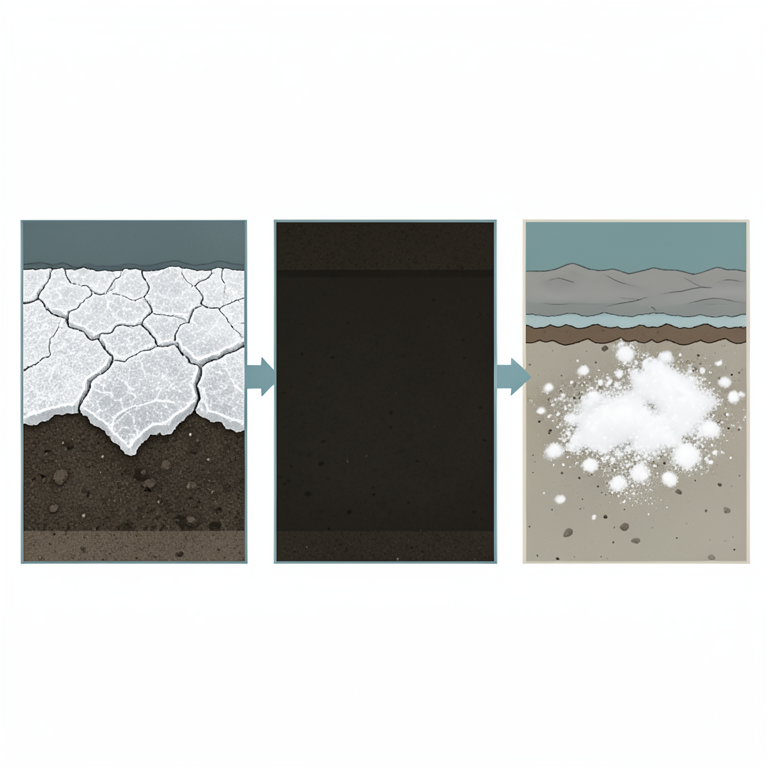
Salinity Response Curve
AI-generated conceptual illustration (salt-affected soil profile). It explains the idea and does not show study data.
View source evidence ↗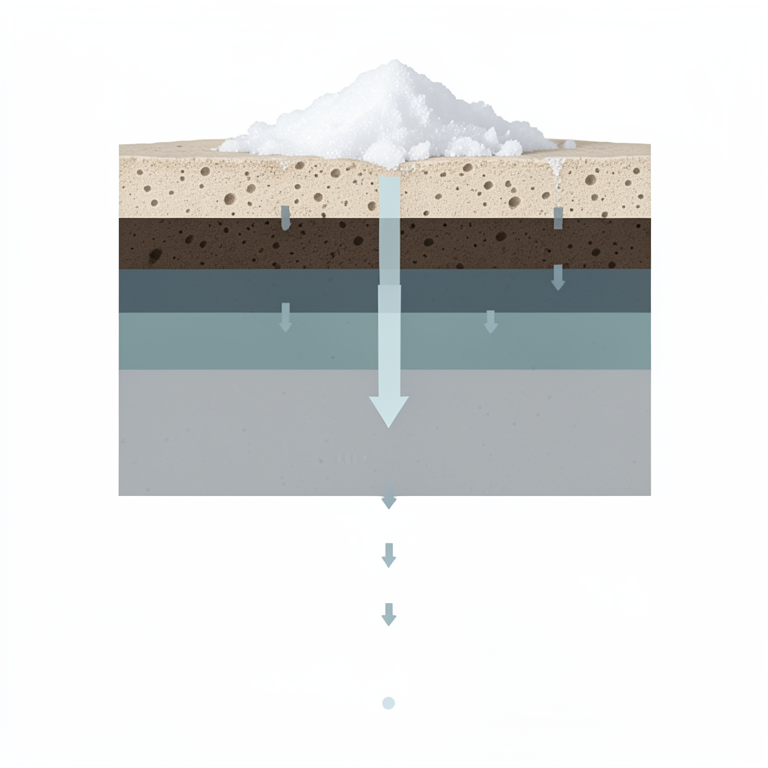
Depth-Dependent Efficiency
AI-generated conceptual illustration (salt-affected soil profile). It explains the idea and does not show study data.
View source evidence ↗Figures & tables
From the original paper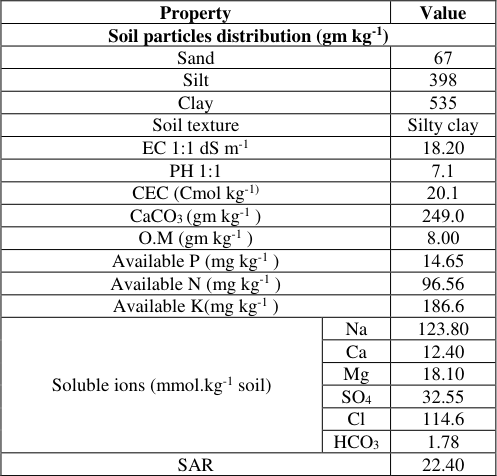 Table 1
 Table 2
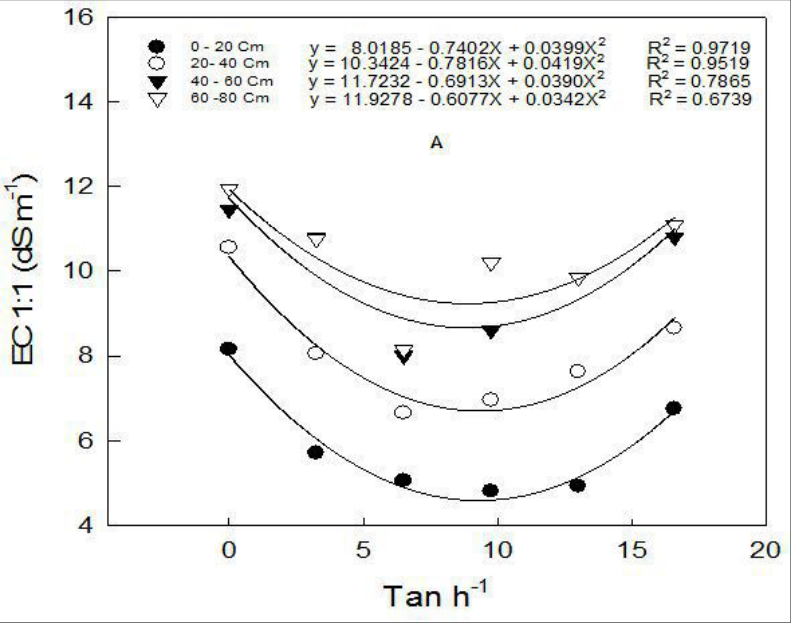 Figure 1
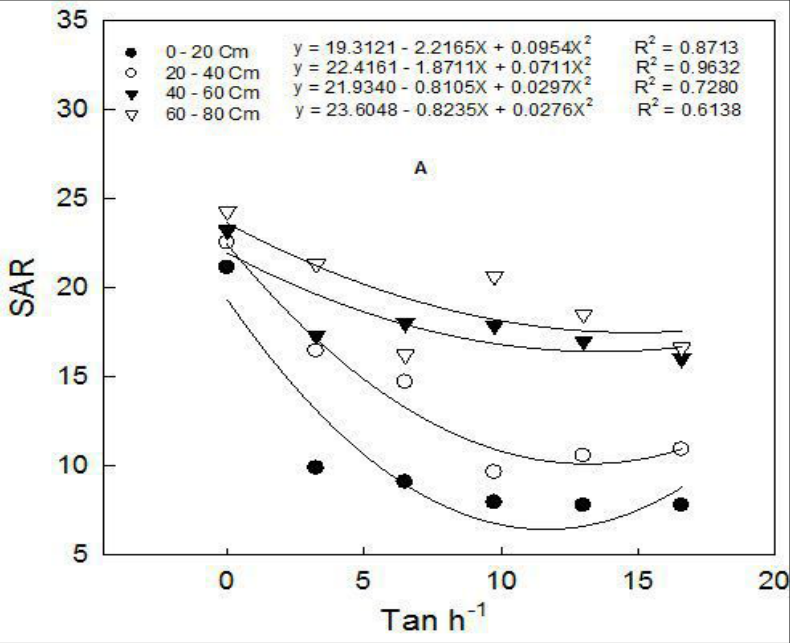 Figure 2
Introduction
Phosphogypsum (PG) is a waste by product from the processing of phosphate rock by the (Wet Acid Method) of fertilizer production (Renterıa-Villalobos, et al., 2010) [10] . At the global level, the annual production of PG is about 300 Mt (Silva et al., 2022) [24] . Only 15% of world PG production is recycled as building materials, agricultural fertilizers or soils stabilization amendments and asset controller in the manufactures of Portland cement (Mesic et al., 2016; Saadaoui, et al., 2017; Calderón-Morales et al., 2021) [12,22] . The remaining 85% is disposed of without any treatment. PG is composed mainly of gypsum (CaSO4•2H2O) it contains elevated levels of impurities, which originate primarily from the source phosphate rock used in the phosphate fertilizer production. There is great interest in using PG as an alternative material for many applications. PG has been used in the cement industry to make gypsum plaster. PG also has been used as agricultural fertilizers or an amendment for the reclamation of degraded soils: saline, sodic, acidic, and alkaline soils (Nayak et al., 2011; Mesic et al., 2016 Saadaoui, et al., 2017) [12,21] . There have been numerous attempts in recent decades by researchers about the possibility of using Phosphogypsum for agricultural purposes and mainly focused their researches in the field for reclamation of sodic soils and saline sodic soils, mostly achieved remarkable success in this area (Shainberg, et al., 1989; Al-Ghrairi et al., 2004; Razaq et al., 2006 and 2016; Agar, 2011; Al-Ghrairi et al., 2021; Hasana et al., 2022) [23, 5, 16-17, 1, 3, 28] . The researches shows that have been applied in this matter, that the use of Phosphogypsum has improved many of the physical and chemical properties related to replacing the calcium ion with the sodium ion in the exchange complexes, and thus enhance the structure of these soils and the subsequent improvement of water and air movement in the soil (Razaq et al., 2006; Yaduvanshi, and Swarup. 2005; Ghafoor, et al., 2001; Gharaibeh et al., 2014; Outbakat et al., 2022) [16,25,8,9,14] . The objective of this study was to evaluate the impact of different Phosphogypsum rates on soil salinity level and Sodium adsorption ratio (SAR) of different depths of salt-affected soil.
Materials and Methods
A field experiment was carried out at Al-Tuwaitha Research Station /Agricultural Research Directorate 30Km southeast of Baghdad, at salt affected soils. The field was divided into four blocks (replications) each block contains 6 experimental units with dimensions of 2 × 3 meter. The soil texture was silty clay, classified as a Typic Torrifluvent (Soil Survey Staff, 2006). Soil samples were taken from the depths of 0-20, 20-40, 40-60 and 60-80 cm, air dried, sieved through a 2.0 mm mesh, analyzed according to the standard methods described in Richards (1954) [20] and Page et al. (1982) [15] as shown in Table 1. The experiment was laid out using Randomized complete block design (R.C.B.D.) with three replications, the experimental unit area 6m 2 , the number of experimental units reached to 6in each block, 1.5m separators was left between the blocks. Treatments consisted of six rates of Phosphogypsum (0, 25%, 50%, 75%, 100% and 125%) from gypsum requirements according to Richards (1954) [20] which equivalent to 3.250, 6.500, 9.750, 13.000 and 16.580 (t ha -1 ) respectively were added in1/7/2017. Saline ground water with EC of 3.5 dSm -1 and SAR of 12.1 was used in irrigation of the experiment by a series of plastic tubes and a special pump. Its properties are shown in Table 2. Barley crop, Samir variety were sown during the two growing seasons 2017-2018 and 2018-2019 with a rate of 160 kg. ha -1 . Recommended fertilization was added with nitrogen and phosphorous in the amount of 200 kg N. ha -1 and 80 kg P. ha -1 for all treatments. Phosphorous was added at sowing as triple super phosphate, while nitrogen fertilizer was added after sowing as a urea in three parts, 30% tailoring stage, 35% at booting stage, 35% at flowering. Stage of Barley growth. Barley plants was harvested when it reached physiological maturity stage; dry matter and grains yield were recorded.
| EC dS.m-1 | pH | Soluble ions (mmol.L-1) | — | — | — | — | — | — |
|---|---|---|---|---|---|---|---|---|
| Na+ | Ca+2 | Mg+2 | Cl-1 | SO4-2 | HCO-3 | SAR | ||
| 3.25 | 7.30 | 24.00 | 0.44 | 3.00 | 12.84 | 9.17 | 5.80 | 12.10 |
Table text extracted from the original PDF; superscript letters are shown inline. The original table image is below.
View original table image
| Property | — | Value |
|---|---|---|
| Soil particles distribution (gm kg-1) | ||
| Sand | 76 | |
| Silt | 893 | |
| Clay | 585 | |
| Soil texture | Silty clay | |
| EC 1:1 dS m-1 | 18.20 | |
| PH 1:1 | 6.7 | |
| CEC (Cmol kg-1) | 1..7 | |
| CaCO3 (gm kg-1 ) | 1.9.. | |
| O.M (gm kg-1 ) | 3... | |
| Available P (mg kg-1 ) | 14.65 | |
| Available N (mg kg-1 ) | 96.56 | |
| Available K(mg kg-1 ) | 186.6 | |
| Soluble ions (mmol.kg-1 soil) | Na | 123.80 |
| Ca | 12.40 | |
| Mg | 18.10 | |
| SO4 | 32.55 | |
| Cl | 114.6 | |
| HCO3 | 1.78 | |
| SAR | 22.40 |
Table text extracted from the original PDF; superscript letters are shown inline. The original table image is below.
View original table image
Results and Discussions 3.1. Characteristics of soil and water
Table 1 shows some of the physical and chemical properties of the soil used in this study. Soil salinity of surface layer as measured by 1:1 soil: solution ratio extract is 18.20 dS. m -1, pH is < 7.5 and SAR is more than 15. So, this soil is classified as a saline alkali soil according to (Richards, 1954 and FAO.1990) [19,7] . Ground well water used in irrigation (Table 2) is relatively of high salt content expressed in terms of electrical conductivity with EC 3.25dS m -1 , SAR is 12.10, pH is 7.30 and, CaCO3 content is 249 gm.kg -1 . Therefore, the ground water of this land used for irrigation is classified as saline water of class S2 according to Soil Salinity Laboratory Staff classification of irrigation (Richards, 1954) [20] . So, high sodium content in the soil and ground well water coupled with heavy textured soil will lead to sever soil dispersion upon cropping (Shainberg et al., 1992) [25] . Therefore, using of chemical amendments for such kind of calcareous soil is inevitable (Al-Ghrairi, 1998; Richards, 1954) [4,20] . This may support the current investigation of application of PG or elemental sulfur as chemical amendments to prevent the accumulation of sodium salts in the soil profile and its resalinization over time.
Soil Salinity (EC) at the soil depths
Figure (1) Shows values of soil salinity (dS m -1 ) it was symmetrical in terms of direction at all depths. Phosphogypsum treatments showed that the highest value of salinity at control treatment (0PG) for all the soil depths and then decreases with increasing amounts of Phosphogypsum added to some extent added level 75% from the gypsum requirements then salinity increases at higher levels (100% and 125% from the gypsum requirements) to all the depths of the soil under study and this may be attributed to the increase release calcium and sodium in the soil solution and thus increase the electrical conductivity) Zahid et al., (2006) [27] . These results also confirm that the EC of soil at any level of PG added increases with soil depth and possible be due to soil permeability decreases with soil depths, or the transmission of ions decreases with increasing depth of soil and this is agree with Khan et al. (2010) [11] and Hurtado et al. (2011) [10] . Mathematical analysis refers to these results that the best formula to describe them mathematically is a quadratic equation Curve linear as follows: Y=8.01 -0.7402X + 0.0399X 2 , R 2 =0.971 ,at depth 0-20 cm. Y=10.34 -0.7816X + 0.0419X 2 , R 2 =0.951 at depth 20-40 cm. Y=11.71 -0.6913X + 0.0390X 2 , R 2 =0.7865 at depth 40-60 cm. Y=11.92 -0.6077X + 0.0342X 2 R 2 =0.6739 at depth 60-80 cm. Y= PG amount (T.ha -1 ), X: Soli salinity And it is clearly that the electrical conductivity of the control treatment at depth 0-20 cm was 8.15 dS m -1 decreases at a rate 0.7402, with increase of level of Phosphogypsum up to the level of 75% from the gypsum requirements, but it is increasing at a rate 0.035 multiplied by the square of quantity added extras that exceed 9.750 Tan. ha -1 Phosphogypsum, while the electrical conductivity at depth of 60-80 cm 11.92 dS m -1 for the control treatment, reduce to 10.2 when increasing the Phosphogypsum up to the level of 75% from the gypsum requirements and increasing at a rate 0.03 to the square of the amount of Phosphogypsum added, and when comparing values electrical conductivity at the level 75% shows that the depth of 60-80 cm were up 12.0 dS m -1 while it 6.0 dS m -1 at depth 0-20 cm, an increase of 50% more than it is at depth 60-80 cm.
Sodium Adsorption Ratio (SAR) at the soil depths
Sodium adsorption ratio (SAR) is one of the important criteria in the evaluation of soil salinity only but also by irrigation water too. Results shown in Figure 2 the amount effect of Phosphogypsum on the SAR value for soil depths 0-20, 20-40, 40-60 and 60-80 cm, it has been observed at the depth 0-20 cm which represents the surface layer of the soil a decrease of SAR for all levels addition of Phosphogypsum and this may be attributed to the role of Phosphogypsum in increasing calcium concentration in the soil, which inevitably leads to a decrease SAR in soil (Ager, 2011) [1] . Also, the decrease at a depth of 20-40 cm is similar to what it is at a depth of 0-20 cm and is close to it. As for the other two depths of 40-60 and 60-80 cm, the decrease in the soil SAR value less than it in the up depths for all levels of Phosphogypsum added, and this agrees with (Sancho et al. 2009 and Al-Ghrairi et al., 2019) [2] . The results of the mathematical analysis of the relationship of the amount of phosphate gypsum used with the soil SAR values showed that the equation is of the Curve linear type and of the second order that describes these results according to the depths shown next to each of them, as follows:
At depth 0-20 cm: Y=19.31-2.216X + 0.0954X 2 R 2 =0.8713.
And at depth 20-40 cm, Y=22.41-1.871X + 0.0711X 2 R 2 =0.9632. Whereas, adding Phosphogypsum at the level of 100% and 125% of the gypsum requirements did not lead to a reduction in the rate of sodium adsorption into the soil at the two depths above (0-20 and 20-40 cm) compared to the addition level of 75% of the gypsum requirements. While the following two equations are described the depths 40-60 and 60-80. At depth 40-60 cm, Y=21.93 -0.8105X + 0.0297X 2 R 2 =0.6138, and Y=23.60 -0.8235X + 0.0276X 2 R 2 =0.7780 at depth 60-80 cm. Y= PG amount (T.ha -1 ), X: SAR It is noted here that the increase achieved in soil SAR at these two depths is a slight increase, close to that increase at the same depths at the addition levels of 25%, 50%, and 75% of the PG, which can be described as a clear linear response. These results also show the role of adding PG in reducing sodium content as express in term soil SAR for the various soil depths under study compared to the control treatment (without adding PG). The results of the mathematical analysis also showed that the rate of displacement decreases with depth, as it was highest at 2.216 at the depth of 0-20 cm and decreased to 0.823 at the depth of 60-80 cm. This confirms that the greatest efficiency of Phosphogypsum was in the addition depth (0-20) cm and for this the result is an important field application in that Phosphogypsum must be mixed with the depth of the soil to be reclaimed. [27,9,5,16,10] about the role of Phosphogypsum in the redistribution of salts in the soil. The results of mathematical analysis also showed displacement rate decreases with depth, where was higher (0.982) at 0-20 cm depth and decreased to 0.041 at 60-80 cm depth, and this confirms that the greatest efficiency of Phosphogypsum added was in depth (0-20 cm), and to this result important of applications fields in terms of the necessity of mixing Phosphogypsum with the soil.
Conclusion
1. Based on the results of this study, when adding any chemical amendments such as Phosphogypsum it is must be mixed with the depth of the soil to be reclaimed, because this is more effective in reducing the salts level and improving the properties of reclaimed soils.
2. It is necessary to monitor the residual effect of PG for more than one season in subsequent studies to determine the optimal time for repeating the application according to the conditions of the reclaimed soil and the condition of the cultivated plants.
Figures and tables from the paper
References
24 in the original paper- Agar AI. Reclamation of Saline and Sodic soil by using divided doses of phosphogypsum in cultivation condition. African Journal of Agriculture Research. 2011;6(18):4243-4252.
- Al-Ghrairi Fok, Dwenee SJH, Al-Temimi AFH, Razzaq IB, Al-Ghrairi SM. Residual effect of Phosphogypsum on sodium distribution in profile of salt-affected soil. Iraqi Journal of Agriculture Research. 2019;24(1):6069.
- Al-Ghrairi FOK, Al-Temimi AFH, Alsaadie NA, AlGhrairi SM. The residual effect of Phosphogypsum on Ca and K:Na ratio in barley plant grown in salt-affected soil. Europe Academic Research. 2021;8(10):64666473.
- Al-Ghrairi SM, Razaq IB, Mugeir HM, Mohammed RS. Effect of chemical treatments of saline groundwater on plant growth in saline sodic soil. Iraqi Journal of Agriculture. 2004;9(3):50-58.
- Calderón-Morales BRS, García-Martínez A, Pineda P, García-Tenório R. Valorization of Phosphogypsum in cement-based materials: Limits and potential in ecoefficient construction. Journal of Building Engineering. 2021;44:102506.
- Ghafoor A, Gill M, Hassan A, Murtaza G, Qadir M. Gypsum: An economical amendment for the amelioration of saline-sodic waters and soils and for improving crop yields. International Journal of Agriculture and Biology. 2001;3(3):266-275.
- Gharaibeh MA, Rusan MJ, Eltaif NI, Shunnar OF. Reclamation of highly calcareous saline-sodic soil International Journal of Agriculture and Nutrition https://www.agriculturejournal.net using low-quality water and Phosphogypsum. Applied Water Science. 2014;4(3):223-230.
- Hurtado MD, Enamorado SM, Andreu L, Delgado A, Maria J. Drain flow and related salt losses as affected by Phosphogypsum amendment in reclaimed marsh soils from SW Spain. Geoderma. 2011;161(1-2):43-49.
- Khan MJ, Jan MT, Khan AU, Arif M, Shaf M. Management of Saline Sodic Soils Through Cultural Practices and Gypsum. Pak. J Bot. 2010;42(6):443-453.
- Mesic M, Brezinˇscak L, Zgorelec ˇ Z, et al. Application of Phosphogypsum in agriculture. Agriculturae Conspectus Scientificus. 2016;81:7-13.
- Nayak S, Mishra CSK, Guru BC, Rath M. Effect of Phosphogypsum amendment on soil physico-chemical properties, microbial load and enzyme activities. Journal of Environmental Biology. 2011;32:613-617.
- Outbakat MB, El Mejahed K, El Gharous M, El Omari K, Beniaich A. Effect of Phosphogypsum on soil physical properties in moroccan salt-affected soils. Sustainability. 2022;14:13087.
- Razaq IB, Al-Ghrairi SM, Mughier HM, Al-Obaidi HS. Role of Phosphogypsum in reducing the level of sodium content and improve cropping of salt-affected soils using saline groundwater. The Iraqi J of Soil Science. 2006;6(1):63-68.
- Razaq IB, Al-Ghrairi SM, Khudhair SA, Al-Obaidi HS, Ali AA. Role of Sesbania in Increasing Reclamation Efficiency of Chemically Amended Calcareous Soil. Eur. Acad. Research. 2016;4(9):7398-7408.
- Renter´ıa-Villalobos M, Vioque I, Mantero J, Manj´on G. Radiological, chemical and morphological characterizations of phosphate rock and Phosphogypsum from phosphoric acid factories in SW Spain. Journal of Hazardous Materials. 2010;181(1-3):193203.
- Alansary Refat Elkhouly, Husen Elbashir Shafsha, Shaily Halab. Studies on hydro chemical characters of ground water in Sabratha region. Int. J Hortic Food Sci. 2021;3(1):51-59.
- Sancho IM, Espejo R, Peregring F. Potentially Toxic Effects of Phosphogypsum on Palexerults in western Spain. SSSA J 2009;73(1):1214-1222.
- Saadaoui E, Ghazel N, Ben Romdhane C, Massoudi N. Phosphogypsum: potential uses and problems: A review. International Journal of Environmental Studies. 2017;74(4):558-567.
- Shainberg I, Keyen R, Frenkel H. Response of soils to gypsum and calcium chloride application. Soil Sci. Soc. Am. J 1989;46:113-117.
- Silva LFO, Oliveira MLS, Crissien TJ, Santosh M, Bolivar J, Shao L, et al. A review on the environmental impact of Phosphogypsum and potential health impacts through the release of nanoparticles. Chemosphere. 2022;286:131513.
- Shainberg I, Levy GI, Rengasamy P, Fernkel H. Aggregate stability and seal formation as affected by drops impact energy and soil amendments. Soil Sci. 1992;154:113-119.
- Yaduvanshi NPS, Swarup A. Effect of continuous use of sodic irrigation water with and without gypsum, farmyard manure, press mud and fertilizer on soil properties and yields of rice and wheat in a long term experiment. Nutrient Cycling in Agro Ecosystems. 2005;73:111-118.
- Zahid L, Niazi MFK. Role of ristech material in the reclamation of saline-sodic soils. Pakistan Journal of Water Resources. 2006;10:43-49.
- Hasana U, Swain SK, George B. A bibliometric analysis of ecotourism: A safeguard strategy in protected areas. Regional Sustainability. 2022 Mar 1;3(1):27-40.
Cited by 1
From OpenAlex, OpenCitations and reference lists read by Scinovex
- Effect of phosphogypsum application rates and methods on the performance of sorghum ( Sorghum L.) and selected chemical properties of saline–sodic soil ↗
Hagerenesh Sankura Sankura Shaga, Sheleme Beyene, Kibebew Kibret · Environmental Research Communications · 2026
Abstract Phosphogypsum (PG) can recoup saline–sodic soil problems, however, its effectiveness in the central rift valley (CRV) of Ethiopia remains understudied. A two-season field experiment was conducted in Metehara to evaluate PG rates and methods of application on the performance of sorghum on saline–sodic soil in CRV. A split plot design with four replications was employed. Two application methods (band…
❝ 1PDF