
Research article · 2025 · Full text
International Journal of Agriculture and NutritionEffect of soil fertility on growth and yield attributes of different millets in the agro-ecological unit of Kuttanad (AEU-4) in Kottayam district, Kerala
Volume 7(2) · Pages 01–04 · DOI: 10.33545/26646064.2025.v7.i1a.203 ↗
Research areasAgricultural Economics and PracticesAgricultural Science and FertilizationRice Cultivation and Yield Improvement
Abstract
Author-writtenA field experiment was conducted to investigate the effect of soil fertility on the growth and yield of millets in Vechoor and Aymanam Panchayats in Kuttanad (AEU -4) in Kottayam district. The experiment was conducted with six millet crops, including three major millets, namely Sorghum (CSH 14), Pearl millet (CO 10), and finger millet (KMR301) and three minor millets, namely foxtail millet (DHFT-109-3), little millet (OLM 203) and barnyard millet (CO 2), in two types of soil i.e., one land filled with laterite soil in Vechoor and the other the alluvial soil of Aymanam. Each crop was replicated thrice in two soil types. There was drastic variation in soil fertility status of the two locations. The alluvial soil had an organic carbon content of 4.8% compared to 0.3% of the laterite soil. Similarly, the available phosphorus and potassium content also varied, being sufficient in alluvial soil, whereas both were deficient in laterite soil of Vechoor. The soil fertility had significant influence on plant height of all the millet crops. The crops grown in the fertile alluvial soil of Aymanam were superior in plant height compared to those grown in laterite soil of Vechoor. The test weight of grains was significantly influenced by soil fertility in the case of Sorghum, Pearl millet, and Foxtail millet. Pearl millet recorded its potential test weight in both soil types (7.71 g and 6.37 g in alluvial and laterite soils, respectively). The effect of soil fertility on grain yield was significant on all the millet crops, with alluvial soils recording higher yields. Pearl millet recorded higher grain yield in both the soils. The higher test weight and grain yield of pearl millet could be attributed to the potential yield of the crop.
Summary
Source-checkedPlain-language reading of the full paper, prepared with AI and checked against the text. Each point links to the authors' own words.
Why it matters
- Millets are considered climate-resilient crops due to their ability to tolerate high temperatures, short life cycles, and low water requirements. View evidence ↗
- The Kuttanad (AEU-4) region in Kerala is a unique agro-ecological unit characterized by waterlogged land surrounding Lake Vembanad. View evidence ↗
- While millets were historically grown in the Vaikom region of North Kuttanad, they are no longer part of the local homestead farming system. View evidence ↗
The question
- The study aimed to investigate the potential for reviving millet cultivation in the Kuttanad region using improved crop varieties across two different locations. View evidence ↗
What they did
- The experiment tested six millet varieties (three major: Sorghum, Pearl, and Finger; three minor: Foxtail, Little, and Barnyard) in two soil types: laterite soil in Vechoor and alluvial soil in Aymanam. View evidence ↗
- Each crop was replicated three times per soil type and received 5 t ha-1 of farm yard manure and fertilizers at a rate of 45:25:25 kg ha-1 (urea, rock phosphate, and muriate of potash). View evidence ↗
- The researchers measured growth attributes (plant height and tiller number) and yield attributes (1000-grain weight and total grain yield). View evidence ↗
What they found
- The alluvial soil in Aymanam was significantly more fertile than the laterite soil in Vechoor, with an organic carbon content of 4.8% compared to 0.3%. View evidence ↗
- All millet crops grew taller in alluvial soil, with Sorghum showing the most dramatic difference, increasing by more than 200% compared to those in laterite soil. View evidence ↗
- Pearl millet produced the highest grain yield, reaching 1350 kg ha-1 in alluvial soil (exceeding national productivity) and 1137 kg ha-1 in laterite soil (below national productivity). View evidence ↗
- The lowest grain yields were recorded in laterite soil, specifically for little millet (180.83 kg ha-1) and barnyard millet (226.66 kg ha-1). View evidence ↗
What it means
- The authors concluded that soil fertility is the primary factor determining the growth and yield of millet crops in this region. View evidence ↗
- The authors recommend that millets can be successfully grown in laterite soils if integrated nutrient management, combining organic, green, and biofertilizers with chemical fertilizers, is used. View evidence ↗
Visual summary
3 visualsIllustrations explain the paper; charts are replotted from the paper's own table values.
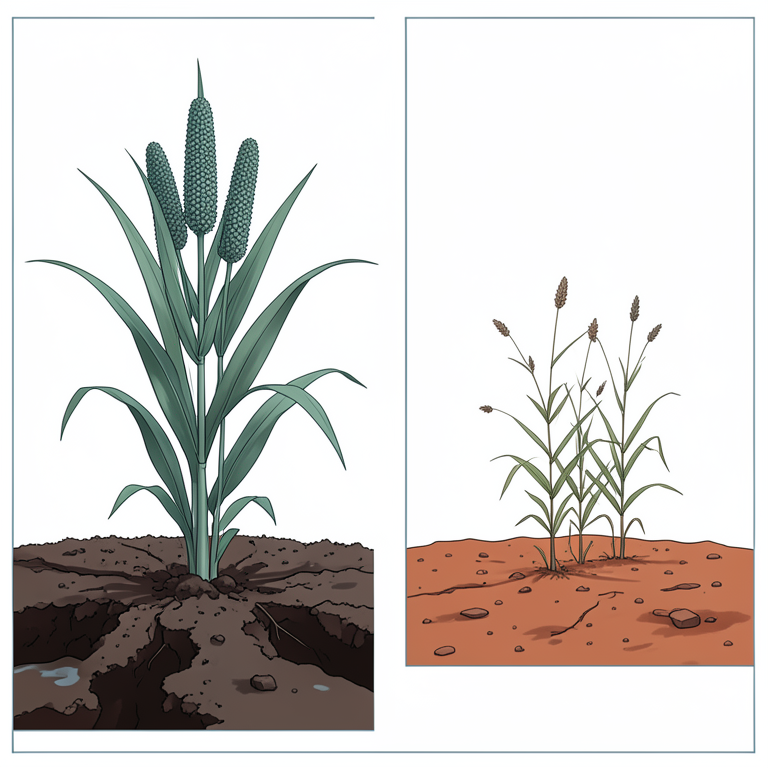
Soil Fertility Comparison
AI-generated conceptual illustration (Pearl millet plants in alluvial and laterite soils). It explains the idea and does not show study data.
View source evidence ↗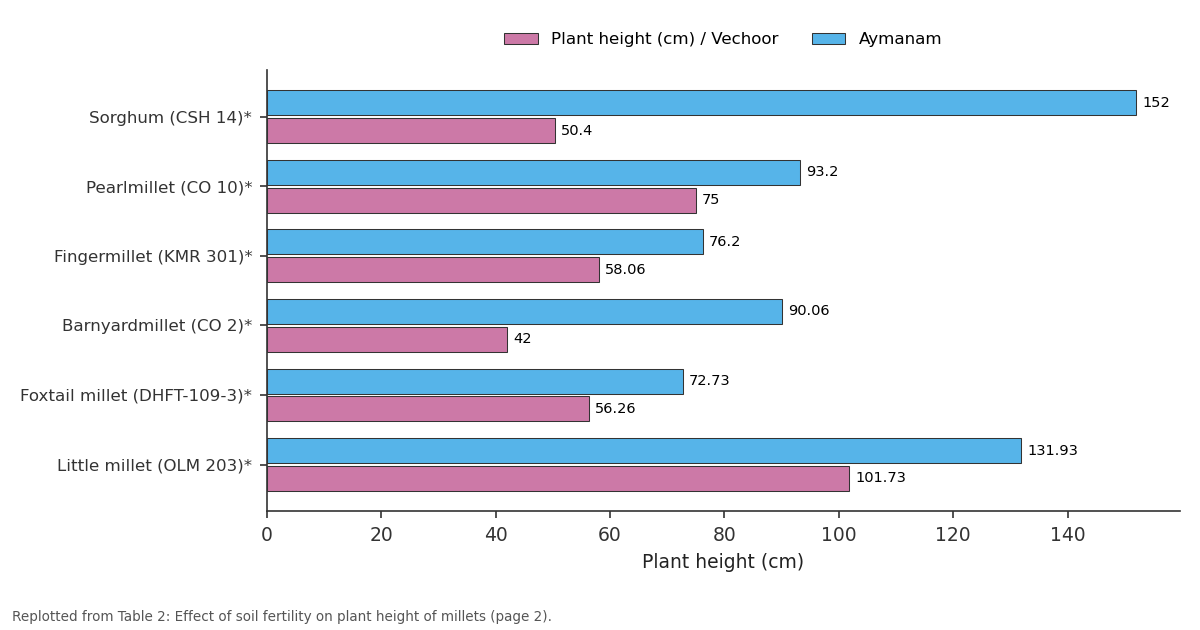
Plant height (cm) / Vechoor and Aymanam: Sorghum (CSH 14)* vs Pearlmillet (CO 10)* vs Fingermillet (KMR 301)* vs Barnyardmillet (CO 2)* vs Foxtail millet...
Replotted from Table 2 (page 2) of the original paper. Every bar is the paper's own table value.
View source evidence ↗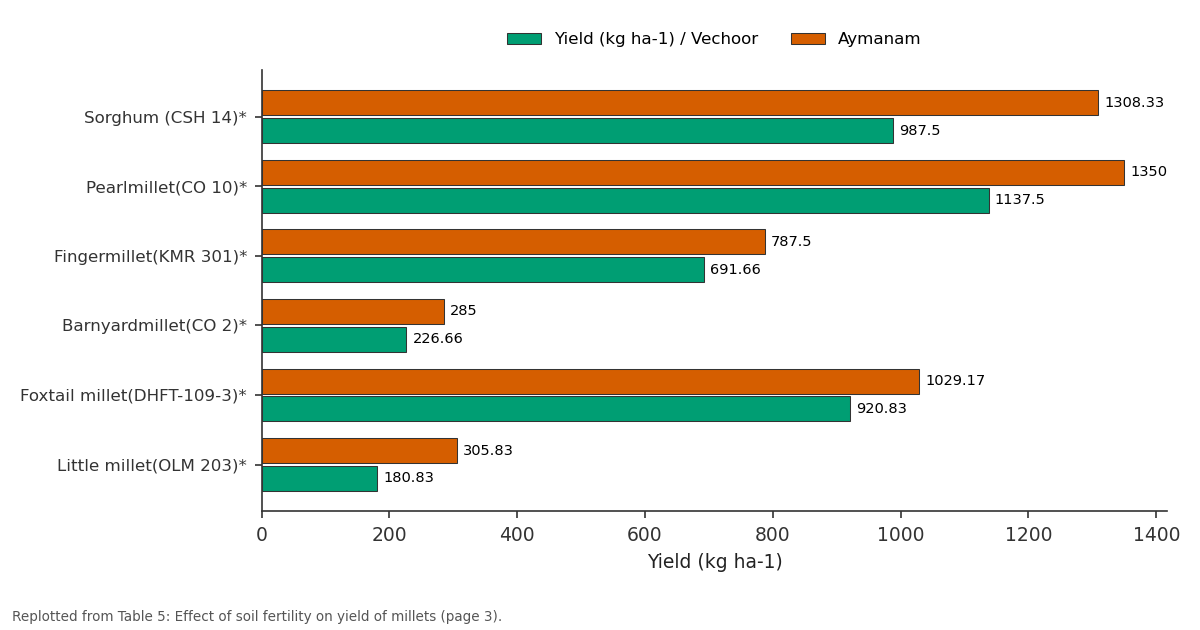
Yield (kg ha-1) / Vechoor and Aymanam: Sorghum (CSH 14)* vs Pearlmillet(CO 10)* vs Fingermillet(KMR 301)* vs Barnyardmillet(CO 2)* vs Foxtail...
Replotted from Table 5 (page 3) of the original paper. Every bar is the paper's own table value.
View source evidence ↗Figures & tables
From the original paper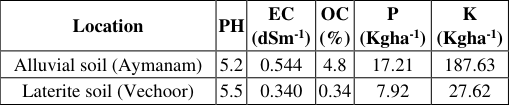 Table 1
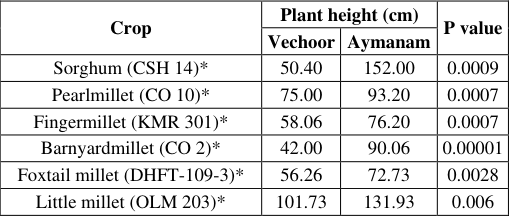 Table 2
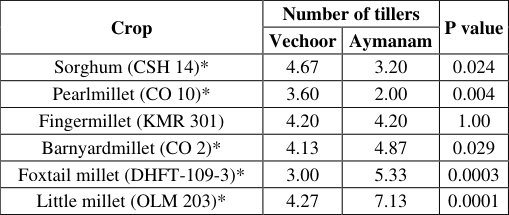 Table 3
 Table 6
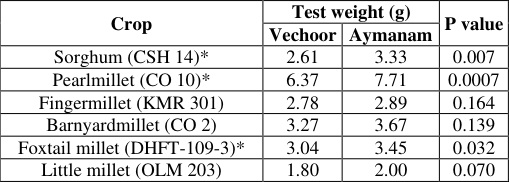 Table 4
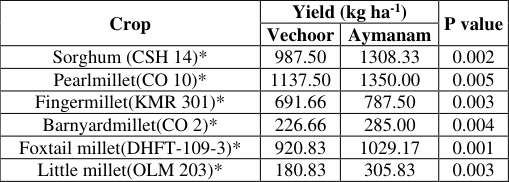 Table 5
Introduction
Millets are age old staple grains now being considered as superfood because of their high nutritional value. Named as Nutri cereals, millets are gaining importance in the diet of people again with the United Nations declaring 2023 as the International Year of Millets. The climate change has taken its toll in the cultivation of many crops causing damages due to rising temperature, prolonged drought and shortage of water for irrigation in many places. The climate resilient nature of millets is an added advantage because of their low water requirement and short life cycle and tolerance to high temperature. Millets are seen as a way to improve food security and reduce poverty in regions with limited resources. Millets are also being promoted as a way to address the issue of climate change, as they are a low-input crop that can be grown using sustainable farming practices (Tripathi and Vyas 2023) [14] . Millets are dependable food crops for the resource-poor farmers of dryland regions with uncertain rainfall, short length of the growing period, limited soil moisture, and poor soil fertility, as they are climate-resilient crops (Sukanya et al., 2022) [13] . Millets are genetically tolerant to abiotic stress challenges such as drought, high temperatures, cold, low soil fertility, and salinity (Sood et al., 2019) [12] . Preferring to be grown in full-sun, millet performs well on high-elevation plateaus and in various soil types (Baltensperger, 1996) [1] . Millets would play a greater role in future agriculture due to challenges posed by climate change, limited water supply, and reduced agro-biodiversity (Yadav et al., 2024) [15] . Millets have been cultivated in South India for thousands of years. Studies show that millets were consumed as a staple food in as far back as 2800-1500 BC (Tripathi and Vyas, 2023) [14] . Millets have been a major occupant in the diet of the tribal communities in Kerala, particularly in the highlands of Attappady (Martin (2023) [10] and Athira (2022)) [9] . The green revolution introduced highyielding varieties of rice and wheat that has sidelined the millets in many parts of India. Cultivation of millets is no longer a priority of Indian farmers, as the area under millets in India have witnessed a significant decline during past 4-5 decades (GoI, 2018) [6] . The year 2023, celebrated as The International Year of Millets, has seen a rejuvenation of millet cultivation which is expanding in Kerala, with districts like Alappuzha and Idukki adopting millet farming in more area. Kuttanad (AEU-4) is a special agro-ecological unit in Kerala representing the waterlogged land mass surrounding the mighty salt water lake Vembanad spreading across Alapuzha, Kottayam and Pathanamthitta districts. The region is characterized with tropical humid monsoon type (mean annual temperature 27.6 °C; rainfall 2,746.1 mm) climate and highly acidic soil (GoK, 2019) [7] . Farmers used to cultivate millets such as ragi and little millets till the beginning of 21 st century in their homesteads in and near Vaikom region of North Kuttanad in Kottayam dt. However, now the millets are no longer a part of their homestead farming system. However, the millets are gaining importance in the diet of people in the region like many other regions in Kerala. Therefore, with the objective of reviving the scope of cultivating millets in the region, a study was carried out with improved varieties of different millet crops in two locations of Kuttanad in Kottayam district.
Materials and Methods
A field experiment was conducted in farmers' fields in Vechoor and Aymanam Panchayats located at 9° 41'14.1" N and 76° 25'26.3" E and 9° 36'28.9" N 76° 28'35.6" E respectively, of Kottayam district during the summer season from December 2022 to March 2023. The average maximum and the minimum temperature during the cropping period were 32.83 °C and 20.87 °C, respectively. The total rainfall, 104 mm was received during the cropping season. The relative humidity ranged from 46.14 to 100 percent. The average bright sunshine hours were 7.5 hours day -1 during the cropping period. The experiment was conducted with six millet crops with three major millets namely Sorghum (CSH 14) (Sorghum bicolor), pearl millet (Co 10) (Pennisetum glaucum), finger millet (KMR301) (Eleusine coracana) and three minor millets namely foxtail millet (DHFT-109-3) (Setaria italica), little millet (OLM 203) (Panicum sumatrense), barnyard millet (Co 2) (Echinochloa esculenta) in two types of soil i.e., one; land filled with laterite soil in Vechoor and the other; the alluvial soil of Aymanam. Each crop was replicated thrice in two soil types. The millet crops in both soil types were applied with manures farm yard manure @ 5 t ha -1 and fertilizers @ 45:25:25 kg ha -1 as urea, rock phosphate and muriate of potash. The millets were raised in beds of plot size 3x3 m each and the seeds were line sown at a row spacing of 45 cm. The growth attributes namely, plant height, number of tillers and yield attributes namely, 1000 grain weight and grain yield were recorded. Statistical analysis was carried out with two sample t test using GRAPES software of Kerala Agricultural University (Gopinath et al., 2020) [8] .
Results and Discussion
Data on soil chemical parameters before the experiment is shown in Table 1. There was a major variation in soil fertility status of the two locations. The alluvial soil had an organic carbon content of 4.8% compared to 0.3% of the laterite soil. Similarly, the P and K content also varied which were sufficient in alluvial soil whereas both were deficient in laterite soil of Vechoor. These results are indicating the superior quality of alluvial soil of Aymanam over the laterite soils of Vechoor. The growth attributes such as plant height and numbers of tillers are given in Table 2 and Table 3. The soil fertility had significant influence on both plant height and tiller number of all the millet crops. The crops grown in the alluvial soil of Aymanam were superior in plant height compared to those grown in laterite soil of Vechoor. The major difference in plant height was observed in Sorghum with a percentage increase of more than 200 in alluvial soil over the laterite. Similarly, the number of tillers were also significantly influenced by soil fertility. However, the Vechoor laterite soil recorded higher tiller number for Sorghum and Pearl millet. Barnyard millet, Foxtail millet and little millet recorded higher tiller number in Aymanam alluvial soil. Little millet recorded the highest tiller number (7.13) and Pearl millet the lowest (2.00). Finger millet had equal number of tillers in both the soil types. The percentage increase was the highest in little millet with around 70 percent higher in alluvial over laterite soil. Similarly, a significant effect on plant height and tillers production by soil fertility was also observed in pearl millet (Kumar et al, 2014) [11] . The yield attributes viz., test weight of 1000 grains and yield are shown in Table 4 and5. The test weight of crops were significantly influenced by soil fertility in case of Sorghum, Pearlmillet and Foxtail millet. Pearl millet recorded the highest test weight in both soil types (7.71 g and 6.37 g in alluvial and laterite soils, respectively). All the crops recorded higher values of test weight in alluvial soil with highest percentage increase of 27.58 over the laterite soil for Pearl millet. The effect of soil fertility on grain yield was significant on all the millet crops, with alluvial soils recording higher yields. Pearl millet recorded higher grain yield in both the soils. India is the largest producer of pearl millet having 6.93 m ha with production of 8.61 mt and with productivity of 1243 kg ha -1 during 2020 (GoI, 2020) [5] . The alluvial soils produced a higher grain yield of 1350 kg ha -1 by pearl millet which was above India's productivity whereas it was only 1137 kg ha -1 in laterite soils which is below the national productivity. The lower grain yield was recorded by little millet (180.83 kg ha -1 ) in laterite soil followed by barnyard millet (226.66 kg ha -1 ) again in laterite soil. The percentage increase in grain yield was highest for little millet with more than 69 percentage in alluvial soil over the laterite. In fact, the millets Sorghum, Pearl millet and foxtail millet have a higher yield potential compared to Finger millet, Barnyard millet and Little millet, which reflected in the experiment also. The grain yield of millet crops in the descending order is given below. Pearl millet>Sorghum>Foxtail millet>Finger millet>Barnyard millet>Little millet in Laterite soil and Pearl millet>Sorghum>Foxtail millet>Finger millet>Little millet>Barnyard millet in alluvial soil. Laterite soils are clayey, compact, and poorly drained, making them less suitable for farming without proper management. They are rich in iron, aluminium, and manganese, giving them reddish to brown hues. They are poor in essential nutrients like lime, nitrogen, and phosphorus, requiring fertilizers and soil amendments. The lateritic soil of Kerala has red colour, which has been attributed to the presence of hematite or anhydrous ferric oxides. They are not fertile due to low organic matter content as well as low essential plant nutrients. These soils are essentially kaolinitic in nature, acidic in reaction and friable. Laterite soil of red and lateritic zone of Eastern India is poor in inherent fertility status with low to medium available nutrients phosphorus, potassium and calcium (Brahmachari et al., 2018) [3] . Alluvial soils are formed by the deposition of sediments (alluvium) by rivers, winds, glaciers, and sea waves and are rich in humus and nutrients like potash but often lack phosphorus. Their fertility is further enhanced as they are renewed annually by river floods. Though grain sorghum can be grown on many different soils it will yield best in deep, fertile, well drained loamy soils. For Finger millet the best soil is alluvial, loamy and sandy soil with good drainage. The Foxtail millet also performs best in well-drained loamy soils (Chapke et al., 2020) [4] . Thus, the soil fertility status of each soil types clearly reflected in the growth and yield attributes of all the millet crops. The soil sample from the two locations collected after harvest was analysed for soil chemical properties (Table 7). There was reduction in soil pH and rise in soil EC after harvest. Also, there was a reduction in organic carbon content and the available nutrient status in both soils during the harvest of the crop. Integrated use of chemical fertilizers with organic manures has been found to be quite promising in maintaining high productivity and providing greater stability to crop production. In addition to supply of nutrients, organic manures may improve the soil health, physico-chemical properties and biological condition of the soil. The use of organic matter along with inorganic fertilizers may help to improve nutrient availability and crop quality in soils (Bharati and Thakare, 2022) [2] . Hence the millets may be grown in laterite soil after improving the soil fertility by following integrated nutrient management with organic manures, green manures and biofertilizers along with chemical fertilizers for obtaining their potential yield.
| Crop | Test weight (g) | — | P value |
|---|---|---|---|
| Vechoor | Aymanam | ||
| Sorghum (CSH 14)* | 2.61 | 3.33 | 0.007 |
| Pearlmillet (CO 10)* | 6.37 | 7.71 | 0.0007 |
| Fingermillet (KMR 301) | 2.78 | 2.89 | 0.164 |
| Barnyardmillet (CO 2) | 3.27 | 3.67 | 0.139 |
| Foxtail millet (DHFT-109-3)* | 3.04 | 3.45 | 0.032 |
| Little millet (OLM 203) | 1.80 | 2.00 | 0.070 |
Table text extracted from the original PDF; superscript letters are shown inline. The original table image is below.
View original table image
| Crop | Number of tillers | — | P value |
|---|---|---|---|
| Vechoor | Aymanam | ||
| Sorghum (CSH 14)* | 4.67 | 3.20 | 0.024 |
| Pearlmillet (CO 10)* | 3.60 | 2.00 | 0.004 |
| Fingermillet (KMR 301) | 4.20 | 4.20 | 1.00 |
| Barnyardmillet (CO 2)* | 4.13 | 4.87 | 0.029 |
| Foxtail millet (DHFT-109-3)* | 3.00 | 5.33 | 0.0003 |
| Little millet (OLM 203)* | 4.27 | 7.13 | 0.0001 |
Table text extracted from the original PDF; superscript letters are shown inline. The original table image is below.
View original table image
| Crop | Plant height (cm) | — | P value |
|---|---|---|---|
| Vechoor | Aymanam | ||
| Sorghum (CSH 14)* | 50.40 | 152.00 | 0.0009 |
| Pearlmillet (CO 10)* | 75.00 | 93.20 | 0.0007 |
| Fingermillet (KMR 301)* | 58.06 | 76.20 | 0.0007 |
| Barnyardmillet (CO 2)* | 42.00 | 90.06 | 0.00001 |
| Foxtail millet (DHFT-109-3)* | 56.26 | 72.73 | 0.0028 |
| Little millet (OLM 203)* | 101.73 | 131.93 | 0.006 |
Table text extracted from the original PDF; superscript letters are shown inline. The original table image is below.
View original table image
| Location | PH | EC (dSm-1) | OC (%) | P (Kgha-1) | K (Kgha-1) |
|---|---|---|---|---|---|
| Alluvial soil (Aymanam) | 5.2 | 0.544 | 4.8 | 17.21 | 187.63 |
| Laterite soil (Vechoor) | 5.5 | 0.340 | 0.34 | 7.92 | 27.62 |
Table text extracted from the original PDF; superscript letters are shown inline. The original table image is below.
View original table image
Conclusion
The soil fertility had significant effect on plant height of all the millet crops with taller plants noticed in fertile alluvial soil. Barnyard millet, Foxtail millet and little millet recorded higher tiller number in the fertile alluvial soil. The test weight of grains was significantly greater for Sorghum, Pearl millet, and Foxtail millet in fertile alluvial soil. The alluvial soils gave higher yields for all the millet crops compared to laterite soils. In general, the soil fertility was found to be the most important factor in determining the growth and yield of millet crops. However, the millets may be grown in laterite soil after improving the soil fertility by following integrated nutrient management with organic manures, green manures and biofertilizers along with chemical fertilizers for obtaining their potential yield.
Figures and tables from the paper
| Location | PH | EC (dSm-1) | OC (%) | P (Kgha-1) | K (Kgha-1) |
|---|---|---|---|---|---|
| Alluvial soil (Aymanam) | 5.0 | 0.968 | 4.2 | 10.52 | 165.22 |
| Laterite soil (Vechoor) | 5.2 | 0.440 | 0.23 | 6.76 | 20.57 |
Table text extracted from the original PDF; superscript letters are shown inline. The original table image is below.
View original table image
| Crop | Yield (kg ha-1) | — | P value |
|---|---|---|---|
| Vechoor | Aymanam | ||
| Sorghum (CSH 14)* | 987.50 | 1308.33 | 0.002 |
| Pearlmillet(CO 10)* | 1137.50 | 1350.00 | 0.005 |
| Fingermillet(KMR 301)* | 691.66 | 787.50 | 0.003 |
| Barnyardmillet(CO 2)* | 226.66 | 285.00 | 0.004 |
| Foxtail millet(DHFT-109-3)* | 920.83 | 1029.17 | 0.001 |
| Little millet(OLM 203)* | 180.83 | 305.83 | 0.003 |
Table text extracted from the original PDF; superscript letters are shown inline. The original table image is below.
View original table image
References
15 in the original paper- Baltensperger DD. Foxtail and Proso Millet. In: Janick J, editor. Progress in New Crops. Alexandria, VA, USA: ASHA Press; 1996. p. 182-190.
- Bharati NK, Thakare R. Soil properties, yield and quality of pearl millet influenced by integrated nutrient management on vertisol. Pharma Innov J. 2022;SP11(5):885-888.
- Brahmachari K, Sarkar S, Santra DK, Maitra S. Millet for food and nutritional security in drought prone and red laterite region of Eastern India. Int J Plant Soil Sci. 2018;26(6):1-7.
- Chapke RR, Shyam Prasad G, Das IK, Hariprasanna K, Singode A, Kanthi Sri BS, Tonapi VA. Latest millet production and processing technologies. Booklet, ICAR-Indian Institute of Millets Research, Hyderabad 500 030, India; 2020. p. 82.
- Govt. of India. Resources: Soil -Status of Environment related issues. Kerala ENVIS Centre, Ministry of Environment and Forests, Govt. of India, Directorate of Millets Development. Available from: http://millets.dacfw.nic.in; 2020.
- Govt. of India. Agricultural statistics at a glance. Directorate of Economics and Statistics; 2018.
- Govt. of Kerala. Kerala Soil Health Information System. Available from: https://www.keralasoilfertility.net/en/agroecology.jsp; 2019.
- Gopinath PP, Parsad R, Joseph B, Adarsh VS. GRAPES: General Rshiny Based Analysis Platform Empowered by Statistics. Available from: https://www.kaugrapes.com/home; version 1.0.0. DOI: 10.5281/zenodo.4923220; 2020.
- Athira M. Millet farming is on an expansion mode in Kerala. The Hindu; 2022. Available from: https://www.smartfood.org/project/millet-farming-ison-an-expansion-mode-in-kerala/.
- Martin M. Adivasis of Kerala's Attappadi hills revive millet cultivation to preserve a fading tradition. Available from: https://india.mongabay.com/2023/12/adivasis-ofkeralas-attappadi-hills-revive-millet-cultivation-topreserve-a-fading-tradition/; 2023.
- Kumar P, Kumar R, Singh SK, Kumar A. Effect of fertility on growth yield and yield attributes of pearl millet (Pennisetum glaucum) under rainfed condition. Agriways. 2014;2(2):89-93.
- Sood S, Joshi DC, Chandra AK, Kumar A. Phenomics and genomics of finger millet: Current status and future prospects. Planta. 2019;250:731-751. doi: 10.1007/s00425-019-03159-6.
- Sukanya TS, Prabhakar KT, Gowda K, Swarna R, Hariprasanna K, Tonapi VA. Good agronomic practices for higher yield in small millets. ICAR-All India Coordinated Research Project on Small Millets, ICARIndian Institute of Millets Research; 2022.
- Tripathi T, Vyas S. From ancient grains to modern solutions: A history of millets and their significance in agriculture and food security. Int J Home Sci. 2023;9(2):72-78.
- Yadav OP, Singh DV, Kumari V, Prasad M, Seni S, Singh RK, et al. Production and cultivation dynamics of millets in India. Crop Sci. 2024;1-26. doi: 10.1002/csc2.21207.
Cited by 1
From OpenAlex, OpenCitations and reference lists read by Scinovex
- Genomic Advances in Millets for Climate-Resilient Agriculture and Nutritional Security ↗
Ayushi Kukreti, Anita Choudhary, Vandana Jaiswal · Springer eBooks · 2026
❝ 0