
Research article · 2025 · Full text
International Journal of Agriculture and Food ScienceSocio personal impact of coconut producer society: An explorative study
Volume 7(2) · Pages 76–79 · DOI: 10.33545/2664844x.2025.v7.i2b.280 ↗
Research areasCoconut Research and ApplicationsInnovation and Socioeconomic Development
Abstract
Author-writtenCoconut Producer Organisations (CPO’s) are a farmer co-operative, formed through the lively institutional aid and monitoring by the Coconut Development Board. A study on assessing the socio personal impact of Coconut Producer Society was conducted in Thiruvananthapuram district of Kerala. Kilimanoor, Perumkadavila and Athiyannoor were the three blocks purposively selected for the study. A sample size of 130 respondents were selected primarily based on proportionate random sampling from each panchayat from the chosen blocks. The findings indicated that majority (58.46%) of the respondents had medium socio-personal impact. This is followed by 21.54 per cent with high and 20.00 per cent with low socio-personal impact. About 61.54 per cent of respondents had an increase in knowledge on harvest and post-harvest related aspect and 38.46 per cent of respondents had no change in knowledge on harvest and post-harvest related aspects. Slightly higher than three-fifths (61.54%) of the respondents acquired an improved skill in identifying appropriate planting material and this is followed by the skill in using coconut climber (56.15%), skill in fertilizer application (54.62%), skill on primary processing of coconut into value added products (52.31%), neera extraction skill (51.53%). Majority (90.77%) of the respondents had an increased contact with other CPS members and a meagre (9.23%) per cent of respondents opined that they had no change in their contact with other CPS members.
Summary
Source-checkedPlain-language reading of the full paper, prepared with AI and checked against the text. Each point links to the authors' own words.
Why it matters
- Coconut (Cocos nucifera) is a major cash crop that provides support to millions of farmers. View evidence ↗
- Coconut Producer Organisations (CPOs) are farmer cooperatives established with the support and monitoring of the Coconut Development Board. View evidence ↗
- Coconut Producer Societies (CPS) act as the fundamental unit of the Farmer Producer Organisation (FPO) framework to improve the social and monetary status of farmers. View evidence ↗
The question
- The study aimed to assess the impact of the Coconut Producer Society from the perspective of the respondents. View evidence ↗
What they did
- The research was conducted in the Thiruvananthapuram district, specifically within the purposively selected blocks of Kilimanoor, Perumkadavila, and Athiyannoor. View evidence ↗
- A total of 130 respondents were chosen using proportionate random sampling from panchayats within the selected blocks. View evidence ↗
- Data collection was performed using a pre-tested interview schedule. View evidence ↗
What they found
- The majority of CPS members (58.46%) experienced a medium level of socio-personal impact. View evidence ↗
- Regarding socio-personal impact, 21.54% of members reported a high impact, while 20.00% reported a low impact. View evidence ↗
- Knowledge regarding harvest and post-harvest aspects increased for 61.54% of respondents, while 38.46% saw no change. View evidence ↗
- Knowledge increased by 60.00% for both cultivation practices and coconut processing/value addition. View evidence ↗
- Over 61.54% of respondents improved their skill in identifying appropriate planting material. View evidence ↗
- Other skill improvements included using a coconut climber (56.15%), fertilizer application (54.62%), primary processing into value-added products (52.31%), and neera extraction (51.53%). View evidence ↗
- Most respondents saw no skill improvement in coconut climbing (94.62%), hybridization techniques (92.31%), or the use of implements (90.00%). View evidence ↗
- Contact with other CPS members increased for 90.77% of respondents, with only 9.23% reporting no change. View evidence ↗
- Exactly 50.00% of the respondents reported an increase in their contact with the Coconut Development Board. View evidence ↗
What it means
- The authors conclude that trainings and meetings organized by the Coconut Development Board for CPS members likely drove the observed medium to high levels of socio-personal impact. View evidence ↗
Visual summary
3 visualsIllustrations explain the paper; charts are replotted from the paper's own table values.
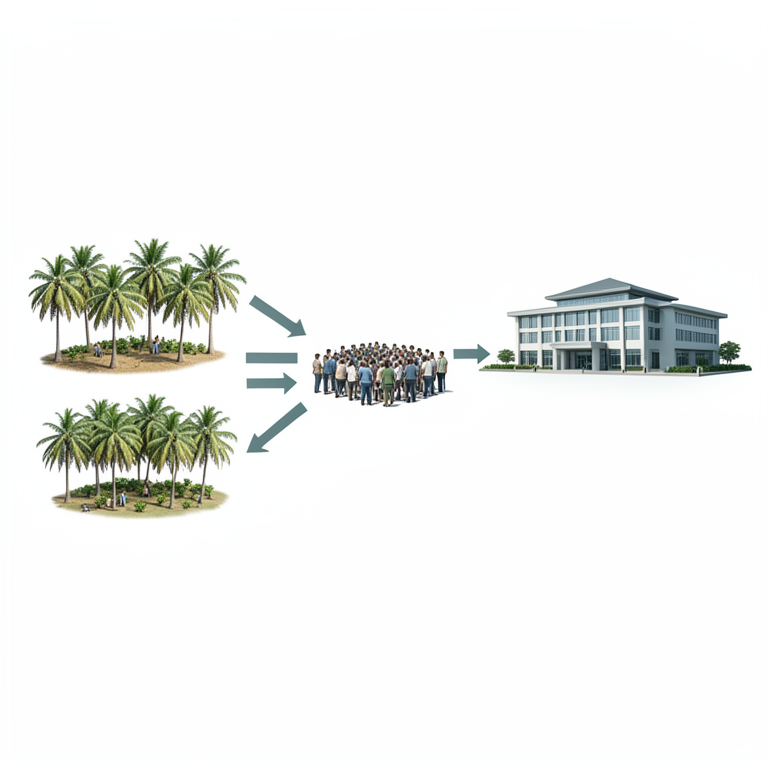
CPO Organizational Structure
AI-generated conceptual illustration (Coconut farmers and coconut palm trees). It explains the idea and does not show study data.
View source evidence ↗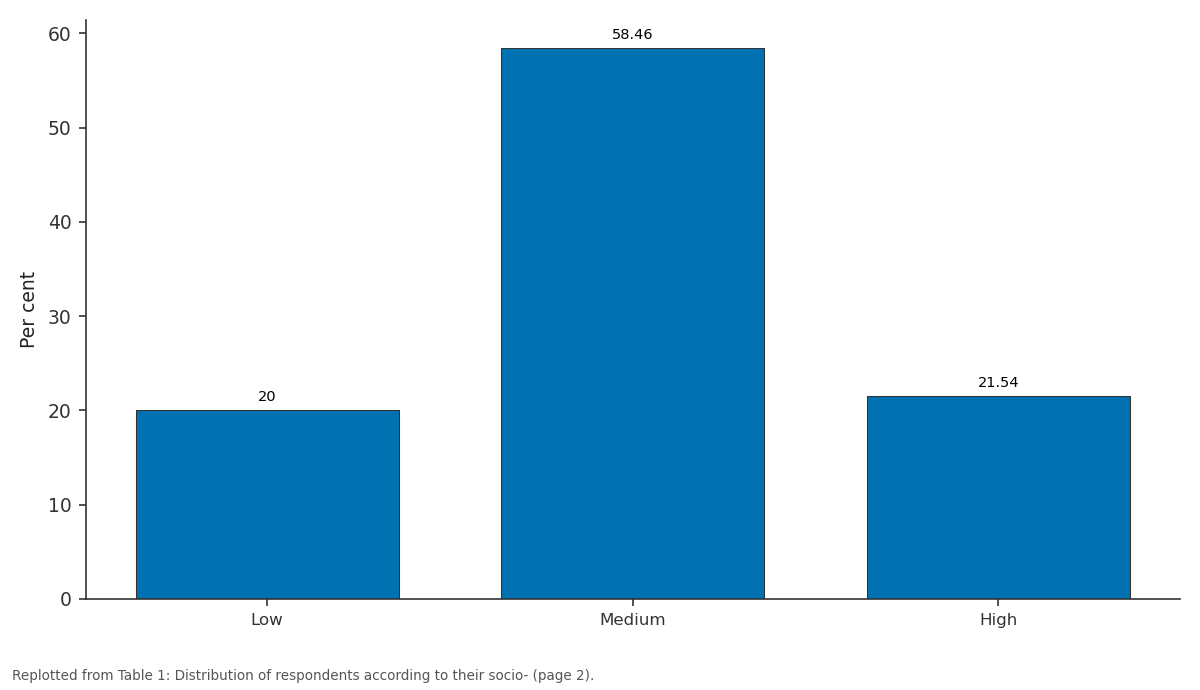
Per cent: Low vs Medium vs High
Replotted from Table 1 (page 2) of the original paper. Every bar is the paper's own table value.
View source evidence ↗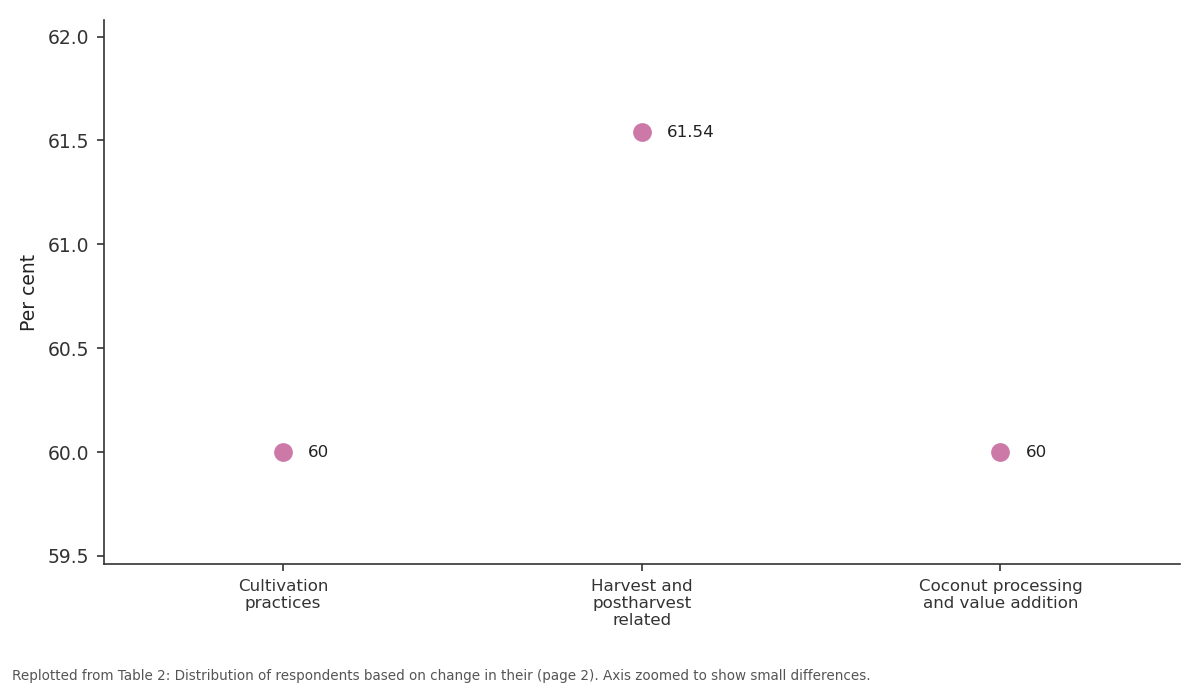
%: Cultivation practices vs Harvest and postharvest... vs Coconut processing and...
Replotted from Table 2 (page 2) of the original paper. Every bar is the paper's own table value.
View source evidence ↗Figures & tables
From the original paper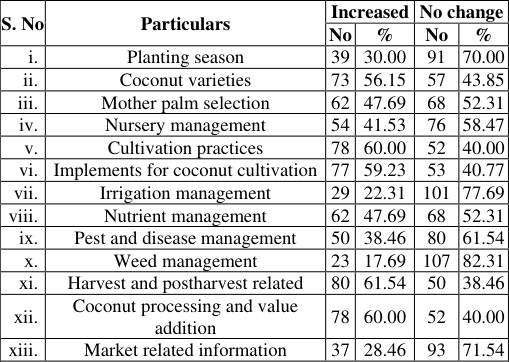 Table 2
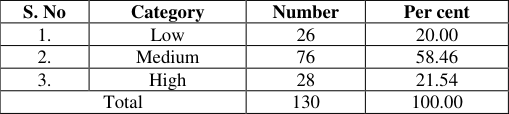 Table 1
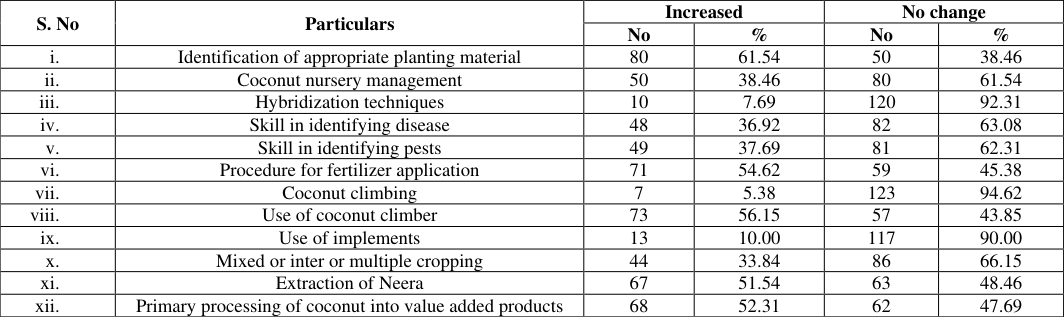 Table 3
 Table 4
Introduction
Cocos nucifera, eulogized as the 'Kalpavriksha' meaning the tree of the heaven is a principal cash crop that supports millions of farmers. It belongs to the family Arecaceae and belonged to Malesia, which is a bio geographical region comprising of Indonesia, Australia, New Guinea, South East Asia and several Pacific island groups (Ahuja et al., 2014) [1] . The secondary origin of coconut was identified as the Indian subcontinent and South Asia (Randhawa, 1980) [2] . The coconut tree plays an important part of life especially in coastal zones in tropical regions of all the continents of the world for of its heavy productivity. (Chopade et al. 2019) [5] The benefits of using each and every parts of coconut tree from its leaves to roots have been realized by the people throughout the world. The demands of coconut and its products are in increasing trend in modern life style. Considering this, India has wide scope in research and development of coconut palm, its products and by-products so as to utilize the possibilities of coconut palm to improve the national economy and employment generation of the rural people of our country. Coconut Producer Organisations (CPO's) are a farmer co-operative, formed through the lively institutional aid and monitoring by the Coconut Development Board. It is a three level structure comprising of Coconut Producer Societies, Coconut Producer Federation and Coconut Producer Company and this assist in uniting the unorganised coconut sector in the country. The coconut producer societies are the small scale farmer producer organisations and comprising of 40-100 coconut farmers with a total minimum of 4000-5000 palms in a contiguous area. The members of coconut producer society have to contribute equity capital and the CPS undertakes interest for improving productivity, cost minimisation, collective marketing, and processing. The CPS serves as the basic unit of FPO framework in the coconut sector which helps in the socio-monetary upliftment of the coconut farmers. Thus the coconut producer societies will ultimately benefit the coconut farmers and helps in improving their overall well-being. With this background, the objective selected for the study was to assess the impact of Coconut Producer Society as perceived by the respondents.
Materials and Methods
Thiruvananthapuram district was purposively selected and from the 11 blocks of the district, 3 blocks specifically Kilimanoor, Perumkadavila and Athiyannoor have been purposively selected. A sample size of 130 respondents were selected primarily based on proportionate random sampling from each panchayat from the chosen blocks.
Fourteen independent variables and impact of coconut producer society as dependent variable were selected for the study. The data were collected using a pre-tested interview schedule and collected data were analysed.
Results and Discussion
Results and Discussion
Socio-personal impact
In order to thoroughly comprehend the social and personal characteristics of the sample respondents from the CPS, socio-personal impact analysis was employed. To understand the socio-personal impact, data were collected and presented in Table 1. From Table 1, it is clear that more than half (58.46%) of the sample CPS members were having medium level of socio personal impact. Further 21.54 per cent of the members of CPS had high socio-personal impact and 20.00 per cent had low socio-personal impact. After getting memberships from the CPS, trainings and meetings were organized by the Coconut Development Board and this aided the farmers to improve their knowledge, skill and communication aspects. This could be the promising reason for medium to high level socio-personal impact. The findings derives support from the findings of Krishna Priya.
| S. No | Category | Number | Per cent |
|---|---|---|---|
| 1. | Low | 26 | 20.00 |
| 2. | Medium | 76 | 58.46 |
| 3. | High | 28 | 21.54 |
| Total | 130 | 100.00 |
Table text extracted from the original PDF; superscript letters are shown inline. The original table image is below.
View original table image
Aspects of Socio-personal impact
The socio-personal impact was studied using three aspects namely improvement in knowledge, skill development and communication aspects.
Improvement in Knowledge
The basic idea of a farmer organisation is to improve the access of farmers to knowledge and modern technologies. This helps the farmers in improving their crop productivities and their overall status. Data were collected on improvement in knowledge of the respondents and are furnished in Table 2. From Table 2 it is observed that about 61.54 per cent of respondents had an increase in knowledge on harvest and post-harvest related aspect and 38.46 per cent of respondents had no change in knowledge on harvest and post-harvest related aspects. An equalising proportion of the respondents had an increase in knowledge on cultivation practices (60.00%) and on coconut processing and value addition (60. 00%). It was also noted that 59.23 per cent of respondents had an increase in knowledge on the implements for coconut cultivation whereas 40.77 per cent had no change in their knowledge on the implements used for coconut cultivation. The possible reason for this might be that the coconut producer society members had undergone trainings on these aspects and this enabled them to gain an increase in their knowledge. Further no change in knowledge was observed largely on weed management (82.31%), irrigation management (77.69%), market related information (71.54%), planting season (70.00%) pest and disease management (61.54%), nursery management (58.47%), mother palm selection (52.31%) and nutrient management (52.31%).
| S. No | Particulars | Increased | — | No change | — |
|---|---|---|---|---|---|
| No | % | No | % | ||
| i. | Planting season | 39 | 30.00 | 91 | 70.00 |
| ii. | Coconut varieties | 73 | 56.15 | 57 | 43.85 |
| iii. | Mother palm selection | 62 | 47.69 | 68 | 52.31 |
| iv. | Nursery management | 54 | 41.53 | 76 | 58.47 |
| v. | Cultivation practices | 78 | 60.00 | 52 | 40.00 |
| vi. | Implements for coconut cultivation | 77 | 59.23 | 53 | 40.77 |
| vii. | Irrigation management | 29 | 22.31 | 101 | 77.69 |
| viii. | Nutrient management | 62 | 47.69 | 68 | 52.31 |
| ix. | Pest and disease management | 50 | 38.46 | 80 | 61.54 |
| x. | Weed management | 23 | 17.69 | 107 | 82.31 |
| xi. | Harvest and postharvest related | 80 | 61.54 | 50 | 38.46 |
| xii. | Coconut processing and value addition | 78 | 60.00 | 52 | 40.00 |
| xiii. | Market related information | 37 | 28.46 | 93 | 71.54 |
Table text extracted from the original PDF; superscript letters are shown inline. The original table image is below.
View original table image
Skill Development
Skill development has an utmost importance in the field of agriculture. For making farming a productive and profitable venture, skill development plays a crucial role. Farmers organisations like coconut producer societies serves as a platform for developing the skill of farmers. Data were collected on skill development from the respondents and are furnished in Table 3.
| S. No | Particulars | Increased | — | No change | — |
|---|---|---|---|---|---|
| No | % | No | % | ||
| i. | Identification of appropriate planting material | 80 | 61.54 | 50 | 38.46 |
| ii. | Coconut nursery management | 50 | 38.46 | 80 | 61.54 |
| iii. | Hybridization techniques | 10 | 7.69 | 120 | 92.31 |
| iv. | Skill in identifying disease | 48 | 36.92 | 82 | 63.08 |
| v. | Skill in identifying pests | 49 | 37.69 | 81 | 62.31 |
| vi. | Procedure for fertilizer application | 71 | 54.62 | 59 | 45.38 |
| vii. | Coconut climbing | 7 | 5.38 | 123 | 94.62 |
| viii. | Use of coconut climber | 73 | 56.15 | 57 | 43.85 |
| ix. | Use of implements | 13 | 10.00 | 117 | 90.00 |
| x. | Mixed or inter or multiple cropping | 44 | 33.84 | 86 | 66.15 |
| xi. | Extraction of Neera | 67 | 51.54 | 63 | 48.46 |
| xii. | Primary processing of coconut into value added products | 68 | 52.31 | 62 | 47.69 |
Table text extracted from the original PDF; superscript letters are shown inline. The original table image is below.
View original table image
Communication Aspects
Communication is an effective tool which helps the farmers in solving their crop related problems and also it helps to keep them updated with the modern technologies. Data were collected on communication aspects and are discussed in Table 4. From Table 4, it is perceived that majority (90.77%) of the respondents had an increased contact with other CPS members and a meagre (9.23%) per cent of respondents opined that they had no change in their contact with other CPS members. This might be because the CPS served as a platform for increasing their communication with other coconut cultivators through meetings and trainings and the coconut cultivators contacted other farmers for getting immediate help in protection, processing and marketing of coconuts. It is also apparent that less than three-fourths (71.54%) of the respondents had an increase in their information seekness and 28.46 per cent of respondents opined that there was no change associated with information seekness. It is clear that 69.23 per cent of respondents had an increase in information sharing and 30.77 had no change in sharing the information to other CPS members on coconut cultivation. Exactly half (50.00%) of the respondents had increased their contact with Coconut Development Board. It is also observed that 64.62 per cent of respondents had no change in their communication skills and 35.38 per cent of respondents had an increase in their communication skills. Further less than three-fourths (73.08%) of the respondents had no change in their contact with other line departments and 26.92 per cent opined an increase in contact with other line departments.
| S. No | Particulars | Increased | — | No change | — |
|---|---|---|---|---|---|
| No | % | No | % | ||
| i. | Contact with other CPS members | 118 | 90.77 | 12 | 9.23 |
| ii. | Contact with CDB | 65 | 50.00 | 65 | 50.00 |
| iii. | Contact with other line departments | 35 | 26.92 | 95 | 73.08 |
| iv. | Information seeking | 93 | 71.54 | 37 | 28.46 |
| v. | Information sharing | 90 | 69.23 | 40 | 30.77 |
| vi. | Communication skills | 46 | 35.38 | 84 | 64.62 |
Table text extracted from the original PDF; superscript letters are shown inline. The original table image is below.
View original table image
References
8 in the original paper- Ahuja SC, Ahuja U, Ahuja S. Coconut-History, Uses, and Folklore. Asian Agri-History. 2014 Jul 1, 18(3).
- Randhawa MS. A history of agriculture in India. Vol. 1: Beginning to 12 th century.-Vol. 2: Eighth to eighteenth century.-Vol. 3: 1757-1947.-Vol. 4: 1947-1981.
- Mathew GS. Augmenting the livelihood of coconut farmers through resilient extension approach [doctoral dissertation]. Department of Agricultural Extension, College of Agriculture, Vellayani; 2014.
- Vignesh G. Role of actors in Farmer Producer Organization (FPO) based millet value chain. Madras Agric J. 2019 Dec 20;106(March (1-3)):1. International Journal of Agriculture and Food Science https://www.agriculturaljournals.com
- Chopade SL, Kapse PS, Dhulgand VG. Estimating profile of the Farmer Producer Company members. Int. J Curr Microbiol App Sci. 2019;8(8):1988-1994.
- Murray EV. Producer company model-current status and future outlook: opportunities for bank finance. Financing Agric. 2008 Jul;40(4):18-26.
- Rupak M. Farmer producer organisations in coconut sector. Indian Coconut J. 2014;LVIII(1):38-41.
- Singh D, Singh BP, Bharti R, Pordhiya KL. A socioeconomic and socio-psychological appraisal of farmer producer organizations. J Pharm Innov. 2019;8(4):686689.