
Research article · 2025 · Full text
International Journal of Horticulture and Food ScienceSensory evaluation and consumer acceptability of buffalo curd prepared at 37 °C incubation temperature with various lactic starter cultures under refrigerated storage conditions
Volume 7(1) · Pages 156–159 · DOI: 10.33545/26631067.2025.v7.i1c.258 ↗
Research areasFood Science and Nutritional StudiesAgricultural Systems and Practices
Abstract
Author-writtenThe major objective\r\nof this work is to determine the\r\nsensory properties of lactic cultures inhabiting buffalo curd. Commercially available indigenous starter cultures\r\nwere used to prepare buffalo milk curd. Buffalo Milk was adjusted to contain 5% fat and 9% SNF levels using the Pearson\r\nsquare method. All the above samples were incubated at 37 °C separately to study the effect of incubation temperature on the sensory\r\nproperties of buffalo curd. All curd samples were compared with the control\r\ncurd sample by sensory evaluation to select the best starter culture\r\ncombination with higher sensory score. The sensory scores\r\nfor buffalo milk curd samples prepared using Buffalo milk curd prepared by Lactococcus\r\nlactis subsp. lactis +\r\nLactococcus lactis subsp. cremoris + Lactococcus lactis subsp.\r\nlactis biovar diacetylactis inoculation and incubated at 37 °Ccombination of starter cultures were higher than\r\nthe control and other treatments in terms of flavour, body and texture, colour\r\nand appearance, overall acceptability (8.88 ±0.01, 8.76 ±0.01, 8.84 ±0.01, 8.87\r\n±0.01) on day 0 and lowest flavour, body and texture, colour and appearance,\r\noverall acceptability scores (7.52 ±0.01, 7.13 ±0.01, 8.03 ±0.01, 7.50 ±0.01)\r\nwere observed for buffalo milk curd sample prepared using Buffalo milk curd prepared by Lactococcus\r\nlactis subsp. cremoris inoculation and incubated at 37 °C starter culture on day 0. Results showed that starter cultures, and incubation temperatures\r\nsignificantly influenced the sensory characteristics of buffalo curd.
Summary
Source-checkedPlain-language reading of the full paper, prepared with AI and checked against the text. Each point links to the authors' own words.
Why it matters
- The sensory characteristics of curd are primarily influenced by the choice of starter cultures and the temperature used during fermentation. View evidence ↗
- Buffalo milk is a suitable base for dairy products because it contains higher levels of fat, lactose, caseins, and minerals like calcium, magnesium, and phosphate than cow milk. View evidence ↗
- The process of curd fermentation is typically a lengthy and time-consuming operation. View evidence ↗
The question
- The study aimed to determine the consumer acceptability and sensory properties of buffalo curd prepared at an incubation temperature of 37 °C and stored under refrigeration. View evidence ↗
What they did
- Buffalo milk was standardized to 5% fat and 9% solids-not-fat (SNF) using the Pearson square method and incubated at 37 °C. View evidence ↗
- A panel of 12 experienced judges performed the sensory evaluations. View evidence ↗
- Sensory parameters were rated by panelists using a 9-point hedonic scale. View evidence ↗
- The evaluation focused on four specific attributes: flavour, body and texture, colour and appearance, and overall acceptability. View evidence ↗
What they found
- On day 0, the combination of L. lactis subsp. lactis, L. lactis subsp. cremoris, and L. lactis subsp. lactis biovar diacetylactis achieved the highest sensory scores for flavour (8.88 ±0.01), body and texture (8.76 ±0.01), colour and appearance (8.84 ±0.01), and overall acceptability (8.87 ±0.01). View evidence ↗
- On day 0, the lowest scores for flavour (7.52 ±0.01), body and texture (7.13 ±0.01), colour and appearance (8.03 ±0.01), and overall acceptability (7.50 ±0.01) were found in samples using only L. lactis subsp. cremoris. View evidence ↗
- After 6 days of storage at 5.00 ± 0.5 °C, the B1Ll+Lc+Ld combination maintained the highest scores for flavour (6.92 ±0.01), body and texture (6.67 ±0.01), colour and appearance (7.05 ±0.01), and overall acceptability (7.04 ±0.01). View evidence ↗
- On day 6 of storage at 5.00 ± 0.5 °C, the S. salivarius subsp. thermophilus (B1St) culture produced the lowest scores for flavour (3.89 ±0.01), body and texture (3.65 ±0.01), colour and appearance (6.16 ±0.01), and overall acceptability (4.04 ±0.02). View evidence ↗
- The study found that both the type of starter culture and the incubation temperature had a significant impact on the sensory characteristics of the buffalo curd. View evidence ↗
What it means
- The authors conclude that buffalo milk curd prepared with a combination of L. lactis subsp. lactis, L. lactis subsp. cremoris, and L. lactis subsp. lactis biovar diacetylactis incubated at 37 °C maintains good consumer acceptability for up to 6 days under refrigeration. View evidence ↗
Visual summary
1 visualsIllustrations explain the paper; they do not show study data.
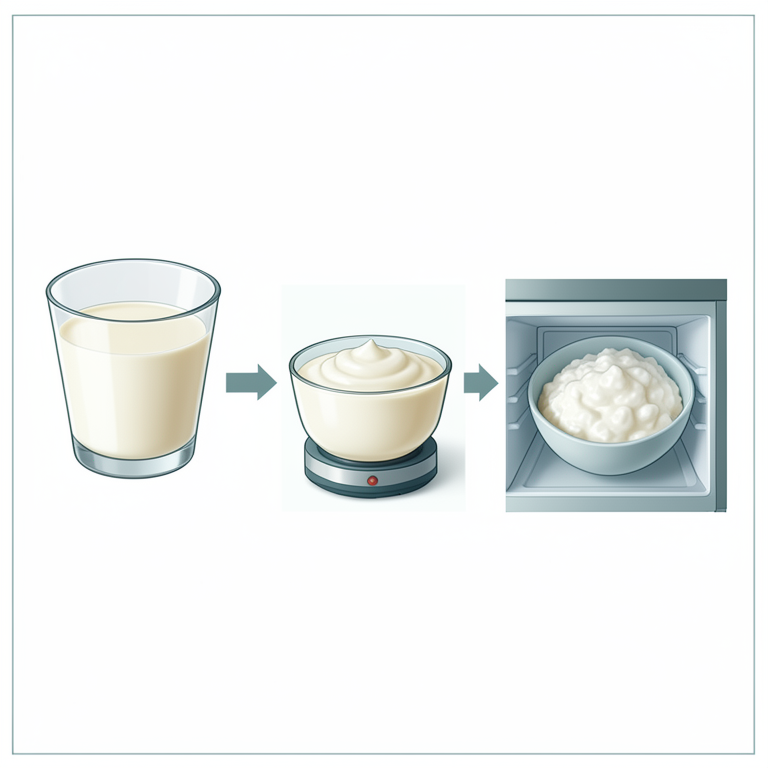
Buffalo Curd Quality Arc
AI-generated conceptual illustration (buffalo milk curd). It explains the idea and does not show study data.
View source evidence ↗Figures & tables
From the original paper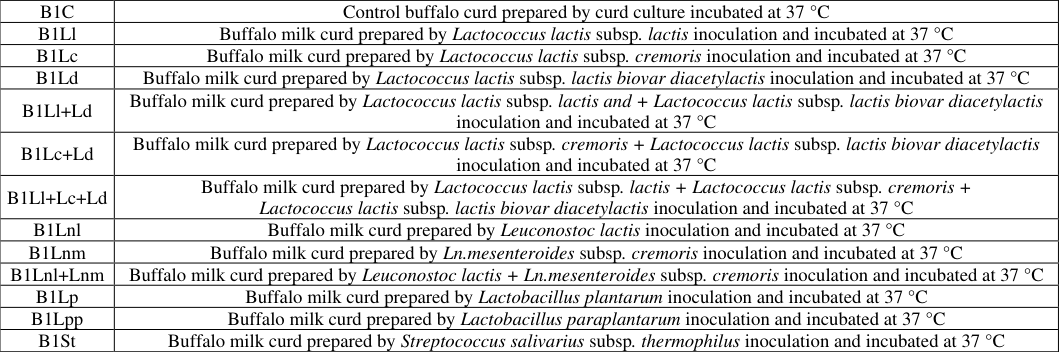 Table 1
 Table 2
 Table 3
 Table 4
 Table 5
Introduction
Starter cultures and fermentation temperature are key factors affecting sensory characteristics of curd. The starter cultures confer distinct textural and flavour properties and are also used to promote acid development during curd manufacturing process. (McSweeney and Sousa, 2000) [14] . Composition of milk is influenced by species, breed, individuality, nutritional status, health, and stage of lactation of milch animals. (Fox et al., 2000) [9] . Buffalo milk is rich in fat, lactose, caseins, calcium, magnesium, and phosphate compared with cow milk (Fundora et al., 2001; Ahmad et al., 2008) [10,1] and, because of its chemical composition, buffalo milk offers excellent opportunities for the development of different dairy products (Murtaza et al., 2008) [15] . Curd is a fermented dairy product that undergoes a complex series of chemical, bacterial, and enzymatic reactions during ripening (Singh et al., 2003; Farkye, 2004) [20,8] , which are responsible for the development of sensory characteristics (Pollard et al., 2003; Smit et al., 2005; Azarnia et al., 2006) [17,21,2] . Fermentation of curd is time-consuming lengthy process (Law, 2001; Murtaza et al., 2012) [13, 16] use of variety of starter cultures in different combinations (Lee et al., 1990), and incubation temperatures (Rehman et al., 2000) [18] . Attempts to shorten the fermentation time using a range of ripening systems have had varying degrees of success (Wilkinson, 1993; Law, 2001) [22,13] . Grading and judging are used extensively for sensory evaluation of dairy products (Bodyfelt et al., 1988) [3] ; Assessment of the sensory characteristics of curd and various sensory characteristics is an important part of cheese quality evaluation and currently involves the use of trained sensory panelists or individuals (Downey et al., 2005) [6] . A product is evaluated based on the presence or absence of specific attributes and on overall quality score. These quality scores are usually based on the opinions of one individual, and the quality score is subjective rather than specifically defined (Drake et al., 2005; Caspia et al., 2006) [7,4] . The study was designed with the objective determine the sensory properties of lactic cultures inhabiting buffalo curd prepared at 37 °C incubation temperature under refrigerated storage conditions and its consumer acceptability.
Materials and Methods
Buffalo milk curd were prepared and incubated at 37 °C using 5 per cent fat and 9 per cent SNF combination by means of pearson square standardization using the starter culture combination listed in table 1.
| B1C | Control buffalo curd prepared by curd culture incubated at 37 °C |
|---|---|
| B1Ll | Buffalo milk curd prepared by Lactococcus lactis subsp. lactis inoculation and incubated at 37 °C |
| B1Lc | Buffalo milk curd prepared by Lactococcus lactis subsp. cremoris inoculation and incubated at 37 °C |
| B1Ld | Buffalo milk curd prepared by Lactococcus lactis subsp. lactis biovar diacetylactis inoculation and incubated at 37 °C |
| B1Ll+Ld | Buffalo milk curd prepared by Lactococcus lactis subsp. lactis and + Lactococcus lactis subsp. lactis biovar diacetylactis inoculation and incubated at 37 °C |
| B1Lc+Ld | Buffalo milk curd prepared by Lactococcus lactis subsp. cremoris + Lactococcus lactis subsp. lactis biovar diacetylactis inoculation and incubated at 37 °C |
| B1Ll+Lc+Ld | Buffalo milk curd prepared by Lactococcus lactis subsp. lactis + Lactococcus lactis subsp. cremoris + Lactococcus lactis subsp. lactis biovar diacetylactis inoculation and incubated at 37 °C |
| B1Lnl | Buffalo milk curd prepared by Leuconostoc lactis inoculation and incubated at 37 °C |
| B1Lnm | Buffalo milk curd prepared by Ln.mesenteroides subsp. cremoris inoculation and incubated at 37 °C |
| B1Lnl+Lnm | Buffalo milk curd prepared by Leuconostoc lactis + Ln.mesenteroides subsp. cremoris inoculation and incubated at 37 °C |
| B1Lp | Buffalo milk curd prepared by Lactobacillus plantarum inoculation and incubated at 37 °C |
| B1Lpp | Buffalo milk curd prepared by Lactobacillus paraplantarum inoculation and incubated at 37 °C |
| B1St | Buffalo milk curd prepared by Streptococcus salivarius subsp. thermophilus inoculation and incubated at 37 °C |
Table text extracted from the original PDF; superscript letters are shown inline. The original table image is below.
View original table image
Sensory evaluation curd
The panel of judges assessed the coded curd samples at random, according to the methodology described by Indian standards (IS, 1971). Sensory evaluation of samples was carried out with a 12-member and the panelists had a good knowledge on the sensory evaluation of dairy products and participated previously in such evaluations. Curd samples, in the plastic containers were conditioned at room temperature for 15 min before testing. Sensory evaluation of the samples was carried out in the sensory evaluation room under appropriate fluorescent lighting. Each panellist was asked to taste the curd samples labelled with code and rate the sensory parameters on a 9-point hedonic scale. According to the 9-point structured hedonic scale, the acceptance test was carried out for the attributes of colour and appearance, body and texture, flavour and overall acceptability. For all the attributes, 9-point scale was defined as that the highest value indicates the highest degree of preference. Panellists were also requested to give the scores and comments on a sensory evaluation score card. Water was provided to rinse the palate before and after tasting the sample. The various starter cultures and their combinations above were used to prepare buffalo milk curd samples with 5% fat and 9% SNF combinations. The sensory scores of buffalo curd samples prepared with various combinations of starter cultures by incubating at 37 °C and stored at refrigeration temperature are shown in Tables 1,2, 3 and 4 respectively.
Results
The sensory scores of buffalo milk curd samples prepared with various combinations of starter cultures by incubating at 37 °C and stored at refrigeration temperature 5.00 ± 0.5 ºC are shown in Tables 2,3, 4 and 5, respectively. The various starter cultures and their combinations as in Table 1 were used to prepare buffalo milk curd samples with 5% fat and 9% SNF combinations by incubating at 37 °C. All buffalo milk curd samples were compared with the control curd sample by sensory evaluation to select the best starter culture combination with extended shelf life. The sensory scores for buffalo milk curd samples prepared using B1Ll+Lc+Ld Lactococcus lactis subsp. lactis + Lactococcus lactis subsp. cremoris + Lactococcus lactis subsp. lactis biovar diacetylactis inoculation and incubated at 37 °C were higher than the control and other treatments in terms of flavour, body and texture, colour and appearance, overall acceptability (8.88 ±0.01, 8.76 ±0.01, 8.84 ±0.01, 8.87 ±0.01) on day 0 and lowest flavour, body and texture, colour and appearance, overall acceptability scores (7.52 ±0.01, 7.13 ±0.01, 8.03 ±0.01, 7.50 ±0.01) were observed for buffalo milk curd sample prepared using Lactococcus lactis subsp. cremoris inoculation and incubated at 37 °C (B1Lc) starter culture on day 0. (Table 2345). The flavour, body and texture, colour and appearance, overall acceptability scores (6.92 ±0.01, 6.67 ±0.01, 7.05 ±0.01, 7.04 ±0.01) were higher than the control and other treatments for the buffalo milk curd samples prepared using B1Ll+Lc+Ld (Table 2345) starter culture combinations and incubated at 37ºC on day 6 of storage at 5.00 ± 0.5ºC and whereas flavour, body and texture, colour and appearance, overall acceptability scores were lower than the control and other treatments for the buffalo milk curd sample prepared using Buffalo milk curd prepared by (B1St) Streptococcus salivarius subsp. thermophilus inoculation and incubated at 37 °C starter culture (3.89 ±0.01, 3.65 ±0.01, 6.16 ±0.01, 4.04 ±0.02) on day 6 of storage at 5.00 ± 0.5 ºC.
Discussion
Buffalo Curd sample containing Lactococcus lactis subsp. lactis, Lactococcus lactis subsp. cremoris and Lactococcus lactis subsp. lactis biovar diacetylactis starter cultures had significantly high sensory scores compared to other starter cultures. These findings are in close agreement with Shekhar et al. (2013) [19] who investigated about the effect of different cultures on physico-chemical and sensory properties of buffalo curd incubated at 30ºC and 42ºC found that the sensory scores of buffalo curd ranged as 6.76 to 7.78. Khedar et al. (2016) reviewed that homofermentative L. lactis subsp. lactis is able to produce free amino acids, which are believed to stimulate the growth of Lac.lactis subsp. cremoris strains. Another important species in the mesophilic starter category is the homofermentative L. lactis subsp. lactis biovar diacetylactis, which is able besides lactic acid production of fermenting citric acid into a number of other compounds such as diacetyl and carbon dioxide. However, at a pH below 5, carbon dioxide and a number of compounds similar to diacetyl, but non-aromatic, are produced. Homofermentative thermophilic starter microorganisms, like L. delbrueckii subsp. bulgaricus and Str. salivarius subsp. thermophilus are used to obtain mildly sour dahi. These starters play an important role in producing a good quality dahi having a firm and uniform consistency with a sweet aroma and acidic taste. (Chatterjee et al.,2022) [5] The lower sensory scores for some starter culture is explained by Ghosh and Rajorhia (1990) [11,12] recorded that certain curd samples scored low flavor ratings because of the heterofermentative nature of the bacterial culture and known to produce small amounts of formic acid and CO 2 imparts a sharp taste to the product.
Conclusion
Conclusively, the results of the present study suggest that the buffalo milk curd prepared with Lactococcus lactis subsp. lactis, Lactococcus lactis subsp. cremoris and Lactococcus lactis subsp. lactis biovar diacetylactis incubated at 37 ºC could be stored at refrigeration temperature for up to 6 days had good consumer acceptability.
Acknowledgement
AcknowledgementsAuthors sincerely thank Tamil Nadu Veterinary and Animal Sciences University for providing necessary facilities to carry out this research work.
Figures and tables from the paper
| Storage period in Days | Starter cultures | — | — | — | — | — | — | — |
|---|---|---|---|---|---|---|---|---|
| B1C | B1Ll | B1Lc* | B1Ld | B1Ll+Ld | B1Lc+Ld | B1Ll+Lc+Ld | B1St | |
| 0 | 8.74cA±0.10 | 8.76bA±0.10 | 7.52eA±0.10 | 8.77 bA±0.10 | 8.88aA±0.10 | 7.57dA±0.10 | 8.88aA±0.10 | 7.57dA±0.10 |
| 2 | 8.05dB ±0.10 | 8.04dB±0.10 | 7.07eB±0.10 | 8.38bA±0.10 | 8.28cB±0.10 | 7.07eB±0.10 | 8.47aA±0.10 | 7.07eB A±0.10 |
| 4 | 6.55cC±0.10 | 6.05dC±0.10 | 6.07dC±0.10 | 7.08bB±0.10 | 7.09bC±0.10 | 6.08dC±0.10 | 7.58aB±0.10 | 6.57cC±0.10 |
| 6 | 4.97bD±0.10 | 4.96cD±0.10 | 4.98cD±0.10 | 4.97cC±0.10 | 4.96cD±0.10 | 4.98cD±0.10 | 6.92aC±0.10 | 3.89dD±0.10 |
| 8 | 3.92bE±0.10 | 3.93bE±0.10 | 3.92bE±0.13 | 3.93bD±0.10 | 3.99bE±0.13 | 3.99bE±0.13 | 5.17aD±0.13 | 2.96cE±0.10 |
| 10 | 2.94bF±0.10 | 3.00aF±0.10 | 2.95bF±0.10 | 2.96bE±0.10 | 3.00aF±0.10 | 2.94bF±0.10 | 3.00aE±0.10 | 3.01aE±0.10 |
Table text extracted from the original PDF; superscript letters are shown inline. The original table image is below.
View original table image
| Storage period in Days | Starter cultures | — | — | — | — | — | — | — |
|---|---|---|---|---|---|---|---|---|
| B1C | B1Ll | B1Lc* | B1Ld | B1Ll+Ld | B1Lc+Ld | B1Ll+Lc+Ld | B1St | |
| 0 | 8.68cA±0.10 | 8.69cA±0.10 | 7.13dA±0.10 | 8.70 bA±0.10 | 8.72aA±0.10 | 7.15dA±0.10 | 8.76aA±0.10 | 7.15dA±0.10 |
| 2 | 7.63dB ±0.10 | 7.63dB±0.10 | 6.65eB±0.10 | 7.96bB±0.10 | 7.86cB±0.10 | 6.65eB±0.10 | 8.05aB±0.10 | 6.65eB±0.10 |
| 4 | 6.13cC±0.10 | 5.54dC±0.10 | 5.55dC±0.10 | 6.66bC±0.10 | 6.67bC±0.10 | 5.67dC±0.10 | 7.16aC±0.10 | 6.15cC±0.10 |
| 6 | 4.54dD±0.10 | 4.63cD±0.10 | 4.65bD±0.10 | 4.66aD±0.10 | 4.65bD±0.10 | 4.66aD±0.10 | 6.67aD±0.10 | 3.65eD±0.10 |
| 8 | 3.63bE±0.10 | 3.63bE±0.10 | 3.65bE±0.13 | 3.66bE±0.10 | 3.67bE±0.13 | 3.67bE±0.13 | 4.87aE±0.13 | 2.87cE±0.10 |
| 10 | 3.05bF±0.10 | 2.69cF±0.10 | 2.65cF±0.10 | 2.66cF±0.10 | 2.68cF±0.10 | 2.66cF±0.10 | 3.72aF±0.10 | 2.69cE±0.10 |
Table text extracted from the original PDF; superscript letters are shown inline. The original table image is below.
View original table image
| Storage period in Days | Starter cultures | — | — | — | — | — | — | — |
|---|---|---|---|---|---|---|---|---|
| B1C | B1Ll | B1Lc* | B1Ld | B1Ll+Ld | B1Lc+Ld | B1Ll+Lc+Ld | B1St | |
| 0 | 8.75cA±0.10 | 8.77bA±0.10 | 8.03dA±0.10 | 8.78 bA±0.10 | 8.83aA±0.10 | 8.14dA±0.10 | 8.84aA±0.10 | 8.07dA±0.10 |
| 2 | 8.48dB ±0.10 | 8.68cB±0.10 | 7.99eA±0.10 | 8.66cA±0.10 | 8.77bA±0.10 | 8.08eA±0.10 | 8.77aA±0.10 | 8.02eA±0.10 |
| 4 | 7.52bC±0.10 | 7.02dC±0.10 | 7.05dB±0.10 | 7.03dB±0.10 | 7.04dB±0.10 | 7.03dB±0.10 | 7.53aB±0.10 | 7.22cB±0.10 |
| 6 | 6.87bD±0.10 | 5.74cD±0.10 | 5.81dC±0.10 | 5.80dC±0.10 | 5.79dC±0.10 | 5.85dC±0.10 | 7.05aB±0.10 | 6.16cC±0.10 |
| 8 | 5.28cE±0.10 | 5.25cD±0.10 | 5.31cC±0.13 | 5.24cD±0.10 | 5.26cD±0.13 | 5.25cD±0.13 | 6.84aC±0.13 | 5.83bD±0.10 |
| 10 | 5.14cF±0.10 | 3.17cE±0.10 | 5.21cD±0.10 | 5.15cD±0.10 | 5.08cD±0.10 | 5.11cD±0.10 | 6.06aD±0.10 | 5.54bD±0.10 |
Table text extracted from the original PDF; superscript letters are shown inline. The original table image is below.
View original table image
| Storage period in Days | Starter cultures | — | — | — | — | — | — | — |
|---|---|---|---|---|---|---|---|---|
| B1C | B1Ll | B1Lc* | B1Ld | B1Ll+Ld | B1Lc+Ld | B1Ll+Lc+Ld | B1St | |
| 0 | 8.72cA±0.10 | 8.83bA±0.10 | 7.50dA±0.10 | 8.82bA±0.10 | 8.85aA±0.10 | 7.52dA±0.10 | 8.87aA±0.10 | 7.51dA±0.10 |
| 2 | 8.02dB ±0.10 | 8.02dB±0.10 | 7.00eA±0.10 | 8.33bB±0.10 | 8.23cB±0.10 | 7.03eA±0.10 | 8.43aA±0.13 | 6.96fB±0.10 |
| 4 | 6.52cC±0.10 | 6.03dC±0.10 | 6.01dB±0.10 | 7.03bC±0.10 | 7.05bC±0.10 | 6.03dB±0.10 | 7.54aB±0.10 | 6.54cC±0.10 |
| 6 | 6.04bD±0.10 | 5.03cD±0.10 | 5.02cC±0.10 | 5.02cD±0.10 | 5.03cD±0.10 | 5.04cC±0.10 | 7.04aC±0.10 | 4.04dD±0.13 |
| 8 | 4.02bE±0.10 | 4.04bE±0.10 | 4.02bD±0.13 | 4.03bE±0.10 | 4.05bE±0.13 | 4.04bD±0.13 | 5.26aD±0.13 | 3.02cE±0.10 |
| 10 | 3.01bF±0.10 | 3.04aF±0.10 | 3.01bE±0.10 | 3.01bF±0.10 | 3.03aF±0.10 | 3.01bE±0.10 | 3.04aE±0.10 | 3.02bF±0.10 |
Table text extracted from the original PDF; superscript letters are shown inline. The original table image is below.
View original table image
References
20 in the original paper- Ahmad S, Gaucher I, Rousseau F, Beaucher E, Piot M, Grongnet JF, et al. Effects of acidification on physicochemical characteristics of buffalo milk: a comparison with cow's milk. Food Chem. 2008;106:11-17.
- Azarnia S, Robert N, Lee B. Biotechnological methods to accelerate Cheddar cheese ripening. Crit Rev Biotechnol. 2006;26:121-143.
- Caspia EL, Coggins PC, Schilling MW, Yoon Y, White CH. The relationship between consumer acceptability and descriptive sensory attributes in Cheddar cheese. J Sens Stud. 2006;21:112-127.
- Chatterjee R, Ray PR, Sena C, Mandal S. Physicochemical, microbiological and antioxidant property of traditionally prepared Misti Dahi sold in West Bengal. Indian J Tradit Knowl. 2022;21(3):637645.
- Downey G, Sheehan E, Delahunty C, O'Callaghan D, Guinee T, Howard V. Prediction of maturity and sensory attributes of Cheddar cheese using nearinfrared spectroscopy. Int Dairy J. 2005;15:701-709.
- Drake MA, Yates MD, Gerard PD. Impact of serving temperature on trained panel perception of cheddar cheese flavor attributes. J Sens Stud. 2005;20:147-155.
- Farkye NY. Cheese technology. Int J Dairy Technol. 2004;57:91-98.
- Fox PF, Guinee TP, Cogan TM, McSweeney PLH. Fundamentals of Cheese Science. Gaithersburg, MD: Aspen Publishers Inc.; 2000.
- Fundora O, Gonzalez ME, Lezcano O, Montejo A, Pompa N, Enriquez AV. A comparative study of milk composition and stability of Murrah river buffaloes and Holstein cows grazing star grass. Cuban J Agric Sci. 2001;35:219-222.
- Ghosh J, Rajorhia GS. Technology for production of misti dahi-a traditional fermented milk product. Ind J Dairy Sci. 1990;43:239-246.
- Ghosh J, Rajorhia GS. Selection of starter culture for production of indigenous fermented milk product (Misti dahi). Lait. 1990;70:147-154.
- Law BA. Controlled and accelerated cheese ripening: The research base for new technologies. Int Dairy J. 2001;11:383-398.
- McSweeney PLH, Sousa MJ. Biochemical pathways for the production of flavour compounds in cheese during ripening: A review. Lait. 2000;80:293-324.
- Murtaza MA, Rehman SU, Anjum FM, Nawaz H. Nutritional comparison of cow and buffalo milk Cheddar cheese. Pak J Nutr. 2008;7:509-512.
- Murtaza MA, Rehman SU, Anjum FM, Huma N, Tarar OM, Mueen-ud-Din G. Organic acids contents of buffalo milk Cheddar cheese as influenced by accelerated ripening and sodium salt. J Food Biochem. 2012;36:99-106.
- Pollard A, Sherkat F, Seuret MG, Halmos AL. Textural changes of natural Cheddar cheese during the maturation process. J Food Sci. 2003;68:2011-2016.
- Rehman SU, Banks JM, Brechany EY, Muir DD, McSweeney PLH, Fox PF. Influence of ripening temperature on the volatiles profile and flavour of Cheddar cheese made from raw or pasteurized milk. Int Dairy J. 2000;10:55-65.
- Shekhar S, Joe J, Kumar R, Jyothis J, Kumar RMK, Priya YA, et al. Effect of heat treatment of milk on the sensory and rheological quality of dahi prepared from cow milk. J Food Dairy Technol. 2013;1(8):14.
- Singh TK, Drake MA, Cadwallader KR. Flavor of cheddar cheese: A chemical and sensory perspective. Comp Rev Food Sci Food Saf. 2003;2:139-162.
- Smit G, Smit BA, Wim JM, Engels JM. Flavour formation by lactic acid bacteria and biochemical flavour profiling of cheese products. FEMS Microbiol Rev. 2005;29:591-610.