
Research article · 2025 · Full text
International Journal of Horticulture and Food SciencePotential application of edible coating for maintaining tomato and brinjal shelf life
Volume 7(1) · Pages 152–155 · DOI: 10.33545/26631067.2025.v7.i1c.257 ↗
Research areasPostharvest Quality and Shelf Life ManagementNanocomposite Films for Food Packaging
Abstract
Author-writtenThis study\r\ninvestigates the impact of Aloe vera gel as an edible coating on the\r\nphysicochemical properties and storage characteristics of tomatoes (Solanum\r\nlycopersicum) and brinjals (Solanum melongena) under room\r\ntemperature conditions. The Aloe vera gel was applied at varying\r\nconcentrations (0.1%, 0.5%, and 1%) to assess its effectiveness in reducing\r\nweight loss, maintaining moisture content, and preserving the quality of the\r\nfruits. The results showed that Aloe vera coating helped in minimizing\r\nweight loss and enhancing moisture retention, with 0.5% concentration proving\r\nmost effective. The pH, titratable acidity, and total soluble solids (TSS) did\r\nnot significantly vary between treated and untreated fruits, indicating the\r\nmild effect of Aloe vera on these parameters. However, the gel coating\r\ncontributed to preserving the color of the brinjal stems, which deteriorated\r\nless in treated fruits. Overall, Aloe vera gel demonstrated its\r\npotential as an eco-friendly and functional edible coating, maintaining the\r\nquality of tomatoes and brinjals during storage and offering an alternative to\r\nconventional postharvest treatments.
Summary
Source-checkedPlain-language reading of the full paper, prepared with AI and checked against the text. Each point links to the authors' own words.
Why it matters
- Post-harvest losses for horticultural crops in Pakistan can reach 25% to 30% due to poor infrastructure and harvesting practices. View evidence ↗
- Brinjals have a short shelf life and suffer from quality deterioration after harvest caused by water loss and physical changes. View evidence ↗
- Tomatoes decay rapidly after harvest, with deterioration primarily driven by weight loss, softening, color changes, and loss of acidity. View evidence ↗
The question
- The study aimed to investigate how Aloe vera gel edible coatings affect the storage characteristics and physicochemical properties of tomatoes and brinjals at room temperature. View evidence ↗
What they did
- Tomatoes and brinjals were dipped for 10 minutes in Aloe vera gel concentrations of 0.1%, 0.5%, and 1%, then stored at room temperature for two weeks. View evidence ↗
- Weight loss and total soluble solids (TSS) were measured every 3 days during the storage period. View evidence ↗
- Brinjal stem color was evaluated using a visual scoring system ranging from 1 (green) to 5 (100% brown/black). View evidence ↗
What they found
- No significant differences in pH were observed between the treated and untreated fruits over the storage period. View evidence ↗
- Titratable acidity did not show significant differences among the various coated samples. View evidence ↗
- TSS values for brinjals ranged from 0.24% to 0.26% and for tomatoes from 2.69% to 3.8% across control and treated groups. View evidence ↗
What it means
- The authors conclude that Aloe vera gel is beneficial for maintaining the quality of tomatoes and brinjals stored at room temperature. View evidence ↗
- The authors recommend Aloe vera as an eco-friendly alternative to chemical coatings for improving the shelf life of horticultural products. View evidence ↗
Visual summary
3 visualsIllustrations explain the paper; charts are replotted from the paper's own table values.
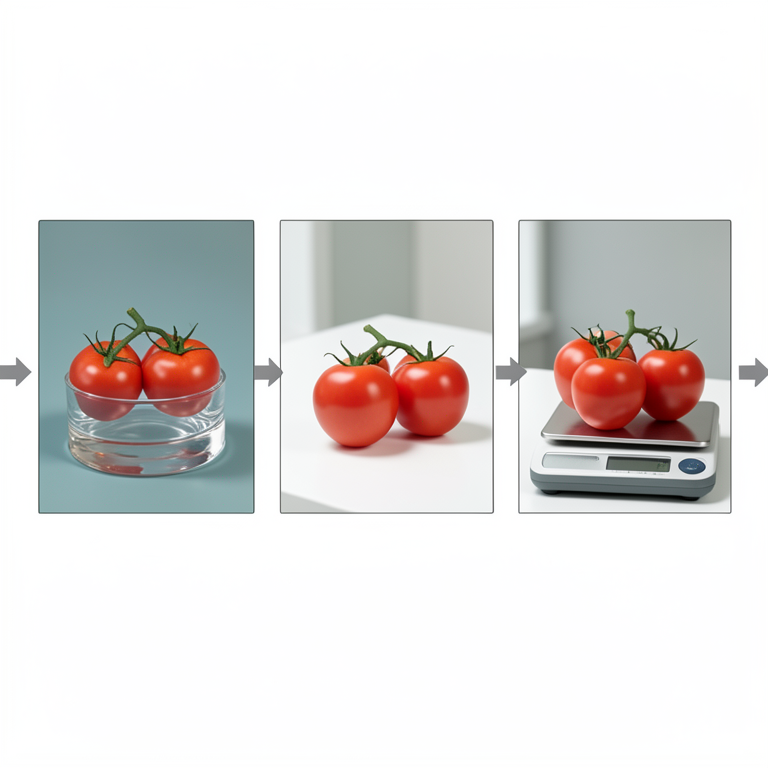
Experimental Workflow
AI-generated conceptual illustration (tomato and brinjal fruits). It explains the idea and does not show study data.
View source evidence ↗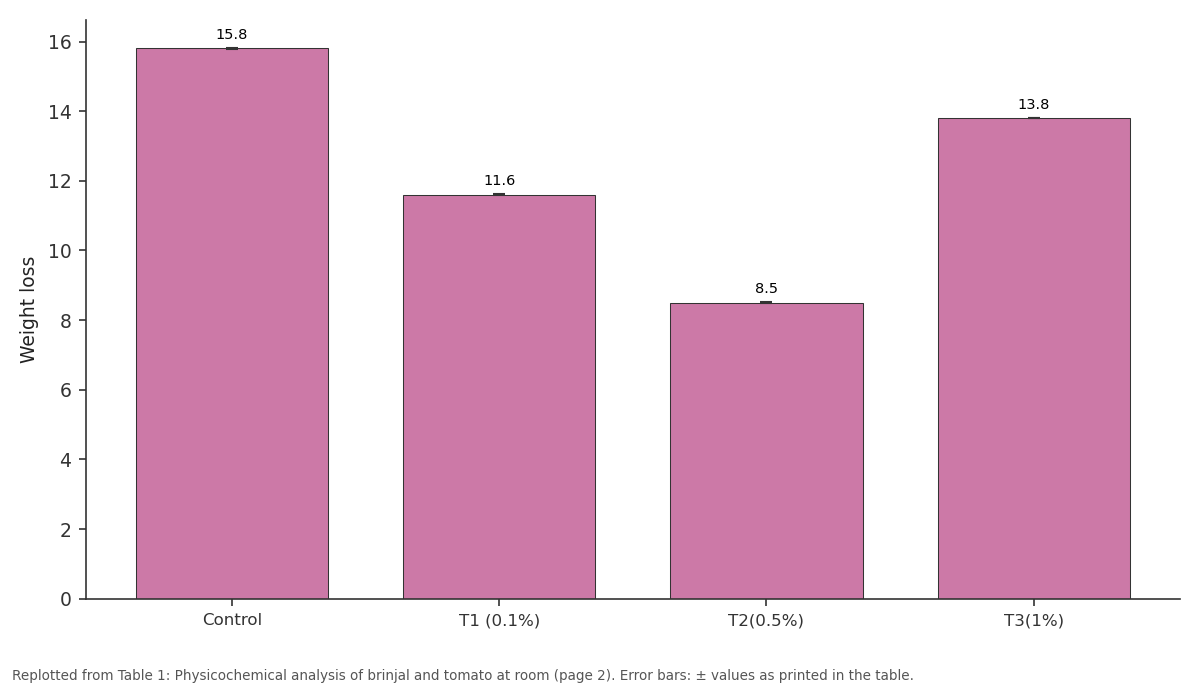
Weight loss: Control vs T1 (0.1%) vs T2(0.5%) vs T3(1%)
Replotted from Table 1 (page 2) of the original paper. Every bar is the paper's own table value.
View source evidence ↗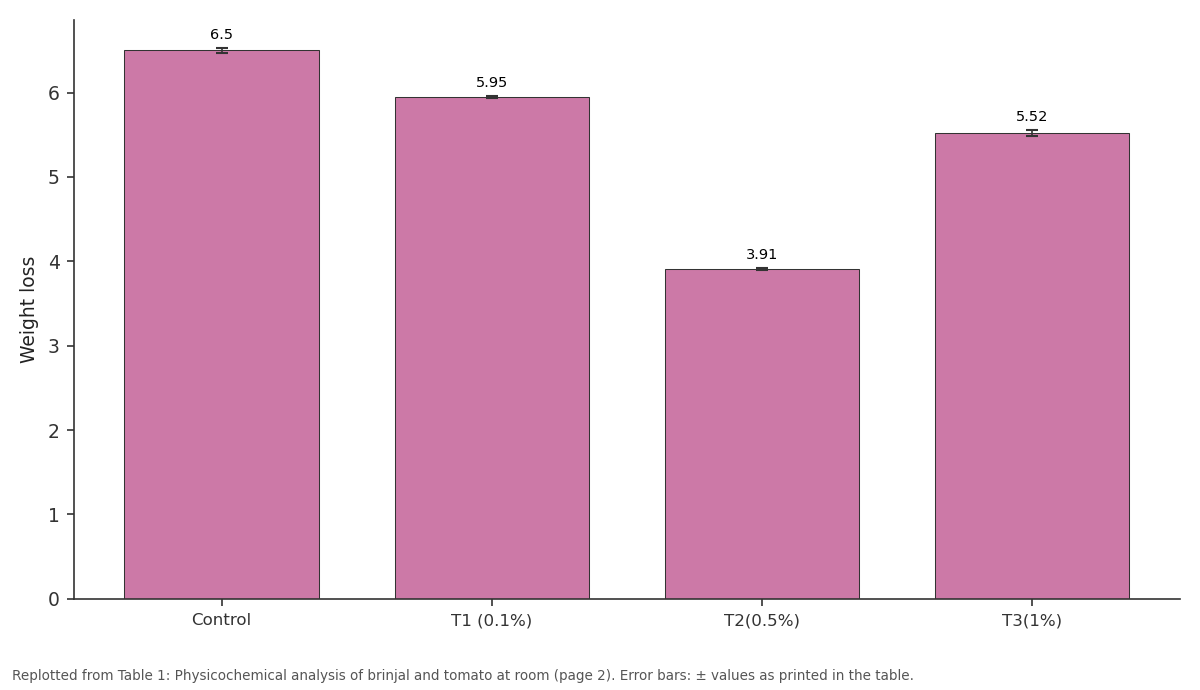
Weight loss: Control vs T1 (0.1%) vs T2(0.5%) vs T3(1%)
Replotted from Table 1 (page 2) of the original paper. Every bar is the paper's own table value.
View source evidence ↗Figures & tables
From the original paper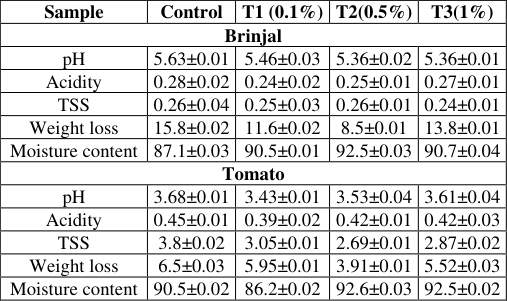 Table 1
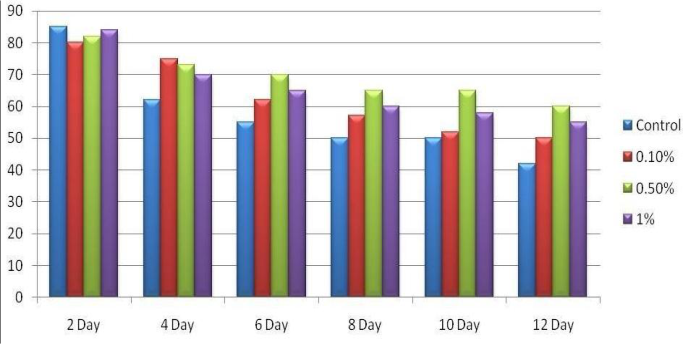 Figure 1
Introduction
Pakistan produces large amounts of fresh horticultural crops, but sadly, fruit losses after harvesting can reach 25% to 30% because of inadequate post-harvest technologies, careless harvesting practices, and a lack of infrastructure. Poor handling not only degrades the quality of produce but also reduces farmers' profitability (Ahmad et al., 2005) [2] . One of the most important vegetable crops cultivated worldwide is brinjal (Solanum melongena L.). With 90% of production coming from around the world, brinjal production is quite intense. When brinjal fruits are physiologically immature, they are harvested. 588 g of carbs, 3.53 g of sugar, 3% vitamin C, 3% phosphorus, 1% calcium, 4% magnesium, and 2% zinc are included in 100 g of brinjal. (anonymous, 2010) [6] . One type of vegetable with a short shelf life is brinjal. Its storage quality deteriorates after harvesting due to physical changes and water loss. The sugar content and skin hardness of fruits (Solanum melongena L.) are essential factors that affect the fruits' sensory qualities (Jha and Matsuoka, 2002) [17] . The sugar content and skin hardness of brinjal fruits diminish with storage (Gajewski, 2002) [11] . The purpose of the study was to examine the internal changes that occur in brinjal fruits as they ripen and mature. The tomato's commercial significance has made it the model species for climate-induced fruit ripening. After harvesting, tomato quality is constantly changing. The quality of fresh tomatoes is based on their flavor, firmness, color, and appearance. Skin color, which is influenced by lycopene concentration and connected to fruit ripening, is the primary quality indicator (Artés,2004) [7] . The total soluble solids-total acidity ratio attained at harvest. Fruit firmness is also an important quality attribute and is directly related to enhancement of storability potential and induction of greater resistance to decay and mechanical damage (Kader,2000) [18] . Tomato fruits do not reach consumers in the best possible condition since they decay quickly after harvest and occasionally after transportation and marketing. Weight loss, color changes, softening, surface pitting, and loss of acidity are the primary causes of tomato deterioration; minor fluctuations in total soluble solids also happen. Edible coatings are a typical application of these technologies to enhance the appearance and preservation of food (Aguiar et al., 2011) [1] . Different substances, including as wax, milk protein's, cellulose, lipids, starch, zein, alginate, and chitosan, have mostly been employed as edible coatings to stop commodity weight loss (García et al,2008) [12] . Aloe vera gel is currently gaining popularity in the food business as a source of functional foods for ice creams, drinks, and other beverages (Moore et al.,1995) [21] . An inventive and intriguing method for commercial use and a substitute for postharvest chemical treatments would be the use of Aloe vera gel as an edible coating for fruit. Our study's objective was to assess how Aloe vera, when used as an edible coating, affected the alterations in tomato-related physicochemical characteristics. Fruit quality in ambient storage and its function in preventing microbial deterioration.
Materials and Methods
Materials and Methods
Plant materials
Fresh tomatoes and brinjals were procured from local market; chosen on the basis of uniformity in size, shape, optimum color and absence of physical damage, abrasion or any evidence of fungal infection. Tomato and brinjal fruits were graded on the basis of physical appearance to have a uniform distribution. Later tomatoes and brinjals were soaked, washed to loosen the dirt and grits adhered to the surface.
Preparation and application of edible coating
Aloe vera gel was collected from fresh leaves of Aloe plant, the matrix was sorted out from outer coverage of leaves and colorless material of gel was homogenized in a blender. The resulting combination was filtered using Whatman filter paper number 100 to remove the impurity and fibers. The gel was pasteurized at 70℃ for 45 min. For stabilizing, gel was cooled immediately to an ambient temperature and then 4.5 g of citric acid was added to regulate pH 4. Polysaccharide based coatings solution of Aloe vera was applied to tomatoes and brinjal fruits. The fruits were dipped at ambient temperature for 10 min in different concentrations (0.1%, 0.5% and 1%) of Aloe vera. The treated tomatoes and brinjals were kept at room temperatures for a period of two weeks.
The coated samples kept at room temperatures were weighed every 3 days interval to determine weight loss (%) during storage. Weight loss (%) was calculated by the following equation: (A. O. A. C, 2003) [22] .
……1
……1
Stem color of brinjal
Stem color was tested by visible sign of color. Stem color was scored as 1=green, 2=75% green, 3=50% green, 4=25% green and 5=100% brown/black.
Chemical analysis pH
Tomatoes and brinjals were cut into small pieces and homogenized in a grinder, and 10 g of ground tomato, brinjals were suspended in 100 mL of distilled water and then filtered. The pH of the samples was assessed using a pH meter (Anon, 2001) [5] .
Titratable Acidity
Tomatoes and brinjals were cut into small pieces and homogenized in a grinder, and 10 g of ground tomato and brinjals were suspended in 100 mL of distilled water and then filtered and titrated using 0.1 N NaOH. Titratable acidity was expressed as g citric acid 100 g-1 of tomato weight (Anon,2001) [5] .
TSS
The total soluble solids were checked by digital refractometer (ATAGO, RX-5000, made in Japan) at 3 days' time interval.
Moisture content
Moisture content was determined gravimetrically by drying 2.5 g of tomato samples in an oven at 105 °C until a constant weight was measured (Anon, 2003) [4] .
Results and Discussions
Results and Discussions
The weight loss of untreated and treated brinjals are of 0,0.1%,0.5%,1% conc (15.8% and 11.6%,8.5%,13.8%), tomatoes are 0,0.1%,0.5%,1% conc (6.5% and 5.45%,3.91%,5.53%) (Table 3 &4). Among the treated samples 0.5% resulted in better moisture retention during the storage period. The moisture content of the untreated and treated brinjals are (87.1% and 90.5%, 92.5%, 90.7%), tomatoes are (90.5% and 86.3%, 93.6%, 92.5%). Among the treated samples 0.5% resulted in better moisture content than the other samples. It is evident that the application of Aloevera aqueous extract did not postpone (p ≤ 0.05) the loss of moisture; this impact is comparable to that of other edible coatings (García, 2009) [13] . Since a physiological weight loss of 10% in tomatoes and brinjals is considered an indicator of the end of their shelf life, the values of this parameter did not, in any of the cases, impact the quality of fruits that were stored, even though the Aloe vera coatings did not lessen the weight loss. (Pal et al., 1997; Getinet et al., 2008) [23,14] . Contrary to our findings on weight loss during storage, it was said that the Aloe vera gel coating worked well as a physical barrier, which decreased weight loss and respiration rate in tomatoes and brinjals, respectively, during postharvest storage (Martínez et al., 2006; Valverde et al., 2005) [20,27] .
Stem color
Stem color
pH, titratable acidity and TSS
The pH values showed a significant increase (p ≤ 0.05) during the first two weeks of the experiment; a decrease in these values toward the end of the storage period took place, while no significant differences (p ≤ 0.05) were observed among treatments. The obtained pH values for tomatoes are between 5.3 and 5.6 and brinjals are between 3.4 and 3.6(Table1 &2). For changes in titratable acidity values, no significant differences (p < 0.05) were found across coated samples; nevertheless, these samples differed considerably (p ≤ 0.05) from the values obtained for uncoated samples. It is evident that the behavior of the pH and titratable acidity values during storage corresponded with one another. Despite being the ripest, the uncoated tomatoes and brinjals had greater titratable acidity levels than coated tomatoes, which is consistent with previous authors' findings (García, 2009) [13] .
| Sample | Control | T1 (0.1%) | T2(0.5%) | T3(1%) |
|---|---|---|---|---|
| Brinjal | ||||
| pH | 5.63±0.01 | 5.46±0.03 | 5.36±0.02 | 5.36±0.01 |
| Acidity | 0.28±0.02 | 0.24±0.02 | 0.25±0.01 | 0.27±0.01 |
| TSS | 0.26±0.04 | 0.25±0.03 | 0.26±0.01 | 0.24±0.01 |
| Weight loss | 15.8±0.02 | 11.6±0.02 | 8.5±0.01 | 13.8±0.01 |
| Moisture content | 87.1±0.03 | 90.5±0.01 | 92.5±0.03 | 90.7±0.04 |
| Tomato | ||||
| pH | 3.68±0.01 | 3.43±0.01 | 3.53±0.04 | 3.61±0.04 |
| Acidity | 0.45±0.01 | 0.39±0.02 | 0.42±0.01 | 0.42±0.03 |
| TSS | 3.8±0.02 | 3.05±0.01 | 2.69±0.01 | 2.87±0.02 |
| Weight loss | 6.5±0.03 | 5.95±0.01 | 3.91±0.01 | 5.52±0.03 |
| Moisture content | 90.5±0.02 | 86.2±0.02 | 92.6±0.03 | 92.5±0.02 |
Table text extracted from the original PDF; superscript letters are shown inline. The original table image is below.
View original table image
Since titratable acidity is expressed as a percentage of citric acid per tomato and brinjal wet weight, the little variations in pH and titratable acidity readings between coated and uncoated tomatoes, brinjals during storage may be caused by sample water loss. When tomato products and brinjals are being developed, the index that has the biggest impact on yield is the soluble solids concentration. However, it has been noted that this indication rises as tomato fruits ripen, but not much (García,2009) [13] . The total soluble solids content of untreated and treated brinjals of 0,0.1,0.5,1% conc (0.26% and 0.25%,0.25%,0.24%), untreated and treated tomatoes of 0,0.1%,0.5%,1% conc (3.8% and 3.05%, 2.69%, 2.87%) (Table 1). Variations in the soluble solids content of tomatoes and brinjals over the course of storage revealed an increase (p < 0.05), with uncoated tomatoes, brinjals, and those coated with diluted Aloe vera extract having considerably higher (p ≤0.05) levels. The variations in the ripening state that have been noted may be related to this observation. Changes in the cellular wall, particularly the pectic compounds and hemicellulose, are linked to variations in the firmness of tomato and brinjal fruits, which in turn are linked to a rise in the soluble solids content of these fruits. The number of soluble solids in samples coated with pure Aloe vera extract increased less. Additionally, the number of soluble solids in the coated and control tomatoes and brinjals increased (Giovannoni, 2004; Park et al 1994; Beckles et al.,2012) [15,24,8] .
For citric fruits, the [soluble solids content / titratable acidity] ratio is regarded as a ripening index; however, in tomatoes and brinjal, this index is employed as a flavor indication (Artés et al.,2004) [7] . In this instance, the soluble solids content values had the biggest impact on this ratio because the titratable acidity barely changed between treatments while being stored. These findings align with those of other writers (García, 2009; Santa-Cruz,2007) [13,26] .
Conclusion
The application of Aloe vera gel as an edible coating on tomatoes and brinjals proved to be beneficial in maintaining fruit quality during storage at room temperature. While the coating did not significantly reduce weight loss, it played a crucial role in preserving moisture content, with the 0.5% Aloe vera solution showing the most promising results. Additionally, Aloe vera gel helped preserve the visual appeal of brinjal stems, delaying the typical deterioration observed in untreated fruits. Although no substantial differences were observed in the pH, acidity, and TSS of treated and untreated fruits, the Aloe vera coating exhibited potential as a natural and functional treatment for postharvest preservation. These findings suggest that Aloe vera could serve as a viable, environmentally friendly alternative to conventional chemical coatings for enhancing the shelf life and quality of fresh horticultural products.
Figures and tables from the paper
References
27 in the original paper- Aguiar RP, Miranda MRA, Lima AMP, Mosca JL, Moreira RA, Eneas J. 2011.
- Ahmad B, Hassan S, Bakhsh K. Factors affecting yield and profitability of carrot in two districts of Punjab. Int J Agric Biol. 2005;7:794-798.
- Ahmed MJ, Singh Z, Khan AS. Postharvest Aloe vera gel-coating modulates fruit ripening and quality of 'Arctic Snow' nectarine kept in ambient and cold storage. Int J Food Sci Technol. 2009;44:1024-1033.
- Anonymous. Official methods of analysis. 17th ed. In: Horwitz W, editor. Assoc Off Anal Chem. 2003.
- Anonymous. Productos de frutas y vegetales. Determinación de la acidez valorable. NCISO 750. Of. Nac. Normal. La Habana, Cuba. 2001.
- Anonymous. Eggplant. [Internet] 2010. Available from: http://en.wikipedia.org/wiki/Eggplant.
- Artés F, Artés-Hernández F. Tratamientos postrecolección del tomate fresco. Tendencias e Innovaciones. In: Namesny A, editor. Tomates. Producción y comercio. Ed. Hortic. S.L.; Reus, Spain; 2004.
- Beckles DM, Hong N, Stamova L, Luengwilai K. Biochemical factors contributing to tomato fruit sugar content: a review. Fruits. 2012;67:49-64.
- Díaz R, Casariego A, Rodríguez J, Martínez A, García M. Coberturas de quitosana como método de envasado activo en vegetales enteros y cortados. Cienc Tecnol Alim. 2010;20:31-36.
- Effect of a galactomannan coating on mango postharvest physicochemical quality parameters and physiology. Fruits. 2011;66:269-278.
- Gajewski M. Quality changes in stored aubergine fruits (Solanum melongena L.) from a plastic tunnel and a greenhouse in relation to the maturity stage and packing method. Pt. I. Physical changes. Folia Hortic. 2002;14(1):119-125.
- García M. Películas y cubiertas de quitosana en la conservación de vegetales. Cienc Tecnol Alim. 2008;18:71-76.
- García M. Empleo de coberturas de quitosana en la conservación de productos hortofrutícolas. Univ. Havana; Thesis; Havana, Cuba; 2009. 80 p.
- Getinet H, Seyoum T. The effect of cultivar, maturity stage and storage environment on quality of tomatoes. J Food Eng. 2008;87:467-478.
- Giovannoni JJ. Genetic regulation of fruit development and ripening. Plant Cell. 2004;16:170-180.
- Gross KC, Wang CY, Saltveit M. The commercial storage of fruits, vegetables, and florist and nursery stocks. Agricultural handbook No. 66, USDA; U.S.A.; 2003.
- Jha SN, Matsuoka T. Surface stiffness and density of eggplant during storage. J Food Eng. 2002;54:23-26.
- Kader AA. Modified atmospheres during transport and storage. In: Kader AA, editor. Postharvest technology of horticultural crops. Univ. Calif.; U.S.A.; 2000.
- Martínez-Romero D, Serrano M, Valero D, Castillo S. Aplicación de Aloe vera como recubrimiento sobre frutas y hortalizas. Spain Patent 200302937. 2003.
- Martínez-Romero D, Alburquerque N, Valverde JM, Guillén F, Castillo S, Valero D, et al. Postharvest sweet cherry quality and safety maintenance by Aloe vera treatment: a new edible coating. Postharvest Biol Technol. 2006;39:93-100.
- Moore ED, MacAnalley BH. A drink containing mucilaginous polysaccharides and its preparation. U.S. Patent. 1995;5:443, 830.
- A.O.A.C. Official Methods of Analysis. Association of official analytical chemists, Washington, DC; 14 th ed. 2003.
- Pal RK, Roy SK, Srivastava SS. Storage performance of Kinnow mandarins in evaporative cool chamber and ambient conditions. J Food Sci Technol. 1997;34:200203.
- Park HJ, Chinnan MS, Shewfelt RL. Edible coating effects on storage life and quality of tomatoes. J Food Sci. 1994;59:568-570.
- Rodríguez M, Ramos V, Del Blanco L, Agulló E. Preservación de tomates con aplicación de capas de quitosano. Inf Tecnol. 2000;11:25-31.
- Santa-Cruz S. Aplicación del ozono en el tratamiento poscosecha de tomate (Lycopersicon esculentum Mill.). Univ. Havana; Thesis; Havana, Cuba; 2007. 62 p.
- Valverde JM, Valero D, Martínez-Romero D, Guillén F, Castillo S, Serrano M. Novel edible coating based on Aloe vera gel to maintain table grape quality and safety. J Agr Food Chem. 2005;53:7807-7813.