
Research article · 2025 · Full text
International Journal of Biology SciencesSupplementation of Pumpkin Cucurbita maxima seed powder as a feed additive on immune response of rohu, Labeo rohita (Hamilton, 1822)
Volume 7(1) · Pages 174–177 · DOI: 10.33545/26649926.2025.v7.i1c.287 ↗
Research areasAquatic life and conservationAquaculture disease management and microbiotaMedicinal Plant Research
Abstract
Author-writtenThis study investigates the impact of incorporating pumpkin (Cucurbita maxima) seed powder (PSP) into the diet of Labeo rohita fingerlings over 60 days. Pumpkin seeds, known for their high antioxidant and vitamin E content, are used as immuno-nutrients due to their nutritional profile and 24.12% protein content. However, they also contain antinutritional and potentially toxic components such as polyphenols, flavonoids, tannins, and cyanogenic glycosides. PSP was included in fish diets at varying levels: T0 (0%), T1 (1.5%), T2 (3%), T3 (4.5%), and T4 (6%). Immune responses were evaluated, revealing that a diet containing 4.5% PSP (T3) significantly improved immunity. By the end of the 60-day trial, immune parameters such as erythrocyte count, leukocyte count, and respiratory burst activity were notably enhanced in the T3 group. Proximate composition analysis indicated higher protein and fat content in the T3 treatments. Therefore, a diet with 4.5% PSP enhanced fish immunity optimally.
Summary
Source-checkedPlain-language reading of the full paper, prepared with AI and checked against the text. Each point links to the authors' own words.
Why it matters
- Aquaculture is critical for maintaining a stable fish supply as wild capture fisheries continue to decline. View evidence ↗
- Rohu (Labeo rohita) is a key species in Indian aquaculture due to its market demand, adaptability, and fast growth. View evidence ↗
- Pumpkin seeds are considered immuno-nutrients because they contain 24.12% protein and are rich in vitamin E and antioxidants. View evidence ↗
The question
- The study aimed to investigate how adding pumpkin seed powder (PSP) to the diet of Labeo rohita fingerlings over a 60-day period affects them. View evidence ↗
What they did
- The experiment utilized 20 rectangular plastic aquarium tanks, each measuring 2 x 1 x 1 feet. View evidence ↗
- The selected fish had an average starting weight of 1.310±0.009 grams. View evidence ↗
- The researchers measured immune responses by analyzing total erythrocyte counts, total leukocyte counts, and respiratory burst activity. View evidence ↗
What they found
- The total leukocyte count was highest in the T3 group (30.44±0.217) and lowest in the T0 group (22.5±0.29) after 60 days. View evidence ↗
What it means
- The authors concluded that supplementing the diet with 4.5% pumpkin seed powder provides the optimal improvement in immune performance for Labeo rohita. View evidence ↗
Visual summary
2 visualsIllustrations explain the paper; charts are replotted from the paper's own table values.
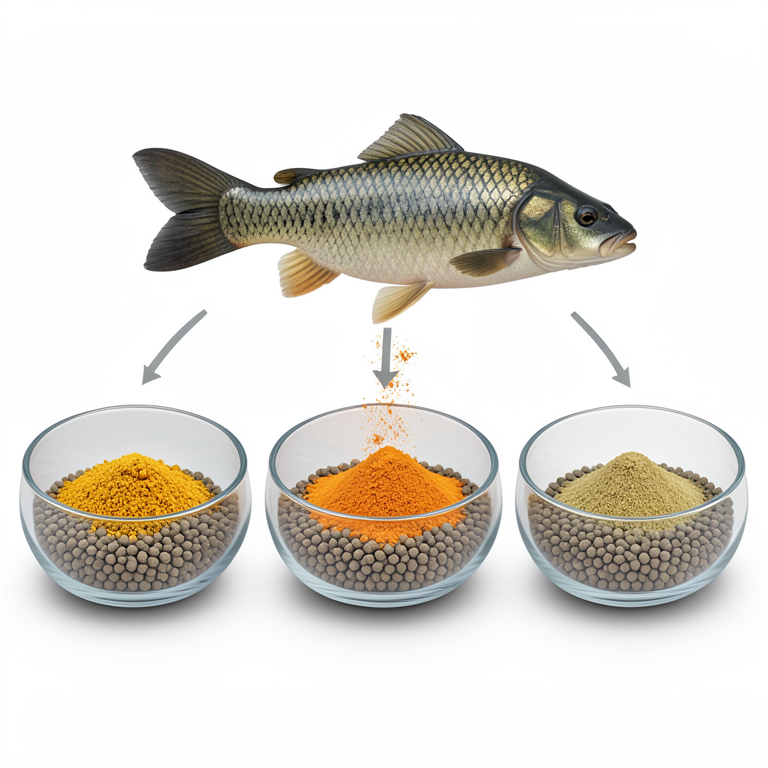
Dietary Supplementation Effect
AI-generated conceptual illustration (Rohu fish (Labeo rohita) and pumpkin seed powder). It explains the idea and does not show study data.
View source evidence ↗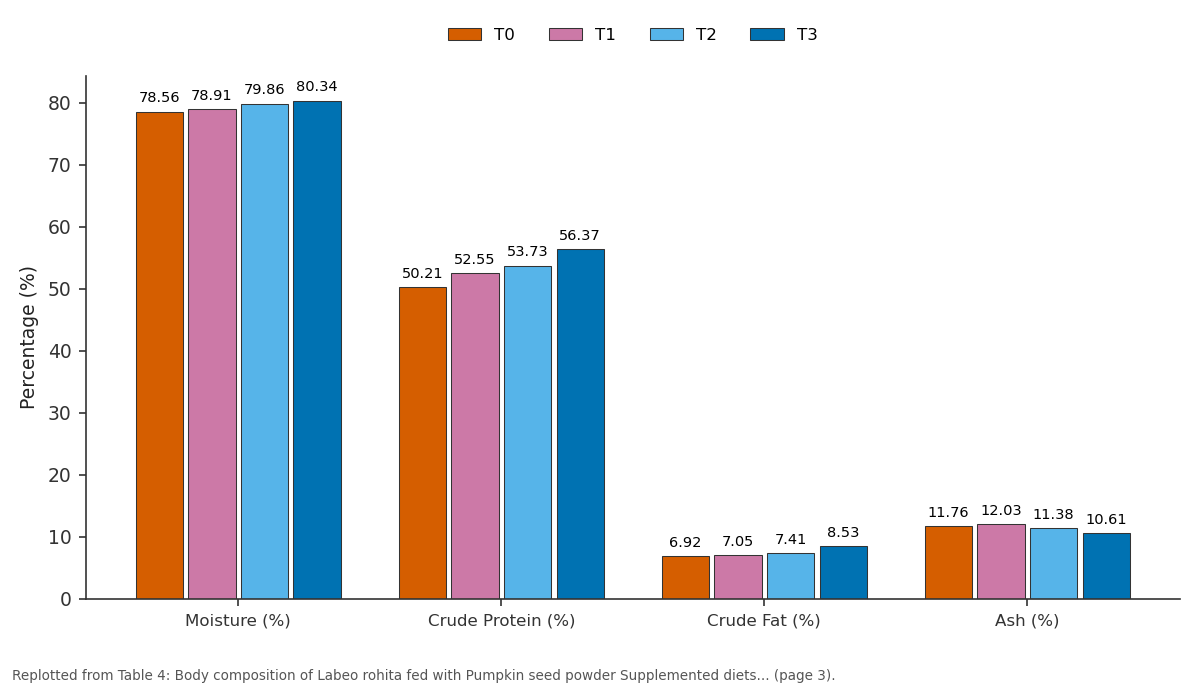
T0 and T1 and more: Moisture (%) vs Crude Protein (%) vs Crude Fat (%) vs Ash (%)
Replotted from Table 4 (page 3) of the original paper. Every bar is the paper's own table value.
View source evidence ↗Figures & tables
From the original paper Table 1
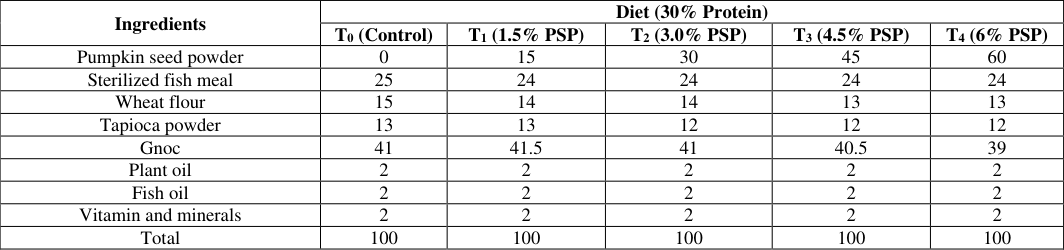 Table 2
 Table 3
 Table 4
Introduction
The aquaculture industry plays an essential role in ensuring a steady fish supply amid the ongoing decline of the capture fisheries sector. Over the past decades, the production of aquatic animals has witnessed remarkable growth, rising from 19 million tonnes (Live weight equivalent) in 1950 to an unprecedented 185 million tonnes in 2022, with an average annual growth rate of 3.2% (FAO, 2024). Notably, global aquaculture production in 2022 reached 130.9 million tonnes, reflecting an increase of 8.1 million tonnes compared to the 122.8 million tonnes reported in 2020. Rohu (Labeo rohita) is the most prominent among the three Indian major carp species commonly used in carp polyculture systems. Its popularity in aquaculture stems from its rapid growth rate, adaptability to diverse environmental conditions, and high market demand. The growth of fish at various stages is largely determined by factors such as feed type, feeding frequency, feed intake, and nutrient absorption capacity (Abid & Ahmed, 2009) [1] . As an omnivorous species, farmed rohu thrives on a diet with a protein content of 30-35% and It is high in protein, vitamin A, Omega-3 fatty acids and essential amino acids (Rasal & Sundaray, 2020) [12] . Medicinal plants have been proven as growth promoters. The introduction has the properties of growthpromoting ability, a tonic to improve the immune system, antimicrobial capability, and stimulating appetite and anti-stress characteristics (Citarasu et al., 2010) [3] . Pumpkin is a well-known edible plant with substantial medicinal properties due to its unique natural edible substances (Yadav et al., 2010) [17] . Pumpkin belongs to the genus Cucurbita, family Cucurbitaceae, and economically important species are Cucurbita moschata, Cucurbita maxima, Cucurbita ficifolia, Cucurbita pepo, Cucurbita mixta and Telfairia occidentalis (Singh & Kumar et al., 2023) [15] . Pumpkin seeds have been used traditionally for herbal, medicinal, and clinical purposes. They contain several useful functional components. Safe antibiotic and deworming medicines have been made from pumpkin seeds (Dubey and Dubey, 2012) [7] . Pumpkin seeds may be small, but they are rich in beneficial nutrients and nutraceuticals, including amino acids, phytosterols, unsaturated fatty acids, phenolic compounds, tocopherols, cucurbitacins, and essential minerals (Dotto et al., 2020) [6] . However, pumpkin seeds also contain antinutritional and potentially toxic compounds such as polyphenols, flavonoids, tannins, and cyanogenic glycosides (Del Vechio et al., 2005) [5] . Despite this, they are rich in nutrients, containing approximately 30% crude protein (Sharma et al., 1986; Esuoso et al., 1998) [14,8] . Utilizing cost-effective, readily available, and nutrient-dense terrestrial resources like Cucurbita maxima seeds is essential for the efficient formulation of fish feed.
Materials and Methods
The experiment was conducted at the Department of Aquaculture, College of Fisheries Science, Veraval to "Supplementation of Pumpkin Cucurbita maxima seed powder as a feed additive on growth, survival and immune response of rohu, Labeo rohita (HAMILTON, 1822)". The experiment was conducted in 20 rectangular plastic aquarium tanks, each measuring (size 2 x 1 x 1 feet). All tanks were thoroughly cleaned and disinfected with potassium permanganate (KMnO4) before use. They were then filled with 40 liters of filtered and disinfected freshwater. Adequate aeration was provided in all 20 experimental tanks. The Labeo rohita seed was sourced from a commercial IMC hatchery and transported to the experimental facility in polythene bags. Upon arrival at the college, the seed was acclimatized in a 500-liter FRP tank with continuous aeration and feeding for 7 days. Fish with an average weight of 1.310±0.009 grams were selected for the experiment.
Experimenatal diet preparation
Five distinct experimental diets were formulated based on the different treatment groups. Treatment groups include T 0 (control, no Pumpkin seed powder (PSP)), T 1 with (1.5% PSP), T 2 (3% PSP), T 3 (4.5% PSP) and T 4 (6% PSP). The required ingredients were collected and precisely weighed according to the feed formula in Table 2. The feed mixture was then subjected to heat treatment at 121 °C under 15 lbs of pressure for 15 minutes. The resulting mixture was then pressed into uniform pellets using a mechanical pelletizer.
| Ingredients | Diet (30% Protein) | — | — | — | — |
|---|---|---|---|---|---|
| T0 (Control) | T1 (1.5% PSP) | T2 (3.0% PSP) | T3 (4.5% PSP) | T4 (6% PSP) | |
| Pumpkin seed powder | 0 | 15 | 30 | 45 | 60 |
| Sterilized fish meal | 25 | 24 | 24 | 24 | 24 |
| Wheat flour | 15 | 14 | 14 | 13 | 13 |
| Tapioca powder | 13 | 13 | 12 | 12 | 12 |
| Gnoc | 41 | 41.5 | 41 | 40.5 | 39 |
| Plant oil | 2 | 2 | 2 | 2 | 2 |
| Fish oil | 2 | 2 | 2 | 2 | 2 |
| Vitamin and minerals | 2 | 2 | 2 | 2 | 2 |
| Total | 100 | 100 | 100 | 100 | 100 |
Table text extracted from the original PDF; superscript letters are shown inline. The original table image is below.
View original table image
To prevent spoilage, the pellets were dried until their moisture content was less than 10%.
Proximate Analysis of Ingredients
The proximate composition of the ingredients was analyzed using the standard method of AOAC (2019). The composition of the experimental diet was formulated using Pearson's square method at a 30% protein level. The formula for the experimental diets, including their percentage composition, is detailed in Table 2 based on the treatment specifications. During the experimental period, Labeo rohita was fed twice daily at 5% of its body weight. The feed used contained 30% protein. Key parameters measured include Total erythrocyte, leukocyte counts and respiratory burst activity across all five treatment groups.
Immune Response
The total erythrocyte count (TEC) was conducted following the method outlined by Lal (2010) [10] . The total leucocyte count (TLC) was carried out using the method of Shah & Altindag (2005) [13] . The respiratory burst activity of phagocytes was measured using the nitroblue tetrazolium (NBT) assay. Carcass composition was measured at last. Completely Randomised Design (CRD) experimental design will be used in the experiment and estimate the arithmetic mean, standard deviation, and coefficient of variation using standard statistical Methods (Snedecor & Cochran, 2014) [16] . The collected data was analyzed using a one-way analysis of variance (ANOVA) to identify significant differences between the means. The statistical analysis was performed using IBM SPSS version 22 software.
Results
The study examines Immunological parameters in L. rohitafed diets with varying levels of pumpkin seed powder.
Effect of dietary pumpkin seed powder on immune response of Labeo rohita
In this experiment, pumpkin seed powder's impact on Labeo rohita immunity was examined by evaluating factors like respiratory burst activity, total erythrocyte count (TEC), total leukocyte count (TLC) and respiratory burst activity. Blood samples were taken using a 26-gauge needle and mixed with an anticoagulant to conduct the immune assessment.
Effect of Pumpkin seed powder on Total erythrocytes counts (TEC) of L. Rohita
At 60 days, the highest Total erythrocyte count was in T 3 (2.10±0.127), and the lowest in T 0 (1.36±0.012). T 3 and T 4 had significantly higher counts (p>0.05). Musthafa et al.
(2017) [11] found that pumpkin seed meal enhanced immune activities in fish, while Dada and Abiodun, (2014) [4] showed that T. occidentalis leaf powder improved growth and erythrocyte count in fish when added to feed.
Effect of Pumpkin seed powder on Total leucocyte count (TLC) of L. Rohita
The Total leucocyte count after 60 days is shown in Table 3, with the highest count in T3 (30.44±0.217) and the lowest in T0 (22.5±0.29). Dada and Abiodun (2014) [4] found that supplementing Nile tilapia with 2.5 g/kg powdered pumpkin extract improved growth, feed utilization, white blood cell counts, and overall hematological health. Fish fed the fluted pumpkin extract had better white blood cell counts and immune protection compared to the control group, suggesting enhanced feed efficiency and immune defense.
| Treatments | Total Erythrocytes count 106 cells/mm-3 | Total Leucocytes count 103 cells/mm-3 | Respiratory burst activity |
|---|---|---|---|
| T0 | 1.36±0.012c | 25.01±0.114e | 0.37±0.006c |
| T1 | 1.42±0.022c | 26.19±0.158d | 0.39±0.014c |
| T2 | 1.52±0.011c | 28.67±0.112c | 0.46±0.015b |
| T3 | 2.10±0.127a | 30.44±0.217a | 0.52±0.016a |
| T4 | 1.82±0.019b | 29.57±0.402b | 0.50±0.010a |
Table text extracted from the original PDF; superscript letters are shown inline. The original table image is below.
View original table image
Effect of Pumpkin seed powder on Reparatory burst activity of Labeo rohita
After 60 days, the highest respiratory burst activity in Labeo rohita was observed in T 3 and T 4 , with no significant difference (p>0.05). Lower values were recorded in T 0 and T 1 , also without significant differences. Diets with 4.5% and 6% pumpkin seed powder enhanced immunity, consistent with Musthafa et al. (2017) [11] , who reported improved respiratory burst activity and immune benefits from pumpkin seed meal, attributed to its rich essential fatty acid content. Supplementing with 4 g/kg and 6 g/kg of pumpkin seed meal.
Effect of pumpkin seed powder supplemented diet on body composition of Labeo rohita
The proximate composition of Labeo rohita, analyzed after the experiment, is shown in Table 4. The fresh fish meat was carefully minced for accuracy.
| Parameters | T0 | T1 | T2 | T3 | T4 |
|---|---|---|---|---|---|
| Moisture (%) | 78.56 | 78.91 | 79.86 | 80.34 | 79.77 |
| Crude Protein (%) | 50.21 | 52.55 | 53.73 | 56.37 | 55.81 |
| Crude Fat (%) | 6.92 | 7.05 | 7.41 | 8.53 | 8.24 |
| Ash (%) | 11.76 | 12.03 | 11.38 | 10.61 | 10.97 |
Table text extracted from the original PDF; superscript letters are shown inline. The original table image is below.
View original table image
To analyze the protein content in the samples, the micro Kjeldahl technique was used. Treatment group T 3 had the highest protein (50.21%). These results demonstrate how the dietary profiles of the various treatment groups differed.
Physico-Chemical water parameters
Water quality was checked every week during the experiment. It was in the ideal range throughout the experiment. Temperature, pH, dissolved oxygen, hardness and Alkalinity were measured by the standard analytic methods (APHA, 2017).
Conclusion
The study concluded that supplementing the Labeo rohita diet with pumpkin seed powder (PSP) positively immune response. Immune response, assessed through respiratory burst activity, total erythrocyte count (TEC), and total leukocyte count (TLC), was enhanced with 4.5% and 6% PSP, with T 3 showing the highest TEC and TLC. The study concluded that 4.5% PSP supplementation improved immune performance in Labeo rohita, yielding the best outcomes.
Figures and tables from the paper
| Ingredients (%) | Crude protein (%) | Crude fat (%) | Ash (%) | Moisture (%) |
|---|---|---|---|---|
| Fishmeal | 55.03 | 4.20 | 15.20 | 7.91 |
| Pumpkin seed powder (PSP) | 24.12 | 22.17 | 3.31 | 6.184 |
| Wheat flour | 11.94 | 1.3 | 5.32 | 9.81 |
| GNOC | 35.56 | 4.92 | 8.07 | 7.19 |
| Tapioca | 4.81 | 0.61 | 0.14 | 8.13 |
Table text extracted from the original PDF; superscript letters are shown inline. The original table image is below.
View original table image
References
15 in the original paper- Abid M, Ahmed MS. Efficacy of feeding frequency on growth and survival of Labeo rohita (Ham.) fingerlings under intensive rearing. J Anim Plant Sci. 2009;19(2):111-113.
- Citarasu T. Herbal biomedicines: a new opportunity for aquaculture industry. Aquac Int. 2010;18(3):403-414.
- Dada AA, Abiodun AD. Effect of dietary fluted pumpkin (Telfairia occidentalis) extract on growth performance, body composition, and hematological parameters of Nile tilapia (Oreochromis niloticus Linnaeus). J Fish. 2014;2(3):203-208.
- Del-Vechio G, Correa AD, Abreu CMPD, Santos CDD. Effect of the thermal processing on pumpkin seeds (Cucurbita spp.) on the levels of antinutritional factors and/or toxics. Ciênc Agrotecnol. 2005;29(2):369-376.
- Dotto JM, Chacha JS. The potential of pumpkin seeds as a functional food ingredient: A review. Sci Afr. 2020;10:e00575:1-14.
- Dubey SD, Dubey S. Overview on Cucurbita maxima. Int. J Phytopharm. 2012;2(3):68-71.
- Esuoso K, Lutz H, Kutubuddin M, Bayer E. Chemical composition and potential of some underutilized tropical biomass. I: fluted pumpkin (Telfairia occidentalis). Food Chem. 1998;61(4):487-492.
- Food and Agriculture Organization (FAO). The State of World Fisheries and Aquaculture 2024. Blue Transformation in action. Rome; 2024. Available from: https://doi.org/10.4060/cd0683en
- Lal S, Mahajan A, Ning Chen W, Chowbay B. Pharmacogenetics of target genes across doxorubicin disposition pathway: A review. Curr Drug Metab. 2010;11(1):115-128.
- Musthafa MS, Ali ARJ, Kumar MSA, Paray BA, AlSadoon MK, Balasundaram C, et al. Effect of Cucurbita mixta (L.) seed meal enrichment diet on growth, immune response and disease resistance in Oreochromis mossambicus. Fish Shellfish Immunol. 2017;68:509-515.
- Rasal KD, Sundaray JK. Status of genetic and genomic approaches for delineating biological information and improving aquaculture production of farmed rohu, Labeo rohita (Ham, 1822). Rev Aquac. 2020;12(4):2466-2480.
- Shah SL, Altindag A. Alteration in the immunological parameters of tench (Tinca tinca) after acute and chronic exposure to lethal and sublethal treatments with mercury, cadmium and lead. Turk J Vet Anim Sci. 2005;29(5):1163-1168.
- Sharma PB, Lal BM, Madaan TR, Chatterjee SR. Studies on the nutritional quality of some cucurbit proteins. J Sci Food Agric. 1986;37(4):418-420.
- Singh A, Kumar V. Pumpkin seeds as nutraceutical and functional food ingredient for future: A review. Grain Oil Sci Technol. 2023;163:226.
- Yadav M, Jain S, Tomar R, Prasad GBKS, Yadav H. Medicinal and biological potential of pumpkin: An updated review. Nutr Res Rev. 2010;23(2):184-190.