
Research article · 2025 · Full text
International Journal of Agriculture and Food ScienceEffect of bioenzyme and chitosan on the growth and quality of Strawberry (Fragarai x Ananasa Dutch)
Volume 7(2) · Pages 01–03 · DOI: 10.33545/2664844x.2025.v7.i2a.270 ↗
Research areasPineapple and bromelain studiesPlant Growth Enhancement TechniquesGrowth and nutrition in plants
Abstract
Author-writtenBio enzyme and chitosan are two new bio stimulants intended to increase strawberry production. As customer demand for safer and healthier products grows, these materials are increasingly employed as agrochemical substitutes. The study aimed to find out the response of bio enzyme and chitosan on the growth and quality of strawberries. The present study was carried out in the year 2021-22 in Central Research farm, Department of Horticulture, Shri Durga Ji Post Graduate College, Chandeshwar, Azamgarh, Uttar Pradesh. The experiment was carried out in a randomized block design which was replicated thrice. The treatments were T1 (Control), T2 (25 ppm Chitosan), T3 (50 ppm Chitosan), T4 (25 ppm Bioenzyme), T5 (25 ppm Bioenzyme + 25 ppm Chitosan), T6 (25 ppm bioenzyme+ 50 ppm chitosan), T7 (50 ppm bioenzyme), T8 (50 ppm bioenzyme+25 ppm chitosan), T9 (50 ppm bioenzyme+50 ppm chitosan). From the present investigation, it can be concluded that treatment T9 (50 ppm bioenzyme+50 ppm chitosan) was found to be best in terms of plant height, plant spread, number of flowers, number of fruits, days to first flowering and fruiting, fruit length, fruit weight, total soluble solids (0B) and ascorbic acid (mg/100 g). According to the current study's findings, chitosan, a biostimulant made from the naturally occurring chitin present in the cell walls of fungi and crustaceans, and Biozyme, an extract from seaweed, can be utilized as ecologically beneficial agents at their lowest rates. Without requiring artificial inputs, these biostimulants support the sustainable production of premium strawberries.
Summary
Source-checkedPlain-language reading of the full paper, prepared with AI and checked against the text. Each point links to the authors' own words.
Why it matters
- Strawberries are globally important fruit crops due to their economic significance and wide cultivation. View evidence ↗
- The production of strawberries is often hindered by environmental stressors, pests, and diseases, which typically lead to a reliance on agrochemicals. View evidence ↗
- There is an increasing demand for pesticide-free produce, driving interest in biostimulants as sustainable alternatives to synthetic chemicals. View evidence ↗
The question
- The research aimed to determine how the application of bioenzyme and chitosan affects the growth and quality of strawberries. View evidence ↗
What they did
- The experiment was conducted during 2021-22 at the Central Research farm in Azamgarh, Uttar Pradesh. View evidence ↗
- The study utilized a randomized block design with three replications. View evidence ↗
- Nine treatments were tested, ranging from a control (T1) to various concentrations (25 ppm and 50 ppm) of chitosan, bioenzyme, and their combinations. View evidence ↗
What they found
- Treatment T9 (50 ppm bioenzyme + 50 ppm chitosan) produced the maximum plant height (up to 23.65 cm at 120 DAT), outperforming the control (22.62 cm at 120 DAT). View evidence ↗
- T9 (50 ppm bioenzyme + 50 ppm chitosan) resulted in the greatest plant spread, reaching 21.27 cm at 120 DAT compared to 18.18 cm for the control. View evidence ↗
- The highest number of flowers was observed in T9 (43.21 flowers), while the control T1 had the lowest (26.32 flowers). View evidence ↗
- T9 (50 ppm bioenzyme + 50 ppm chitosan) yielded the most fruits (35.17), significantly more than the control (19.26 fruits). View evidence ↗
- T9 (50 ppm bioenzyme + 50 ppm chitosan) accelerated flowering, with the first flowers appearing in 37.26 days, compared to 49.16 days for the control. View evidence ↗
- Fruit length was greatest in T9 (4.42 cm) and lowest in the control T1 (3.01 cm). View evidence ↗
- T9 (50 ppm bioenzyme + 50 ppm chitosan) produced the heaviest fruits (25.72 g), while the control produced the lightest (18.37 g). View evidence ↗
- The highest total soluble solids (TSS) were found in T9 (8.78 0B), compared to the control (7.28 0B). View evidence ↗
- T9 (50 ppm bioenzyme + 50 ppm chitosan) resulted in the highest ascorbic acid content (48.95 mg/100g), while the control had the lowest (36.19 mg/100g). View evidence ↗
What it means
- The authors concluded that the combination of 50 ppm bioenzyme and 50 ppm chitosan (T9) is the most effective treatment for improving strawberry growth, yield, and quality. View evidence ↗
- The authors recommend bioenzymes and chitosan as environmentally sustainable tools for improving crop performance in modern agriculture. View evidence ↗
Visual summary
2 visualsIllustrations explain the paper; charts are replotted from the paper's own table values.
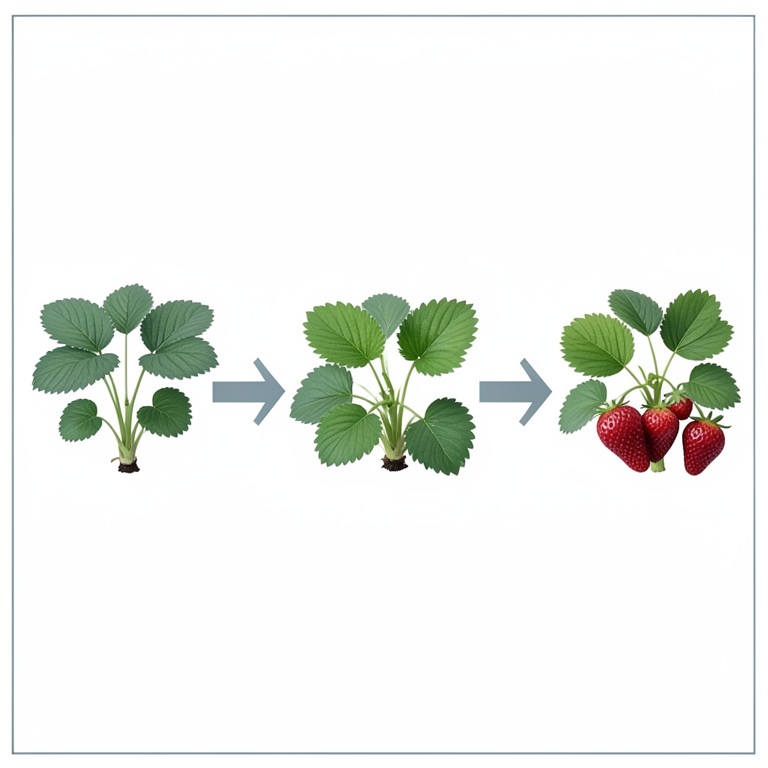
Experimental Treatment Layout
AI-generated conceptual illustration (Strawberry plants (Fragaria x ananassa)). It explains the idea and does not show study data.
View source evidence ↗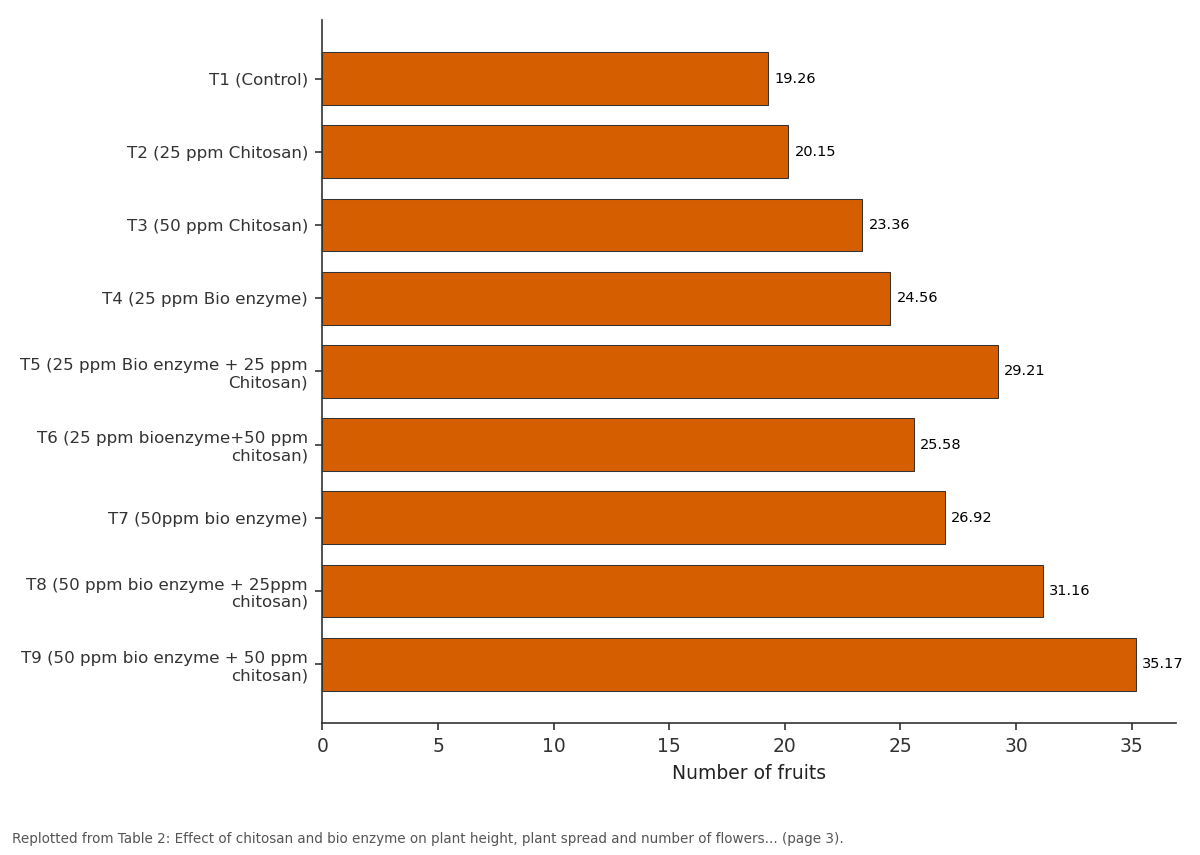
Number of fruits: T1 (Control) vs T2 (25 ppm Chitosan) vs T3 (50 ppm Chitosan) vs T4 (25 ppm Bio enzyme) vs T5 (25 ppm Bio enzyme +...
Replotted from Table 2 (page 3) of the original paper. Every bar is the paper's own table value.
View source evidence ↗Figures & tables
From the original paper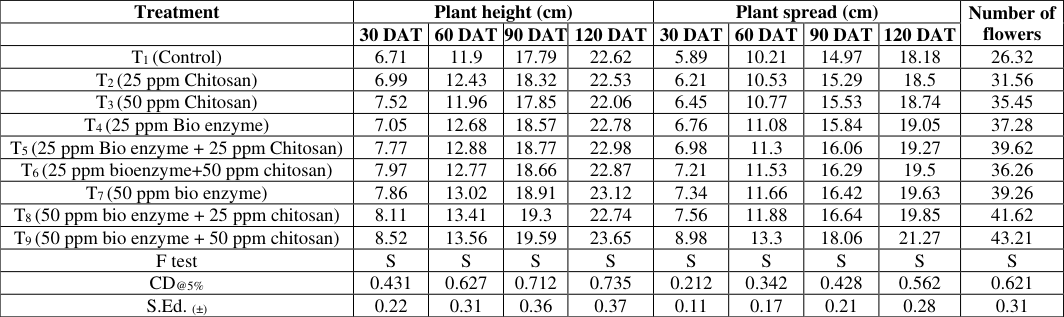 Table 1
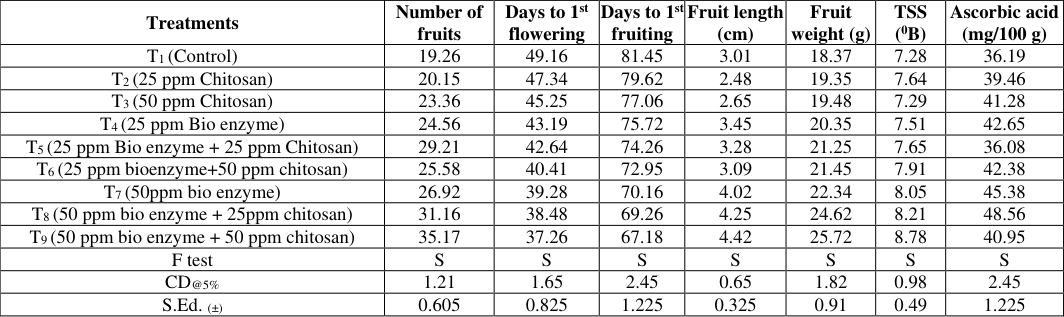 Table 2
Introduction
Strawberry (Fragaria × ananassa) is one of the most widely cultivated and economically significant fruit crops worldwide. Its popularity can be attributed to its nutritional value, pleasant taste, and versatility in various food products Khan et al., 2009) [7] . However, strawberry production faces several challenges, including susceptibility to pests, diseases, and environmental stressors, which often necessitate the use of agrochemicals. The growing consumer demand for healthier, pesticide-free produce has led to increased interest in sustainable agricultural practices, promoting the use of bio stimulants as viable alternatives to synthetic chemicals Kossak and Dyki, (2008) [8] . Bio stimulants, including natural substances such as bio enzymes and chitosan, are gaining recognition for their potential to enhance plant growth and improve the quality of crops. Bio enzyme, a seaweed extract, contains a rich array of bioactive compounds that stimulate plant growth, enhance nutrient uptake, and provide protection against environmental stressors Ghaouth et al., 1991 [12] . Chitosan, a biopolymer derived from chitin found in the shells of crustaceans and fungal cell walls, has been shown to possess antimicrobial, growthpromoting, and stress-reducing properties in various crops Kumar et al., (2023) [10] . These bio stimulants are considered environmentally friendly and have the potential to replace or reduce the reliance on chemical inputs in agriculture Sakif et al., 2016 [13] . This study aims to explore the effect of bio enzyme and chitosan on the growth and quality of strawberries. By examining their influence on key parameters such as plant growth, fruit yield, and fruit quality, the research seeks to evaluate their effectiveness in enhancing strawberry production under sustainable agricultural practices. The findings could provide valuable insights into the use of these bio stimulants as alternative solutions for improving strawberry cultivation while minimizing the environmental impact associated with conventional farming practices Cardozo et.al. 2007 [3] .
Materials and Methods
The present study was conducted in Horticulture Research farm, Department of Horticulture, College of Agriculture, Azamgarh.
The study was carried out in the randomized block design which was replicated thrice. The treatments were T 1 (Control), T 2 (25 ppm Chitosan), T 3 (50 ppm Chitosan), T 4 (25 ppm Bio enzyme), T 5 (25 ppm Bio enzyme + 25 ppm Chitosan), T 6 (25 ppm bioenzyme+50 ppm chitosan), T 7 (50ppm bio enzyme), T 8 (50 ppm bioenzyme+25 ppm chitosan), T 9 (50ppm bioenzyme+50 ppm chitosan).
Results and Discussion
From Table 1 it can be inferred that the maximum plant height was recorded in the treatment T 9 (50 ppm bioenzyme+50 ppm chitosan) during experiments with the plant height of 8.52, 13.56, 19.59, and 23.65 cm at 30, 60, 90 and 120 days after transplanting which was followed by the treatment T 8 (50 ppm bio enzyme + 25 ppm chitosan) with the plant height of 8.11, 13.41, 19.30 and 22.74 cm which was statistically superior over T 1 (Control) with 6.71, 11.90, 17.79 and 22.62 cm at 30, 60, 90 and 120 days after transplanting respectively. The maximum plant spread was recorded in the treatment T 9 (50 ppm bioenzyme+50 ppm chitosan) during experiments with the plant height of 8.98, 13.30, 18.06, and 21.27 cm at 30, 60, 90 and 120 days after transplanting which was followed by the treatment T 8 (50ppm bio enzyme + 25ppm chitosan) with the plant height of 7.56, 11.88, 16.64 and 19.85 cm which was statistically superior over T 1 (Control) with 5.89, 10.21, 14.97 and 18.18 cm at 30, 60, 90 and 120 days after transplanting respectively. The vegetative growth of the strawberry plants during the growing season was considerably (p≤0.05) impacted by the application of chitosan and biozyme. The plants that were treated according to the treatment that was allocated to them significantly varied from each other and showed a significant impact on the vegetative growth of the plant. The combination of both biostimulants has an additive effect which leads to rapid somatic cell division which furthers promotes mitotic cell division increasing vegetative growth. The maximum number of flowers was recorded in T 9 (50 ppm bioenzyme +50 ppm chitosan) with 43.21 flowers which was followed by treatment T 8 (50 ppm bio enzyme + 25 ppm chitosan) with 41.26 flowers and the minimum number of flowers was recorded in the treatment T 1 (Control) with (26.32) flowers. The maximum number of fruits was recorded in T 9 (50 ppm bioenzyme+ 50 ppm chitosan) with 35.17 fruits which was followed by treatment T 8 (50 ppm bio enzyme + 25 ppm chitosan) with 31.16 fruits and the minimum number of flowers was recorded in the treatment T 1 (Control) with (19.26) fruits. The minimum number of days taken for 1 st flowering was recorded in the treatment T 9 (50 ppm bioenzyme+50 ppm chitosan) with 37.26 days which was followed by the treatment T 8 (50 ppm bio enzyme + 25 ppm chitosan) with 38.48 days and the maximum number of days taken for 1 st flowering was recorded in T 1 (Control) with 49.16 days. The minimum number of days taken for 1 st fruiting was recorded in the treatment T 9 (50 ppm bioenzyme+ 50 ppm chitosan) with 67.18 days which was followed by the treatment T 8 (50 ppm bio enzyme + 25 ppm chitosan) with 69.26 days and the maximum number of days taken for 1 st flowering was recorded in T 1 (Control) with 81.45 days. The application of biozyme and chitosan rates had a substantial impact on the quantity of flowers and fruit produced by each plant. In comparison to the control, more blooms and fruits were seen on the treated plants. Decreased flower drops and increased fruit set may result from cytokinin and auxin-induced delays in abscission, which preserve the loss of pectin material in the middle lamella and improve resilience to nutrition and water stress (Kachave and Bhosale, 2007) [6] . Additionally, biozyme improved metabolite mobilisation to the flowers and photosynthesis (Bhatia and Kaur, 1997) [2] . The outcomes concur with those of Gore et al. (2007) and Kumar et al. (2000) [5,9] , who found that the use of biozyme considerably raised the yield of chilli. The maximum length of fruits was recorded in T 9 (50 ppm bioenzyme+50 ppm chitosan) with 4.42 cm which was followed by treatment T 8 (50 ppm bio enzyme + 25 ppm chitosan) with 4.25 cm and the minimum number of flowers was recorded in the treatment T 1 (Control) with 3.01 cm. The maximum weight of fruits was recorded in T 9 (50 ppm bioenzyme+ 50 ppm chitosan) at 25.72 g which was followed by treatment T 8 (50 ppm bio enzyme + 25 ppm chitosan) with 24.62 g and the minimum number of flowers was recorded in the treatment T 1 (Control) with 18.37 g. The application of biozyme and chitosan had a substantial impact on the length and diameter of strawberry fruits. The treated plots with the lowest rates of biozyme and chitosan produced the longest fruit length and diameter compared to the control. This increase in fruit size following the application of biozyme and chitosan might be attributed to the ability of auxins (NAA) to drive cell division and cell expansion in fruits. Biozyme promotes cell activation and differentiation, leading to increased floral buds and fruit production. Using biozyme during fruit growth promotes the creation of more epidermal cells, leading to larger and more commercially stable fruits. This study found that applying varied dosages of chitosan to the strawberry canopy improved vegetative growth, fruit output, and quality compared to the untreated control. Chitosan has been shown to reduce pre-and post-harvest diseases and boost production in ornamental and horticultural crops globally (Pichyangkura et al., 2015) [11] . The maximum total soluble solids of fruits was recorded in T 9 (50ppm bioenzyme+50 ppm chitosan) at 8.78 0 B which was followed by treatment T 8 (50 ppm bio enzyme + 25 ppm chitosan) with 8.21 0 B and the minimum number of flowers was recorded in the treatment T 1 (Control) with 7.28 0 B. The maximum ascorbic acid of fruits was recorded in T 9 (50 ppm bioenzyme+ 50 ppm chitosan) at 48.95 mg/100g which was followed by treatment T 8 (50 ppm bio enzyme + 25 ppm chitosan) with 47.56 mg/100 g and the minimum number of flowers was recorded in the treatment T 1 (Control) with 36.19 mg/100 g.
| Treatment | Plant height (cm) | — | — | — | Plant spread (cm) | — | — | — | Number of flowers |
|---|---|---|---|---|---|---|---|---|---|
| 30 DAT | 60 DAT | 90 DAT | 120 DAT | 30 DAT | 60 DAT | 90 DAT | 120 DAT | ||
| T1 (Control) | 6.71 | 11.9 | 17.79 | 22.62 | 5.89 | 10.21 | 14.97 | 18.18 | 26.32 |
| T2 (25 ppm Chitosan) | 6.99 | 12.43 | 18.32 | 22.53 | 6.21 | 10.53 | 15.29 | 18.5 | 31.56 |
| T3 (50 ppm Chitosan) | 7.52 | 11.96 | 17.85 | 22.06 | 6.45 | 10.77 | 15.53 | 18.74 | 35.45 |
| T4 (25 ppm Bio enzyme) | 7.05 | 12.68 | 18.57 | 22.78 | 6.76 | 11.08 | 15.84 | 19.05 | 37.28 |
| T5 (25 ppm Bio enzyme + 25 ppm Chitosan) | 7.77 | 12.88 | 18.77 | 22.98 | 6.98 | 11.3 | 16.06 | 19.27 | 39.62 |
| T6 (25 ppm bioenzyme+50 ppm chitosan) | 7.97 | 12.77 | 18.66 | 22.87 | 7.21 | 11.53 | 16.29 | 19.5 | 36.26 |
| T7 (50 ppm bio enzyme) | 7.86 | 13.02 | 18.91 | 23.12 | 7.34 | 11.66 | 16.42 | 19.63 | 39.26 |
| T8 (50 ppm bio enzyme + 25 ppm chitosan) | 8.11 | 13.41 | 19.3 | 22.74 | 7.56 | 11.88 | 16.64 | 19.85 | 41.62 |
| T9 (50 ppm bio enzyme + 50 ppm chitosan) | 8.52 | 13.56 | 19.59 | 23.65 | 8.98 | 13.3 | 18.06 | 21.27 | 43.21 |
| F test | S | S | S | S | S | S | S | S | S |
| CD@5% | 0.431 | 0.627 | 0.712 | 0.735 | 0.212 | 0.342 | 0.428 | 0.562 | 0.621 |
| S.Ed. (±) | 0.22 | 0.31 | 0.36 | 0.37 | 0.11 | 0.17 | 0.21 | 0.28 | 0.31 |
Table text extracted from the original PDF; superscript letters are shown inline. The original table image is below.
View original table image
Conclusion
In the present study, the combined application of bioenzyme and chitosan was investigated to assess its impact on strawberry growth and quality. Among the treatments tested, T 9 (50 ppm bioenzyme + 50 ppm chitosan) consistently outperformed others in enhancing vegetative growth, yield, and fruit quality. This study aims to highlight the synergistic effect of these biostimulants in optimizing strawberry production while maintaining ecological balance. Both bioenzymes and chitosan are environmentally sustainable and exhibit the potential to improve crop performance, making them ideal for modern agricultural practices.
Figures and tables from the paper
| Treatments | Number of fruits | Days to 1st flowering | Days to 1st fruiting | Fruit length (cm) | Fruit weight (g) | TSS (0B) | Ascorbic acid (mg/100 g) |
|---|---|---|---|---|---|---|---|
| T1 (Control) | 19.26 | 49.16 | 81.45 | 3.01 | 18.37 | 7.28 | 36.19 |
| T2 (25 ppm Chitosan) | 20.15 | 47.34 | 79.62 | 2.48 | 19.35 | 7.64 | 39.46 |
| T3 (50 ppm Chitosan) | 23.36 | 45.25 | 77.06 | 2.65 | 19.48 | 7.29 | 41.28 |
| T4 (25 ppm Bio enzyme) | 24.56 | 43.19 | 75.72 | 3.45 | 20.35 | 7.51 | 42.65 |
| T5 (25 ppm Bio enzyme + 25 ppm Chitosan) | 29.21 | 42.64 | 74.26 | 3.28 | 21.25 | 7.65 | 36.08 |
| T6 (25 ppm bioenzyme+50 ppm chitosan) | 25.58 | 40.41 | 72.95 | 3.09 | 21.45 | 7.91 | 42.38 |
| T7 (50ppm bio enzyme) | 26.92 | 39.28 | 70.16 | 4.02 | 22.34 | 8.05 | 45.38 |
| T8 (50 ppm bio enzyme + 25ppm chitosan) | 31.16 | 38.48 | 69.26 | 4.25 | 24.62 | 8.21 | 48.56 |
| T9 (50 ppm bio enzyme + 50 ppm chitosan) | 35.17 | 37.26 | 67.18 | 4.42 | 25.72 | 8.78 | 40.95 |
| F test | S | S | S | S | S | S | S |
| CD@5% | 1.21 | 1.65 | 2.45 | 0.65 | 1.82 | 0.98 | 2.45 |
| S.Ed. (±) | 0.605 | 0.825 | 1.225 | 0.325 | 0.91 | 0.49 | 1.225 |
Table text extracted from the original PDF; superscript letters are shown inline. The original table image is below.
View original table image
References
11 in the original paper- Abou El-Yazied A, El-Gizawy AM, Ragab MI, Hamed ES. Effect of seaweed extract and compost treatments on growth, yield and quality of snap bean. J Am Sci. 2012;8(6):1-20.
- Bhatia DS, Kaur J. Effect of homobrassinolide and humicil on chlorophyll content, hill activity and yield components in mungbean (Vigna radiata L. Wilczek). Phytomorphol. 1997;47:421-426.
- Cardozo K, Guaratini T, Barros MP, Falcão VR, Tonon AP, Lopes NP, et al. Metabolites from algae with economical impact. Comp Biochem Physiol C. 2007;146:60-78.
- Gore AK, Jadhav SB, Gore AK, Ghuge TD. Effect of different bio-enzymes on growth, flowering and yield of green chilli (Capsicum annuum L.) variety "Pusa Jwala". J Soils Crops. 2007;17:105-109.
- Kachave DB, Bhosale AM. Effect of plant growth regulators and micronutrients on fruiting and yield parameters of Kagzi lime (Citrus aurantifolia Swingle) fruits. Asian J Hort. 2007;2:75-79.
- Khan W, Rayirath UP, Subramanian S, Jithesh MN, Rayorath P, Hodges DM, et al. Seaweed extracts as biostimulants of plant growth and development. J Plant Growth Regul. 2009;28:386-399.
- Kumar R, Bakshi P, Srivastava JN. Fruit Cracking: A Challenging Problem of Fruit Industry. Krishi Sandesh. 2010..
- Kumar AS, Malik K. Standardization of fermentation process for mass production of fungal chitosan using agro-industrial waste. Int J Adv Biochem Res. 2023;7(2):5-11. DOI:10.33545/26174693.2023.v7.i2a.180
- Pichyangkura R, Chadchawan S. Biostimulant activity of chitosan in horticulture. Scientia Hort. 2015;196:4965.
- El Ghaouth A, Arul J, Ponnampalam R, Boulet M. Chitosan coating effect on storability and quality of fresh strawberries. Journal of food science. 1991 Nov;56(6):1618-1620.
- Sakif TI, Dobriansky A, Russell K, Islam T. Does chitosan extend the shelf life of fruits?. Advances in Bioscience and Biotechnology. 2016;7(08):337.