
Research article · 2025 · Full text
International Journal of Agriculture and Food ScienceCoinoculation effect of endophytic PGPR and Rhizobium for Pigeonpea yield performance
Volume 7(1) · Pages 240–242 · DOI: 10.33545/2664844x.2025.v7.i1d.261 ↗
Research areasLegume Nitrogen Fixing SymbiosisSoybean genetics and cultivationPlant Growth and Agriculture Techniques
Abstract
Author-writtenTo assess the effect of endophytic PGPR and Rhizobium on yield of Pigeonpea, a trial was laid out at National Pulse Research Centre using different strains viz., received from various AICRP centres. A total of nine treatments comprising of Rhizobium (Local best), Rhizobium+V4RB1 Pseudomonas marginalis (Ludhiana), Rhizobium + V4RB3 Serratialiquefaciens (Ludhiana), Rhizobium + PPR-46 Pantoea sp. (Kanpur), Rhizobium + PPR-57C Burkholderia sp. (Kanpur), Rhizobium + KP-3(Kalaburagi), Rhizobium + KP- 1(Kalaburagi), N asper RDF and control. PGPR promotes plant growth through nutrient mobilization, growth hormone secretion and protects the plants from pest/diseases. Pigeonpea seeds were treated with all the PGPR along with the local best Rhizobium BMBS 47 strains. Observations were recorded at 45th DAS to assess their effect on plant growth parameters viz., number of nodules /plants, root length and shoot length and nodule dry weight and yield parameters at harvest. Among the multifunctional rhizobacteria Rhizobium + PPR-46 Pantoea sp. (Kanpur) recorded a greater number of nodules/plant (18.66/plant) and nodule dry weight (18.16 g/plant) which is higher than other rhizobacteria. This was followed by Rhizobium + PPR-57C Burkholderia sp. (Kanpur) which recorded 17.00 nodules /plant. Uninoculated control recorded the least nodulation as 09.66 plant which is significantly lesser than all the other treatments. Crop was harvested at 65 DAS and yield parameters viz., number of pods per plant, plant dry weight and yield were recorded and tabulated (Table 4). The Rhizobium + PPR-46 Pantoea sp. (Kanpur) treatments recorded higher values for number of pods/plant (99 pods/plant) and plant dry weight (156.66g/plant) when compared to the uninoculated control. Among the different rhizobacteria Rhizobium + PPR-46 Pantoea sp. (Kanpur) inoculated treatment recorded the highest yield of 1064 kg/ha followed by Rhizobium + PPR-57C Burkholderia sp. (Kanpur).
Summary
Source-checkedPlain-language reading of the full paper, prepared with AI and checked against the text. Each point links to the authors' own words.
Why it matters
- Pigeonpea is a globally significant pulse crop, ranking fifth worldwide and second in India. View evidence ↗
- As a pulse crop, pigeonpea helps improve soil fertility, which benefits the productivity of subsequent crops. View evidence ↗
- While chemical fertilizers increase productivity, their excessive use can damage soil health and the ecosystem. View evidence ↗
The question
- The study aimed to investigate how co-inoculating pigeonpea with Plant Growth Promoting Rhizobacteria (PGPR) and Rhizobium strains affects growth, nodulation, and dry matter yield. View evidence ↗
What they did
- The trial was conducted at the National Pulse Research Centre using various strains obtained from AICRP centres. View evidence ↗
- The researchers used the VBN 3 variety of pigeonpea in a Randomized Block design consisting of nine treatments with three replicates. View evidence ↗
- Growth parameters, including root and shoot length, nodule number, and nodule dry weight, were measured at 45 days after sowing (DAS). View evidence ↗
What they found
- The combination of Rhizobium + PPR-46 Pantoea sp. (Kanpur) achieved the highest nodule count (18.66/plant) and nodule dry weight (18.16 g/plant). View evidence ↗
- The uninoculated control had the lowest nodulation at 9.66 per plant, which was significantly lower than all other treatments. View evidence ↗
- Compared to the control, the Rhizobium + PPR-46 Pantoea sp. (Kanpur) treatment resulted in more pods per plant (99) and a higher plant dry weight (156.66 g/plant). View evidence ↗
- The highest crop yield was recorded for the Rhizobium + PPR-46 Pantoea sp. (Kanpur) treatment at 1064 kg/ha, followed by the Rhizobium + PPR-57C Burkholderia sp. (Kanpur) treatment. View evidence ↗
What it means
- The authors conclude that using effective PGPR and Rhizobium strains increases pod yield by enhancing nodulation. View evidence ↗
- The authors suggest that biofertilizers serve as a cost-effective and eco-friendly supplement to chemical fertilizers. View evidence ↗
Visual summary
2 visualsIllustrations explain the paper; charts are replotted from the paper's own table values.
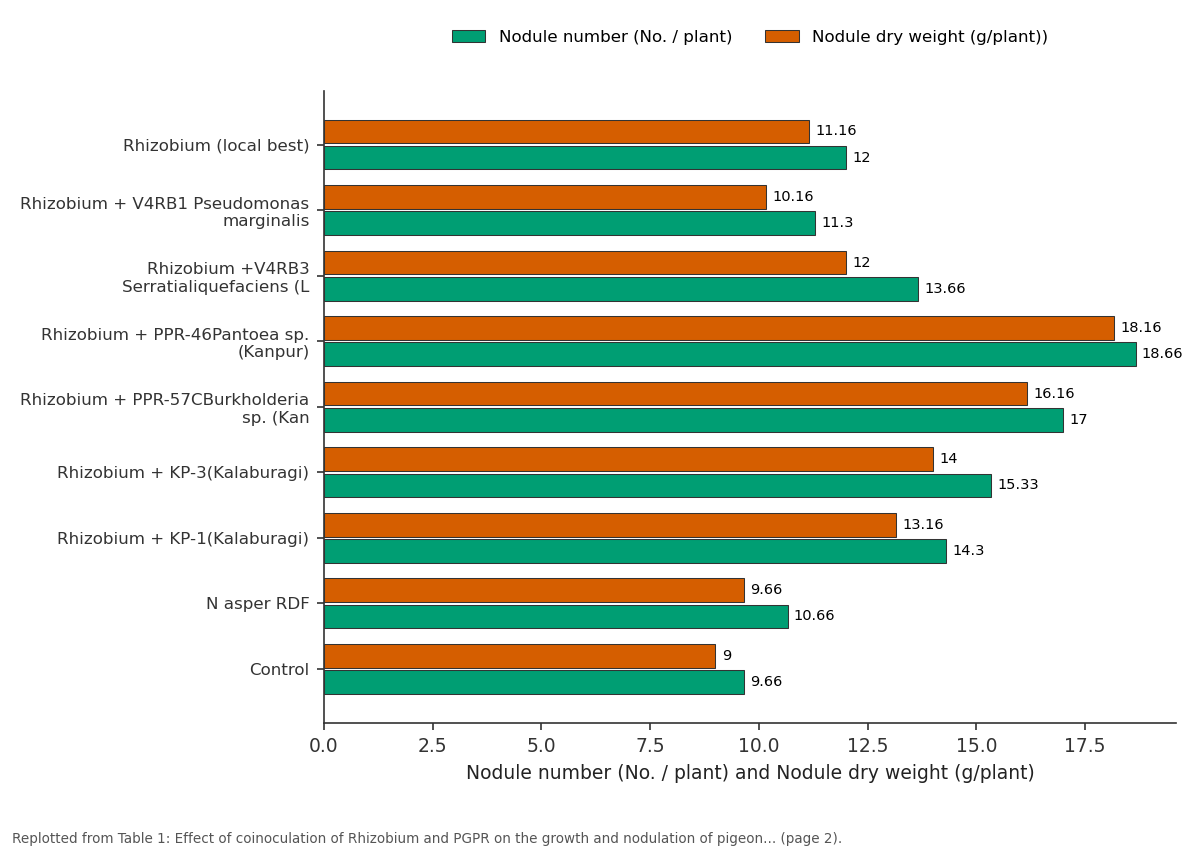
Nodule number (No. / plant) and Nodule dry weight (g/plant)): Rhizobium (local best) vs Rhizobium + V4RB1... vs Rhizobium +V4RB3... vs Rhizobium +... vs Rhizobium +...
Replotted from Table 1 (page 2) of the original paper. Every bar is the paper's own table value.
View source evidence ↗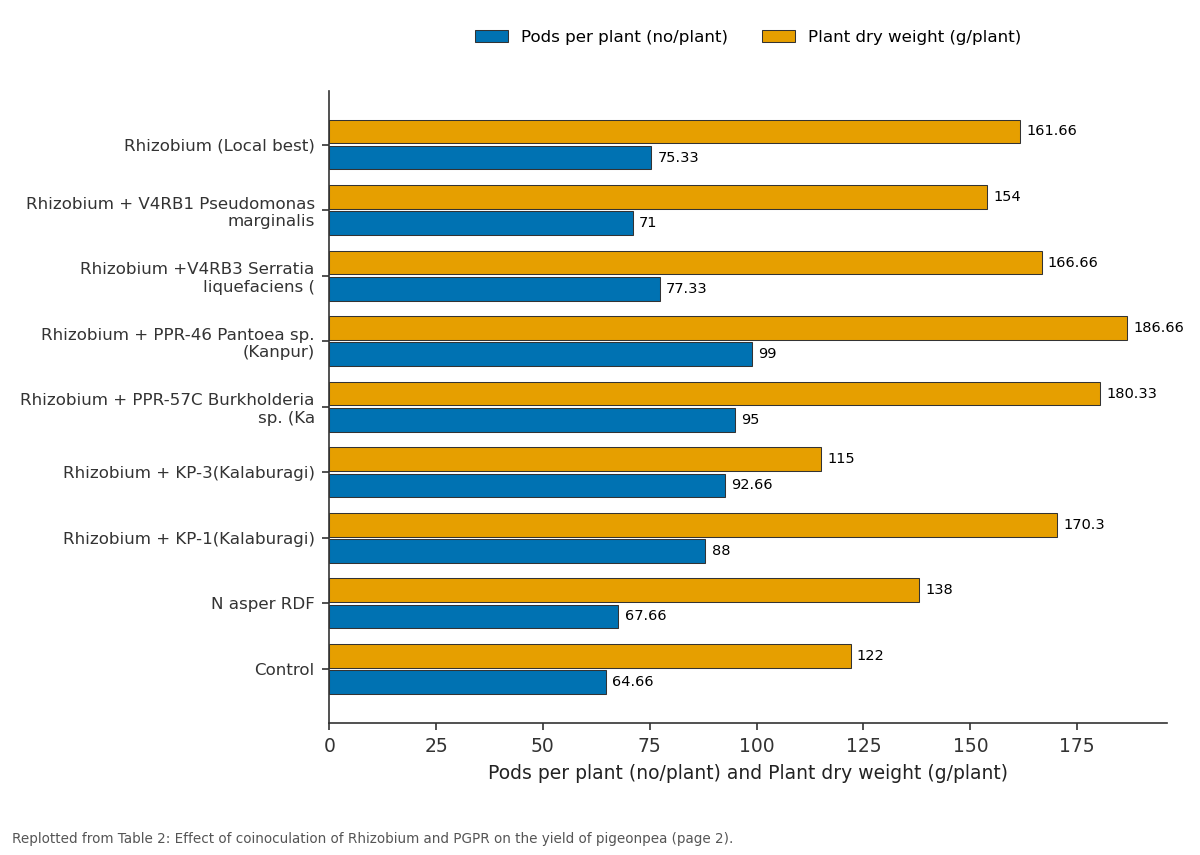
Pods per plant (no/plant) and Plant dry weight (g/plant): Rhizobium (Local best) vs Rhizobium + V4RB1... vs Rhizobium +V4RB3... vs Rhizobium + PPR-46... vs Rhizobium + PPR-57C...
Replotted from Table 2 (page 2) of the original paper. Every bar is the paper's own table value.
View source evidence ↗Figures & tables
From the original paper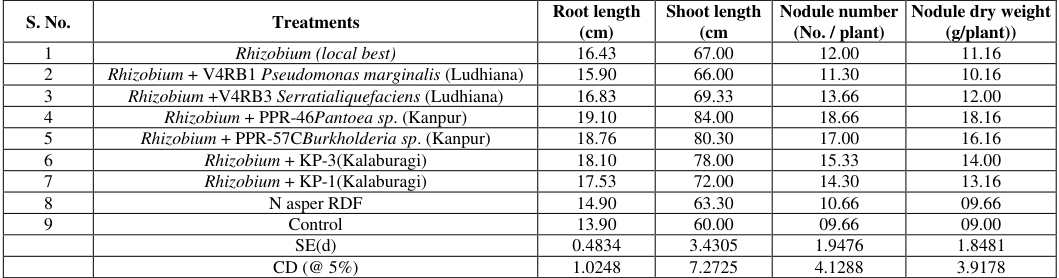 Table 1
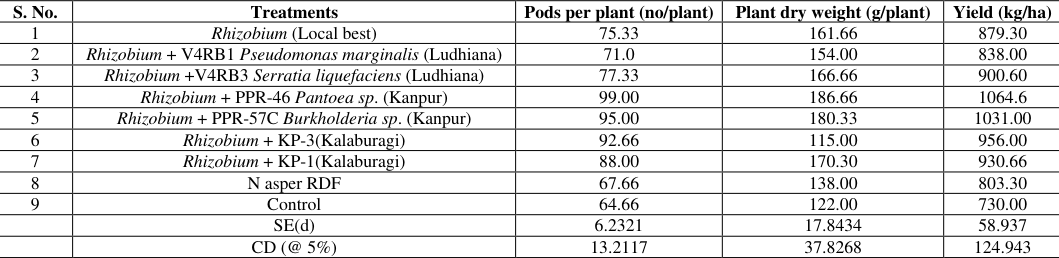 Table 2
Introduction
Pigeonpea (Cajanus cajan L. Millsp.) is the fifth prominent pulse crop in the world and second in India after chickpea. Being a pulse, it plays an important role for improving the soil fertility and consequently the productivity of succeeding crops. To meet the demands of pulse crops of ever-increasing population of our country, it is necessary to improve the production and productivity of pulse crops. In order to increase the production further there is no other option except to increase productivity by using available resources most efficiently. Fertilizers use continued to play a key role in augmenting higher crop productivity but reckless use of it deteriorates soil health, energy conserving ecosystem and economics. It has been realized that not only chemical fertilizers but also organic manures in conjunction with biofertilizers will sustain and maintain the productivity of soil. Therefore, it is needed to compare various organic as well as biological sources of nutrients with chemical fertilizers in order to find out most effective combination. Keeping this objective in view, the present investigation was conducted to study the co-inoculation of PGPR with Rhizobium strains on growth, nodulation and dry matter yield of pigeonpea.
Materials and Methods
To assess the effect of multifunctional rhizobacteria on yield of pigeonpea, a trial was laid out using different multifunctional rhizobacteria received from various AICRP centres. The variety chosen for experiment was VBN 3 in Randomized Block design with nine treatments in three replicates. The details of the experiment is given below.
Experimental field
Pigeon pea seeds were treated with all the PGPR along with the local best Rhizobium BMBS 47 strains. Observations were recorded at 45 th DAS to assess their effect on plant growth parameters viz., number of nodules /plants, root length and shoot length and nodule dry weight and yield parameters at harvest.
Results and Discussion
Seed inoculation with biofertilizers significantly increased the growth parameters viz., plant height and number of branches per plant at harvest and number of root nodules at 30, 60 and 90 DAS as well as yield attributes viz., number of pods per plant, number of grains per pod, grain yield per plant and test weight of pigeon pea crop as compared to control. Among the multifunctional rhizobacteria Rhizobium + PPR -46 Pantoea sp. (Kanpur) recorded a greater number of nodules/plant (18.66/plant) and nodule dry weight (18.16 g/plant) which is higher than other rhizobacteria. This was followed by Rhizobium + PPR-57C Burkholderia sp. (Kanpur) which recorded 17.00 nodules /plant. Uninoculated control recorded the least nodulation as 09.66 plant which is significantly lesser than all the other treatments. 1). Those results agreed with the findings of A.B. Patil* and D.R. Padmani,2007 and showed that the biofertilizers inoculation resulted in greater nodulation resulted in increased availability of fixed as well as applied nitrogen and phosphorus to the plants, which in turn encourage cell formation, division and multiplication. The beneficial effect of these inoculations on yield attributes seem to be due to better availability of nutrient and their translocation, which reflect in terms of increased yield attributes of pigeonpea. Also similar findings agreed with the result of Podile (1995) [2] , suggested that increasing nodulation in pigeonpea (18-24%) by the inoculation of seeds with Bacillus subtilis over control. This may be due to produce many plant growth promoting substance like IAA, gibberellic acids and vitamins etc., which help in the synthesis of nodular tissue. Crop was harvested at 65 DAS and yield parameters viz., number of pods per plant, plant dry weight and yield were recorded and tabulated (Table 4). The Rhizobium + PPR-46Pantoea sp. (Kanpur) treatments recorded higher values for number of pods/plant (99 pods/plant) and plant dry weight (156.66g/plant) when compared to the uninoculated control. Among the different rhizobacteria Rhizobium + PPR-46Pantoea sp. (Kanpur) inoculated treatment recorded the highest yield of 1064 kg/ha followed by Rhizobium + PPR-57CBurkholderia sp. (Kanpur) (Table 2).
| S. No. | Treatments | Pods per plant (no/plant) | Plant dry weight (g/plant) | Yield (kg/ha) |
|---|---|---|---|---|
| 1 | Rhizobium (Local best) | 75.33 | 161.66 | 879.30 |
| 2 | Rhizobium + V4RB1 Pseudomonas marginalis (Ludhiana) | 71.0 | 154.00 | 838.00 |
| 3 | Rhizobium +V4RB3 Serratia liquefaciens (Ludhiana) | 77.33 | 166.66 | 900.60 |
| 4 | Rhizobium + PPR-46 Pantoea sp. (Kanpur) | 99.00 | 186.66 | 1064.6 |
| 5 | Rhizobium + PPR-57C Burkholderia sp. (Kanpur) | 95.00 | 180.33 | 1031.00 |
| 6 | Rhizobium + KP-3(Kalaburagi) | 92.66 | 115.00 | 956.00 |
| 7 | Rhizobium + KP-1(Kalaburagi) | 88.00 | 170.30 | 930.66 |
| 8 | N asper RDF | 67.66 | 138.00 | 803.30 |
| 9 | Control | 64.66 | 122.00 | 730.00 |
| SE(d) | 6.2321 | 17.8434 | 58.937 | |
| CD (@ 5%) | 13.2117 | 37.8268 | 124.943 |
Table text extracted from the original PDF; superscript letters are shown inline. The original table image is below.
View original table image
Appreciable increase in number of pods per plant and grains per pod (Table 1) as a result of fertilizer application might have reflected in increased grain yield whereas, improvement in growth parameters viz., plant height and number of branches per plant (Table 1) due to fertilizer application might have resulted in higher stover yield.
| S. No. | Treatments | Root length (cm) | Shoot length (cm | Nodule number (No. / plant) | Nodule dry weight (g/plant)) |
|---|---|---|---|---|---|
| 1 | Rhizobium (local best) | 16.43 | 67.00 | 12.00 | 11.16 |
| 2 | Rhizobium + V4RB1 Pseudomonas marginalis (Ludhiana) | 15.90 | 66.00 | 11.30 | 10.16 |
| 3 | Rhizobium +V4RB3 Serratialiquefaciens (Ludhiana) | 16.83 | 69.33 | 13.66 | 12.00 |
| 4 | Rhizobium + PPR-46Pantoea sp. (Kanpur) | 19.10 | 84.00 | 18.66 | 18.16 |
| 5 | Rhizobium + PPR-57CBurkholderia sp. (Kanpur) | 18.76 | 80.30 | 17.00 | 16.16 |
| 6 | Rhizobium + KP-3(Kalaburagi) | 18.10 | 78.00 | 15.33 | 14.00 |
| 7 | Rhizobium + KP-1(Kalaburagi) | 17.53 | 72.00 | 14.30 | 13.16 |
| 8 | N asper RDF | 14.90 | 63.30 | 10.66 | 09.66 |
| 9 | Control | 13.90 | 60.00 | 09.66 | 09.00 |
| SE(d) | 0.4834 | 3.4305 | 1.9476 | 1.8481 | |
| CD (@ 5%) | 1.0248 | 7.2725 | 4.1288 | 3.9178 |
Table text extracted from the original PDF; superscript letters are shown inline. The original table image is below.
View original table image
The increase in grain yield may be attributed to the reason that chemical fertilizers along with FYM possibly increased the concentrations of N, P and K ions of soil solution and ultimately affected the formation of more nodules, vigrous root development, better N fixation and better development of plant growth leading to higher photosynthetic activity and translocation of photosynthates to the sink which in turn resulted in better development of yield attributes and finally in higher grain yield. The results are substantiated with the studies conducted by Rao et al. (1983) and Thakur et al.
Conclusion
Biofertilizers are cheaper, eco-friendly and based on renewable energy sources has gained momentum to supplement the parts of chemical fertilizer (Meena et al., 2015a). Inoculation with an effective and persistent PGPR and Rhizobium strains has numerous benefits, which increase the pod yield due to increased nodulation. The results agreed with the same findings showed that inoculation of PSB strains increased the yield of pigeonpea (Podile, 1995) [2] . The use of farm derived source such as FYM has extensively been used in various crops. These organic additives can be used to promote the development of beneficial organisms in the soil, water holding capacity and cation exchange capacity (Singh et al., 2008) [5] . Organic amendment also increases the efficiency of biofertilizers
Acknowledgement
AcknowledgmentsWe would like to sincerely thank the corresponding author for their valuable support throughout this work. I am also immensely grateful to the ICAR -AICRP scheme for providing the financial assistance necessary to conduct the field trial. Additionally, we appreciate the coauthor for their essential logistical support, which contributed significantly to the success of this project Compliance with ethical standards
References
5 in the original paper- Patil AB, Padmani DR. Effect of integrated nutrient management on growth and yield of pigeonpea (Cajanus cajan L. Millsp.). Int J Agric Sci. 2007;3(2):49-51.
- Podile AR. Seed bacterization with Bacillus subtilis AF1 enhances seedling emergence, growth and nodulation of pigeonpea. Indian J Microbiol. 1995;35:199-204.
- Rao YY, Reddy G, Ramasubba C, Ramaseshaish K. Response of rabi red gram to different levels of fertility. Andhra Agric J. 1983;30:196-199.
- Thakur HS, Raghuwanshi RKS, Verma RS, Verma GP. Effect of fertilizer doses and plant density on yield of pigeonpea. Adv Crops Monit Environ Process Ecol. 1988;10:373-377.
- Singh A, Singh VK, Rana NS, Kumar S, Panwar GS, Kumar Y. Response of urdbean to farmyard manure and phosphorus application under urdbean-wheat cropping sequence. J Food Legumes. 2008;21:119-121.
Cited by 1
From OpenAlex, OpenCitations and reference lists read by Scinovex
- Optimizing groundnut cultivation through integrated crop management enhances seasonal yields and economic returns ↗
Chandra Sekhar Praharaj, Aaradhana Chilwal, Keval Hirapara, Kiran Reddy · Scientific Reports · 2026
Abstract Given study aimed at enhancing groundnut ( Arachis hypogaea L.) productivity through the integration of available, time-tested and cost-effective Best Management Practices (BMPs) under the semi-arid conditions of Gujarat, India during the 2022 and 2023 spring-summer and rainy seasons. A field experiment evaluated three management practices for optimizing productivity: (1) Farmers’ Practice (Control), (2) Progressive Farmers’ Practice, and (3)…
❝ 0PDF