
Research article · 2025 · Full text
International Journal of Biology SciencesMultifunctional rhizobacteria with Rhizobium for yield maximization in mungbean
Volume 7(1) · Pages 171–173 · DOI: 10.33545/26649926.2025.v7.i1c.286 ↗
Research areasLegume Nitrogen Fixing SymbiosisSoybean genetics and cultivationPlant Growth and Agriculture Techniques
Abstract
Author-writtenTo assess the effect of multifunctional rhizobacteria on yield of mungbean, a trial was laid out using different multifunctional rhizobacteria viz., Kalaburagi (GUR5 & GUR8), Akola (WUR 12-1), Vamban (VUC), and Pantnagar (A-3, P-5 & PUR 34), received from various AICRP centres. A total of four multifunctional rhizobacteria were obtained from three different AICRP centres viz., Pantnagar, Coimbatore and Ludhiana. Multifunctional rhizobacteria promotes plant growth through nutrient mobilization, growth hormone secretion and protects the plants from pest/diseases. Mungbean seeds were treated with all the multifunctional rhizobacteria along with the local best Rhizobium BMBS 47. Observations were recorded at 45th DAS to assess their effect on plant growth parameters viz., number of nodules /plants, root length and shoot length and nodule dry weight and yield parameters at harvest. Among rhizobacteria Methylobacterium (Coimbatore) recorded a greater number of nodules/plant (53.3/plant) and nodule dry weight (0.069 g/plant) which is higher than other rhizobacteria. This was followed by NE 10 (Bacillus cereus) (Pantnagar Ch.) which recorded 44.3 nodules/plant and nodule dry weight (0.057 g/plant). Uninoculated control recorded the least nodulation as 23/plant which is significantly lesser than all the other treatments. Among the different rhizobacteria Methylobacterium (Coimbatore) inoculated treatment recorded the higher yield of 1115.3 kg/ha followed by NE 10 (Bacillus cereus) (Pantnagar Ch.) (990 kg/ha).
Summary
Source-checkedPlain-language reading of the full paper, prepared with AI and checked against the text. Each point links to the authors' own words.
Why it matters
- Nitrogen fixation via the symbiosis between legumes and Rhizobium is economically important for increasing agricultural productivity. View evidence ↗
- Plant growth-promoting rhizobacteria (PGPR) can improve plant nutrition by mobilizing phosphorus and boosting native rhizobia populations. View evidence ↗
- Multifunctional rhizobacteria support plant growth by secreting growth hormones, mobilizing nutrients, and providing protection against diseases and pests. View evidence ↗
The question
- The study aimed to evaluate how different multifunctional rhizobacteria affect the yield of mungbean. View evidence ↗
What they did
- Field experiments were performed during kharif 2022 in red sandy loam soil with a pH of 7.3. View evidence ↗
- The study used a Randomized Block Design with seven treatments, each replicated three times in plots measuring 4.0 x 3.0 m. View evidence ↗
- Mungbean seeds of variety VBN8 were treated with inoculants at a rate of 200 g per 10 kg of seeds during sowing. View evidence ↗
- Growth parameters (nodule number, root length, shoot length, and nodule dry weight) were measured at 45 days after sowing (DAS), with yield parameters recorded at harvest. View evidence ↗
What they found
- Methylobacterium (Coimbatore) achieved the highest nodulation with 53.3 nodules per plant and a nodule dry weight of 0.069 g/plant. View evidence ↗
- NE 10 (Bacillus cereus) from Pantnagar Ch. had the second-highest results, with 44.3 nodules per plant and a nodule dry weight of 0.057 g/plant. View evidence ↗
- The uninoculated control showed the lowest nodulation at 23 nodules per plant, which was significantly lower than all other treatments. View evidence ↗
- The highest yield was recorded for the Methylobacterium (Coimbatore) treatment at 1115.3 kg/ha, followed by NE 10 (Bacillus cereus) at 990 kg/ha. View evidence ↗
- All inoculated treatments resulted in a higher number of pods per plant and greater plant dry weight compared to the uninoculated control. View evidence ↗
What it means
- The authors conclude that these rhizobacteria strains can be used in agricultural products as a cost-effective alternative for farmers to increase legume production. View evidence ↗
Visual summary
1 visualsIllustrations explain the paper; they do not show study data.
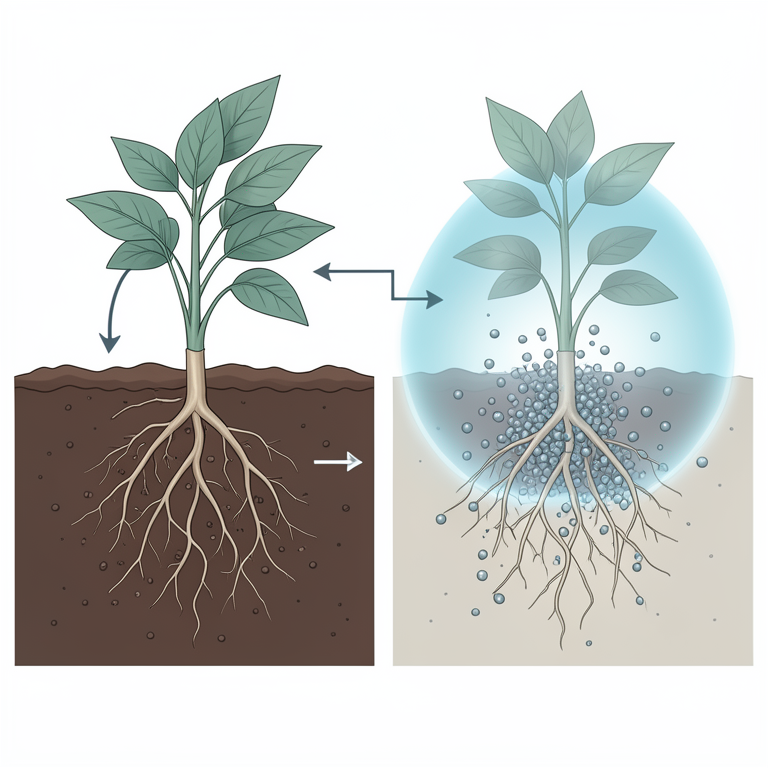
Mechanism of Multifunctional Rhizobacteria
AI-generated conceptual illustration (mungbean plants). It explains the idea and does not show study data.
View source evidence ↗Figures & tables
From the original paper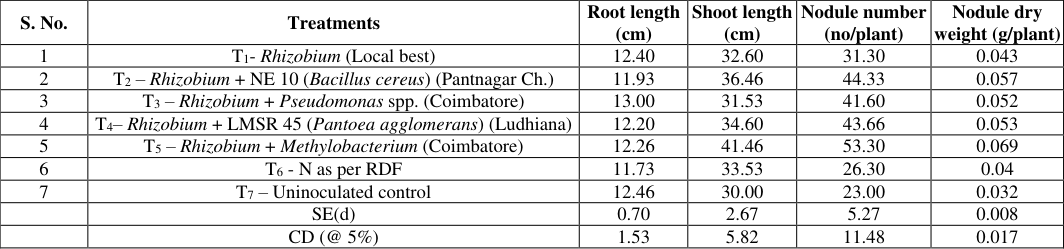 Table 1
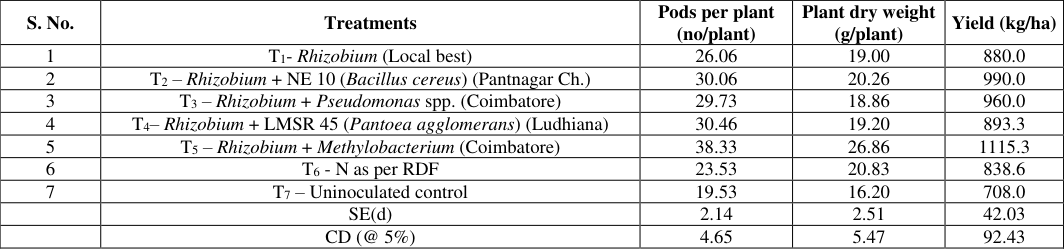 Table 2
Introduction
Nitrogen (N) fixation through the symbiotic relationship between legumes and Rhizobium is essential for enhancing agricultural productivity and carries significant economic importance. Recent studies indicate that other beneficial soil bacteria can positively affect the performance of rhizobia in this symbiosis. Inoculating plants with selected plant growthpromoting rhizobacteria (PGPR) can boost the native populations of rhizobia and help mobilize phosphorus (P) from sources that are not easily available, thereby improving plant nutrition (Richardson et al., 2009) [8] . Notably, Paenibacillus polymyxa and Bacillus megaterium have proven particularly effective in promoting growth and phosphorus uptake in tomatoes (Ei-Yazeid and Abou-Aly, 2011) [3] . Moreover, the growth and yield of legumes improve significantly with Rhizobium inoculation. Research shows that co-inoculating plants with phosphorus-solubilizing bacteria and Rhizobium stimulates plant growth more effectively than either treatment alone (Walpola and Yoon, 2013) [12] . For instance, Bai et al. (2003) [1] found that co-inoculating soybean plants with Bacillus strains and Bradyrhizobium japonicum resulted in significant increases in nodule number, nodule weight, shoot weight, root weight, total biomass, total nitrogen, and grain yield. Additionally, non-rhizobial plant growth-promoting bacteria can enhance nodulation and grain yield in legumes when co-inoculated with specific crop rhizobia. Furthermore, Remans et al. (2007) [7] observed that the ability of Rhizobium isolates to nodulate bean plants increased when phosphate-solubilizing bacteria were applied simultaneously. Silva et al. (2007) [10] reported that co-inoculating Vigna unguiculata with Bradyrhizobium sp., Paenibacillus polymyxa, and Bacillus sp. led to specific stimulation of nodulation and increased root dry matter. Lastly, endophytic plant growth-promoting bacteria and nitrogen-fixing Rhizobium species can work synergistically to enhance nitrogen fixation efficiency in lentils (Saini and Khana, 2012) [9] .
Materials and Methods
To assess the performance of Rhizobium strains at various locations, a trial was laid out with Rhizobium strains received from various AICRP centres. The experimental details are mentioned below. The field experiments were conducted during kharif 2022 in red sandy loam soil of pH 7. Among rhizobacteria Methylobacterium (Coimbatore) recorded more number of nodules/plant (53.3/plant) and nodule dry weight (0.069 g/plant) which is higher than other rhizobacteria. This was followed by NE 10 (Bacillus cereus) (Pantnagar Ch.) which recorded 44.3 nodules/plant and nodule dry weight (0.057 g/plant). Uninoculated control recorded the least nodulation as 23/plant which is significantly lesser than all the other treatments (Table 6).
Experimental field
The results corroborated with the findings of Korir et al., 2017 [4] , concluded that co-inoculation of the rhizobia strains with the PGPR generally enhanced the nodulation of common bean compared to single rhizobial inoculation. Bacillus megaterium + IITA-PAU 987 and B. megaterium + CIAT 899 resulted in extra abundant nodulation of the common bean. This was followed by IITA-PAU 983 + Bacillus megaterium IITA-PAU 983 + P. polymyxa that recorded abundant nodulation. However, inoculation with CIAT 899 alone recorded a higher nodulation compared to CIAT 899 + P. polymyxa and IITA-PAU 987 + P. polymyxa. This implies that different PGPR vary in their ability to increase nodulation when coinoculated with the rhizobia strains with co-inoculation with B. megaterium showing higher response than P. polymyxa. Inoculation of common beans with rhizobial strains significantly increased the number of nodules of common bean over the control. The rhizobia inoculated treatment had abundant nodulation with the control having moderate nodulation. Application of mineral nitrogen recorded the least (Few) number of nodules. Co-inoculation of rhizobia strains with the PGPR increased the nodule fresh weight as compared to single rhizobia inoculation. Root nodules accommodate various non-nodulating bacteria having definite influence on the survival, nodulation, and grain yield of crop (Mishra et al., 2009) [5] reported the isolation of Paenibacillus polymyxa HKA-15, a Grampositive bacterium from root nodules of soybean. A total of 75 endophytic bacteria isolated from nodules of field pea and 88 from nodules of chickpea showed that 93.4% in were Gram positive (Narula et al., 2013) [6] . Diep et al. (2016) [2] also isolated endophytic bacteria in soybean root nodules. Crop was harvested at 65 DAS and yield parameters viz., number of pods per plant, plant dry weight and yield were recorded and tabulated (Table 2). The inoculated treatments recorded higher values for number of pods/plant and plant dry weight when compared to the uninoculated control. Among the different rhizobacteria Methylobacterium (Coimbatore) inoculated treatment recorded the higher yield of 1115.3 kg/ha followed by NE 10 (Bacillus cereus) (Pantnagar Ch.) (990 kg/ha). The results agreed with the yield parameters of Verma et al. (2012) [11] suggested that the plants grown with combination showed increased root and shoot weight suggesting a promising way for enhancing the growth of legume crops. aswellas showed significant results with the combination of Mesorhizobium sp. BHURC02 with B. megaterium, to be superior over uninoculated control. Results from the contrast analysis showed that co-inoculation of common bean with rhizobia strain and the two PGPR strains were comparable to mineral nitrogen addition. Therefore, these strains can be used in the formulation of agricultural product and provide cheaper alternative to farmers in production of common bean in such soils.
| S. No. | Treatments | Pods per plant (no/plant) | Plant dry weight (g/plant) | Yield (kg/ha) |
|---|---|---|---|---|
| 1 | T1- Rhizobium (Local best) | 26.06 | 19.00 | 880.0 |
| 2 | T2 – Rhizobium + NE 10 (Bacillus cereus) (Pantnagar Ch.) | 30.06 | 20.26 | 990.0 |
| 3 | T3 – Rhizobium + Pseudomonas spp. (Coimbatore) | 29.73 | 18.86 | 960.0 |
| 4 | T4– Rhizobium + LMSR 45 (Pantoea agglomerans) (Ludhiana) | 30.46 | 19.20 | 893.3 |
| 5 | T5 – Rhizobium + Methylobacterium (Coimbatore) | 38.33 | 26.86 | 1115.3 |
| 6 | T6 - N as per RDF | 23.53 | 20.83 | 838.6 |
| 7 | T7 – Uninoculated control | 19.53 | 16.20 | 708.0 |
| SE(d) | 2.14 | 2.51 | 42.03 | |
| CD (@ 5%) | 4.65 | 5.47 | 92.43 |
Table text extracted from the original PDF; superscript letters are shown inline. The original table image is below.
View original table image
Acknowledgement
AcknowledgmentsWe would like to sincerely thank the corresponding author for their valuable support throughout this work. I am also immensely grateful to the ICAR -AICRP scheme for providing the financial assistance necessary to conduct the field trial. Additionally, we appreciate the coauthor for their essential logistical support, which contributed significantly to the success of this project Compliance with ethical standards
Figures and tables from the paper
| S. No. | Treatments | Root length (cm) | Shoot length (cm) | Nodule number (no/plant) | Nodule dry weight (g/plant) |
|---|---|---|---|---|---|
| 1 | T1- Rhizobium (Local best) | 12.40 | 32.60 | 31.30 | 0.043 |
| 2 | T2 – Rhizobium + NE 10 (Bacillus cereus) (Pantnagar Ch.) | 11.93 | 36.46 | 44.33 | 0.057 |
| 3 | T3 – Rhizobium + Pseudomonas spp. (Coimbatore) | 13.00 | 31.53 | 41.60 | 0.052 |
| 4 | T4– Rhizobium + LMSR 45 (Pantoea agglomerans) (Ludhiana) | 12.20 | 34.60 | 43.66 | 0.053 |
| 5 | T5 – Rhizobium + Methylobacterium (Coimbatore) | 12.26 | 41.46 | 53.30 | 0.069 |
| 6 | T6 - N as per RDF | 11.73 | 33.53 | 26.30 | 0.04 |
| 7 | T7 – Uninoculated control | 12.46 | 30.00 | 23.00 | 0.032 |
| SE(d) | 0.70 | 2.67 | 5.27 | 0.008 | |
| CD (@ 5%) | 1.53 | 5.82 | 11.48 | 0.017 |
Table text extracted from the original PDF; superscript letters are shown inline. The original table image is below.
View original table image
References
12 in the original paper- Bai Y, Zhou-Xiao M, Smith DL. Enhanced soybean plant growth resulting from coinoculation of Bacillus strains with Bradyrhizobium japonicum. Crop Sci. 2003;43:1774-1781. DOI: 10.2135/cropsci2003.1774.
- Diep CN, My NTX, Nhu VTP. Isolation and characterization of endophytic bacteria in soybean root nodules. World J Pharm Pharm Sci. 2016;5:222-241.
- Ei-Yazeid AA, Abou-Aly HE. Enhancing growth, productivity and quality of tomato plants using phosphate solubilizing microorganisms. Aust J Basic Appl Sci. 2011;7:371-379.
- Korir H, Mungai NW, Thuita M, Hamba Y, Masso C. Co-inoculation effect of rhizobia and plant growth promoting rhizobacteria on common bean growth in a low phosphorus soil. Front Plant Sci. 2017;8:141. DOI: 10.3389/fpls.2017.00141.
- Mishra PK, Mishra S, Selvakumar G, Bishr JK, Kundu S, Gupta HS. Co-inoculation of Bacillus thuringiensisKR1 with Rhizobium leguminosarum enhances plant growth and nodulation of pea (Pisum sativum L.) and lentil (Lens culinaris L.). World J Microbiol Biotechnol. 2009;25:753-761. DOI: 10.1007/s11274-009-9963-z.
- Narula S, Anand RC, Dudeja SS. Beneficial traits of endophytic bacteria from field pea nodules and plant growth promotion of field pea. J Food Legume. 2013;26:73-79.
- Remans R, Croonenborghs A, Gutierrez RS, Michiels J, Vanderleyden J. Effects of plant growth-promoting rhizobacteria on nodulation of Phaseolus vulgaris L. are dependent on plant P nutrition. Eur J Plant Pathol. 2007;119:341-351. DOI: 10.1007/s10658-007-9154-4.
- Richardson AE, Barea JM, McNeill AM, PrigentCombaret C. Acquisition of phosphorus and nitrogen in the rhizosphere and plant growth promotion by microorganisms. Plant Soil. 2009;321:305-339. DOI: 10.1007/s11104-009-9895-2.
- Saini P, Khana V. Evaluation of native Rhizobacteria as promoters of plant growth for increased yields in lentils (Lens culinaris). Recent Res Sci Technol. 2012;4:5-9.
- Silva VN, Silva LESF, Martinez CR, Seldin L, Burity HA, Figueiredo MVB. Effect of Paenibacillus strains on specific nodulation in Bradyrhizobium-bacillus symbiosis. Acta Sci Agron. 2007;29:331-338.
- Verma JP, Yadav J, Tiwari KN. Enhancement of nodulation and yield of chickpea by co-inoculation of indigenous mesorhizobium spp. and Plant GrowthPromoting Rhizobacteria in Eastern Uttar Pradesh. Commun Soil Sci Plant Anal. 2012;43:605-621. DOI: 10.1080/00103624.2012.639110.
- Walpola BC, Yoon M. Phosphate solubilizing bacteria: Assessment of their effect on growth promotion and phosphorus uptake of mung bean (Vigna radiata [L.] R. Wilczek). Chil J Agric Res. 2013;73:275-281. DOI: 10.4067/S0718-58392013000300010.