
Research article · 2025 · Full text
International Journal of Agriculture and Food ScienceStudies on the quality of Lassi collected from Kolkata and its suburbs
Volume 7(1) · Pages 246–248 · DOI: 10.33545/2664844x.2025.v7.i1d.263 ↗
Research areasAgricultural Economics and Practices
Abstract
Author-writtenThe storage studies on the lassi samples have shown that there is a sharp increase in the titratable acidity during storage at 302 0C while the rate of increase of titratable acidity of lassi samples during storage at 52 0C was rather slow. During storage at 302 0C the maximum increase in acidity was noticed after 24 hrs of storage while increase in acidity during storage at 52 0C was always steady. Yeast and mould in the products increased progressively during storage. A sharp increase in the yeast and mould population is noticeable during storage at 302 0C while increase is relatively gradual during storage at 52 0C. The rates of destruction of coliform organisms were higher at room temperature (302 0C) than at refrigeration temperature (52 0C). The overall relatively poor results obtained for all the samples in relation to their microbiological quality indicate that step should be taken to improve their quality.
Summary
Source-checkedPlain-language reading of the full paper, prepared with AI and checked against the text. Each point links to the authors' own words.
Why it matters
- Lassi is a traditional cultured milk beverage made by whipping dahi, with optional sugar or salt. View evidence ↗
- The drink is considered an effective thirst-quencher due to its lactic acid content and contains phospholipids and milk proteins. View evidence ↗
- Because it is fermented by lactic culture, lassi is noted for having therapeutic value. View evidence ↗
The question
- The study aims to determine the quality, sanitary conditions, and public health impact of marketed lassi in Kolkata and its suburbs through microbiological examination. View evidence ↗
What they did
- The researchers collected 30 lassi samples from Kolkata and its surrounding suburbs. View evidence ↗
- The analysis included measuring titratable acidity and counting coliforms, yeast, and mould using standardized methods. View evidence ↗
- Storage experiments were conducted at two temperatures: room temperature (30±2 °C) and refrigeration temperature (5±2 °C). View evidence ↗
What they found
- Titratable acidity increased much faster in samples stored at 30±2 °C compared to those stored at 5±2 °C. View evidence ↗
- At 30±2 °C, the highest increase in acidity occurred after 24 hours, whereas the increase at 5±2 °C remained steady. View evidence ↗
- Yeast and mould populations grew sharply at 30±2 °C, while the growth was gradual at 5±2 °C. View evidence ↗
- Coliform organisms were destroyed more quickly at room temperature (30±2 °C) than at refrigeration temperature (5±2 °C). View evidence ↗
- Coliforms survived longer when stored at refrigeration temperature (5±2 °C) compared to room temperature. View evidence ↗
What it means
- The authors conclude that the microbiological quality of the samples was relatively poor and steps must be taken to improve it. View evidence ↗
- The authors state that lassi is more likely to spoil at room temperature (30±2 °C) because yeast and mould grow faster at that temperature. View evidence ↗
Visual summary
1 visualsIllustrations explain the paper; they do not show study data.
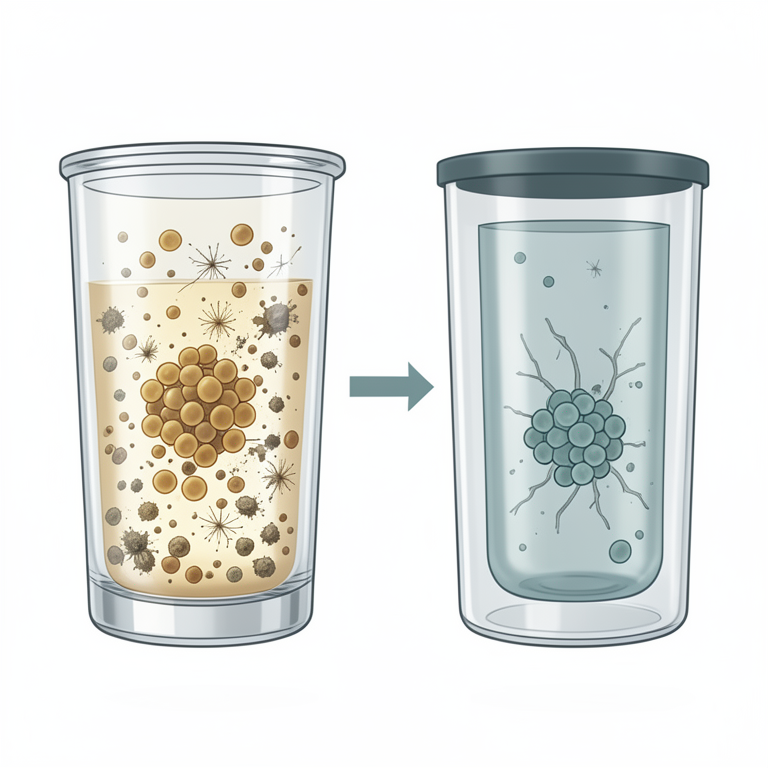
Temperature Comparison of Lassi Quality
AI-generated conceptual illustration (Lassi (yogurt-based drink) in glass containers). It explains the idea and does not show study data.
View source evidence ↗Figures & tables
From the original paper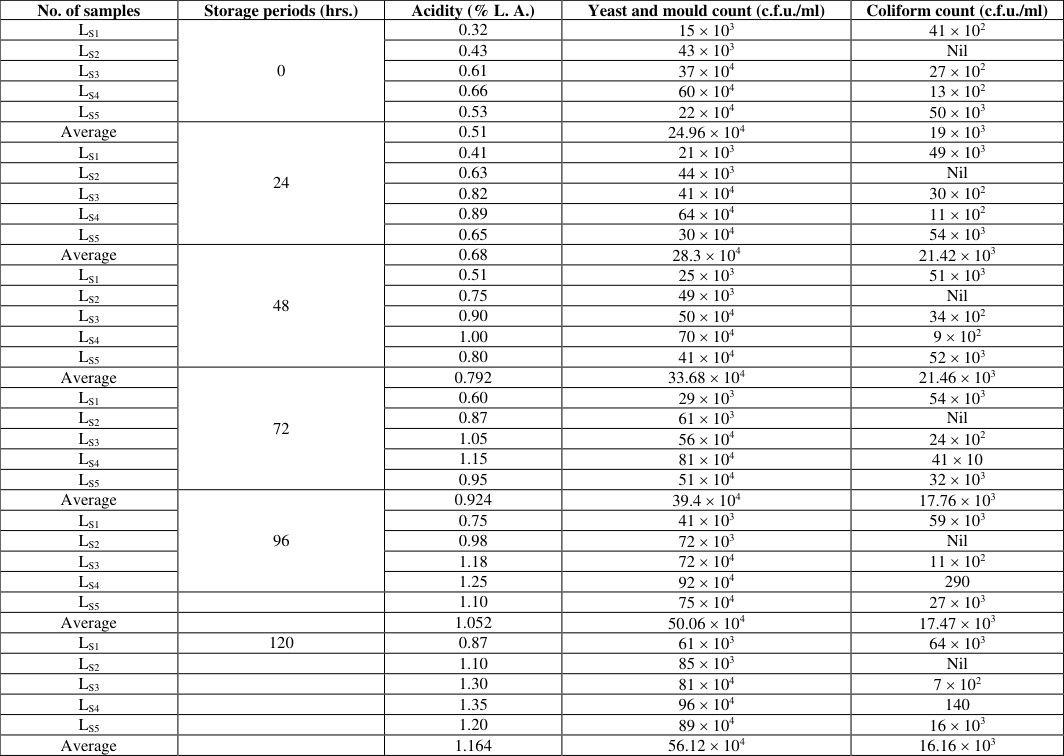 Table 1
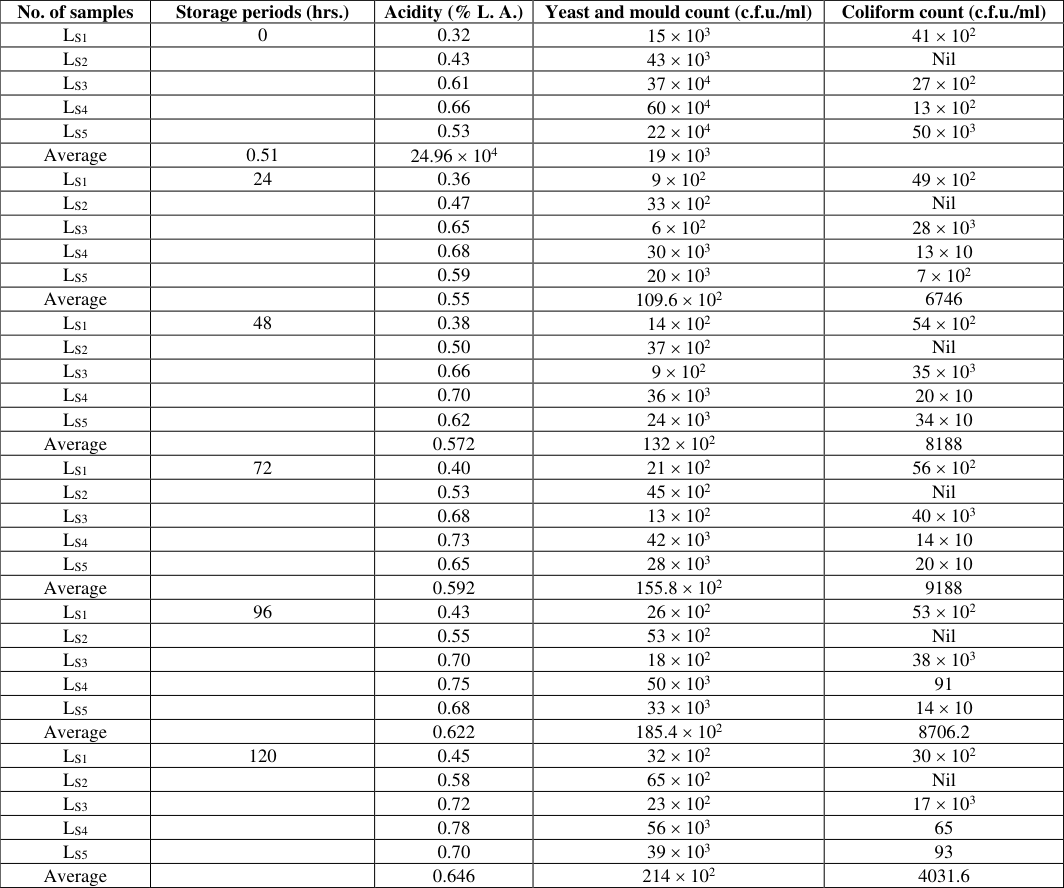 Table 2
Introduction
Lassi is a traditional indigenous refreshing cultured milk drink. It is prepared by whipping dahi with or without addition of sugar or salt depending upon the choice of customer. As the dahi is used as the base material for the preparation of lassi, it is also very popular in eastern, northern as well as southern part of our country, especially in summer. Lassi contains appreciable amounts of milk proteins and phospholipids, and is an excellent beverage for quenching thirst by reason of its lactic acid. Lassi is also a by-product obtained during the preparation of country butter from dahi by indigenous method, which is generally called as Ghol in our state. It is very popular in countryside and according to estimation by Yadav et al. (1992) [10] , approximately 2,114 million-lit of lassi is produced in India annually. Being a fermented milk product as fermented by lactic culture, lassi has got some therapeutic value. It was extrapolated that high number of viable Lactobacillus acidophilus in gastrointestinal tract may reduce the potential for cancer initiation (Lee, 1989) [11] . Lassi is also a very much healthy drinks to the lactose intolerance people. Volatile acidity is better indicator of aroma and flavour of dahi. This aroma and flavour come into the lassi from the curd. The amount of volatile acid produce varies generally from organisms to organisms. With the advent of genetic improvement in the starter culture technology together with programs for the improvement of this product, progress in technology and particularly the increased understanding of its beneficial effects on human nutrition and health, this product has become increasingly popular throughout the world. In the present investigation, the microbiological examinations will help in determining the quality of the product, the sanitary and hygienic conditions maintained and the effect of public health for the marketed product available in Kolkata and its suburbs.
Materials and Methods
Materials and Methods
Collection of samples
The samples (30 Samples) of Lassi were collected from Kolkata and its suburbs. Storage studies: Storage studies were done at 302 °C and 52 °C till the quality remained good in term of titratable acidity, Yeast and mould count and Coliform count.
Results and Discussion
Effect of storage period on titratable acidity of Lassi From Table-1 and Table-2 it is cleared that during storage at 302 0 C the titratable acidity of lassi samples increased at a faster rate while the rate of increase of titratable acidity of lassi samples during storage at 52 °C was very slow. During storage at 302 °C the maximum increase in acidity was noticed after 24 hrs of storage. But during storage at 52 °C the rate of increase in acidity was always steady. The findings of this investigation were in tune with that of Mahanon et al. (1984) [5] . They reported that the temperature has a role in variation of titratable acidity of lassi. It may be due to the fact that at 302 °C temperature the atmosphere for growth of lactic acid bacteria is very much favourable. On the other hand, the growth rate of lactic acid bacteria at 52 °C temperature is very slow.
Effect of storage period on Yeast and mould count of
Lassi: From Table-1 and Table-2 it is evident that the number of yeast and mould in the products increased progressively during storage. A sharp increase in the yeast and mould population is noticeable during storage at 302 °C while increase is relatively gradual during storage at 52 °C. It is observed that the rate of growth of yeast and mould count is higher when sufficient acidity is produce to bring the pH down to around 5.0. It may be concluded that the chance of spoilage of lassi is higher during storage at room temperature (302 °C) due to higher rate of growth of yeast and mould at room temperature.
Effect of storage period on Coliform count of Lassi
From Table -1 andTable-2 it is clear that during storage the rates of destruction of coliform organisms were higher at room temperature (302 °C) than at refrigeration temperature (52 0 C). In regard to the effect of storage temperature it was observed that these organisms survived for longer period of time at refrigeration temperature (52 0 C) than that at room temperature (302 °C). In this connection, it has been reported that viable counts of coliform decreased very rapidly with the fall of ph below 4.0 (Tiwari and Singh, 1966; Goel et al., 1971) [19,3] . The slow rate of destruction of the coliform is ascribed to gradual increase in acidity, which perhaps permits development of acid tolerant strains (Prasad et al., 1984) [7] . In the light of the above report, it may be concluded that lassi stored at a lower temperature is of no value in preventing the destruction of coliform if the product is already contaminated. It is possible that lassi kept at room temperature during summer months is less likely to be a source of coliform than that samples of lassi stored at the temperature during winter months.
Figures and tables from the paper
| No. of samples | Storage periods (hrs.) | Acidity (% L. A.) | Yeast and mould count (c.f.u./ml) | Coliform count (c.f.u./ml) |
|---|---|---|---|---|
| L S1 | 0 | 0.32 | 15 103 | 41 102 |
| L S2 | 0.43 | 43 103 | Nil | |
| L S3 | 0.61 | 37 104 | 27 102 | |
| L S4 | 0.66 | 60 104 | 13 102 | |
| L S5 | 0.53 | 22 104 | 50 103 | |
| Average | 24 | 0.51 | 24.96 104 | 19 103 |
| L S1 | 0.41 | 21 103 | 49 103 | |
| L S2 | 0.63 | 44 103 | Nil | |
| L S3 | 0.82 | 41 104 | 30 102 | |
| L S4 | 0.89 | 64 104 | 11 102 | |
| L S5 | 0.65 | 30 104 | 54 103 | |
| Average | 48 | 0.68 | 28.3 104 | 21.42 103 |
| L S1 | 0.51 | 25 103 | 51 103 | |
| L S2 | 0.75 | 49 103 | Nil | |
| L S3 | 0.90 | 50 104 | 34 102 | |
| L S4 | 1.00 | 70 104 | 9 102 | |
| L S5 | 0.80 | 41 104 | 52 103 | |
| Average | 72 | 0.792 | 33.68 104 | 21.46 103 |
| L S1 | 0.60 | 29 103 | 54 103 | |
| L S2 | 0.87 | 61 103 | Nil | |
| L S3 | 1.05 | 56 104 | 24 102 | |
| L S4 | 1.15 | 81 104 | 41 10 | |
| L S5 | 0.95 | 51 104 | 32 103 | |
| Average | 96 | 0.924 | 39.4 104 | 17.76 103 |
| L S1 | 0.75 | 41 103 | 59 103 | |
| L S2 | 0.98 | 72 103 | Nil | |
| L S3 | 1.18 | 72 104 | 11 102 | |
| L S4 | 1.25 | 92 104 | 290 | |
| L S5 | 1.10 | 75 104 | 27 103 | |
| Average | 1.052 | 50.06 104 | 17.47 103 | |
| L S1 | 120 | 0.87 | 61 103 | 64 103 |
| L S2 | 1.10 | 85 103 | Nil | |
| L S3 | 1.30 | 81 104 | 7 102 | |
| L S4 | 1.35 | 96 104 | 140 | |
| L S5 | 1.20 | 89 104 | 16 103 | |
| Average | 1.164 | 56.12 104 | 16.16 103 |
Table text extracted from the original PDF; superscript letters are shown inline. The original table image is below.
View original table image
| No. of samples | Storage periods (hrs.) | Acidity (% L. A.) | Yeast and mould count (c.f.u./ml) | Coliform count (c.f.u./ml) |
|---|---|---|---|---|
| LS1 | 0 | 0.32 | 15 103 | 41 102 |
| LS2 | 0.43 | 43 103 | Nil | |
| LS3 | 0.61 | 37 104 | 27 102 | |
| LS4 | 0.66 | 60 104 | 13 102 | |
| LS5 | 0.53 | 22 104 | 50 103 | |
| Average | 0.51 | 24.96 104 | 19 103 | |
| LS1 | 24 | 0.36 | 9 102 | 49 102 |
| LS2 | 0.47 | 33 102 | Nil | |
| LS3 | 0.65 | 6 102 | 28 103 | |
| LS4 | 0.68 | 30 103 | 13 10 | |
| LS5 | 0.59 | 20 103 | 7 102 | |
| Average | 0.55 | 109.6 102 | 6746 | |
| LS1 | 48 | 0.38 | 14 102 | 54 102 |
| LS2 | 0.50 | 37 102 | Nil | |
| LS3 | 0.66 | 9 102 | 35 103 | |
| LS4 | 0.70 | 36 103 | 20 10 | |
| LS5 | 0.62 | 24 103 | 34 10 | |
| Average | 0.572 | 132 102 | 8188 | |
| LS1 | 72 | 0.40 | 21 102 | 56 102 |
| LS2 | 0.53 | 45 102 | Nil | |
| LS3 | 0.68 | 13 102 | 40 103 | |
| LS4 | 0.73 | 42 103 | 14 10 | |
| LS5 | 0.65 | 28 103 | 20 10 | |
| Average | 0.592 | 155.8 102 | 9188 | |
| LS1 | 96 | 0.43 | 26 102 | 53 102 |
| LS2 | 0.55 | 53 102 | Nil | |
| LS3 | 0.70 | 18 102 | 38 103 | |
| LS4 | 0.75 | 50 103 | 91 | |
| LS5 | 0.68 | 33 103 | 14 10 | |
| Average | 0.622 | 185.4 102 | 8706.2 | |
| LS1 | 120 | 0.45 | 32 102 | 30 102 |
| LS2 | 0.58 | 65 102 | Nil | |
| LS3 | 0.72 | 23 102 | 17 103 | |
| LS4 | 0.78 | 56 103 | 65 | |
| LS5 | 0.70 | 39 103 | 93 | |
| Average | 0.646 | 214 102 | 4031.6 |
Table text extracted from the original PDF; superscript letters are shown inline. The original table image is below.
View original table image
References
9 in the original paper- Ghosh J, Rajorhia GS. Chemical, microbiological and sensory properties of misti dahi sold in Kolkata. Asian J Dairy Res. 1987;6:11.
- Goel MC, Kulshrestha DC, Marth EH, Francis DW, Gradsaw JG, Read RS. J Milk Fd Technol. 1971;36:418. Cited from Mohanon et al., 1985.
- Kulkarni MB. Volatile acids level and panel preferences for aroma of curd (Dahi). Indian Dairyman. 1972;24:20.
- Mohanan KR, Sankar PA, Laxminarayana H. Growth and acid production of dahi starter cultures at suboptimum temperatures. Indian J Dairy Sci. 1984;37:177.
- Mukhopadhyay S, Singh RS. Studies on the bacteriological quality of dahi of eastern region. NDRI Annual Report. 1973, 213.
- Prasad G, Khan BL, Kulshrestha DC. Survival of Escherichia coli and Enterobacter aerogenes in dahi. II. Contamination after curdling of milk. Indian J Dairy Sci. 1984;37:261.
- Ray HP, Srinivasan RA. Use of micro-organisms for production of indigenous fermented milk products (Sweetened dahi). J Fd Sci Technol. 1972;9:62.
- Tiwari MP, Singh IP. Survival of pathogens in dahi. II. Contamination after curdling of milk. Indian J Dairy Sci. 1966;19:162.
- Lee AS. A scientific methodology for MIS case studies. MIS quarterly. 1989 Mar 1:33-50.