
Research article · 2025 · Full text
International Journal of Horticulture and Food ScienceAssessing the water stress of crop plants using infrared thermal imaging
Volume 7(1) · Pages 144–148 · DOI: 10.33545/26631067.2025.v7.i1c.255 ↗
Research areasSpectroscopy and Chemometric Analyses
Abstract
Author-writtenInfrared thermal\r\nimaging is a significant advancement in managing crop water stress, offering a\r\nnon-invasive approach to monitor plant health and irrigation requirements\r\neffectively. Research studies emphasize that canopy temperature-derived metrics\r\ncan serve as early stress indicators, improving water management practices in\r\nagriculture. For example, research by Foral et al., (2021) [13]\r\nshowcases the potential of thermal imaging in detecting drought stress in\r\ncreeping bentgrass before visible symptoms emerge. Additionally, studies by\r\nCegarra E et al, (2021) [11] highlight the effectiveness of\r\nUAV-based Crop Water Stress Index (CWSI) measurements in monitoring almond\r\ntrees, advocating for precision agriculture techniques. The integration of\r\nthermal imaging technologies is crucial for refining irrigation strategies and\r\nensuring sustainable crop production in water-scarce environments as\r\nagricultural practices evolve. The utilization of infrared thermal imaging for\r\nassessing crop water stress yields valuable insights into plant irrigation\r\nneeds. Canopy temperature metrics provide early detection of stress conditions,\r\naiding in optimizing irrigation schedules and enhancing water use efficiency.\r\nAdvanced sensor technologies like Vapor Pressure Deficit (VPD) and Crop Water\r\nStress Index (CWSI) offer precise data on water stress levels in diverse crops,\r\nfacilitating efficient resource management. By combining these innovative\r\napproaches, the agricultural sector can enhance sustainability practices,\r\noptimize resource allocation, and improve resilience against environmental challenges.\r\nThese findings play a crucial role in refining irrigation methods, boosting\r\ncrop yields, and promoting informed decision-making in agricultural management.
Summary
Source-checkedPlain-language reading of the full paper, prepared with AI and checked against the text. Each point links to the authors' own words.
Why it matters
- Assessing crop water stress is becoming more critical because of increasing food production demands and unpredictable climate change patterns. View evidence ↗
- Conventional methods for measuring water stress are often labor-intensive and can produce inconsistent results. View evidence ↗
- Crop water stress happens when water supply cannot meet plant physiological needs, which reduces growth, yield, and health. View evidence ↗
The question
- The paper examines how infrared thermal imaging can be used to assess crop water stress and provide insights into irrigation needs. View evidence ↗
What they did
- Infrared thermal imaging is a non-invasive method that measures thermal radiation emitted by plants to understand transpiration rates and physiological states. View evidence ↗
- The technology works by detecting infrared radiation and converting it into visible data reflecting thermal properties without needing direct contact with the plant. View evidence ↗
- Small unmanned aircraft systems (sUAS) are integrated with thermal imaging to provide a cost-effective way to monitor crop stress. View evidence ↗
What they found
- Water deficiency in plants causes a physiological response that increases leaf temperatures because transpiration is reduced. View evidence ↗
- Thermal imaging can detect drought stress in creeping bentgrass before any visible symptoms appear. View evidence ↗
- UAV-based Crop Water Stress Index (CWSI) measurements have proven effective for monitoring water stress in almond trees. View evidence ↗
- The normalized difference vegetation index (NDVI) is a pivotal tool for evaluating the water needs and health of crops. View evidence ↗
- Sensor technologies such as Vapor Pressure Deficit (VPD) and the Crop Water Stress Index (CWSI) provide precise data on water stress across various crop types. View evidence ↗
What it means
- The authors conclude that integrating thermal imaging is essential for optimizing irrigation and ensuring sustainable crop production in areas with scarce water. View evidence ↗
- The accuracy of thermal data can be negatively impacted by variable weather, and the complexity of processing the data remains a challenge. View evidence ↗
- High equipment costs create a barrier that prevents many small-scale farmers from accessing sophisticated thermal imaging technology. View evidence ↗
Visual summary
1 visualsIllustrations explain the paper; they do not show study data.
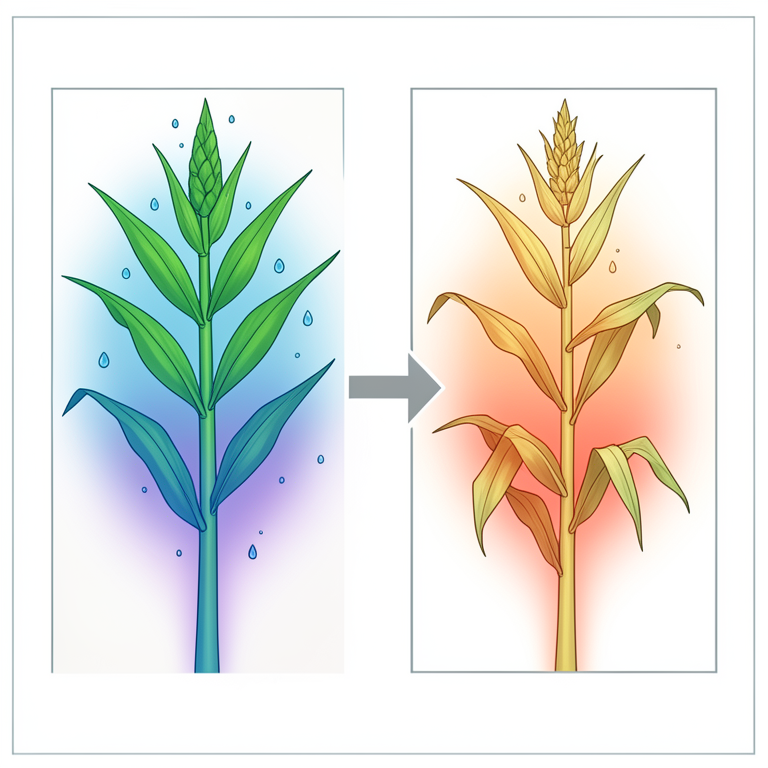
Plant Response to Water Stress
AI-generated conceptual illustration (maize plants). It explains the idea and does not show study data.
View source evidence ↗Introduction
In the context of modern agriculture, the assessment of crop water stress is increasingly critical due to the escalating demands for food production and the unpredictable patterns of climate change. Understanding the hydration status of crops not only informs irrigation strategies but also aids in maximizing yield and ensuring food security. Traditional methods of measuring water stress often involve labor-intensive practices that can yield inconsistent results. However, infrared thermal imaging has emerged as a revolutionary technology that offers a non-invasive, efficient means of monitoring plant health in real time. By capturing the thermal signatures emitted by crops, this advanced imaging technique allows for the detection of water stress long before visible wilting occurs. Thus, integrating infrared thermal imaging into agricultural practices presents a promising avenue for more precise water management strategies, ultimately leading to enhanced crop resilience and sustainable farming practices.
Definition of crop water stress
Understanding crop water stress is essential for optimizing agricultural productivity, particularly in regions subject to water scarcity. Crop water stress occurs when the water supply is insufficient to meet the physiological demands of plants, leading to reduced growth, yield, and overall health. Signs of this stress include wilting, leaf discoloration, and decreased photosynthetic activity, which can be detrimental to crop viability. Remote sensing technologies, including infrared thermal imaging, provide valuable tools for assessing this stress by measuring leaf temperature and determining stomatal responses to water availability. Research indicates that indices such as the water deficit index correlate closely with crop physiological parameters, aiding in the identification of water-stressed plants (Albrizio R et al., 2020) [1] . Furthermore, advancements in thermographic techniques allow for detailed mapping of water stress at the field level, enhancing irrigation strategies to ensure adequate water supply and improve agricultural resilience in the face of climate change (Fata L et al., 2021) [15] .
Importance of assessing water stress in agriculture
The assessment of water stress in agriculture has emerged as a critical component for sustainable crop management, particularly in regions facing climate variability. Understanding water stress not only aids in optimizing irrigation practices but also enhances overall crop health and yield. Advanced technologies, such as infrared thermal imaging, enable farmers to monitor plant responses to varying water availability accurately. This precision is vital, especially in arid regions where water scarcity is prevalent, as highlighted by research emphasizing the need for effective water resource utilization to sustain agricultural productivity (Fata L et al., 2021) [15] . Additionally, small unmanned aircraft systems (sUAS) have revolutionized the monitoring process by providing high-resolution data necessary to identify stress in crops, thus facilitating timely interventions (Bremer et al., 2023) [6] . By utilizing these innovative techniques, agricultural stakeholders can make informed decisions, ultimately leading to improved resource management and resilience against water shortages.
Overview of infrared thermal imaging technology
Infrared thermal imaging technology has emerged as a critical tool in the assessment of crop water stress, enabling precise monitoring of plant health and irrigation needs. This non-invasive technique measures the thermal radiation emitted by plants, providing valuable insights into transpiration rates and overall physiological states. By detecting variations in surface temperature, thermal imaging helps identify areas of water deficiency before visual symptoms manifest. As highlighted in recent studies, accurate assessment and monitoring of plant water stress are essential for optimizing irrigation strategies and enhancing water-use efficiency (Rezvani F et al., 2023) [12] . Moreover, the integration of thermal imaging with other remote sensing technologies can further enrich agricultural practices, expanding the potential for real-time data collection and analysis. Consequently, infrared thermal imaging stands out not only for its immediacy and precision in detecting water stress but also as a significant contributor to sustainable agricultural management practices.
Principles of Infrared Thermal Imaging
The principles of infrared thermal imaging play a crucial role in assessing crop water stress by providing noninvasive and accurate measurements of plant temperature. This technology operates by detecting the infrared radiation emitted from objects, converting it into visible data that reflect thermal properties without direct contact, which is essential in agricultural settings. Recent advancements have enhanced the effectiveness of thermal imaging in monitoring crop health, as evidenced by its application in evaluating various quality traits of agricultural products. For instance, the integration of small unmanned aircraft systems (sUAS) has revolutionized remote sensing, offering a costeffective means to monitor crop stress compared to traditional methods (Bremer et al., 2023) [6] . Furthermore, thermal imaging has shown promise in detecting specific indicators of plant stress, such as transpiration rates and soil moisture levels, allowing for timely interventions and improved crop management strategies (Al-Rejaie et al., 2020) [3] .
Explanation of infrared radiation and thermal imaging
Infrared radiation plays a critical role in thermal imaging technology, enabling precise assessment of crop water stress. This technique utilizes the infrared spectrum emitted by objects, primarily plants, to derive temperature readings that correlate with physiological conditions. By capturing the thermal emissions, thermal imaging converts this data into temperature distribution maps, facilitating the identification of stress in crops due to water shortages. Research demonstrates that infrared thermography can successfully measure leaf temperatures, which serve as essential indicators for calculating the Crop Water Stress Index (CWSI) (Cukrov A et al., 2021) [2] . As water scarcity becomes a growing concern, particularly in arid regions, the application of thermal imaging in agriculture becomes increasingly vital. It not only allows for timely irrigation decisions but also enhances resource management by providing immediate feedback regarding plant health and water requirements (Fata L et al., 2021) [15] . Thus, infrared thermal imaging emerges as an indispensable tool in modern agricultural practices.
How thermal imaging detects plant temperature variations
The implementation of infrared thermal imaging serves as a pivotal technique for detecting temperature variations in plants, providing a crucial insight into their water stress levels. As plants experience water deficiency, their physiological response leads to increased leaf temperatures due to reduced transpiration. By employing thermal imaging, researchers can accurately capture these temperature differentials across large areas, an advantage not easily achieved with traditional measurement methods. This allows for the calculation of the Crop Water Stress Index (CWSI), which correlates leaf temperature with water stress indicators such as leaf water potential (LWP) (Cukrov A et al., 2021) [2] . Moreover, thermal imaging technology enhances the understanding of plant water status amid the challenges posed by climate change, as it enables efficient, non-destructive monitoring over extensive agricultural landscapes (Fischer B et al., 2024) [7] . Ultimately, this technique plays a significant role in optimizing irrigation practices, thereby promoting sustainable agricultural productivity.
The relationship between plant temperature and water stress
Understanding the relationship between plant temperature and water stress is essential for effective crop management, particularly in the context of climate variability. When plants experience water stress, their physiological processes are disrupted, leading to increased leaf temperatures due to reduced transpiration rates. Infrared thermal imaging emerges as a critical tool for assessing these temperature changes, enabling the non-destructive monitoring of plant health over extensive areas. For example, crop canopy temperature measurements are pivotal in calculating the Crop Water Stress Index (CWSI), which assists in formulating irrigation strategies tailored to specific crop needs (Giménez Gallego et al., 2021) [14] . Moreover, recent advancements in both proximal and remote sensing methods, including low-cost thermal cameras, offer new avenues for continuously monitoring plant water status and facilitating data collection in real-time (Fischer B et al., 2024) [7] . Thus, integrating thermal imaging techniques not only enhances our understanding of plant responses to water stress but also contributes significantly to optimizing irrigation practices.
Applications of Infrared Thermal Imaging in Agriculture
In recent years, the integration of infrared thermal imaging in agriculture has revolutionized how crop water stress is assessed and managed. By providing precise temperature distribution maps through the detection of emitted infrared radiation, this technology enables farmers to monitor the physiological responses of crops to water availability. As climate change exacerbates water shortages, particularly in arid regions, methods such as those discussed in (Fata L et al., 2021) [15] become increasingly vital for efficient water resource use. Furthermore, advancements in small unmanned aircraft systems (sUAS) have made it more feasible to collect thermal data across extensive agricultural landscapes, enhancing the ability to predict and manage crop health under stress conditions, as highlighted in (Bremer et al., 2023) [6] . Despite its potential, challenges such as variable weather impacts on thermal data accuracy and the complexity of data processing still need to be addressed for optimal deployment in agricultural practices.
Monitoring crop health and water requirements
Effective monitoring of crop health and water requirements is crucial for enhancing agricultural productivity and sustainability. Technologies such as infrared thermal imaging have emerged as powerful tools for assessing crop water stress, allowing for real-time insights into plant physiological responses to varying water regimes. UAVs, equipped with thermal and multispectral cameras, facilitate the timely identification of crop anomalies and stress indicators throughout the growing season, greatly improving water management practices and crop yield potential. Research has demonstrated that indices like the normalized difference vegetation index (NDVI) can be pivotal in evaluating crop health and water needs, with UAV-derived data providing enhanced accuracy in assessing irrigated areas and water productivity (Chimonyo et al., 2020) [8] . Moreover, studies indicate that integrating remote sensing with ground-based data can significantly optimize the evaluation of crop conditions and water stress levels, leading to improved agricultural outcomes (Albrizio R et al., 2020) [1] .
Early detection of water stress in various crops
The early detection of water stress in crops is crucial for optimizing irrigation practices and ensuring sustainable agricultural productivity. Emerging technologies, particularly infrared thermal imaging, facilitate the monitoring of complex physiological responses to water deficiencies. By capturing the thermal properties of plant foliage, these systems can identify variations in leaf temperature that indicate water stress before visible symptoms emerge. This capability is further enhanced by innovations in small unmanned aircraft systems (sUAS), which offer affordable yet effective means to survey large agricultural areas quickly and accurately, as discussed in (Bremer et al., 2023) [6] . Simultaneously, the integration of remote sensing technologies can support precision agriculture by analyzing spectral reflectance changes related to crop health, thereby allowing farmers to address potential threats from both water stress and pest outbreaks. Such advancements underscore the significance of early intervention strategies in managing crop health and resilience.
Integration with precision agriculture practices
The integration of precision agriculture practices with advanced technologies like infrared thermal imaging is pivotal for enhancing agricultural efficiency and sustainability. By accurately assessing crop water stress, farmers can optimize irrigation strategies, culminating in significant water conservation while maintaining yield. This necessity is underscored by the challenges posed by climate change and diminishing water resources, particularly in arid regions where effective management is crucial (Fata L et al., 2021) [15] . Moreover, the implementation of drone technology within these precision practices offers a promising avenue for real-time monitoring and data acquisition, facilitating timely interventions based on crop health assessments (Dawodu et al., 2020) [9] . Despite the technological advantages, obstacles such as high equipment costs and the need for refined image analysis techniques remain critical considerations for widespread adoption. Nonetheless, as improvements in technology emerge, the integration of these practices holds the potential to revolutionize resource management in agriculture, leading to enhanced productivity and environmental stewardship.
Advantages and Limitations of Infrared Thermal Imaging
The application of infrared thermal imaging in assessing crop water stress offers significant advantages while also presenting certain limitations. This non-invasive technique allows for the rapid detection of plant temperature variations, which can correlate with water stress levels, thereby significantly enhancing irrigation management practices. The ability to identify stressed plants across large fields effectively improves water use efficiency, a critical requirement in sustainable agriculture, as emphasized by the insights derived from Crop Water Stress Index (CWSI) analyses (Rezvani F et al., 2023) [12] . However, the limitations of infrared thermal imaging cannot be overlooked; factors such as atmospheric conditions, sensor calibration, and the inherent spatial resolution of the imaging systems can affect the accuracy of assessments. Moreover, the reliance on environmental parameters can complicate direct comparisons between different studies, posing challenges for the standardization and validation of results (Baysal-Gurel et al., 2021) [5] . Thus, while infrared thermal imaging presents a promising tool for monitoring crop health, its efficacy is contingent upon addressing these limitations.
Benefits of using thermal imaging for water stress assessment
Thermal imaging has emerged as a transformative tool for assessing water stress in crops, facilitating more efficient irrigation management and sustainable agricultural practices. By providing a non-invasive means to measure plant temperature, thermal imaging allows for the detection of physiological changes induced by water deficits, which can be correlated with vital traits such as transpiration and photosynthesis. This method surpasses traditional water stress assessment techniques, offering timely insights that enable farmers to make informed decisions regarding irrigation scheduling and crop management. The integration of low-cost thermal cameras, enhanced through advanced image processing techniques like the proposed VisTA-SR method, further democratizes access to this technology, fostering broader application in the field (Bailey et al., 2024) [4] . Additionally, the combination of thermal imaging with methodologies such as Vapor Pressure Deficit (VPD) and Crop Water Stress Index (CWSI) presents a robust framework for optimizing water resource management, ultimately contributing to more resilient agricultural systems (Rezvani F et al., 2023) [12] .
Challenges and limitations of the technology
While infrared thermal imaging presents significant advancements in assessing crop water stress, several challenges and limitations impede its widespread application. One primary concern is the accuracy of thermal data acquisition, which can be adversely affected by variable environmental conditions, such as ambient temperature and humidity fluctuations, leading to potential measurement errors. Additionally, the high costs associated with sophisticated thermal imaging equipment and platforms present a barrier to accessibility for many smallscale farmers, resulting in unequal adoption of the technology within the agricultural sector (Rezvani F et al., 2023) [12] . Furthermore, the complexities inherent in image analysis and processing necessitate specialized skill sets, often limiting the effective interpretation of thermal data (Rezvani F et al. 2023) [12] . These challenges underscore the need for ongoing research and development to refine the technology, improve its accuracy, and enhance usability, ultimately enabling broader implementation for effective water stress management in agriculture.
Comparison with traditional methods of assessing water stress
Traditional methods of assessing water stress in crops often rely on labor-intensive techniques such as visual inspections, physiological measurements, and the use of soil moisture probes. While these conventional approaches can yield relevant data, they frequently lack the precision and efficiency required for contemporary agricultural practices. In contrast, infrared thermal imaging offers a non-invasive and rapid means of monitoring plant water stress by detecting temperature variations indicative of physiological responses to water deficits. This method aligns with the findings in (Rezvani F et al. 2023) [12] , which emphasize the importance of accurate detection for optimizing irrigation strategies. Furthermore, advancements in image-based techniques have also improved frost detection, showcasing automation potential absent in traditional methods (Diepeveen et al., 2022). By integrating these innovative technologies into agricultural practices, we can significantly enhance our ability to manage water resources effectively and promote sustainable crop production in an era of increasing environmental challenges.
Conclusion
In conclusion, the application of infrared thermal imaging represents a pivotal advancement in the management of crop water stress, providing a non-invasive method for monitoring plant health and irrigation needs. The studies reviewed illustrate that metrics derived from canopy temperatures can serve as early indicators of stress conditions, significantly enhancing water management practices in agriculture. For instance, the research highlighted in underscores the potential of thermal imaging to identify drought stress in creeping bentgrass, suggesting that specific temperature metrics indicate stress before visible symptoms appear. Additionally, the findings reported in (Cegarra E et al., 2021) [11] demonstrate the efficacy of UAV-based Crop Water Status Index (CWSI) measurements in monitoring almond trees, reinforcing the need for precision agriculture. Ultimately, as agricultural practices evolve, the integration of thermal imaging technologies will be essential for optimizing irrigation strategies and ensuring sustainable crop production in waterscarce environments.
Summary of key findings
The integration of infrared thermal imaging in assessing crop water stress has yielded significant findings that enhance our understanding of plant irrigation needs. Notably, research indicates that metrics derived from canopy temperature (Tc) can serve as early indicators of water stress, effectively identifying conditions prior to visible wilt (Foral et al., 2021) [13] . This underscores the potential of consistent monitoring through thermal imaging to optimize irrigation scheduling, ultimately leading to improved water use efficiency. Moreover, advancements in sensor technologies, including Vapor Pressure Deficit (VPD) and Crop Water Stress Index (CWSI), further enrich the field by providing precise data on water stress levels in various crops (Rezvani F et al., 2023) [12] . By combining these innovative approaches, the agricultural sector can better manage resources and foster sustainable practices, illuminating a pathway towards resilience in the face of persistent environmental challenges. Such findings are essential for refining irrigation methods and enhancing crop yields through informed management strategies.
Future prospects for infrared thermal imaging in agriculture
The future prospects for infrared thermal imaging in agriculture appear promising, particularly in enhancing the assessment of crop water stress. As precision agriculture continues to evolve, the integration of advanced thermal imaging technologies will enable farmers to monitor crop health more accurately and respond to water deficits promptly. Innovations in sensor technology, such as the interplay between Vapor Pressure Deficit (VPD) and Crop Water Stress Index (CWSI), are crucial in providing insights into plant stress conditions, ultimately optimizing irrigation practices and improving water use efficiency (Rezvani F et al., 2023) [12] . Moreover, the adoption of Unmanned Aerial Vehicles (UAVs) equipped with thermal cameras allows for comprehensive monitoring of crops throughout their growth cycle, facilitating timely interventions where necessary (Chimonyo et al., 2020) [8] . These advancements will not only bolster agricultural productivity but also contribute to sustainable water resource management, essential in addressing the challenges posed by climate change and global food security.
Final thoughts on the importance of water stress assessment for sustainable farming
In conclusion, the assessment of water stress in crops is pivotal for the sustainability of agricultural practices in an increasingly resource-constrained world. By employing sophisticated techniques such as infrared thermal imaging, farmers can obtain precise and real-time data on crop water needs, enabling them to make informed irrigation decisions. This proactive approach not only enhances crop yield but also conserves precious water resources, fostering an environmentally sustainable farm management strategy. Furthermore, understanding water stress patterns facilitates the optimization of agricultural productivity while minimizing ecological footprints, thus supporting the longterm viability of farming ecosystems. As climate variability continues to challenge traditional farming methods, it becomes increasingly evident that robust water stress assessment is not merely an option but a necessity for ensuring food security and resilience in agriculture. Ultimately, integrating advanced technologies with sustainable practices can lead to a more efficient and responsible agricultural framework.
References
14 in the original paper- Albrizio R, Cantore V, De Mastro G, Mzid N, Sellami MH, Todorovic M. The application of ground-based and satellite remote sensing for estimation of biophysiological parameters of wheat grown under different water regimes. MDPI AG. 2020. https://core.ac.uk/download/541251483.pdf
- Cukrov A, Ranilović B, Boras I, Zovko M, Švaić S. Infrared thermography as a prediction tool for the irrigation requirement in agriculture. Faculty of Mechanical Engineering and Naval Architecture, University of Zagreb. 2021. https://core.ac.uk/download/388191613.pdf
- Al-Rejaie S, Belin E, ElGamal R, ElMasry M, et al. Emerging thermal imaging techniques for seed quality evaluation: principles and applications. Elsevier BV. 2020. https://core.ac.uk/download/326813003.pdf
- Bailey BN, Diepenbrock CH, Earles JM, Lo YC, et al. VisTA-SR: Improving the accuracy and resolution of low-cost thermal imaging cameras for agriculture. arXiv. 2024. http://arxiv.org/abs/2405.19413
- Bremer DJ, Hong M, McCall D, Sullivan DG, et al. Considerations with using unmanned aircraft systems in turfgrass. Burleigh Dodds Science Publishing. 2023. https://core.ac.uk/download/586378483.pdf
- Bulacio Fischer PT, Carella A, Lo Bianco R, Massenti R, et al. Continuous plant-based and remote sensing for determination of fruit tree water status. CH. 2024. https://core.ac.uk/download/614221031.pdf
- Chimonyo VGP, Clulow AD, Mabhaudhi T, Magidi D, et al. Prospects of improving agricultural and water productivity through unmanned aerial vehicles. MDPI AG. 2020. https://core.ac.uk/download/373459091.pdf
- Dawodu A. Drone technology in precision agriculture: are there no environmental concerns? The International Institute for Science, Technology and Education (IISTE). 2020. https://core.ac.uk/download/352519707.pdf
- Diepeveen D, Jones MGK, Shammi S, Sohel MI, et al. A survey of image-based computational learning techniques for frost detection in plants. Elsevier B.V. on behalf of KeAi Communications Co. Ltd. 2022. https://core.ac.uk/download/511411941.pdf
- Egea Cegarra G, Gala González-Santiago JD, García Tejero IF, Gutiérrez Gordillo F, et al. Monitoring of emerging water stress situations by thermal and vegetation indices in different almond cultivars. MDPI AG. 2021. https://core.ac.uk/download/490594285.pdf
- Rezvani F, Rezvani Z. A review of recent advances in water vapor deficit sensor technology for improving plant water usage efficiency. Shahid Bahonar University of Kerman. 2023. https://core.ac.uk/download/614084773.pdf
- Foral J Jr. Using thermal imaging to measure water stress in creeping bentgrass putting greens. DigitalCommons@University of Nebraska -Lincoln. 2021. https://core.ac.uk/download/478907247.pdf
- Giménez Gallego J, González Teruel JD, Jiménez Buendía M, Navarro Hellín H, et al. Intelligent thermal image-based sensor for affordable measurement of crop canopy temperature. Elsevier BV. 2021. https://core.ac.uk/download/516795640.pdf
- La Fata A. Thermography to assess grapevine status and traits: opportunities and limitations in crop monitoring and phenotyping -a review. s.n. 2021. https://core.ac.uk/download/541297900.pdf
Cited by 1
From OpenAlex, OpenCitations and reference lists read by Scinovex
- AI Camera Sensor-Based Detection of Crop Water Stress and Pesticide Requirement ↗
Ravindra Vishwakarma · International Journal of IoT Embedded Systems and Industrial Automation · 2026
Artificial intelligence (AI)-enabled camera sensor systems are increasingly transforming precision agriculture by providing non-destructive, rapid, and scalable methods for monitoring crop health. Two of the most critical applications are the detection of crop water stress and the assessment of pesticide requirement through pest, disease, and symptom recognition. This literature review synthesizes published work on RGB, thermal, multispectral, and hyperspectral imaging…
❝ 0PDF