
Research article · 2025 · Full text
International Journal of Veterinary Sciences and Animal HusbandryAssessment of TANUVAS Aseel on the growth performance and suitability to backyard system in Virudhunagar District of Tamil Nadu
Volume 10(1) · Pages 156–158 · DOI: 10.22271/veterinary.2025.v10.i1c.2014 ↗
Research areasAgricultural Economics and Practices
Abstract
Author-writtenThe study has been carried out in ICAR Krishi Vigyan Kendra, Aruppukottai, Virudhunagar District of Tamil Nadu to assess the TANUVAS Aseel chicken for the growth performance and its suitability for backyard system of rearing in field conditions. Under the Front Line Demonstration (FLD) programme, 250 numbers of day-old straight run chicks of TANUVAS Aseel procured from Regional Research and Educational Centre (RREC), Pudukottai were distributed to the beneficiaries of Virudhunagar district. Body weight was recorded from day old to 12th week at weekly interval and from the data, weekly body weight gain was calculated to assess the growth performance. The mean (±S.E) hatch weight of TANUVAS Aseel chick recorded was 36.2±0.40g. The mean (±S.E) body weight at 8th week and 12th week was 700.2±0.85g and 1050.2±0.56g respectively. The maximum body weight gain of 119.88±0.62g was recorded during the eight week and thereafter gradual reduction in the rate of weight gain was noticed. In the study, the overall livability percentage recorded for TANUVAS Aseel was 95.8%. From the study it is obvious that, the growth performance of TANUVAS Aseel is promising and they can thrive well under hot semi-arid region of Virudhunagar district. Hence, TANUVAS Aseel can be a better option for backyard poultry farmers to get desirable market price in a short duration.
Summary
Source-checkedPlain-language reading of the full paper, prepared with AI and checked against the text. Each point links to the authors' own words.
Why it matters
- Poultry production is a rapidly expanding part of Indian agriculture, growing by 8-10% annually through both commercial and backyard farming. View evidence ↗
- Small-scale backyard poultry farmers in India face challenges including poor production, diseases, predation, and a lack of knowledge regarding improved poultry breeds. View evidence ↗
- The TANUVAS Aseel is a dual-purpose native variety developed in 2017 for table purposes. View evidence ↗
The question
- The study aimed to assess the growth performance and suitability of TANUVAS Aseel chickens for backyard rearing under field conditions. View evidence ↗
What they did
- Chicks underwent a 21-day brooding period using electric bulbs for heat, starting at 35 °C, with 23 hours of light for the first five days. View evidence ↗
- The birds were fed a starter ration for the first month before being transitioned to open foraging in an enclosed area. View evidence ↗
- Growth performance was measured by recording body weight at weekly intervals from day one to the 12th week. View evidence ↗
What they found
- The average hatch weight of the TANUVAS Aseel chicks was 36.2±0.40g. View evidence ↗
- The mean body weights reached 700.2±0.85g by the 8th week and 1050.2±0.56g by the 12th week. View evidence ↗
- The highest weekly weight gain occurred during the eighth week at 119.88±0.62g, followed by a gradual decline in the growth rate. View evidence ↗
- The overall livability of the TANUVAS Aseel chickens was recorded at 95.83%. View evidence ↗
- Livability reached 100% from the 10th week onwards, suggesting high resistance to common poultry diseases. View evidence ↗
What it means
- The authors conclude that TANUVAS Aseel is preferable for backyard rearing in the Virudhunagar district due to its high growth rate and strong disease resistance. View evidence ↗
- The breed is recommended for backyard poultry as a means to improve rural livelihoods by providing a source of subsidiary income. View evidence ↗
Visual summary
3 visualsIllustrations explain the paper; charts are replotted from the paper's own table values.
Suitability Assessment Flow
AI-generated conceptual illustration (TANUVAS Aseel chickens in a rural backyard setting). It explains the idea and does not show study data.
View source evidence ↗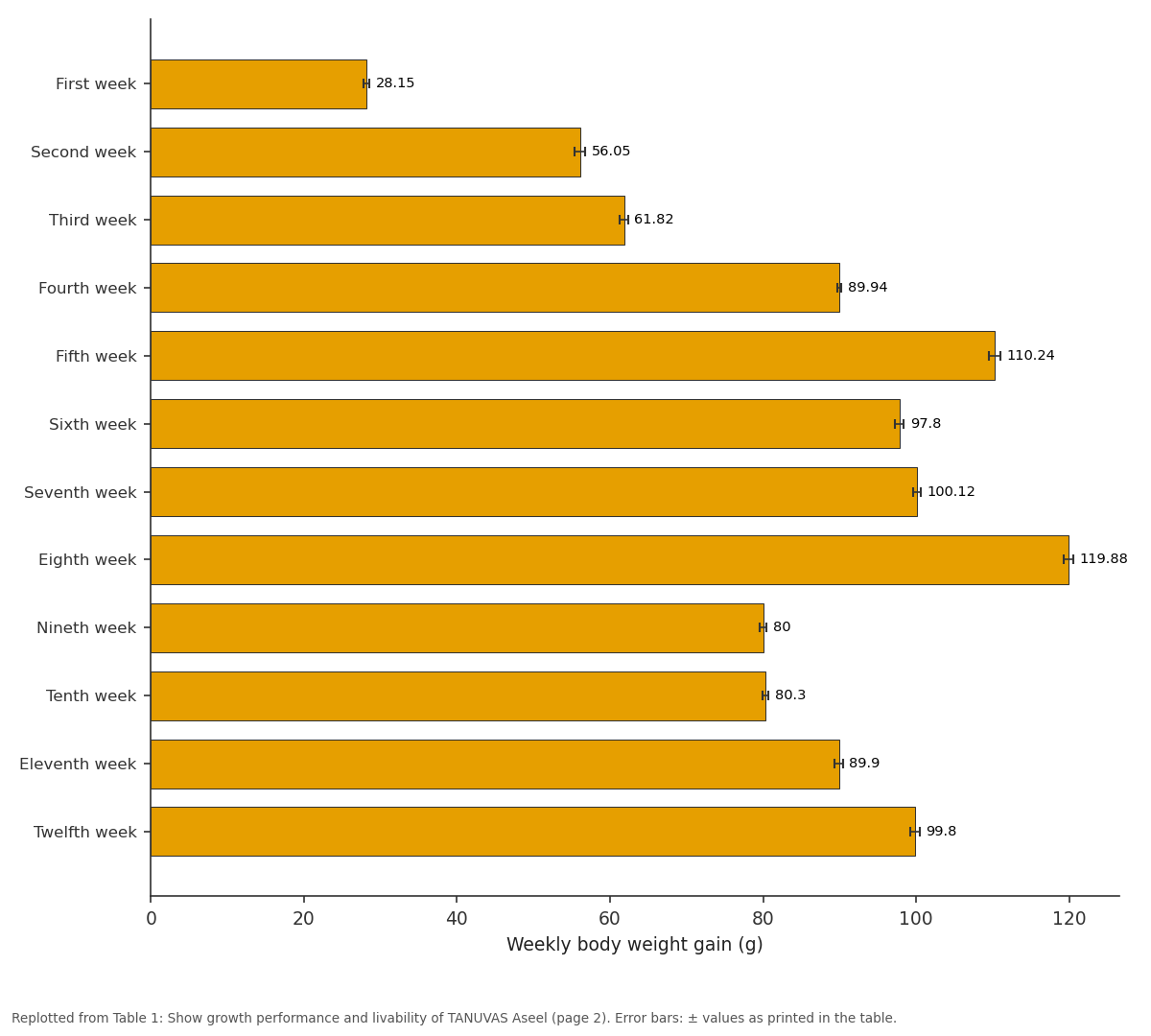
Weekly body weight gain (g) / -: First week vs Second week vs Third week vs Fourth week vs Fifth week
Replotted from Table 1 (page 2) of the original paper. Every bar is the paper's own table value.
View source evidence ↗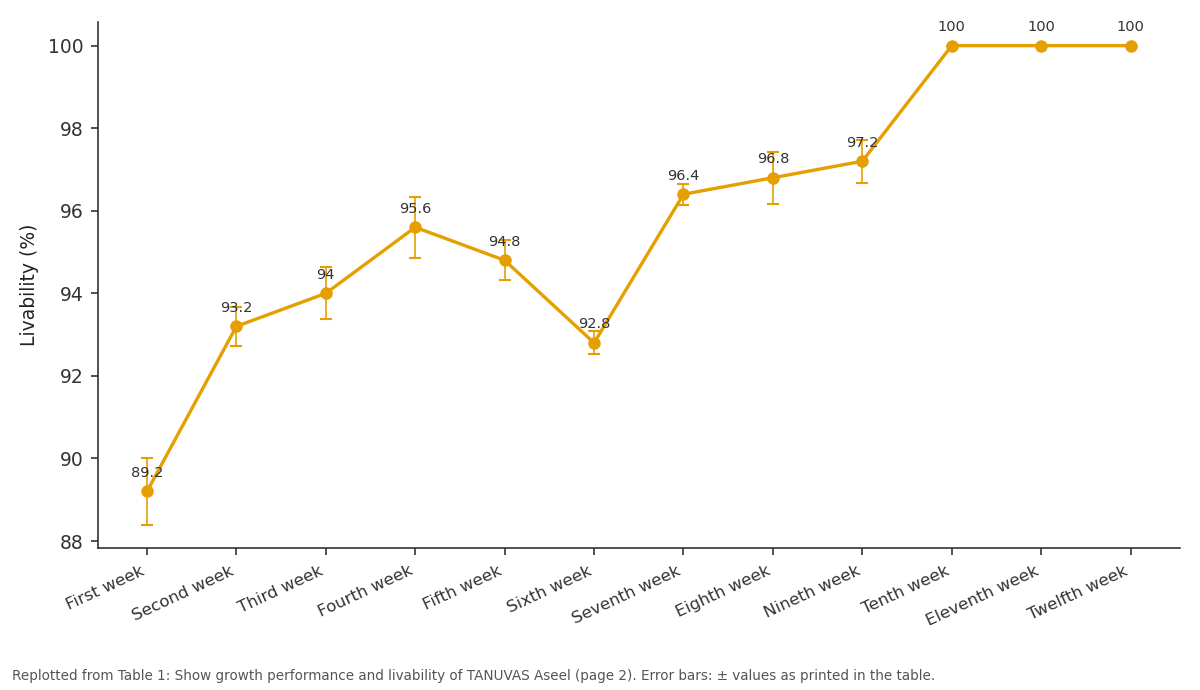
Livability (%) / -: First week vs Second week vs Third week vs Fourth week vs Fifth week
Replotted from Table 1 (page 2) of the original paper. Every bar is the paper's own table value.
View source evidence ↗Figures & tables
From the original paper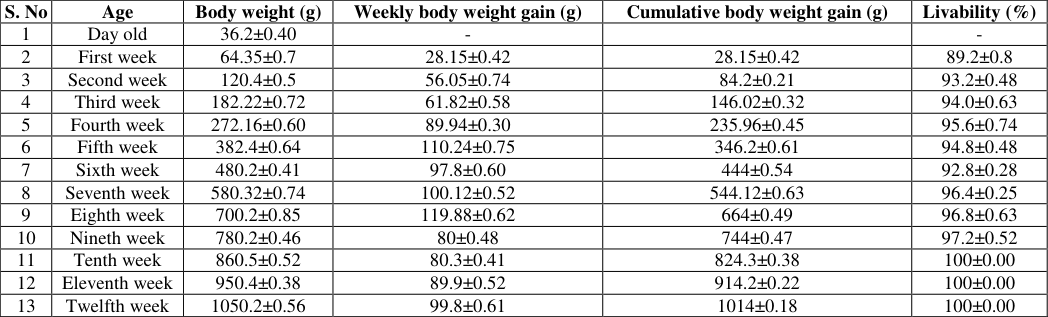 Table 1
Introduction
Poultry production is one of the fastest growing segments of Indian agriculture sector with an average growth rate of 8-10 percent per year which results from the significant contribution of both commercial and backyard poultry farming. As per the 20 th livestock census (2019), the total backyard poultry is 317.07 million which has increased 45.78 % over previous livestock census and 30 million rural households involved in backyard poultry rearing. According to BAHS (2023), [1] India produced 138.38 billion eggs in 2022-2023, of which 20.20 billion eggs are produced from backyard poultry, positioning India as the third largest egg producer in the world. The total meat production for the country in the year 2022-23 is 9.77MMT and poultry accounted for 51.14% which ranks India fifth in the world for chicken meat production. This consistent growth clearly indicates the importance of backyard poultry in the country's economy and in the rural livelihood as well. Though backyard poultry rearing is gaining popularity in India, the problems faced by the small holders viz., poor production, loss due to predation and diseases, lack of knowledge on improved fowls cannot be overlooked. Providing Suitable intervention in health control measures, feeding system, prevention of predation and by introducing genetically improved poultry germplasm adaptable to rural husbandry conditions will help to transform backyard poultry system from subsistence to economically viable sustainable system. As a measure, it is planned to popularize the improved native chicken variety 'TANUVAS Aseel' among the farmers of Virudhunagar District through Front Line Demonstration (FLD) programme and a study has been conducted on the growth performance and its suitability to backyard system under field conditions. TANUVAS Aseel is a dual-purpose native variety of Aseel evolved for table purpose developed by Poultry Research Station, Tamil Nadu Veterinary and Animal Sciences University (TANUVAS) in the year 2017. This improved variety is capable to attain 1.0 kg body weight at 12 weeks with the Feed Conversion Ratio (FCR) of 3.5 and 95 percent livability. (TANUVAS Technical Reporter, 2018) [8] .
Materials and Methods
The study has been conducted at Virudhunagar District which covers an area of 4222.23km 2 (1630.2 sq mi). This district has an average elevation of 102MSL. Virudhunagar has a borderline hot semi-arid climate (Koppen BSh) not quite wet enough for tropical savanna (As) classification. Like the rest of Tamil Nadu, Virudhunagar experiences hot weather between April and June and is relatively cooler in December and January. The average daily temperature ranges from a maximum of 34.9 o C (102.02 o F) to a minimum of 22.7 o C (72.86 o F). The Virudhunagar District receives an annual average rainfall of 793 mm. The total average rainy days prevails in Virudhunagar district is about 58 days. (DAMU, KVK, Virudhunagar, 2022) [4] . A total of 250 numbers of straight run day old chicks of TANUVAS Aseel were procured from the Regional Research and Educational Centre (RREC), Pudukottai, TANUVAS and distributed to 5 numbers of small-scale backyard poultry farmers of Virudhunagar district each with fifty chicks. The selected backyard poultry famers were all already trained about brooding techniques and other basic poultry rearing practices including disease control measures through trainings and demonstrations conducted at KVK, Virudhunagar. On the day of arrival, the chicks were randomly measured for hatch weight before distributed to the beneficiaries. All the chicks were provided with clean, boiled, cooled drinking water mixed with 5g of glucose, 1g of antibiotic and 2ml of vitamin mixture. Medicated water continued for 5 days. The brooding programme was carried out for a period of 21 days. Electric bulbs were used as a source of heat. Twenty-three (23) hours lighting was provided for the first 5 days to avoid mortality due to cuddling. The temperature of 35 °C was maintained initially and gradual reduction was practiced in the following weeks depending upon the duration of day length and the behaviour of chicks in the brooding area. The chicks were maintained in cage rearing system with recommended floor space, feeding space and watering space. Chicks were provided with starter ration up to the age of one month and then allowed for open foraging in an enclosed area. The chicks were vaccinated against Ranikhet disease periodically. Body weight was recorded at weekly interval and mortality was recorded at the occurrence. From the above data, weekly body weight gain, cumulative body weight gain and livability percentage were calculated. The data collected are subjected to statistical analysis (Snedecor and Cochran, 1994) [7] .
Results and Discussion
The mean (±S. E) growth performance and livability of TANUVAS Aseel is presented in Table 1.
| S. No | Age | Body weight (g) | Weekly body weight gain (g) | Cumulative body weight gain (g) | Livability (%) |
|---|---|---|---|---|---|
| 1 | Day old | 36.2±0.40 | - | - | |
| 2 | First week | 64.35±0.7 | 28.15±0.42 | 28.15±0.42 | 89.2±0.8 |
| 3 | Second week | 120.4±0.5 | 56.05±0.74 | 84.2±0.21 | 93.2±0.48 |
| 4 | Third week | 182.22±0.72 | 61.82±0.58 | 146.02±0.32 | 94.0±0.63 |
| 5 | Fourth week | 272.16±0.60 | 89.94±0.30 | 235.96±0.45 | 95.6±0.74 |
| 6 | Fifth week | 382.4±0.64 | 110.24±0.75 | 346.2±0.61 | 94.8±0.48 |
| 7 | Sixth week | 480.2±0.41 | 97.8±0.60 | 444±0.54 | 92.8±0.28 |
| 8 | Seventh week | 580.32±0.74 | 100.12±0.52 | 544.12±0.63 | 96.4±0.25 |
| 9 | Eighth week | 700.2±0.85 | 119.88±0.62 | 664±0.49 | 96.8±0.63 |
| 10 | Nineth week | 780.2±0.46 | 80±0.48 | 744±0.47 | 97.2±0.52 |
| 11 | Tenth week | 860.5±0.52 | 80.3±0.41 | 824.3±0.38 | 100±0.00 |
| 12 | Eleventh week | 950.4±0.38 | 89.9±0.52 | 914.2±0.22 | 100±0.00 |
| 13 | Twelfth week | 1050.2±0.56 | 99.8±0.61 | 1014±0.18 | 100±0.00 |
Table text extracted from the original PDF; superscript letters are shown inline. The original table image is below.
View original table image
Body weight and body weight gain
The mean (±SE) body weight of TANUVAS Aseel from day old to 12 weeks of age were given in the Table .1. The body weight of a bird is an important trait, and it indicates its genetic constitution concerning the specific environment and its adaptability to that environment. Growth rates in different breeds of chicken depend mainly on the hatching weight of chicks. Body weight and growth rate are genetically correlated traits. Selection for early marketing weight results in faster growth rates in chicken. Generally, heavier breeds of chicken have faster growth rates up to the marketing age in comparison to lighter chicken breeds. Within a particular chicken breed, growth rates in flocks may depend on many factors such as the genetic merit of breeder flocks, brooding conditions, the occurrence of diseases and feed quality. (Manish K, Singh et al., 2023) [2] .
In the present study, the hatch weight, 8 th week body weight and 12 th week body weight of the TANUVAS Aseel chick recorded was 36.2±0.40g, 700.2±0.85g and 1050.2±0.56g
respectively. The results were comparable with that of Chitra, (2021), [3] but higher body weight of 1.23±0.17g was observed at 12 weeks by Lurthu Reetha Thomas et al., (2023). [6] Abrupt changes in the body weight may be correlated with the environment and feeding system. In general, growth will be at its highest between 6 and 11 weeks. In this study also, maximum body weight gain was recorded in seventh week (100.12±0.52g) and eight week (119.88±0.62g).
Livability
The livability percentage of TANUVAS Aseel from 1 st week to 12 th week was given in the Table .1. In the present study, overall livability of TANUVAS Aseel observed was 95.83%. similar result was obtained by Leonal Rabins et al., (2024) [5] (95.7%) and Vinothraj et al., (2020) [9] (96.2%). High mortality was observed in the first two weeks which may be due to some managerial issues in the brooding programme and thereafter a gradual reduction in the mortality was observed except in fifth and sixth week. The mortality at this stage may be due to the change in the system of rearing and change in the diet. No incidence of infectious diseases was recorded throughout the study period and 100 percent livability was observed from 10 th week onwards which clearly indicates that the TANUVAS Aseel birds are highly resistant to most of the diseases of poultry and livability percentage increases with age. Pecking problem was reported during the fourth week of age which was minimized by the incorporation green fodder in the diet.
Conclusion
The study reveals that, high growth rate (1050.2g of body weight at 12-week age) and good disease resistance capacity (95.83% livability) are the notable features of TANUVAS Aseel which make them more preferable for backyard poultry rearing in Virudhunagar district. Farmers also expressed that, there is no issues in marketing the birds as they fetch very good market price. Hence, TANUVAS Aseel can very well be recommended for backyard poultry rearing which will be a promising venture for improving rural livelihood by providing subsidiary income in a shorter period of time besides ensuring nutritional security to the family.
Conflict of Interest Not available
Conflict of Interest Not available
Financial Support
Financial Support
References
9 in the original paper- Government of India, Ministry of Fisheries Animal Husbandry and Dairying, Ministry of Animal Husbandry and Dairying. Basic Animal Husbandry Statistics-2023. New Delhi: Krishi Bhawan, 2023, p. 15-22.
- Singh MK, Kumar S, Singh SK, Sharma RK, Prakash A, Prasad S, et al. Body weights and growth rates in indigenous chicken breeds of India. World's Poul. Sci. J. 2023;79(4): DOI: 10.1080/00439339.2023.2239775.
- Chitra P. Comparative study of TANUVAS Aseel and Desi chicken rearing under backyard in rural areas of Tiruppur district in Tamil Nadu, India. Int. J. Agri, Envi and Biotech. 2021;14(03):485-488.
- District Agro-Meteorology Unit (DAMU), Krishi Vigyan Kendra, 2022.
- Rabins SL, Jose J, Sethupathi S. Economic traits of TANUVAS Aseel on backyard rearing at Tenkasi district of Tamil Nadu. Int. J. Vet. Sci. and Ani. Hus. 2024;SP(1):182-185.
- Thomas L, Ilavarasan S, Kalaikannan R, Sheeba A, Sathya J. The Phar. Innov. J. 2023;SP(12):3475-3477.
- Snedecor GW, Cochran WG. Statistical Methods. 8th ed. Ames, Iowa, USA: The Iowa State University Press, 1994.
- TANUVAS Technical Reporter. Jan-Feb 2018;2(5):1-2.
- Vinothraj S, Alagesan P, Pachiappan P, Saravanakumar S, Siva M, Srinivasan RD. Production performance of TANUVAS Aseel poultry breed in Western zone of Tamil Nadu, India. Int. J. Curr. Mic. and App. Sci. 2020;9(09):2447-2450.