
Research article · 2025 · Full text
International Journal of Veterinary Sciences and Animal HusbandryClinical management of Lumpy Skin Diseases (LSD) in a calf with homeopathy medicine in field conditions: A case report
Volume 10(1S) · Pages 30–31 · DOI: 10.22271/veterinary.2025.v10.i1sa.2008 ↗
Research areasPoxvirus research and outbreaksToxin Mechanisms and ImmunotoxinsTransgenic Plants and Applications
Abstract
Author-writtenA four months old crossbred Jersey calf was affected with a history of anorexia for the past five days and presence of cutaneous nodules all over the body for past five days. On Clinical examination pyrexia (40.4 °C), Tachycardia (110 bpm), Tachypnoea (70), Congested mucous membrane and Lymphadenopathy. Haematology results revealed elevated leucocytes count in the blood. Based on the history, clinical signs and laboratory findings, it was diagnosed as Lumpy Skin Diseases (LSD) in the field. The affected calf was treated with Inj. Oxytetracycline, Inj. Ivermectin and Inj. Flunixin. In addition, homeopathy medicine was also prescribed for a period of 20 days. The disappearance of nodules was noticed and the calf was recovered uneventfully after the treatment.
Summary
Source-checkedPlain-language reading of the full paper, prepared with AI and checked against the text. Each point links to the authors' own words.
Why it matters
- Lumpy skin disease (LSD) is a contagious viral infection affecting water buffaloes and cattle in India. View evidence ↗
- The disease causes significant economic losses for farmers due to factors like reduced milk yield, poor growth, infertility, and animal death. View evidence ↗
- LSD is spread mechanically through contaminated needles and arthropod vectors such as ticks, flies, and mosquitoes. View evidence ↗
The question
- The study aims to report on the clinical management of Lumpy Skin Disease in a calf using homeopathic medicine under field conditions. View evidence ↗
What they did
- The subject of the case report was a four-month-old crossbred Jersey calf. View evidence ↗
- Initial clinical examination of the calf showed a temperature of 40.4 °C, a heart rate of 110 bpm, a respiratory rate of 70, lymphadenopathy, and congested mucous membranes. View evidence ↗
- A Complete Blood Count (CBC) was performed, which showed an elevated leukocyte count. View evidence ↗
- The calf received conventional treatment consisting of intramuscular Oxytetracycline (15mg/kg), subcutaneous Ivermectin (0.2mg/kg), and intravenous Flunixin (2.2 mg/kg). View evidence ↗
- A homeopathic combination at 200C potency was used, including Ars alb, Variolinum, Kaliphos, Nat Mur, Silicea, Merc sol, and Dulcamera. View evidence ↗
- The homeopathic cocktail was administered as 10 oral drops four times daily at 6-hour intervals for a duration of 20 days. View evidence ↗
What they found
- Following the combined treatment course, the skin nodules disappeared and the calf recovered without further complications. View evidence ↗
What it means
- The authors conclude that homeopathic medications may be used to treat lumpy skin disorder in cattle to facilitate faster recovery. View evidence ↗
- To prevent the spread of LSD, the authors recommend restricting animal movement and avoiding grazing in areas where vectors are present. View evidence ↗
Visual summary
1 visualsIllustrations explain the paper; they do not show study data.
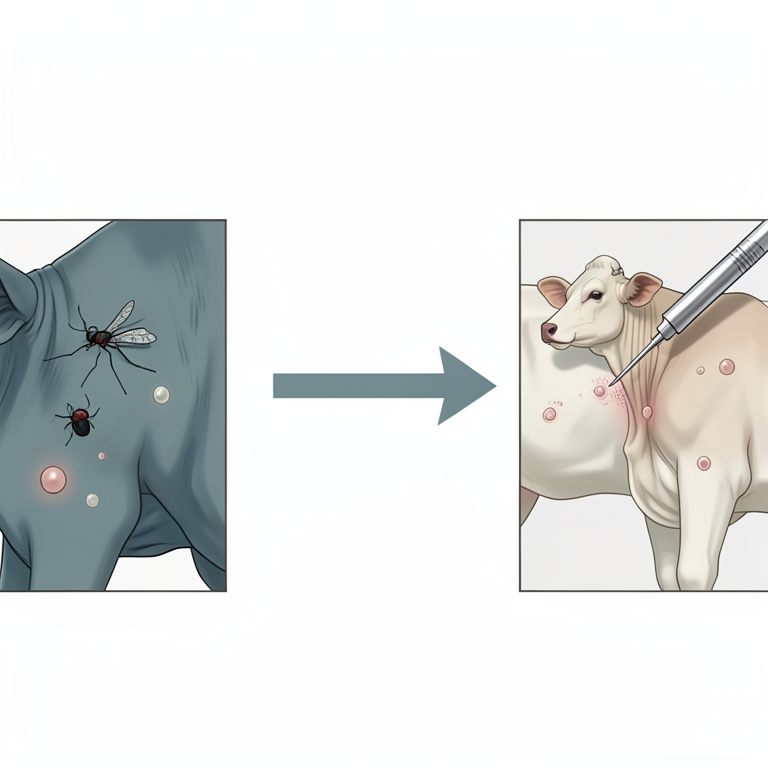
LSD Transmission Cycle
AI-generated conceptual illustration (calf and arthropod vectors). It explains the idea and does not show study data.
View source evidence ↗Introduction
Lumpy skin disease (LSD) is a contagious viral disease that affects cattle and water buffaloes in India. LSD is caused by LSDV, which belongs to the Capripoxvirus genus in the Poxviridae family. It is closely antigenically related to sheep and goat pox virus (Woods et al., 1988) [6] . Lumpy skin disease (LSD) was first reported in North Rhodesia (Zambia) in the year 1929, which was initially thought to be due to an allergic reaction in cattle caused by biting insects. In India, lumpy skin disease was first reported from Mayurbhanj and Bhadrak Districts in Odisha in August 2019 (Sudhakar et al. 2020) [5] . Lumpy skin disease causes severe loss to farmers in terms of chronic debility, decreased milk yield, poor growth rate, infertility, abortion and even death (Abutarbush et al. 2013) [1] . The LSD virus causes an acute disease in cattle, characterized by elevated body temperature, skin nodules, skin swelling, weight loss, and lymph node enlargement (Gamil et al. 2024) [2] . The LSD virus is mechanically transmitted by arthropod vectors (mosquitoes, files, ticks etc) and contaminated needles. Clinically, the disease is characterized by distinctive nodular lesions on the skin which consequently result in loss of production and fertility in turn resulting in economic losses. As the treatment is only symptomatic, therefore, prevention is a more effective way to avoid economic losses (Sikder et al. 2021) [3] .
Case History and Observation
A four months old crossbreed jersey calf was affected with a history of anorexia for the past 5 days and the presence of cutaneous nodules all over the body. The animal had been treated by a quack for the past 2 days and no improvement was noticed by the owner. On clinical examination, pyrexia (40.4 °F), Tachycardia (110 bpm), Tachypnoea (70), Congested mucous membrane and Lymphadenopathy were observed. Pus discharge from the right lateral thoracic wall was also observed in the affected calf.
Diagnosis and Treatment
The diagnosis of LSD is based on typical clinical signs combined with laboratory confirmation of the presence of the virus or antigen.
International Journal of Veterinary Sciences and Animal Husbandry https://www.veterinarypaper.com
A field presumptive diagnosis of LSD can be done on the basis of presence of skin nodules, enlargement of lymph nodes draining the affected areas, pox lesions on the mucous membrane of the mouth, pharynx, epiglottis, tongue, mucous membranes of the nasal cavity, edematous brisket region. Preliminary diagnosis of LSD can also be done by palpation of enlarged Pre-Scapular lymph nod. The blood sample was collected for a Complete Blood Count (CBC) and it revealed elevated leucocytes. Based on the history, clinical signs and laboratory findings, it was diagnosed as Lumpy Skin Diseases (LSD). The affected animal was treated with Inj. Oxytetracycline (Long acting) 15mg/kg IM, Inj. Ivermectin 0.2mg/kg SC and Inj. Flunixin 2.2 mg/kg IV. In addition to that, Homeopathy is a combination of Ars alb, Variolinum, Kaliphos, Nat Mur, Silicea, Merc sol (Yogeshwari G 2023) [7] and Dulcamera (useful in lung involvement) at 200C potency. A cocktail of homeopathic medicine was given as oral drops (10 drops/time) for four times in a day @ 6 hours interval for 20 days. The disappearance of nodules was noticed and the animal was recovered uneventfully after a course of treatment.
Before treatment -After treatment
Conclusion
Lumpy Skin Disease (LSD) causes huge economic losses in the livestock industry due to the weakness of the affected animal, decrease in milk production, loss of hide values and delayed response to the daily clinical treatment. Based on the case report, it concluded that homeopathic medications may also be used to treat lumpy skin disorder in cattle for faster recovery. Further, to prevent the spread/occurrence of LSD disease, animals should not be left for grazing in the vectorborne areas and complete restriction on movement of the animals at village or district or state level is strictly to be implement.
Conflict of Interest Not available
Conflict of Interest Not available
Financial Support
Financial Support
References
7 in the original paper- Abutarbush SM. Hematological and serum biochemical findings in clinical cases of cattle naturally infected with lumpy skin disease. J Infect Dev Ctries. 2013;9:283-288.
- Gamil SGZ, Abeer MA, Ahmad MA, Sobhy A. Molecular detection of lumpy skin disease virus in naturally infected cattle and buffaloes: unveiling the role of tick vectors in disease spread. Vet Res Commun. 2024;48:3921-3939.
- Sikder JI, Champak D, Palash JS. Treatment and management of lumpy skin disease in cow: A case report. Int J Vet Sci Anim Husb. 2021;6(2):26-27.
- Smriti S, Upasana V, Chitralekha D, Seema, Surendra KK, Ritu G. Successful therapeutic management of lumpy skin disease. The Pharma Innov J. 2023;12(8):467-469.
- Sudhakar SB, Mishra N, Kalaiyarasu S, Jhade SK, Hemadri D. Lumpy skin disease (LSD) outbreaks in cattle in Odisha state, India in August 2019: epidemiology features and molecular studies. Transbound Emerg Dis. 2020; DOI: 10.1111/tbed.13579.
- Woods JA. Lumpy skin disease -A review. Trop Anim Health Prod. 1988;20:11-17.
- Yogeshwari G. Effectiveness of homoeopathy in lumpy skin disease -A review of experimental evidence. Homeopathy for All. 2023;72-74.