
Research article · 2025 · Full text
International Journal of Veterinary Sciences and Animal HusbandryClinical management of viper envenomation in a Labrador retriever: A case report
Volume 10(1S) · Pages 28–29 · DOI: 10.22271/veterinary.2025.v10.i1sa.2007 ↗
Research areasVenomous Animal Envenomation and StudiesHealthcare and Venom ResearchInsect and Pesticide Research
Abstract
Author-writtenA one-year-old male Labrador retriever dog was presented with a history of snake bite (Russel’s viper) followed by vomiting. On clinical examination, no fang marks could be detected, but the dog was dull and depressed with tachycardia (142bpm) and congested mucous membranes were noticed. Based on history, clinical symptoms and whole blood clotting test, it was diagnosed as viper snake bite. The affected dog was treated with fluids, anti-snake venom, antibiotics and corticosteroid. The kidney and liver function tests were normal and no significant changes were observed. The animal had uneventfully recovery.
Summary
Source-checkedPlain-language reading of the full paper, prepared with AI and checked against the text. Each point links to the authors' own words.
Why it matters
- Snakebites occur more frequently in dogs and horses than in cattle, sheep, or goats, often due to human encroachment and land scarcity. View evidence ↗
- The most common venomous snakes found in the Indian subcontinent include the Common Krait, Indian Cobra, and Russell's viper. View evidence ↗
- Envenomation by the Russell's viper primarily leads to renal failure and defects in blood coagulation. View evidence ↗
The question
- The study aims to report the clinical management of a Labrador retriever affected by viper envenomation. View evidence ↗
What they did
- The subject of the case report was a one-year-old male Labrador retriever with a history of vomiting following a Russell's viper bite. View evidence ↗
- Diagnostic procedures included serum biochemistry and a Complete Blood Count (CBC). View evidence ↗
- A 20-minute whole blood clotting time (WBCT) test was performed as a standard diagnostic for Russell's viper envenomation. View evidence ↗
- Treatment consisted of polyvalent anti-snake venom (one vial), Dextrose Normal Saline (10ml/kg IV), Dexamethasone (2mg/kg IM), Enrofloxacin (5mg/kg IM), and Tetanus Toxoid (1ml IM). View evidence ↗
What they found
- Initial clinical examination showed tachycardia at 142bpm and congested mucous membranes, although no fang marks were visible. View evidence ↗
- Laboratory results showed normal liver and kidney function tests and no significant changes in the Complete Blood Count (CBC). View evidence ↗
- The diagnosis of Russell's viper envenomation was confirmed by a positive 20-minute whole blood clotting time test. View evidence ↗
- Following treatment, the 20-minute WBCT became negative the next day, and the dog recovered without further clinical signs. View evidence ↗
What it means
- The authors conclude that Russell's viper envenomation is a serious threat to dogs that requires immediate and comprehensive veterinary care. View evidence ↗
- Improving outcomes for affected animals depends on a thorough understanding of treatment strategies, complications, and clinical manifestations. View evidence ↗
Visual summary
1 visualsIllustrations explain the paper; they do not show study data.
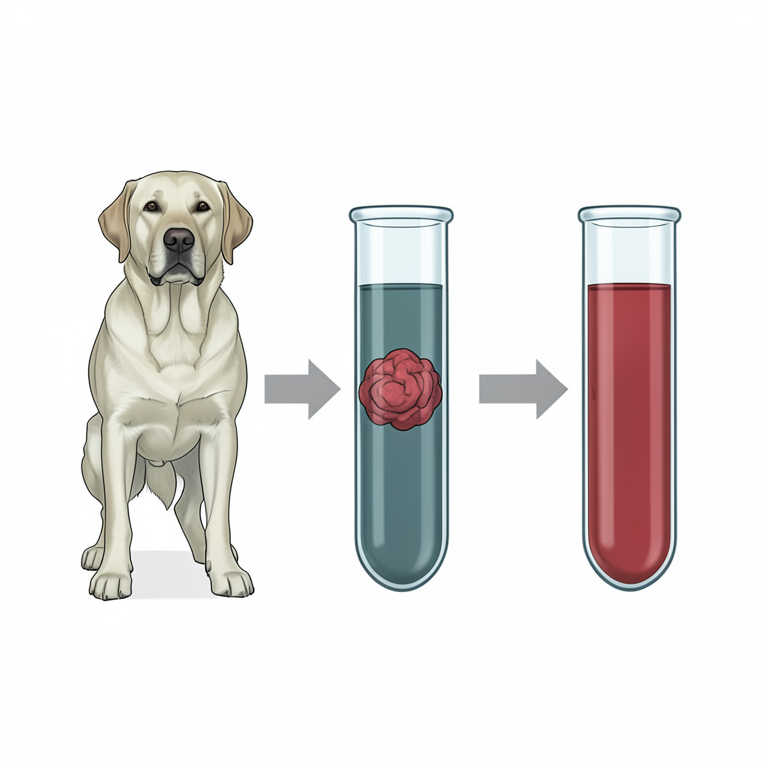
Diagnostic Timeline of WBCT
AI-generated conceptual illustration (Labrador retriever and blood samples in glass tubes). It explains the idea and does not show study data.
View source evidence ↗Introduction
Snakebite is more common in horses and dogs when compared to other animals such as cattle, sheep and goat due to scarcity of land and human encroachment. In the Indian subcontinent the common venomous snakes encountered are the Indian Cobra (Naja naja), Russell’s viper (Daboia russelli) and the Common Krait (Bungarus caeruleus). Snake envenomation may be difficult to diagnose if the incident is not witnessed. Clinical signs may vary greatly depending on the species of snake involved and the quantity and toxicity of the venom injected (Inbaraj et al. 2023) [3].
Russel viper is one of the dangerous snakes in Asian continent. Russel’s envenomation causes mainly blood coagulation defect and renal failure. Generally, in animals snake bites were reported during grazing, hunting or while playing (Saravanan et al. 2017) [4]. Case History and Observation A one year old Labrador retriever dog was presented with a history of snake bite (Russel’s viper) followed by vomiting.
The owner informed that his dog was playing in the farm areas and he founded dead Russel viper near by the dog. On clinical examination no fang marks could be detected but the dog was dull and depressed with tachycardia (142bpm) and congested mucous membrane with no swelling in animal body. Diagnosis and treatment The blood sample was collected for a Complete Blood Count (CBC) and Serum biochemistry. No significant changes could be detected in CBC values.
In serum biochemistry, the kidney and liver function tests were normal. But for 20 minutes the whole blood clotting time was positive which is a standard test for Russel viper envenomation. Based on the owner history, clinical examinations and laboratory findings, it was confirmed as a snake bite case. The affected dog was treated with Inj.
Dextrose Normal Saline 10ml/kg IV, one vial of lyophilized polyvalent anti-snake venom, Inj. Enrofloxacin 5mg/kg IM, Inj. Tetanus Toxoid 1ml IM and Inj. Dexamethasone 2mg/kg IM (Ananda et al. 2009, Saravanan et al. 2017) [1, 4].
The next day, 20 Minutes WBCT was negative and the dog was recovered uneventfully without any clinical signs. VET 2025; SP-10(1): 28-29 P Ravi Associate Professor and Head, Department of Livestock Production Management, Veterinary College and Research Institute, Udumalpet, Tamil Nadu, India C Inbaraj Assistant Professor, Department of Veterinary Clinical Medicine, Veterinary College and Research Institute, Udumalpet, Tamil Nadu, India L Arun Assistant Professor, Department of Veterinary and Animal Husbandry Extension, Veterinary College and Research Institute, Udumalpet, Tamil Nadu, India R Vivekanandhan Assistant Professor, Department of Veterinary Public Health and Epidemiology, Veterinary College and Research Institute, Udumalpet, Tamil Nadu, India S Vinothraj Assistant Professor, Department of Animal Genetic and Breeding, Veterinary College and Research Institute, Udumalpet, Tamil Nadu, India C Inbaraj Assistant Professor, Department of Veterinary Clinical Medicine, Veterinary College and Research Institute, Udumalpet, Tamil Nadu, India https://www.veterinarypaper.com its therapeutic management: A case report. Bull Environ Pharmacol Life Sci. 2017;6(11):144-148. 5. Vigneswari M.
Snake bite in dogs and its management. Int J Vet Sci Anim Husb. 2020;5(4):75-76. How to Cite This Article Ravi P, Inbaraj C, Arun L, Vivekanandhan R, Vinothraj S. Clinical management of viper envenomation in a Labrador retriever: A case report.
International Journal of Veterinary Sciences and Animal Husbandry. 2025;SP-10(1):28-29. Creative Commons (CC) License This is an open-access journal, and articles are distributed under the terms of the Creative Commons Attribution-Non Commercial-Share Alike 4.0 International (CC BY-NC-SA 4.0) License, which allows others to remix, tweak, and build upon the work non-commercially, as long as appropriate credit is given and the new creations are licensed under the identical terms. Affected dog Anti-snake venom
Conclusion
The present study concluded that Russel’s viper envenomation in dogs poses a serious threat, necessitating prompt and comprehensive veterinary intervention. Understanding the clinical manifestations, complications and treatment strategies is crucial for improving outcomes in affected animals. Conflict of Interest Not available Financial Support Not available Reference 1. Ananda KJ, Mohan K, Kamran A, Sharada A.
Snake bite in dogs and its successful treatment. Vet World. 2009;12(2):212-213. 2. Arul V, Inbaraj C, Brindha V. Management of snake bite envenomation in an indigenous cow.
J Entomol Zool Stud. 2020;8(1):844-845. 3. Inbaraj C, Thangapandiyan M, Vigneshwaran S, Monica G, Rama T, Chandrasekaran D, et al. Clinical management of snake envenomation in a non-descriptive dog: A case report. J Krishi Vigyan. 2023;11(Supple):248-250. 4.
Saravanan M, Sivakumar M, Yogeshpriya S, Veeraselvam M, Krishnakumar S, Ranjithkumar M, et al. Russell's viper envenomation in Doberman Pinscher and