
Research article · 2025 · Full text
International Journal of Agriculture and Food ScienceBotanical management of Sitophilus oryzae (L.) in sorghum seeds
Volume 7(1) · Pages 35–37 · DOI: 10.33545/2664844x.2025.v7.i1a.235 ↗
Research areasInsect Pest Control StrategiesAgricultural pest management studiesBotanical Research and Chemistry
Abstract
Author-writtenLaboratory experiment was conducted to study the efficacy of botanicals against the management of Sitophilus oryzae (L.) in sorghum seeds. Leaf powders of Catharanthus roseus (Periwinkle), Vitex negundo (Nochi), Calotropis gigantea (Milkweed), Azadirachta indica (Neem), Annona squamosa (Custard apple) and Acorus calamus TNAU formulation @ 10 ml / kg of seeds were evaluated. Leaf powders at the rate of 10 g/kg of seeds were admixed with 500 g of sorghum seeds. Immediately after treatment and at monthly intervals up to a period of six months, mortality was recorded after 3, 7 and 15 days. Seed damage, weight loss and germination was assessed after six months. Higher mortality of S. oryzae, lower seed damage and lower weight loss were observed in A. calamus formulation treatment and less than 20.0 per cent mortality in botanical leaf powder treatments.
Summary
Source-checkedPlain-language reading of the full paper, prepared with AI and checked against the text. Each point links to the authors' own words.
Why it matters
- The rice weevil (Sitophilus oryzae) is a critical pest that causes significant damage to stored cereals and legumes. View evidence ↗
- Infestations by this weevil can lead to extreme losses, potentially destroying up to 100% of stored produce. View evidence ↗
- Heavy reliance on chemical insecticides for weevil management poses risks to human health and the environment. View evidence ↗
The question
- The study aimed to evaluate how effective various botanical treatments are in managing the rice weevil. View evidence ↗
What they did
- The research was a laboratory experiment conducted in Tamil Nadu using sorghum seeds infested with Sitophilus oryzae. View evidence ↗
- The treatments tested included leaf powders from Periwinkle, Nochi, Milkweed, Neem, and Custard apple, as well as an Acorus calamus TNAU formulation. View evidence ↗
- Botanical leaf powders were applied at a dosage of 10 g per kg of seeds, mixed into 500 g samples. View evidence ↗
- Mortality was measured by releasing 10 pairs of adult weevils into 50 g seed samples at monthly intervals for six months, recording deaths at 3, 7, and 15 days. View evidence ↗
- To determine the effect of treatments on seed viability, germination was assessed using 100 seeds per replication after six months. View evidence ↗
What they found
- Immediately after treatment, the Acorus calamus formulation caused the highest mortality, while all leaf powder treatments resulted in less than 20% mortality. View evidence ↗
- The effectiveness of the A. calamus treatment declined over time, with mortality dropping to between 16.0% and 24.0% after six months. View evidence ↗
- By the fourth month, mortality in the botanical leaf powder treatments fell to either zero or less than 5.0%. View evidence ↗
- The Acorus calamus treatment resulted in the lowest levels of seed damage and weight loss compared to other treatments. View evidence ↗
- All treatments maintained germination rates above 80.0%, suggesting that neither the leaf powders nor the A. calamus formulation negatively impacted seed viability. View evidence ↗
What it means
- The authors concluded that the Acorus calamus TNAU formulation is the most effective treatment for maximizing weevil mortality and minimizing seed damage and weight loss. View evidence ↗
Figures & tables
From the original paper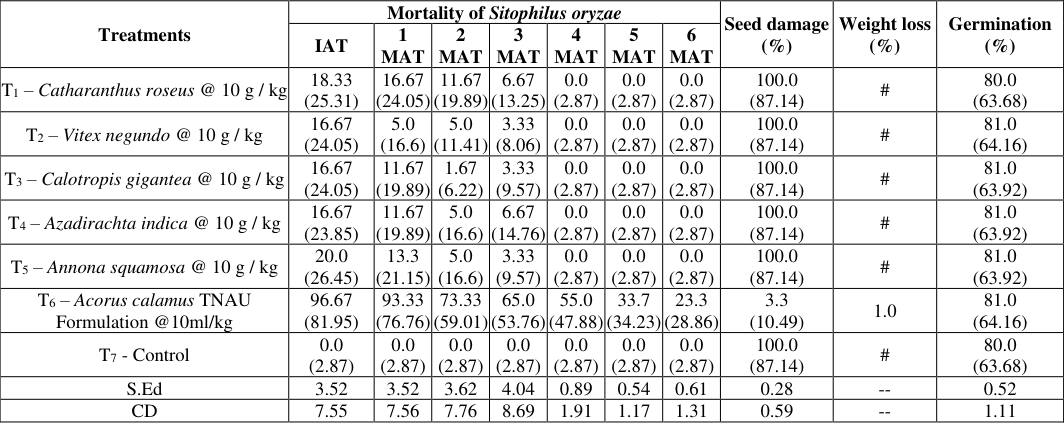 Table 1
Introduction
The rice weevil, Sitophilus oryzae (L.) is one of the most critical and pervasive insect, which devastated the storage legumes and cereals (Park et al., 2003) [10] . The weevil causes huge losses to the storage produce even upto 100 per cent (Singh et al., 1975) [12] . Essential oils are used against the management of S. oryzae (Idouaarame et al., 2018) [5] . Pal et al., 2018 [9] reported botanical powders are most effective to control rice weevil. To manage this insect, bountiful number of insecticides will pave way to increases the possibility of human illness, detrimental effect to the environment (Prasannath, 2016) [11] . In Nepal, Aluminium phosphide and EDCT mixtures are extensively used chemicals to manage this particular insect (Neupane, 2018) [8] . In addition, the toxic chemicals also affect the stored grains in terms of residues. To avoid the environmental and residual problem, botanical products are the finest solution with traditional storage facilities (Belmain et al. 2001) [3] . Kathirvelu and Raja, 2015 [6] stated that bio-fumigants are safer to the human and the environment. The botanicals are not as much of poisonous to humans, easily degradable and ecofriendly (Guzzo et al., 2006) [4] . Most of the plant products are acquiring insecticidal and repellent property (Uma Reddy and Shoba Reddy, 1987) [15] without affecting the storage produce and natural ecosystem. Keeping in this view, the present study was planned to know the efficacy of different botanicals against rice weevil.
Materials and Methods
Laboratory experiment was conducted at Agricultural College and Research Institute, Vazhavachanur, Tamil Nadu to study the efficacy of botanicals against the management of Sitophilus oryzae (L.) in sorghum seeds. Leaf powders of Catharanthus roseus (Periwinkle), Vitex negundo (Nochi), Calotropis gigantea (Milkweed), Azadirachta indica (Neem), Annona squamosa (Custard apple) and Acorus calamus TNAU formulation @ 10 ml / kg of seeds were evaluated in the study. Untreated check was maintained and each treatment was replicated thrice. Design of the experiment was Completely Randomized Design was followed. A. calamus TNAU formulation was obtained from Department of Agricultural Entomology, TNAU, Coimbatore. Freshly harvested and untreated sorghum seeds were used Leaf powders at the rate of 10 g / kg of seeds were admixed with 500 g of sorghum seeds. The treatment Acorus calamus TNAU formulation @ 10 ml / kg of seed was the check. The treated seeds were placed in a plastic container (1 kg capacity) and stored under ambient condition. Immediately after treatment and at monthly intervals up to a period of six months, 50 g of seeds were taken from each replication, stored in a small container and ten pairs of newly emerged S. oryzae adults were released. Immediately after treatment and at monthly intervals up to a period of six months, 50 g of seeds were taken from each replication in a small container, 10 pairs of newly emerged S. oryzae adults were released and mortality was recorded after 3, 7 and 15 days.
Results and Discussion
Immediately after treatment, higher mortality of S. oryzae was observed in A. calamus formulation treatment and less than 20.0 per cent mortality in botanical leaf powder treatments. There was a gradual decline in mortality in A. calamus treatment over the storage period and after six months the mortality percentage ranged from 16.0 to 24.0 per cent. The mortality was either less than 5.0 per cent or nil in the botanical leaf powder treatments after four months.
After six months of treatment, no live insects were observed in all the treatments baring A. calamus treatment. Overall minimum S. oryzae population was observed in A. calamus treatment. Lesser seed damage and weight loss were observed in A. calamus treatment. The germination was above 80.0 per cent in all the treatments which indicates that the leaf powder and A. calamus treatment did not have any effect on germination. Tiwari et al. (2018) [14] reported that, A. Calamus performed lesser damage against weevil population. In addition, Asawalam et al., (2012) [2] stated that, the rhizome powder of A. Calamus leads to suffocation of the weevil, in turn it resulted as death of the storage insects were observed. The present study was also in accordance with the earlier studies.
In contrast, the adults of S. oryzae population were reduced due to the application of basil oil (Lopez et al. 2008) [7] . Essential oils are suppressing the activity of Sitophilus oryzae (L.) and Rhiyzopertha dominica and it serves as an alternative for the chemical insecticides (Abo Arab et al., 2022) [1] . Certain plant materials viz., pomegranate peel and lemon grass powders (0.1g/100g rice grains) were showed high adult mortalities (Tayeb et al., 2018) [13] . The study concluded that, minimum seed damage as well as weight loss against Acorus calamus TNAU formulation treatment for the management of rice weevil.
Figures and tables from the paper
| Treatments | Mortality of Sitophilus oryzae | — | — | — | — | — | — | Seed damage (%) | Weight loss (%) | Germination (%) |
|---|---|---|---|---|---|---|---|---|---|---|
| IAT | 1 MAT | 2 MAT | 3 MAT | 4 MAT | 5 MAT | 6 MAT | ||||
| T1 – Catharanthus roseus @ 10 g / kg | 18.33 (25.31) | 16.67 (24.05) | 11.67 (19.89) | 6.67 (13.25) | 0.0 (2.87) | 0.0 (2.87) | 0.0 (2.87) | 100.0 (87.14) | # | 80.0 (63.68) |
| T2 – Vitex negundo @ 10 g / kg | 16.67 (24.05) | 5.0 (16.6) | 5.0 (11.41) | 3.33 (8.06) | 0.0 (2.87) | 0.0 (2.87) | 0.0 (2.87) | 100.0 (87.14) | # | 81.0 (64.16) |
| T3 – Calotropis gigantea @ 10 g / kg | 16.67 (24.05) | 11.67 (19.89) | 1.67 (6.22) | 3.33 (9.57) | 0.0 (2.87) | 0.0 (2.87) | 0.0 (2.87) | 100.0 (87.14) | # | 81.0 (63.92) |
| T4 – Azadirachta indica @ 10 g / kg | 16.67 (23.85) | 11.67 (19.89) | 5.0 (16.6) | 6.67 (14.76) | 0.0 (2.87) | 0.0 (2.87) | 0.0 (2.87) | 100.0 (87.14) | # | 81.0 (63.92) |
| T5 – Annona squamosa @ 10 g / kg | 20.0 (26.45) | 13.3 (21.15) | 5.0 (16.6) | 3.33 (9.57) | 0.0 (2.87) | 0.0 (2.87) | 0.0 (2.87) | 100.0 (87.14) | # | 81.0 (63.92) |
| T6 – Acorus calamus TNAU Formulation @10ml/kg | 96.67 (81.95) | 93.33 (76.76) | 73.33 (59.01) | 65.0 (53.76) | 55.0 (47.88) | 33.7 (34.23) | 23.3 (28.86) | 3.3 (10.49) | 1.0 | 81.0 (64.16) |
| T7 - Control | 0.0 (2.87) | 0.0 (2.87) | 0.0 (2.87) | 0.0 (2.87) | 0.0 (2.87) | 0.0 (2.87) | 0.0 (2.87) | 100.0 (87.14) | # | 80.0 (63.68) |
| S.Ed | 3.52 | 3.52 | 3.62 | 4.04 | 0.89 | 0.54 | 0.61 | 0.28 | -- | 0.52 |
| CD | 7.55 | 7.56 | 7.76 | 8.69 | 1.91 | 1.17 | 1.31 | 0.59 | -- | 1.11 |
Table text extracted from the original PDF; superscript letters are shown inline. The original table image is below.
View original table image
References
14 in the original paper- Abo Arab RB, El Tawelah NM, Abouelatta AM, Hamza AM. Potential of selected plant essential oils in management of Sitophilus oryzae (L.) and Rhizopertha International Journal of Agriculture and Food Science https://www.agriculturaljournals.com dominica (F.) on wheat grains. Bull Natl Res Cent. 2022;46(192):1-11.
- Asawalam EF, Ebere UE, Emeasor KC. Effect of some plant products on the control of rice weevil Sitophilus oryzae (L.) Coleoptera: Curculionidae. J Med Plant Res. 2012;6(33):4811-4814.
- Belmain SR, Neal GE, Ray DE, Golob P. Insecticidal and vertebrate toxicity associated with ethnobotanicals used as post-harvest protectants in Ghana. Food Chem Toxicol. 2001;39(3):287-291.
- Guzzo EC, Tavares MAGC, Vendramim JD. Evaluation of insecticidal activity of aqueous extracts of Chenopodium spp. in relation to Rhizopertha dominica (Fabr.) (Coleoptera: Bostrichidae). Int Pest Control. 2006:926-930.
- Idouaarame SA, Abdel-hamid AA, Elfarnini M, Filali A, Blaghen M. Insecticidal activity of essential oils from five Moroccan plants on three insect pests of stored cereals. GSC Biol Pharm Sci. 2018;4(2):52-57.
- Kathirvelu C, Raja RS. Efficacy of selected plant extracts as insecticidal fumigant against certain stored grain insect pests under laboratory conditions. Plant Arch. 2015;15(1):259-266.
- Lopez MD, Jordan MJ, Puscual Villalobos MJ. Toxic compounds in essential oils of coriander, caraway, and basil active against stored rice pests. J Stored Prod Res. 2008;44(3):273-278.
- Pal MK, Kafle K, Shrestha J. Efficacy of plant leaf extracts against mustard aphid Lipaphis erysim (Kalt.) under field condition. World Sci News. 2018;105:2939.
- Park IK, Lee SG, Choi DH, Park JD, Ahn YJ. Insecticidal activities of constituents identified in the essential oil from leaves of Chamaecyparis obtusa against Callosobruchus chinensis (L.) and Sitophilus oryzae (L.). J Stored Prod Res. 2003;39:375-384.
- Prasannath K. Botanical insecticides-special reference to horticultural insect pest management: a review. Int J Adv Res Rev. 2016;1(5):14-18.
- Singh K, Agrawal NS, Girish GK. Studies on the damage of Sitophilus oryzae and its effect on the germination of seeds of various high yielding varieties of wheat and maize. Indian J Entomol. 1975;37:146149.
- Tayeb EHM, Saad ASA, Mackled MI, Kordi AMA, Ahmed AE. Botanical powders and essential oils alone or carried on Celatom as rice protectants against the rice weevil Sitophilus oryzae (Curculionidae). Curr Sci Int. 2018;7(4):508-515.
- Tiwari S, Thapa RB, Sharma S. Use of botanicals for weevil management: an integrated approach of maize weevil (Sitophilus zeamais) management in a storage J Agric Anim Sci. 2018;35:167-172.
- Uma Reddy M, Shobareddy. Effectiveness of selected plant material as protectants against insect infestation and nutrient components during storage of greengram (Vigna radiata). Bull Grain Tech. 1987;25(1):48-56.