
Research article · 2025 · Full text
International Journal of Horticulture and Food ScienceFarmers towards integrated pest management practice for disease vectoring mealy bug management in grapefruit vineyards (Vitis vinifera)
Volume 7(1) · Pages 16–21 · DOI: 10.33545/26631067.2025.v7.i1a.237 ↗
Research areasInsect-Plant Interactions and ControlResearch on scale insectsHemiptera Insect Studies
Abstract
Author-writtenThe perspective of\\r\\nfarmers regarding Integrated Pest Management (IPM) for disease vectoring mealy\\r\\nbug management in grape vineyards has not been surveyed in Jumla, district.\\r\\nThus, a survey was carried out during May 2021 to October 2021 to assess the\\r\\nfarmers perspective in various control methods including Integrated Pest\\r\\nManagement (IPM) of mealy bugs in grape vineyards (Vitis vinifera).\\r\\nPrimarily two methods were used to conduct the research namely, KIIs (Key\\r\\nInformant Interview) and FGDs (Focus Group Discussions) in two farmer groups\\r\\n(each with 25 participants), where prospects of practices of mealy bug management\\r\\nand its consequences in grape production were discussed. Information and data\\r\\nwere harvested from the past three years. Approximately 40% of farmers were\\r\\nfound using imidacloprid followed by 28% neem extract (Azadirachta indica),\\r\\n25% Beauveria bassiana, 5% handpicking and 2% Integrated Pest\\r\\nManagement (IPM) during the year 2018. This increased, and changed to 21% for\\r\\nIPM, 27% for B. bassiana, 34% for neem extracts, 17% for\\r\\nimidacloprid, and 1% for handpicking in the year 2021. The percentage of farmers\\r\\nsignificantly increased in the application of Integrated Pest Management (IPM)\\r\\nin managing grape mealy bugs. Highest percentage of farmers revealed knowledge\\r\\nof IPM (60%) followed by climate change (30%) and biological control agents\\r\\n(10%) with respect to grape mealy bugs. Though initially the production of\\r\\ngrapevines was lower through the application of Integrated Pest Management\\r\\n(IPM) method, it gradually increased and later became an effective strategy to\\r\\nmanage the population of mealy bug thereby increasing the production of\\r\\ngrapevine compared with other methods of the pest control. Therefore,\\r\\nIntegrated Pest Management (IPM) would be an effective management method for\\r\\nreducing disease vectoring mealy bugs in grape vineyards for the farmers in the\\r\\ndistrict.
Summary
Source-checkedPlain-language reading of the full paper, prepared with AI and checked against the text. Each point links to the authors' own words.
Why it matters
- The vine mealy bug is a major pest for grape production in several high-producing global regions. View evidence ↗
- Mealy bugs transmit viruses that can reduce grape yields, lower sugar levels, alter fruit color, and delay ripening. View evidence ↗
- Integrated Pest Management (IPM) is used as a sustainable, eco-friendly alternative to standalone insecticides to reduce environmental damage. View evidence ↗
The question
- The study aimed to understand how farmers in the Jumla district perceive the use of IPM for controlling mealy bug populations in grape vineyards. View evidence ↗
What they did
- The survey took place in Chandannath, Jumla district, from May 2021 to October 2021. View evidence ↗
- Researchers used Key Informant Interviews (KIIs) and Focus Group Discussions (FGDs) with two groups of 25 farmers each. View evidence ↗
- The study collected data and information spanning the three years prior to the survey. View evidence ↗
- Data analysis was performed using R studio and Microsoft Excel 2013. View evidence ↗
What they found
- In 2018, the most common control method was imidacloprid (40%), while IPM was used by only 2% of farmers. View evidence ↗
- By 2021, IPM adoption increased to 21%, while imidacloprid use dropped to 17%. View evidence ↗
- Farmer knowledge was highest for IPM (60%), followed by the effects of climate change (30%) and biological control agents (10%). View evidence ↗
- In 2018, the highest average yield was 900 kg/ropani for imidacloprid-treated yards, compared to 750 kg/ropani for IPM yards. View evidence ↗
- By 2021, IPM yards achieved the highest average yield at 930 kg/ropani, while imidacloprid yards fell to 690 kg/ropani. View evidence ↗
What it means
- The authors conclude that IPM is an effective method for reducing disease-vectoring mealy bugs in the district's grape vineyards. View evidence ↗
Figures & tables
From the original paper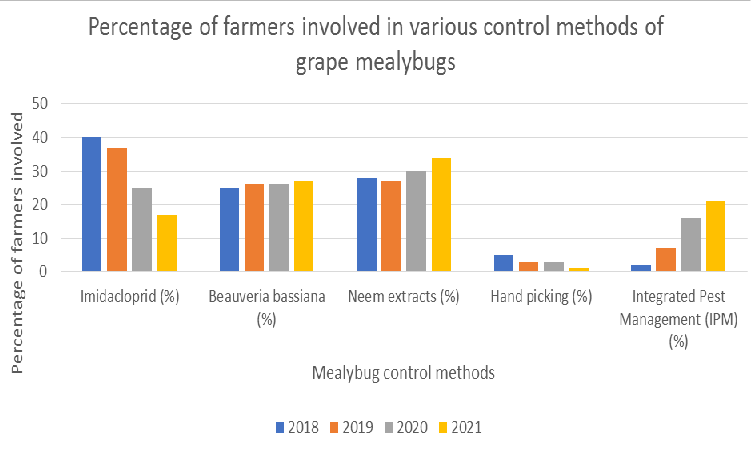 Figure 1
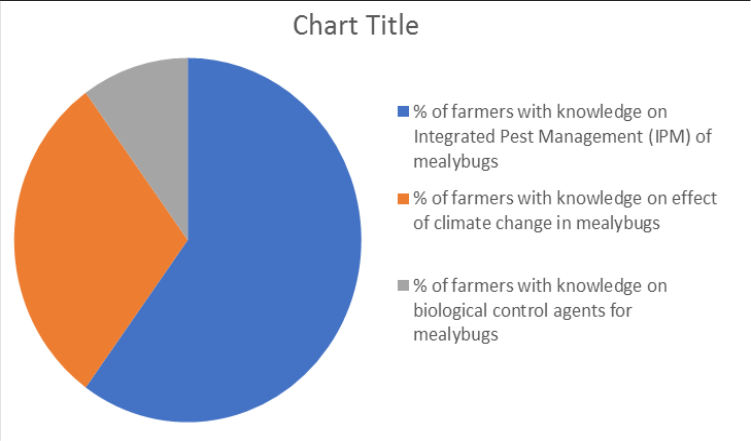 Figure 2
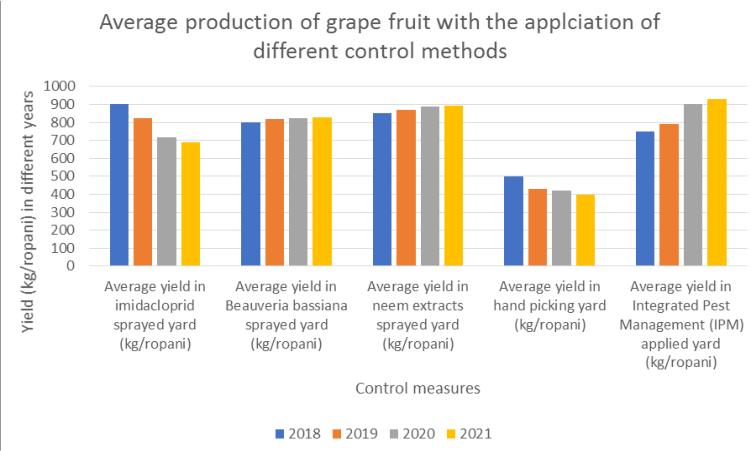 Figure 3
Introduction
A grape is a fruit, botanically called a berry, of the deciduous woody vines of the flowering plant genus Vitis. There are many multi-applications of grapes that includes making wine, juice, raisins, vinegars, oil, etc. Grapes are a non-climatic type of fruit, generally occurring in clusters. According to the Food and Agriculture Organization (FAO), 75,866 square kilometers of the world are dependable in grape production. About 71% of world grape products are used for wine, 27% as fresh fruit, and 2% as dried fruit. The vine mealy bug (VMB) is considered a the significant pest of grape in highly grape producing regions of the world (Argentina, California, Europe, Mediterranean Africa, Mexico, the Near and Middle East and South Africa) (Daane et al. 2008, 2012) [10,11] . The vine mealy bug is regarded as the key economic scale insect pest species occurring in vineyards worldwide, including the Mediterranean basin, that is known for its native extension (Daane et [11,13,19,26,37,42] . Many diseases transmitted by mealy bugs have been documented in numerous parts of the word. These are transformed through complex viruses from the families Closteroviridae and Flexiviridae. In New Zealand, the most famous viruses are GLRaV-3 (Petersen & Jordan 1992) [33] , which belongs to the Closteroviridae in the genus Ampelovirus. The consequence of such viruses tends to decline yield, minimize the sugar levels and changes in color, and forces in late ripening of berries.
Both red and white grape varieties are infected, however, the peculiar symptoms are rolled leaves and reddening of the inter-vein area in red varieties. The feeding damage on the developing parts of the plant that tends to malformation of the shoots (Kairo et al., 2000) [23] . Occurrence of black sooty mould fungus could be seen after the sugary honey dew being produced by the mealy bug in fruit trees (Alleyne, 2004) [2] . This mould creates covering of leaves and lowering of photosynthesis by proving stress to the vines. Ultimately, the production and market quality of the vines decreases. A study by Dara et al. (2016) [14] found that the health of plant improved due to the application of entomopathogenic fungi, Beauveria bassiana that resulted with enhanced shoot-root ratio for plants Metarhizium robertsii and B. bassiana, two well recognized entomopathogenic fungal species, have strains that lowers the pest population including mealy bugs (Sandhu et. al., 2012) [38] . At present context many people spray insecticides that have unlimited threats in soil, crops including emergence of insecticide resistance in pest population (Venkatesan et al. 2016) [41] and pose a significant challenges in mealy bug mass management programs. Repeated application of insecticides has posed residual effect including negative consequence in the population of predators, non-target insects like bees, etc. However, the effective results of insecticides such as imidacloprid are still praised against the mealy bug population (Franco et al. 2009) [17] . The intensive application of botanical oils have also helped in integrate pest management of insects like mealy bugs, it may be due to their repellent property, antifeedant nature, growthinhibiting activity, easy biodegradability, and safety to nontarget insects (Oparaeke et al. 2005) [31] . Some plant species that fall in EOs have aromatic smell, especially in mint spp. (Mentha spp.) and have adulticidal, larvicidal, and growth and reproduction inhibitory effects, as well as repellent intervention against various stored product pests and vectors including malybugs ( [36,24,30] . It has been long time that some farmers and entrepreneurs practice integrated pest management as a combination of chemical, biological, physical and pesticidal method to control mealy bug population and their devastating effect in grape vineyards (Daane et al. 2003; Walton 2003; Castillo et al. 2005; Gülec et al. 2007) [12,43,9,20] . Integrated Pest Management (IPM) have provided a strategic tool to control the pest sustainably as an eco-friendly method to protect negative effects of standalone insecticide in our environment and associated structure. This survey was carried out to understand the perception of farmers in Integrated Pest Management (IPM) in controlling mealy bug population in grape vineyards in Jula district.
Materials and Methods
A survey was conducted during May 2021 to October 2021 in Chandannath, Jumla district to understand farmers perspective in various control methods and Integrated Pest Management (IPM) of mealy bugs in grape vineyards (Vitis vinifera). KIIs (Key Informant Interview) and FGDs (Focus Group Discussions) were done with two farmer groups (each with 25 participants), where methods of mealy bug management and its opportunities in grape production were enquired. Grape producing commercial farmer groups were selected for the survey. Secondary data were collected from the government body and stakeholders in the district regarding the practices and return of grape vine. Information and data were harvested from past three years. Old literatures, previous studies and research were reviewed as a source of secondary information. The recorded data were arranged and analyzed by using M. S. Excel 2013 and R studio. [4,18,15,18,34] . Integrated Pest management has been successfully working to manage mealy bugs in grape farms in sustainable and eco-friendly manner (Johnson and Tabashnik 1999; Stark et al. 2007) [22,40] . Integrated Pest Management (IPM) has been emerged as the process to maintain and increase agricultural productivity without dependence on synthetic chemical inputs. Most of the producers are reliant on botanical pesticides, and integrated management of pest due to their effective nature and cost-effective output for invasive insect pest management such as mealy bugs. Earlier study in Kenya found that most of the farmers were known on the quick effect of insecticides (Abong'o et al., 2014; Marete et al., 2021) [1,27] . at earlier time. It may be the knowledge gap at those days, while later same producers applied non-agrochemicals to control the insect pest later days (Marete et al., 2021) [27] . Such studies are in line with our survey that the attitudes of farmers have been changing gradually to minimize the application of insecticides, while promoting botanical pesticides and Integrated Pest Management (IPM). The highest percentage of farmers (60%) were found with knowledge of Integrated Pest Management (IPM) of disease vectoring grape mealy bugs followed by knowledge on effect of climate change in mealy bug population (30%) and knowledge on biological control agents for mealy bugs (10%) (Figure 2). Negligible ratio of farmers has idea on natural enemies, their implications, benefits, and combination in Integrated Pest Management (IPM). Improving numbers of farmers found with appropriate ideas on Integrated Pest management, mostly the combination of synthetic insecticides, botanical pesticides and entomopathogenic fungi sometimes addition of physical methods in response of mealy bug management in grape vineyards. Good percentage of farmers were observed with experience and knowledge on climate change such as variable temperature, rainfall, and drought with certain effect in growth, development, and activities of mealy bug in the yards. The perception of the farmers that relies on the information related with climate change (variable temperature) affects the population of mealy bugs (Prasad et al., 2012) [35] . In many studies it was found that the farmers aware on climate change are also more cautious in promptly initiating measures like pruning and destroying of mealy bug infested plants or their parts, and soon carry measures to control the spread of mealy bug infestation in the grape field. Some other investigation from other parts of world found that temperature and other factors of weather that are changing each year have significant or non-significant implication in the growth and development of mealy bug population (Mertz et al., 2009; Kusakari et al., 2014) [29,25] , and such ideas were brought at front by the producers themselves.
Results and Discussion
Results and Discussion
Farmers methods in controlling disease vectoring mealy bugs in grape vineyards
Farmers methods in controlling disease vectoring mealy bugs in grape vineyards
Farmers knowledge on Integrated Pest Management (IPM), climate change and biological control agents with respect to disease vectoring grape mealy bugs
The importance of natural enemies such as ladybugs in controlling mealy bugs have been described in various literature (McIlveen et al., 1252) [28] . Most of the studies revealed that mealy bugs have positive correlation with temperature and negative correlation with rainfall and humidity such information have been well known by farmers. In our study also average ratio of participants have knowledge on various aspects of climate change and environmental factors that related with the mealy bugs and its damage. The average yield (kg/ropani) of grapefruit found to be 900, 800, 850, 500, and 750 in imidacloprid sprayed, Beauveria bassiana sprayed, neem extract sprayed, hand picking and Integrated Pest Management (IPM) method of mealy bug control yards respectively during 2018. During 2019, the average yield kg/ropani) of grapefruit found to be 825, 820, 870, 430, and 790 in imidacloprid sprayed, Beauveria bassiana sprayed, neem extract sprayed, hand picking and Integrated Pest Management (IPM) method of mealy bug control yards respectively. Similarly, during 2020, the average yield kg/ropani) of grapefruit found to be 717, 825, 890, 420, and 900 in imidacloprid sprayed, Beauveria bassiana sprayed, neem extract sprayed, hand picking and Integrated Pest Management (IPM) method of mealy bug control yards respectively. Finally, during 2021, the average yield kg/ropani) of grapefruit found to be 690, 830, 895, 400, and 930 in imidacloprid sprayed, Beauveria bassiana sprayed, neem extract sprayed, hand picking and Integrated Pest Management (IPM) method of mealy bug control yards respectively (Figure 3). Though initially the highest production of grapevine was known with the application of imidacloprid, however, it gradually decreased in each year; at the same time the production of fruits increased slowly in Integrated pest Management (IPM) deployed yards in each year even though they have lower production at early years (in IPM deployed field). The investigation of Arnold et al. 2014 found that participatory and integrated approach of insect management is more effective in controlling mealy bugs in grape vines. Application of single dose of insecticides have always reflected negative consequence either of insecticide resistance or residual effect or other. The residual effect of insecticides has many consequences on grape quality, and thus human health, is unknown (Benheim et al. 2012) [5] . Other negative effect in production including non-target pest of such insecticides (when applied singly) were described by Bordelon et al.
Average production of grape vineyard (Vitis vinifera) with different mealy bug control methods
2018 [8] . The application of IPM strategy (i.e., an insecticide applied based on weekly scouting and an economic threshold) may cost high but regarded effective and profitable in comparison with insecticidal treatments alone (KD Johnson et al. 2009) [21] . Such activities to incorporate Integrated Pest Management always enhance quality, quantity and marketable product of grapefruit reducing the effect of mealy bugs. Improved knowledge and practice of IPM methods n mealy bug management has provided effective return than application of single control methods in the grape vineyard.
Conclusion
A survey was carried out during May 2021 to October 2021 in Chandannath, Jumla district to determine the farmers perspective in various control methods including Integrated Pest Management (IPM) of mealy bugs in grape vineyards (Vitis vinifera). KIIs (Key Informant Interview) and FGDs (Focus Group Discussions) were conducted with two farmer groups (each with 25 participants), where methods of mealy bug management and its opportunities in grape production were discussed. During previous years, highest farmers found applying Imidacloprid to control grape mealy bugs followed by farmers using neem extracts (Azadirachta indica), Beauveria bassiana, hand picking and Integrated Pest Management (IPM). Later, the ratio of farmers increased in applying IPM practice compared with other methods in controlling the mealy bugs. Highest percentage of farmers noticed with knowledge of IPM followed by climate change and biological control agents with respect to grape mealy bugs. Though initially the production of grapevines was lower through the application of Integrated Pest Management (IPM) method, it gradually increased and later became an effective strategy to manage
Figures and tables from the paper
References
42 in the original paper- Abong'o DA, Wandiga SO, Jumba IO, Madadi VO, Kylin H. Impacts of pesticides on human health and environment in the River Nyando catchment, Kenya. Int J Humanities Arts Med Sci. 2014;2(3):1-14.
- Alleyne JC. Controlling a dangerous pest: pink hibiscus mealy bug. Univ Florida Newslett. 2004;38:2-3.
- Arnold K, Golino D, McRoberts N. Working with workgroups: A neighborhood approach to area wide disease management of GLRaV-3 in CA vineyards. (Abstract) Phytopathology. 2014;103:9.
- Belzunces LP, Tchamitchian S, Brunet JL. Natural effects of insecticides in the honey bee. Apidologie. 2012;43:348-370. https://doi.org/10.1007/s13592-012-0134-0.
- Benheim D, Rochfort S, Robertson E, Potter ID, Powell KS. Grape phylloxera (Daktulosphaira vitifoliae) -a review of potential detection and alternative management options. Ann Appl Biol. 2012;161:91-115.
- Biondi A, Campolo O, Desneux N, Siscaro G, Palmeri V, Zappalà L. Life stage-dependent susceptibility of Aphytis melinus DeBach (Hymenoptera: Aphelinidae) to two pesticides commonly used in citrus orchards. Chemosphere. 2015;128:142-7. https://doi.org/10.1016/j.chemosphere.2015.01.034.
- Biondi A, Mommaerts V, Smagghe G, Viñuela E, Zappalà L, Desneux N. The non-target impact of spinosyns on beneficial arthropods. Pest Manag Sci. 2012;68:1523-36. https://doi.org/10.1002/ps.3396.
- Bordelon B, Foster R, Beckerman J, Geudot C, Strang J, Gautier NW. Midwest fruit pest management guide. West Lafayette, Indiana: Purdue Extension Education, 2018. https://ag.purdue.edu/hla/hort/documents/id-465.pdf.
- Castillo AAF, Hernández HG, Daane KM. Pijo Vid LHDL. Libro Técnico No 9. Instituto Nacional de Investigaciones Forestales, Agrícolas y Pecuarias, 2005.
- Daane KM, Almeida RPP, Bell VA, Walker JTS, Botton M, Fallahzadeh M, et al. Biology and management of mealy bugs in vineyards. In: Bostanian N, Vincent C, Isaacs R, editors. Arthropod management in vineyards: pests, approaches, and future directions. Dordrecht: Springer, 2012, p. 271-307.
- Daane KM, Cooper ML, Sime KR, Nelson E, Battany MC, Rust MK. Testing baits to control Argentine ants (Hymenoptera: Formicidae) in vineyards. J Econ Entomol. 2008;101:699-709.
- Daane KM, Kuenen MR, Guillén M, Bentlyey WJ, Bianchi M, Gonzalez D. Abiotic and biotic refuges hamper biological control of mealy bug pests in California vineyards. In: van Driesch R, editor. Proceedings of the 1 st International Symposium on Biological Control of Arthropods, 2003, p. 389-98.
- Dalla Montà L, Duso C, Malagnini V. Current status of scale insects (Hemiptera: Coccoidea) in the Italian vineyards. Boll Zool Agr Bachic. 2001;33:343-350.
- Dara SK, Peck D, Farms MB. Impact of entomopathogenic fungi and beneficial microbes on strawberry growth, health, and yield, 2016.
- Desneux N, Decourtye A, Delpuech JM. The sublethal effects of pesticides on beneficial arthropods. Annu Rev Entomol. 2007;52:81-106. https://doi.org/10.1146/annurev.ento.52.110405.09144
- Fand BB, Tonnang HEZ, Kumar M, Kamble AL, Bal SK. A temperature-based phenology model for predicting development, survival and population growth potential of the mealy bug, Phenacoccus solenopsis Tinsley (Hemiptera: Pseudococcidae). Crop Protect. 2014;55:98-108.
- Franco JC, Zada A, Mendel Z. Novel approaches for the management of mealy bug pests. In: Ishaaya I, Horowitz AR, editors. Biorational control of arthropod pests application and resistance management. Dordrecht: Springer, 2009, p. 233-78.
- Gill HK, Garg H. Pesticides: environmental impacts and management strategies. In: Pesticides-toxic effects. In Tech Open, 2014. https://doi.org/10.5772/57399.
- Güleç G, Kilinçer AN, Kayden MB, Ülgentürk S. Some biological interactions between the parasitoid Anagyrus pseudococci (Girault) (Hymenoptera: Encyrtidae) and its host Planococcus ficus (Signoret) (Hemiptera: Coccoidea: Pseudococcidae). J Pest Sci. 2007;80:439. https://doi.org/10.1007/s10340-006-0152-7.
- Gülec G, Kilincer AN, Kaydan MB, Ulgenturk S. Some biological interactions between the parasitoid Anagyrus pseudococci (Girault) (Hymenoptera: Encyrtidae) and its host Planococcus ficus (Signoret) (Hemiptera: Coccoidea: Pseudococcidae). J Pest Sci. 2007;80:43-49.
- Johnson KD, O'Neal ME, Ragsdale DW, DiFonzo CO, et al. Probability of cost-effective management of soybean aphid (Hemiptera: Aphididae) in North America. J Econ Entomol. 2009;102:2101-2108.
- Johnson MW, Tabashnik BE. Enhanced biological control through pesticide selectivity. In: Fisher T, Bellows TS, Caltagirone LE, Dahlsten DL, Huffaker C, Gordh G, editors. Handbook of biological control. San Diego: Academic, 1999, p. 297-317.
- Kairo MTK, Pollard GV, Peterkin DD, Lopez VF. Biological control of hibiscus mealy bug, Maconellicoccus hirsutus in the Caribbean. Integ Pest Manag Rev. 2000;5:241-245.
- Kumar P, Mishra S, Malik A, Satya S. Insecticidal properties of Mentha species: A review. Ind Crops Prod. 2010;34:802-817.
- Kusakari Y, Asubonteng KO, Jasaw GS, Dayour F, et al. Farmer-perceived effects of climate change on livelihoods in West District, Upper West Region of Ghana. J Disaster Res. 2014;9(4):516-528.
- Mansour R, Grissa-Lebdi K, Suma P, Mazzeo G, Russo A. Key scale insects (Hemiptera: Coccoidea) of high economic importance in a Mediterranean area: host plants, bio-ecological characteristics, natural enemies and pest management strategies a review. Plant Prot Sci. 2017;53:1-14. https://doi.org/10.17221/53/2016-PPS.
- Marete GM, Lalah JO, Mputhia J, Wekesa VW. Pesticide usage practices as sources of occupational exposure and health impacts on horticultural farmers in Meru County, Kenya. Heliyon. 2021;7(2):e06118. https://doi.org/10.1016/j.heliyon.2021.e06118.
- Mertz O, Mbow C, Reenberg A, Diouf A. Farmers' perceptions of climate change and agricultural adaptation strategies in rural Sahel. Environ Manage. 2009;43(5):804-816.
- Michaelakis A, Papachristos D, Kimbaris D, Polissiou M. Larvicidal evaluation of three Mentha species essential oils and their isolated major components against the West Nile virus mosquito. Hellenic Plant Protect J. 2012;4:35-48
- Oparaeke AM, Dike MC, Amatobi CI. Evaluation of botanical mixtures for insect pests management on cowpea plants. J Agric Rural Dev Trop Subtrop. 2005;106(1):41-48.
- Silva PDVC, Bertin A, Blin A, Germain JF, Bernardi D, Rignol G, et al. Molecular and morphological identification of mealy bug species (Hemiptera: Pseudococcidae) in Brazilian vineyards. PLOS One. 2014;9(7):e103267. https://doi.org/10.1371/journal.pone.0103267.
- Petersen CL, Jordan D. ELISA works well for the identification of leaf roll. In: Proceedings of the New Zealand Grape and Wine Symposium: profit in the market, in the winery, in the vineyard. Christchurch, New Zealand: New Zealand Society for Viticulture and Oenology, 1992, p. 54-5.
- Pisa LW, Rogers AV, Belzunces LP, Bonmatin JM, Downs CA, Goulson D, et al. Effects of neonicotinoids and fipronil on non-target invertebrates. Environ Sci Pollut Res. 2015;22:68-102. https://doi.org/10.1007/s11356-014-3471-x.
- Prasad YG, Prabhakar M, Sreedevi G, Rao GR, Venkateswarlu B. Effect of temperature on development, survival and reproduction of the mealy bug, Phenacoccus solenopsis Tinsley (Hemiptera: Pseudococcidae) on cotton. Crop Protect. 2012;39:81-8.
- Rajendran S, Sriranjini V. Plant products as fumigants for stored-product insect control. J Stored Prod Res. 2008;44:126-135.
- Reineke A, Thiéry D. Grapevine insect pests and their natural enemies in the age of global warming. J Pest Sci. 2016;89:313-328. https://doi.org/10.1007/s10340-016-0761-8.
- Sandhu SS, Sharma AK, Beniwal V, Goel G, Batra P, Kumar A, et al. Myco-Biocontrol of insect pests: factors involved, mechanism, and regulation. J Pathogens, 2012, p. 1-10. https://doi.org/10.1155/2012/126819.
- Sforza R, Kirk A, Jones WA. Results of foreign exploration for natural enemies of Planococcus ficus (Homoptera: Pseudococcidae), a new invasive mealy bug in California vineyards. In: Septième conférence international sur les ravageurs en agriculture. AFPP, Montpellier, 2005.
- Stark JD, Vargas R, Banks JE. Incorporating ecologically relevant measures of pesticide effect for estimating the compatibility of pesticides and biocontrol agents. J Econ Entomol. 2007;100:1027-32. https://doi.org/10.1603/00220493(2007)100[1027:IERMOP]2.0.CO;2.
- Venkatesan T, Jalali SK, Ramya SL, Prathibha M. Insecticide resistance and its management in mealy bugs. In: Mani M, Shivaraju C, Editors. Mealy bugs and their management in agricultural and horticultural crops. New Delhi: Springer, 2016, p. 223-9.
- Walton VM, Krüger K, Saccaggi DL, Millar IM. A survey of scale insects (Sternorryncha: Coccoidea) occurring on table grapes in South Africa. J Insect Sci. 2009;9(47):1-6. https://doi.org/10.1673/031.009.4701.
- Walton VM. Development of an integrated pest management system for vine mealy bug, Planococcus ficus (Signoret), in vineyards in the Western Cape Province, South Africa. PhD Thesis. Stellenbosch: University of Stellenbosch, 2003.