
Research article · 2025 · Full text
International Journal of Biology SciencesSynergistic healing: Efficacy of extracorporeal shock wave therapy and low level laser therapy in managing plantar fasciitis heel pain: A pilot Study
Volume 7(1) · Pages 17–19 · DOI: 10.33545/26649926.2025.v7.i1a.266 ↗
Research areasTendon Structure and TreatmentShoulder Injury and TreatmentLaser Applications in Dentistry and Medicine
Abstract
Author-writtenBackground: Plantar heel pain, a common regional pain condition, can cause significant discomfort and interfere with patients' typical activities. Walking discomfort can have a detrimental impact on a patient's quality of life, and the first step in the morning can yield diagnostic information for Plantar Fasciitis patients. Objectives: The purpose of this study was to assess the efficacy of extracorporeal shock wave treatment (ESWT) combined with low level laser therapy (LLLT) in alleviating heel pain in Plantar Fasciitis patients. Materials and Methods: Plantar fasciitis was identified in 15 patients ranging in age from 45 to 52 years. Clinical symptoms and anamnesis confirm the diagnosis, with pain on the first step in the morning and discomfort after exercise being the most typically reported symptoms. This treatment session lasted four days a week for four weeks total. The patient was examined using the Numeric Pain Rating Scale (NPRS). Results: Participants showed significant improvement in pre-test and post-test scores for Numeric Pain rating scale (NPRS)which was considered as statistically significant. Conclusion: This study suggests that extracorporeal shock wave therapy (ESWT) combined with low level laser therapy (LLLT) reduces heel pain in Plantar Fasciitis patients.
Summary
Source-checkedPlain-language reading of the full paper, prepared with AI and checked against the text. Each point links to the authors' own words.
Why it matters
- Plantar heel pain is a widespread condition, affecting approximately 10% of people during their lifetime. View evidence ↗
- Plantar fasciitis, the inflammation of the thick tissue band connecting the heel bone to the toes, is the most frequent cause of this pain. View evidence ↗
- This condition can significantly reduce a patient's quality of life by severely limiting their movement. View evidence ↗
The question
- The study aimed to evaluate how effective the combination of Extracorporeal Shock Wave Therapy (ESWT) and Low-Level Laser Therapy (LLLT) is for relieving heel pain in patients with plantar fasciitis. View evidence ↗
What they did
- The study focused on a 52-year-old female patient who had been suffering from diagnosed plantar fasciitis for six months. View evidence ↗
- The treatment protocol consisted of combined LLLT and ESWT administered four days a week for a total of four weeks. View evidence ↗
- ESWT was delivered at an energy level of 0.2 mJ/mm² with 1000-1500 impulses per session. View evidence ↗
- LLLT used a wavelength of 800-1000 nm and was applied to the affected area for 10-15 minutes per session. View evidence ↗
What they found
- The patient's pain score on the NPRS decreased from 8/10 at the start of the study to 3/10 after four weeks of combined therapy. View evidence ↗
- Statistical analysis using a paired t-test showed a significant reduction in pain (p < 0.05), indicating the combined approach was effective. View evidence ↗
- The patient reported functional improvements, including less uncomfortable morning walking and the ability to walk without severe pain. View evidence ↗
- The patient noted an increased ability to perform daily activities, specifically standing for longer durations and walking further. View evidence ↗
What it means
- The authors conclude that the combined ESWT and LLLT approach is a viable non-invasive option for plantar fasciitis patients, particularly those who fail conservative treatments. View evidence ↗
- The findings have limited generalizability because the study focused on very few patients. View evidence ↗
- The long-term durability of the pain relief is unknown as the study did not assess long-term outcomes. View evidence ↗
Visual summary
1 visualsIllustrations explain the paper; they do not show study data.
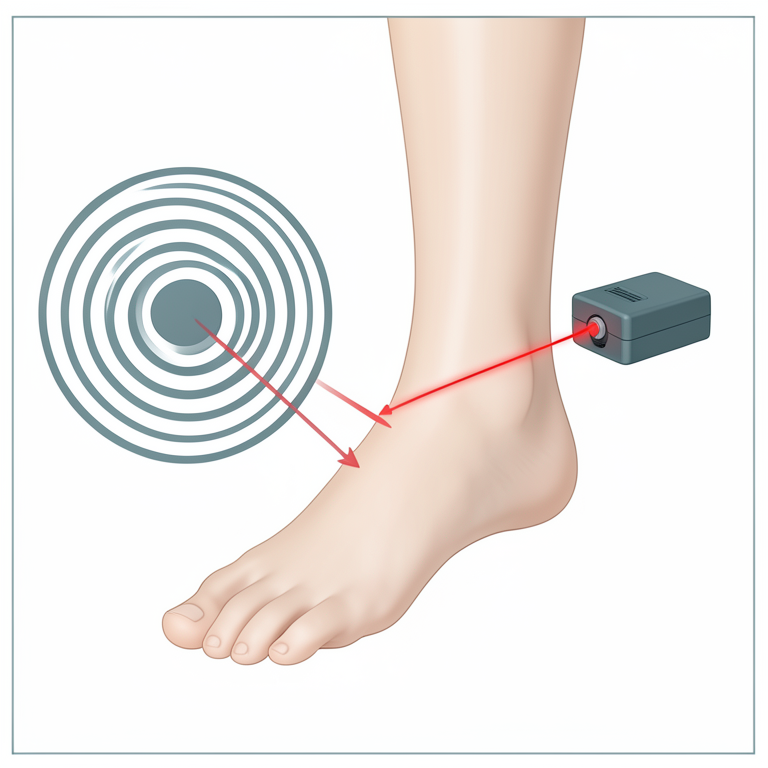
Combined Therapy Concept
AI-generated conceptual illustration (human heel and foot). It explains the idea and does not show study data.
View source evidence ↗Introduction
Plantar heel pain is a common condition that affects around 10% of the population at some point in their lives. The most common cause of this discomfort is plantar fasciitis, which is defined as inflammation of the plantar fascia, a thick band of tissue that runs along the bottom of the foot and connects the heel bone to the toes. Patients with plantar fasciitis generally experience severe discomfort when taking their first steps in the morning, which may subside with activity but often returns after longer durations of standing, walking, or exercise. The illness can severely limit movement and lower quality of life. Conservative therapies for plantar fasciitis include physical therapy, orthotic devices, stretching exercises, and non-steroidal anti-inflammatory medications (NSAIDs). When these procedures prove insufficient, more complex treatment interventions may be required. Extracorporeal Shock Wave Therapy (ESWT) and Low-Level Laser Therapy (LLLT) are two such therapies that have been found to be beneficial in musculoskeletal problems in terms of pain relief and tissue healing. ESWT includes delivering shock waves to the afflicted area, which promotes tissue healing and lowers inflammation. This method is especially useful in chronic instances where conservative therapies have failed. In contrast, LLLT penetrates the tissue with low-intensity lasers, boosting cellular regeneration while minimizing pain and inflammation. The combination of these two therapies has been proposed to have synergistic effects for the treatment of illnesses such as plantar fasciitis. The purpose of this study is to assess the efficacy of ESWT and LLLT in relieving heel pain in a plantar fasciitis patient, with pain intensity quantified using the Numeric Pain Rating Scale (NPRS) as the primary outcome measure.
Background
Microtears and inflammation are the results of overuse or repetitive strain on the plantar fascia, which causes plantar fasciitis. Obesity, extended standing, inappropriate footwear, and high-impact exercises like jogging are risk factors. Morning heel pain is the defining symptom that helps distinguish plantar fasciitis from other heel pain sources. Usually confined to the base of the heel, the discomfort may spread to the foot's arch. Based on the patient's medical history and physical examination, plantar fasciitis is mostly diagnosed clinically. In uncommon cases or when ruling out other disorders like stress fractures or nerve entrapment, imaging methods like ultrasound or MRI may be utilized to confirm the diagnosis. For plantar fasciitis, extracorporeal shock wave therapy (ESWT) has become a popular non-invasive treatment option, especially when conservative measures fail. ESWT increases blood flow, stimulates fibroblast activity, and breaks up any calcifications that may have formed in the tissue by applying acoustic shock waves to the affected area. Another non-invasive therapy option is called Low-Level Laser Therapy (LLLT), which targets underlying tissues by penetrating the skin with low-level lasers. By altering cellular function, boosting mitochondrial activity, and raising ATP synthesis, LLLT is believed to lessen pain and inflammation. LLLT may help reduce plantar fascia irritation and speed up the healing process in cases of plantar fasciitis. Few research has examined the synergistic effects of using ESWT and LLLT together, making it a relatively novel treatment option for plantar fasciitis. The goal of this study is to add to the increasing amount of data that supports this combination treatment.
Objectives
This study's main goal was to assess how Extracorporeal Shock Wave Therapy (ESWT) and Low-Level Laser Therapy (LLLT) affected a patient with plantar fasciitis's heel discomfort. The study specifically sought to: 1. Use the Numeric Pain rating scale (NPRS) to measure the decrease in pain intensity. 2. Assess the patient's perceived increase in functionality and mobility while performing daily tasks. 3. Assess if ESWT and LLLT together offer a useful remedy for heel discomfort associated with plantar fasciitis.
Materials and Methods
Materials and Methods
Patient Profile
The patient in this case study was a 52-year-old female who presented with a six-month history of heel pain, which had been diagnosed as plantar fasciitis. The patient reported experiencing sharp, stabbing pain upon taking her first steps in the morning, as well as pain after prolonged walking or standing. Previous conservative treatments, including stretching exercises and NSAIDs, had provided minimal relief. The patient's baseline pain level was assessed using the Numeric Pain rating scale (NPRS), a 10-point scale where 0 indicates no pain and 10 represents the worst possible pain.
At the start of the study, the patient rated her pain as 8/10.
Treatment Protocol
For four weeks, the patient underwent a combination of Low-Level Laser Therapy (LLLT) and Extracorporeal Shock Wave Therapy (ESWT) four days a week. The two therapies were alternated with each session, which lasted roughly thirty minutes.
Extracorporeal Shock Wave Therapy (ESWT):
1. A focused ESWT device was used to deliver shock waves to the plantar fascia. 2. The treatment area was localized by palpating the heel and identifying the most painful spot. 3. Shock waves were administered at a frequency of 1000-1500 impulses per session, with an energy level of 0.2 mJ/mm². 4. Each ESWT session lasted approximately 15 minutes.
Low-Level Laser Therapy (LLLT):
1. A low-intensity laser device was used to target the plantar fascia and heel. 2. The laser was applied directly to the affected area for 10-15 minutes per session, with a wavelength of 800-1000 nm. 3. The treatment was applied using circular motions to ensure even coverage of the painful area.
Assessment Tools
The patient's pain levels were assessed using the Numeric Pain rating scale (NPRS) at two points: Before the first treatment session (baseline).
After the final treatment session at the end of the fourweek period.
In addition NPRS scores, the patient provided subjective feedback on her mobility, ability to perform daily activities, and overall improvement in symptoms.
Results
Following the combination ESWT and LLLT treatment, the patient's pain levels significantly improved. After four weeks of treatment, her NPRS score dropped from 8/10 at baseline to 3/10. This statistically significant decrease in pain suggests that the patient's symptoms were well managed by the combined therapy. Regarding functional improvement, the patient stated that she could now walk without experiencing severe pain and that her morning ambulations were less uncomfortable. She also reported being able to carry out everyday tasks like walking farther and standing for longer periods of time.
Statistical Analysis
The pre-treatment and post-treatment NPRS scores were analyzed using a paired t-test to assess the statistical significance of the change in pain levels. The results demonstrated a significant reduction in pain (p< 0.05), supporting the efficacy of the combined ESWT and LLLT approach in reducing heel pain associated with plantar fasciitis.
Discussion
The The combination of these two therapies offers a dual approach to treatment, addressing both the inflammatory and structural components of plantar fasciitis.
Limitations
This study is limited by its focus on few patients, which restricts the generalizability of the findings. Further research is needed with larger sample sizes to confirm the effectiveness of this combined therapy. Additionally, the study did not assess long-term outcomes, so the durability of the pain relief provided by ESWT and LLLT remains unknown.
Conclusion
This study shows that a patient with plantar fasciitis can benefit from a combination of Low-Level Laser Therapy (LLLT) and Extracorporeal Shock Wave Therapy (ESWT) in terms of decreased heel discomfort and increased functionality. After four weeks of treatment, the patient's mobility and pain levels significantly improved, and their Numeric Pain Rating Scale (NPRS) ratings decreased statistically significantly. For patients with plantar fasciitis, especially those who have not responded to conservative therapy, this dual approach may be a viable non-invasive therapeutic option.
References
15 in the original paper- Buchbinder R. Clinical practice. Plantar fasciitis. New England Journal of Medicine. 2004;350(21):2159-2166. https://doi.org/10.1056/NEJMcp032745
- Crawford F, Atkins D, Edwards J, Campbell W. Interventions for treating plantar heel pain. Cochrane Database of Systematic Reviews, 1999, (3)CD000416. https://doi.org/10.1002/14651858.CD000416
- Dizon JN, Gonzalez-Suarez CB, Zamora MT, Gambito ED. Effectiveness of extracorporeal shock wave therapy on chronic plantar fasciitis: A systematic review and meta-analysis. American Journal of Physical Medicine & Rehabilitation. 2013;92(7):606-620. https://doi.org/10.1097/PHM.0b013e3182876a48
- Gollwitzer H, Diehl P, Von Korff A, Rahlfs VW, Gerdesmeyer L. Extracorporeal shock wave therapy for chronic painful heel syndrome: A prospective, double blind, randomized trial assessing the efficacy of a new electromagnetic shock wave device. Journal of Foot and Ankle Surgery. 2007;46(5):348-357. https://doi.org/10.1053/j.jfas.2007.06.009
- Gerdesmeyer L, Frey C, Vester J, Maier M, Weil L, Weil L, et al. Radial extracorporeal shock wave therapy is safe and effective in the treatment of chronic recalcitrant plantar fasciitis: Results of a confirmatory randomized placebo-controlled multicenter study. American Journal of Sports Medicine. 2008;36(11):2100-2109. https://doi.org/10.1177/0363546508324176
- Henrotin Y, Lambert C, Couchourel D, Ripoll C, Chiotelli E. Potential applications for polyunsaturated fatty acids in the management of osteoarthritis. Proceedings of the Nutrition Society. 2011;70(1):145157. https://doi.org/10.1017/S0029665110003987
- Landorf KB, Menz HB. Plantar heel pain and fasciitis. BMJ Clinical Evidence. 2008;2008:1111. https://www.ncbi.nlm.nih.gov/pmc/articles/PMC29079 57/
- Lee SY, Chen YJ. Low-level laser therapy and extracorporeal shockwave therapy for heel pain: A randomized trial. Lasers in Medical Science. 2012;27(5):911-916. https://doi.org/10.1007/s10103011-0976-9
- Mahindra P, Yamin M, Selhi HS, Soni A, Jindal R. Chronic plantar fasciitis: Effect of low dose versus high dose shock wave therapy on pain and function. Foot and Ankle International. 2016;37(5):495-501. https://doi.org/10.1177/1071100715618200
- Mense S, Hoheisel U. Shock wave treatment improves nerve regeneration in the rat. Muscles, Ligaments and Tendons Journal. 2013;3(1):12-20. https://doi.org/10.32098/mltj.01.2013.03
- Nakhostin-Roohi B, Nasirvand M, Bohlooli S, Khoshkhahesh F. Effects of low-level laser therapy on delayed onset muscle soreness. Journal of Clinical and Diagnostic Research. 2015;9(2):YC01-YC04. https://doi.org/10.7860/JCDR/2015/10740.5525
- Ogden JA, Alvarez RG, Marlow M, Sullivan S. Shock wave therapy for chronic proximal plantar fasciitis. Clinical Orthopaedics and Related Research. 2002;387:47-59. https://doi.org/10.1097/00003086-200206000-00007
- Rompe JD, Furia J, Maffulli N. Efficacy of shock wave treatment for chronic plantar fasciopathy. American Journal of Sports Medicine. 2009;37(3):463-470. https://doi.org/10.1177/0363546508326983
- Speed CA. Extracorporeal shock-wave therapy in the management of chronic soft-tissue conditions. Journal of Bone and Joint Surgery. 2004;86-B(2):165-171. https://doi.org/10.1302/0301-620X.86B2.14705
- Thiele S, Gatz M, Bielefeld R, Krauspe R, Zilkens C. The efficacy of low-level laser therapy for the treatment of plantar fasciitis: A systematic review. Journal of Foot and Ankle Surgery. 2015;54(5):703-708. https://doi.org/10.1053/j.jfas.2015.01.007