
Research article · 2025 · Full text
International Journal of Biology SciencesPulses of progress: Russian current therapy in managing knee osteoarthritis
Volume 7(1) · Pages 10–12 · DOI: 10.33545/26649926.2025.v7.i1a.264 ↗
Research areasPerfectionism, Procrastination, Anxiety Studies
Abstract
Author-writtenBackground: Knee osteoarthritis (OA) is a degenerative joint condition that is largely caused by wear and tear and the progressive loss of articular cartilage. Clinical signs include knee discomfort that worsens with movement, stiffness, oedema, and crepitus. Russian current is a modulated medium-frequency sinusoidal alternating current that is used to alleviate pain and increase muscular strength. Case Presentation: The patient was a 55-year-old female who had been diagnosed with bilateral grade III OA after experiencing discomfort during exercise and swelling on the medial side of both knees for 8 months. The outcome measurements were the Numeric Pain Rating Scale (NPRS) for pain and the Western Ontario and McMaster Universities Arthritis Index (WOMAC) for function. The patient got Russian current six times per week for four weeks, combined with conservative knee exercises. Result: The patient's NPRS improved from 8 to 3 points and 7 to 3 points on the right and left knees, respectively. After completing the physiotherapy program, the right knee's WOMAC score decreased by 61 points, while the left knee's score decreased by 45 points. Conclusion: The patient's pain and function improved significantly. So, Russian current combined with conservative knee exercises may be a viable therapeutic option for osteoarthritis.
Summary
Source-checkedPlain-language reading of the full paper, prepared with AI and checked against the text. Each point links to the authors' own words.
Why it matters
- Knee osteoarthritis is a degenerative condition characterized by the progressive loss of articular cartilage and wear and tear of the joint. View evidence ↗
- Common clinical signs of the condition include stiffness, edema, crepitus, and knee discomfort that increases during movement. View evidence ↗
- Russian current is a medium-frequency sinusoidal alternating current used in therapy to increase muscle strength and reduce pain. View evidence ↗
The question
- The study aimed to investigate if combining Russian current therapy with conservative exercises could improve function and pain in a patient with bilateral knee osteoarthritis. View evidence ↗
What they did
- The subject was a 55-year-old female with bilateral grade III knee osteoarthritis and an 8-month history of swelling and discomfort. View evidence ↗
- The Russian current treatment was applied to the quadriceps at 2500 Hz (50 Hz burst modulation) with a 10s on/50s off duty cycle for 15-minute sessions, six times per week for four weeks. View evidence ↗
- The therapy included conservative exercises focusing on strength and mobility, specifically hamstring stretches, quadriceps sets, and non-weight-bearing knee extension and flexion. View evidence ↗
- Pain was measured using the Numeric Pain Rating Scale (NPRS), while functional performance was assessed using the Western Ontario and McMaster Universities Arthritis Index (WOMAC). View evidence ↗
What they found
- Pain scores (NPRS) decreased from 8 to 3 points for the right knee and from 7 to 3 points for the left knee. View evidence ↗
- Functional performance improved, with WOMAC scores decreasing by 61 points for the right knee and 45 points for the left knee. View evidence ↗
- The right knee WOMAC score dropped from 89 to 28 points, and the left knee score dropped from 82 to 37 points. View evidence ↗
What it means
- The authors conclude that combining Russian current with conservative exercises may be a viable therapeutic option for managing osteoarthritis due to significant improvements in pain and function. View evidence ↗
- The study is limited by its short intervention duration and the lack of long-term follow-up data. View evidence ↗
- The authors state that the evidence is limited by the small scale and lack of a control group, necessitating larger randomized controlled trials. View evidence ↗
Visual summary
3 visualsIllustrations explain the paper; charts are replotted from the paper's own table values.
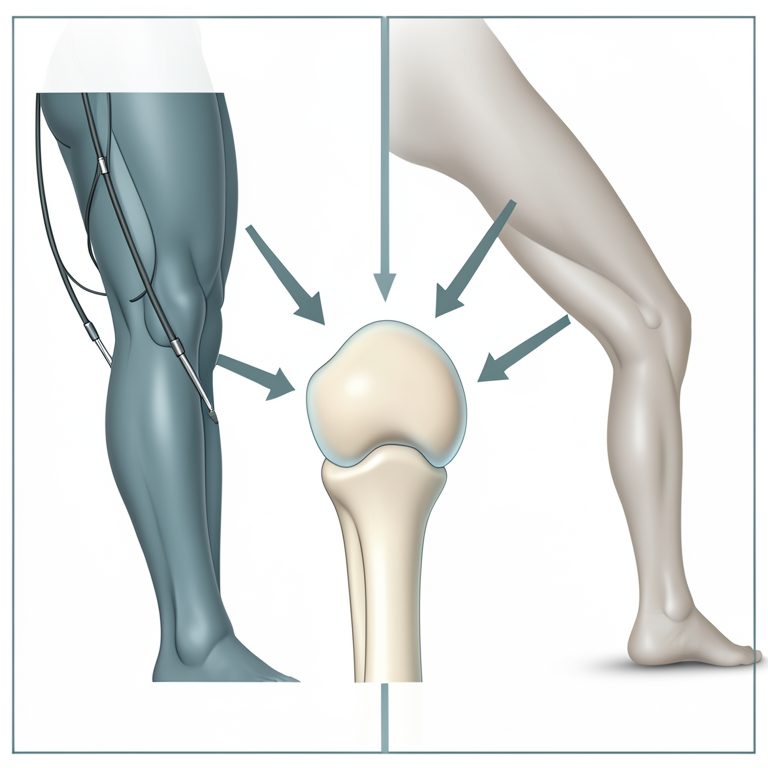
Combined Therapy Model
AI-generated conceptual illustration (human knee joint and quadriceps muscle). It explains the idea and does not show study data.
View source evidence ↗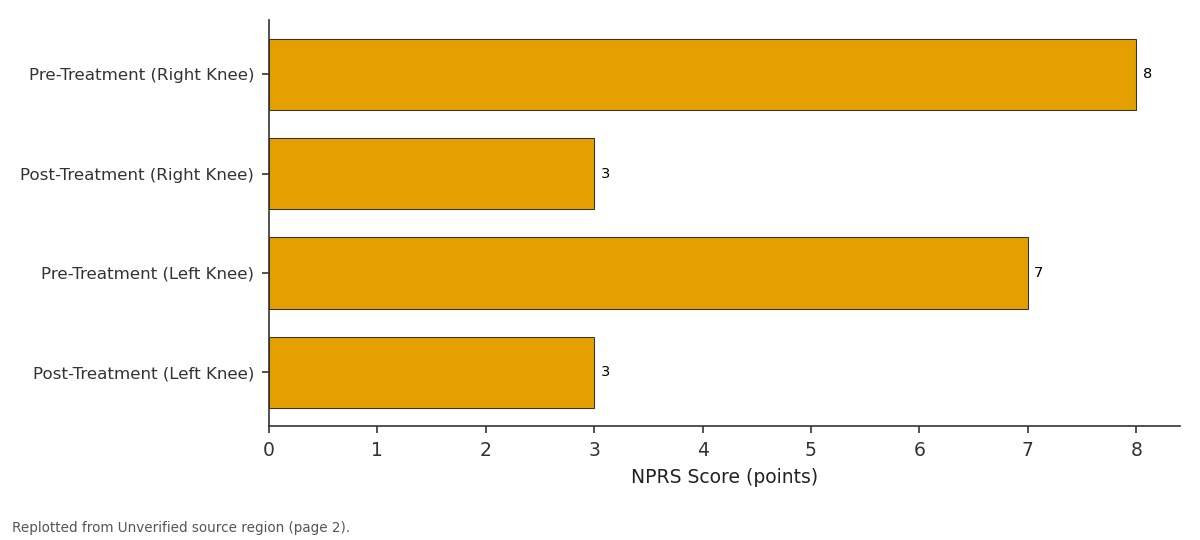
NPRS Score (points): Pre-Treatment (Right... vs Post-Treatment (Right... vs Pre-Treatment (Left... vs Post-Treatment (Left...
Replotted from a table (page 2) of the original paper. Every bar is the paper's own table value.
View source evidence ↗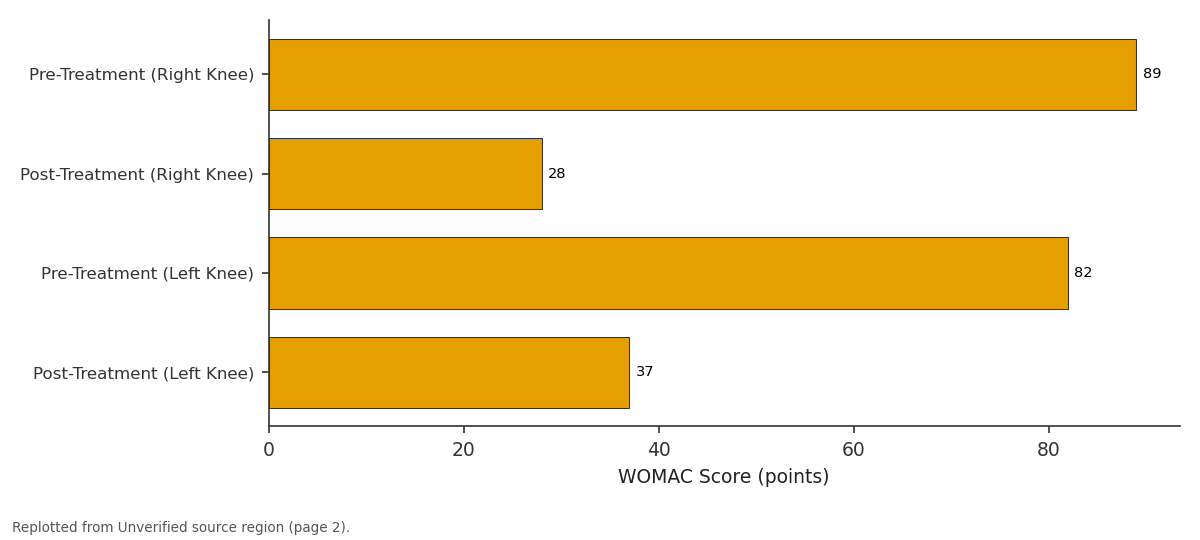
WOMAC Score (points): Pre-Treatment (Right... vs Post-Treatment (Right... vs Pre-Treatment (Left... vs Post-Treatment (Left...
Replotted from a table (page 2) of the original paper. Every bar is the paper's own table value.
View source evidence ↗Introduction
Osteoarthritis (OA) is one of the most common chronic diseases, affecting the knee joint in older persons. It is distinguished by the slow deterioration of articular cartilage, alterations in subchondral bone, and synovial inflammation, all of which cause pain, stiffness, swelling, and functional impairment. The increased global prevalence of OA is raising health concerns, particularly among the elderly (Cross et al., 2014) [5] . Despite multiple conservative treatment options, including pharmaceutical and non-pharmacological therapies, managing knee OA remains a substantial issue (Hunter & Bierma-Zeinstra, 2019) [12] . Russian current, invented by Kots in the 1970s, is a medium-frequency alternating current (2500 Hz) modulated into 50 Hz bursts with a particular duty cycle. It is commonly used in rehabilitation to increase muscular strength, alleviate discomfort, and improve joint function (Ward & Shkuratova, 2002) [16] . Russian current has been proven to enhance muscular contraction by activating deep muscle fibers, which can be especially useful in treating muscle weakness associated with knee OA (Alnahdi, Zeni, and Snyder-Mackler, 2012) [1] . The present case study investigates the effectiveness of Russian current therapy, combined with conservative exercises, in improving pain and function in a patient with bilateral knee OA. The outcome measures include the Numeric Pain Rating Scale (NPRS) for pain assessment and the Western Ontario and McMaster Universities Arthritis Index (WOMAC) for functional performance.
Literature Review Knee Osteoarthritis Pathophysiology
Knee osteoarthritis predominantly damages cartilage, subchondral bone, and the synovial membrane, resulting in joint deterioration. Aging, obesity, joint trauma, and genetic susceptibility are the key risk factors for knee osteoarthritis. Cartilage degeneration causes joint space shortening, osteophyte development, and increased friction between bones, leading in discomfort, inflammation, and a restricted range of motion (Hosseinzadeh et al., 2021) [11] . Nonsteroidal anti-inflammatory medicines (NSAIDs), intraarticular corticosteroid injections, and physical therapy exercises focused at increasing joint mobility and muscle strength are examples of traditional treatment techniques (Glyn-Jones et al., 2015) [9] . While these treatments are beneficial for pain management and function restoration, long-term dependence on pharmaceuticals may result in side effects, necessitating the use of alternative remedies.
Russian Current in
Pain Management and Rehabilitation Electrical stimulation in rehabilitation has gained popularity over the years due to its therapeutic effects. Russian current, in particular, has been demonstrated to promote muscular strength, reduce discomfort, and enhance joint function (Ward & Shkuratova, 2002) [16] . This modality operates at a medium frequency, allowing for greater penetration into muscle fibres and hence stronger muscular contractions than low-frequency currents (Alnahdi et al., 2012) [1] . Russian current has been shown in studies to relieve pain in patients with musculoskeletal illnesses, including knee OA, by boosting endorphin release, improving blood circulation, and encouraging tissue repair (Johnson et al. 2007) [13] . Furthermore, the strengthening benefits of Russian current have been proven to be particularly useful in patients with knee OA, who commonly exhibit quadriceps weakness and decreased proprioception (Alnahdi et al., 2012) [1] . Despite the promising outcomes associated with Russian current, its use in clinical settings for knee OA remains relatively limited. Further studies are required to assess its long-term efficacy and safety, particularly when combined with conservative exercise programs.
Case Presentation Patient History and Examination:
A 55-year-old woman complained of bilateral knee discomfort, swelling, and trouble walking, climbing stairs, and crouching, among other everyday tasks. Based on a clinical examination and radiographic evaluation, the patient was diagnosed with grade III knee OA after their symptoms had been worse over the previous eight months. The patient had no prior history of knee injuries or operations, and their modest hypertension was treated with medication. The patient stated that extended standing and walking made the discomfort worse and that it was particularly noticeable on the left knee. Upon examination, the patient reported oedema in both knees, crepitus during knee flexion and extension, and discomfort across the medial joint line. Flexion was limited to 90 degrees for the right knee and 85 degrees for the left, limiting range of motion. With an NPRS score of 8 points for the right knee and 7 points for the left, the patient claimed severe discomfort during weight-bearing activities, and muscle strength tests showed bilateral quadriceps weakening (rated 3/5).
Treatment Plan: A physiotherapy program that included conservative knee exercises and Russian current treatment was planned for the patient. Applying Russian current to the quadriceps muscles of both knees at a frequency of 2500 Hz, with a duty cycle of 10 seconds on/50 seconds off and a 50 Hz burst modulation, was part of the therapy regimen. Duration of session: 15 minutes, six sessions each week for four weeks. Concurrent conservative knee exercises, such as quadriceps sets, hamstring stretches, and non-weightbearing knee flexion and extension exercises that emphasize mobility and strength.
Outcome Measures: Two primary outcome measures were used to assess the effectiveness of the intervention: Numerical Pain Rating Scale (NPRS): The Numerical Pain Rating Scale (NPRS) is a widely used tool for assessing pain intensity in individuals with conditions like knee osteoarthritis (OA). It involves the patient rating their pain on a scale from 0 to 10, where: • 0 represents "no pain." • 10 represents "the worst pain imaginable." This tool is easy to administer, requires no equipment, and has proven reliability and validity for pain assessment across various populations, including those with knee osteoarthritis. (Jensen et al., 1986) [3] . The Western Ontario and McMaster Universities Osteoarthritis Index (WOMAC) is a widely utilized, selfadministered questionnaire designed to evaluate pain, stiffness, and physical function in individuals with hip and knee osteoarthritis (OA). It comprises 24 items divided into three subscales: Pain (5 items): Assesses the degree of pain experienced during various activities.
Stiffness (2 items):
Evaluates the amount of joint stiffness experienced after first waking and later in the day.
Physical Function (17 items): Measures the difficulty in performing daily activities.
Each item is typically scored on a scale from 0 (no symptoms) to 4 (extreme symptoms), with higher scores indicating greater levels of pain, stiffness, or functional limitation. The WOMAC is valued for its sensitivity to changes in a patient's condition, making it a reliable tool for both clinical assessments and research studies.
Results: Following four weeks of treatment, the patient reported significant improvements in pain and functional performance.
NPRS Scores:
The patient's VAS score for the right knee decreased from 8 -points to 3 -points, while the left knee score decreased from 7 -points to 3 -points, indicating substantial pain relief.
WOMAC Scores: The patient's WOMAC score for right knee decreased by 61 points, while the left knee's score decreased by 45 points.
Discussion
The findings of this case study suggest that Russian current therapy may be an effective adjunct for managing knee osteoarthritis (OA), particularly when combined with conservative exercise programs. The marked decrease in NPRS scores indicates its ability to alleviate pain, likely through enhanced muscle strength and improved joint function (Johnson et al., 2007) [13] . Additionally, the improvements in WOMAC scores reflect better functionality, as the patient reported reduced difficulty in performing daily activities that were previously hindered by pain and weakness. While conservative exercise alone is a well-established approach for managing knee OA (Fransen et al., 2015) [9] , incorporating Russian current appears to provide additional advantages, particularly in reducing pain and boosting muscle strength. This observation aligns with earlier studies that highlight the superior outcomes of combining electrical stimulation with therapeutic exercises compared to exercises alone (Alnahdi et al., 2012) [1] . Nonetheless, this case study has limitations, such as the short duration of the intervention and the absence of longterm follow-up. Further research is necessary to evaluate the sustainability of the observed benefits over time and to compare the effectiveness of Russian current with other modalities, including transcutaneous electrical nerve stimulation (TENS) and ultrasound therapy.
Conclusion
Russian current therapy, when used alongside conservative knee exercises, shows significant promise as an effective treatment approach for managing knee osteoarthritis (OA).
This combined intervention has demonstrated potential in alleviating pain, improving joint functionality, and enhancing the overall quality of life for individuals with OA. By incorporating targeted electrical stimulation to strengthen muscles and optimize joint mechanics, this therapy may offer advantages over standalone exercise programs. However, despite these encouraging outcomes, the evidence remains limited by the small scale and lack of control in current studies. To establish the full potential of Russian current therapy as a standard treatment for knee OA, robust research involving larger sample sizes and well-designed randomized controlled trials is essential. Such studies would provide greater insight into its efficacy, safety, and optimal application parameters. Furthermore, this research could help develop detailed, evidence-based protocols tailored to different patient profiles, ensuring consistent and reliable results across diverse populations.
References
15 in the original paper- Alnahdi AH, Zeni JA, Snyder-Mackler L. Muscle impairments in patients with knee osteoarthritis. Sports Health. 2012;4(4):284-292. https://DOI.org/10.1177/1941738112445727
- Altman RD, Asch E, Bloch D, Bole G, Bombardier C, Carline T, et al. Development of criteria for the classification and reporting of osteoarthritis: Classification of osteoarthritis of the knee. Arthritis Rheum. 2001;44(1):1-7.
- Jensen MP, Karoly P, Braver S. The measurement of clinical pain intensity: A comparison of six methods. Pain. 1986;27(1):117-126.
- Briggs KK, Lysholm J, Tegner Y, Rodkey WG, Kocher MS, Steadman JR. The reliability, validity, and responsiveness of the Lysholm knee score and Tegner activity scale for patients with meniscal injury of the knee. J Bone Joint Surg Am. 2009;91(3):698-705. https://DOI.org/10.2106/JBJS.H.01030
- Cross M, Smith E, Hoy D, Nolte S, Ackerman I, Fransen M, et al. The global burden of hip and knee osteoarthritis: Estimates from the Global Burden of Disease 2010 study. Ann Rheum Dis. 2014;73(7):132330. https://DOI.org/10.1136/annrheumdis-2013-204763
- Danneskiold-Samsøe B. The effects of Russian current on muscle strength and pain. Phys Ther. 1986;66(4):620-625.
- Felson DT. Osteoarthritis as a disease of mechanics. Osteoarthritis Cartilage. 2020;28(2):157-163. https://DOI.org/10.1016/j.joca.2019.11.009
- Fransen M, McConnell S, Harmer AR, Van der Esch M, Simic M, Bennell KL. Exercise for osteoarthritis of the knee: A Cochrane systematic review. Br J Sports Med. 2015;49(24):1554-1557. https://DOI.org/10.1136/bjsports-2015-095424
- Glyn-Jones S, Palmer AJ, Agricola R, Price AJ, Vincent TL, Weinans H, et al. Osteoarthritis. Lancet. 2015;386(9991):376-387. https://DOI.org/10.1016/S0140-6736(14)60802-3
- Hawker GA, Mian S, Kendzerska T, French M. Measures of adult pain: Visual Analog Scale for Pain (VAS Pain), Numeric Rating Scale for Pain (NRS Pain), McGill Pain Questionnaire (MPQ), Short-Form McGill Pain Questionnaire (SF-MPQ), Chronic Pain Grade Scale (CPGS), and Measure of Intermittent and Constant Osteoarthritis Pain (ICOAP). Arthritis Care Res (Hoboken). 2011;63(S11):S240-52. https://DOI.org/10.1002/acr.20543
- Hosseinzadeh M, Hadian MR, Karami K, Torkaman G. The impact of knee osteoarthritis on muscle strength and proprioception. J Phys Ther Sci. 2021;33(2):24550. https://DOI.org/10.1589/jpts.33.245
- Johnson JM, Shoemaker JK, Seals DR. Endorphins, pain relief, and physical rehabilitation. J Appl Physiol. 2007;103(5):1671-1678. https://DOI.org/10.1152/japplphysiol.00601.2007
- Kots Y. The use of Russian current in physical therapy. J Phys Ther. 1977;57(2):105-110.
- Sundstrup E. Medium-frequency electrical stimulation: A review. J Rehabil Res Dev. 1992;29(1):32-40.
- Ward AR, Shkuratova N. Russian electrical stimulation: The early experiments. Phys Ther. 2002;82(10):10191030.