
Research article · 2025 · Full text
International Journal of Agriculture and Food ScienceAdoption of climate change mitigation technologies among farmers: The case of Mamprugu Moaduri District of the North East Region of Ghana
Volume 7(1) · Pages 04–12 · DOI: 10.33545/2664844x.2025.v7.i1a.230 ↗
Research areasSustainable Development and Environmental Policy
Abstract
Author-writtenThis study investigates the climate change mitigation technologies adopted by farmers in the Mamprugu Moaduri District of the North East Region of Ghana. The objectives were to assess the demographic characteristics of farmers, their perceptions of climate change, and the impact of adopted mitigation strategies on agricultural productivity. A sample of 80 farmers was selected using random and purposive sampling techniques, and data were collected through structured questionnaires. The analysis employed descriptive statistics using the Statistical Packages for Social Sciences (SPSS). Results indicated that the majority (75%) of farmers engaged in subsistence farming, with access to climate information primarily through radio and television. Farmers reported experiencing climate change variations, including higher temperatures, delayed rainfall, and flooding. Knowledge of climate change occurrences was prevalent, with many farmers recognizing the adverse effects on crop yield and agricultural practices. The study identified several climate change mitigation strategies employed by farmers, such as using improved seed varieties, tree planting, and improved farming methods. However, challenges such as limited access to capital, inadequate knowledge of mitigation options, and insufficient labor hindered effective implementation. The findings underscore the need for enhanced education and support systems to empower farmers in adopting effective climate change mitigation strategies. Overall, the study highlights the critical role of climate-smart agriculture in improving resilience and productivity in the face of climate change, emphasizing the importance of targeted interventions to address the unique challenges faced by farmers in the region.
Summary
Source-checkedPlain-language reading of the full paper, prepared with AI and checked against the text. Each point links to the authors' own words.
Why it matters
- Climate change is projected to cause severe weather conditions in the global south, posing significant risks to forests, food and water supplies, and agriculture. View evidence ↗
- Africa is particularly vulnerable to climate change due to a fragile adaptive capacity and a heavy reliance on outdated farming practices. View evidence ↗
- Climate change mitigation focuses on reducing greenhouse gases and carbon emissions, often utilizing climate-smart agriculture to lower the impacts of climate change. View evidence ↗
The question
- The study aims to identify the specific climate change mitigation technologies adopted by farmers in the Mamprugu Moaduri District and evaluate their effects. View evidence ↗
What they did
- The researchers used random and purposive sampling to select 80 farmer group leaders from various farming communities in the Mamprugu Moaduri district. View evidence ↗
- Data on demographics, perceptions, and mitigation technologies were collected via structured questionnaires and analyzed using SPSS software. View evidence ↗
What they found
- The majority of the surveyed farmers (75%) are engaged in subsistence farming. View evidence ↗
- About 80% of farmers have access to climate information, primarily relying on household radios (85%), followed by extension services (75%) and television (65%). View evidence ↗
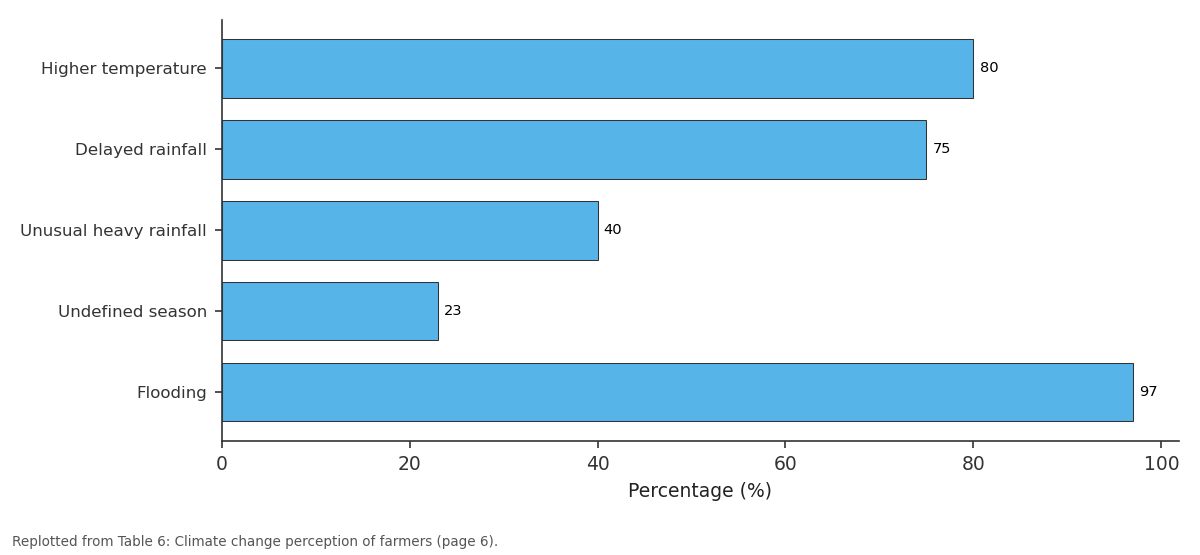
- Farmers identified flooding (97%), higher temperatures (80%), and delayed rainfall (75%) as the primary indicators of climate change in their region. View evidence ↗
- The most dominant negative effect of climate change on production was low crop yield (97%), followed by seedling drying (65%) and stunted growth (62%). View evidence ↗
- The most widely adopted mitigation technologies were tree planting (97%) and the use of improved seed varieties (92%). View evidence ↗
- Implementation of mitigation strategies is primarily hindered by limited access to capital (95%), insufficient land (72%), and inadequate knowledge of options (70%). View evidence ↗
- Farmers reported that their mitigation efforts helped reduce flooding (87%), lower temperatures (75%), and mitigate drought (52%). View evidence ↗
What it means
- The authors conclude that there is a critical need for improved education and support systems to help farmers effectively adopt climate change mitigation strategies. View evidence ↗
- The study emphasizes that targeted interventions and climate-smart agriculture are essential for improving agricultural productivity and resilience in the region. View evidence ↗
Visual summary
2 visualsIllustrations explain the paper; charts are replotted from the paper's own table values.
Percentage (Yes): Higher temperature vs Delayed rainfall vs Unusual heavy rainfall vs Undefined season vs Flooding
Replotted from Table 6 (page 6) of the original paper. Every bar is the paper's own table value.
View source evidence ↗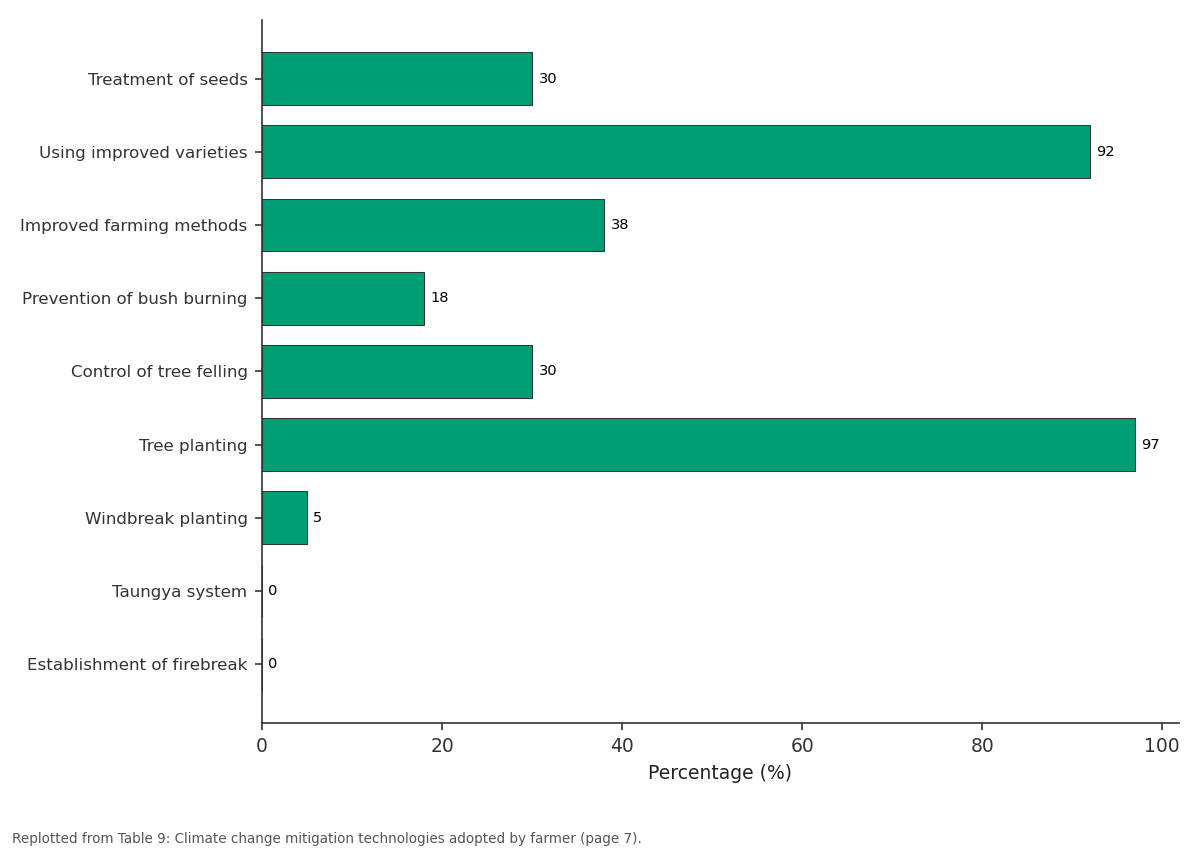
Percentage (Yes): Treatment of seeds vs Using improved varieties vs Improved farming methods vs Prevention of bush... vs Control of tree felling
Replotted from Table 9 (page 7) of the original paper. Every bar is the paper's own table value.
View source evidence ↗Figures & tables
From the original paper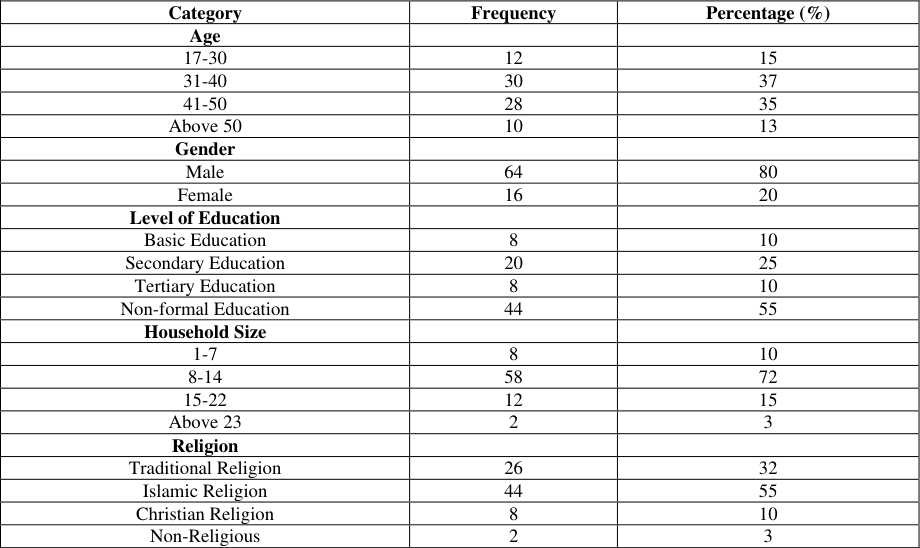 Table 1
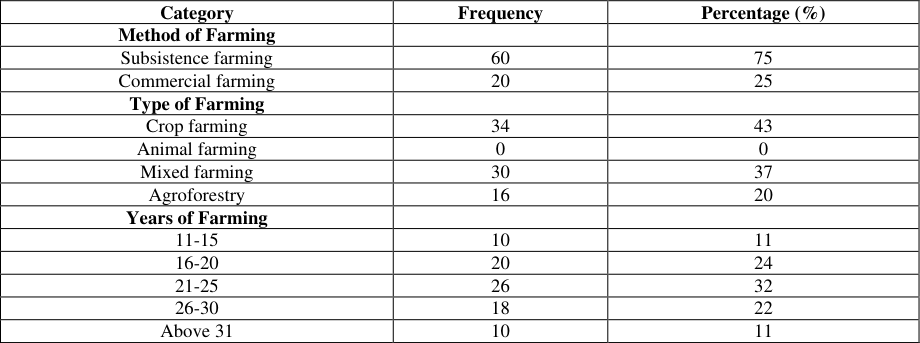 Table 2
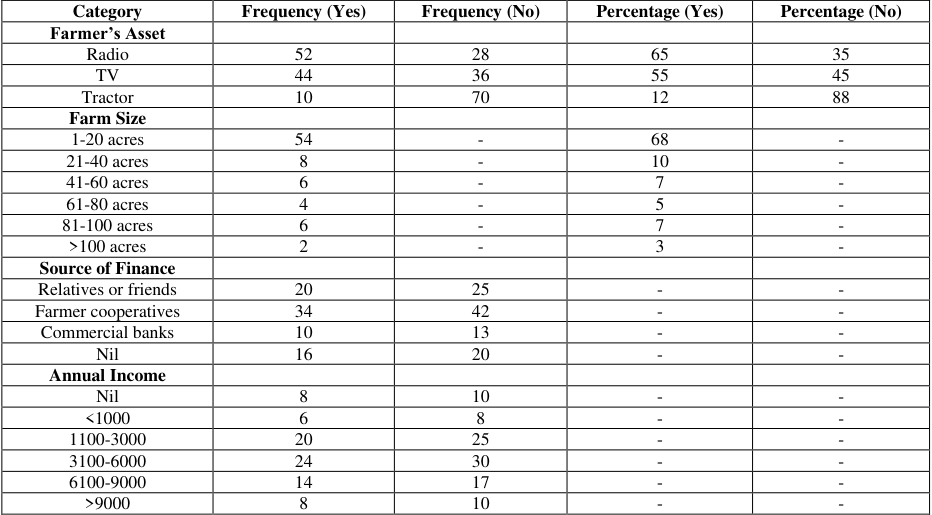 Table 3
 Table 4
 Table 5
 Table 6
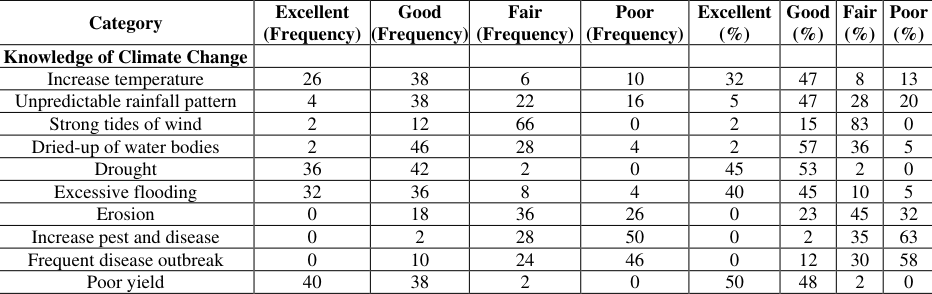 Table 7
 Table 8
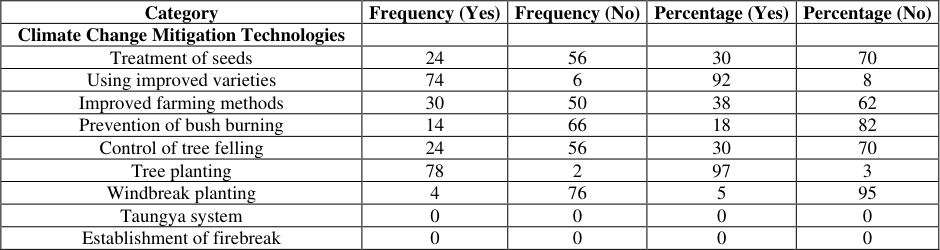 Table 9
 Table 10
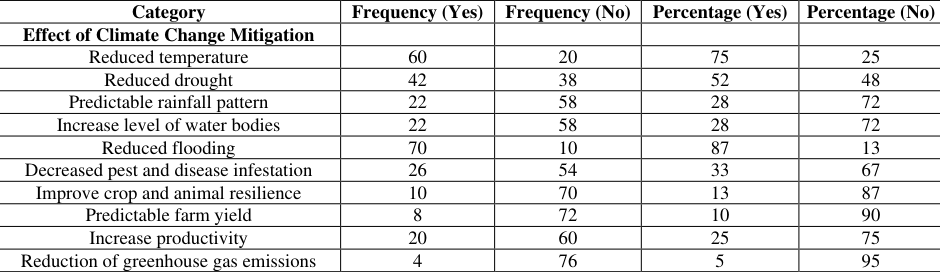 Table 11
Introduction
Debates and dialogues on international environmental change are presently focused on climate change (O'Neill et al., 2017) [1] . The effects of climate change on the environment have called for a combine effort globally towards unbiased policy action that will work effectively and efficiently (Harris, 2007) [2] . In the coming years, the effects of climate change such as higher temperatures, irregular precipitate, flooding and life threatening weather conditions in global south are projected to be severe. However, these climate change effects pose risks for agriculture, forests and supply of basic necessities including food and water (Kifle, 2008) [3] . Climate change and its consequences from the early 1970s up to date is being experienced in Africa in terms of the environmental changes such as an increase in temperature, decline in agrarian production, changes in weather and spread of disease (Girvetz et al., 2019) [4] . Africa's climate vulnerability is purported to be as a result of a series of factors including fragility of their adaptive capacity, over dependence on outmoded agrarian practices for their survival on ecosystem commodities among others (Ofoegbu et al., 2019) [5] . According to Kurukulasuriya et al. (2006) [6] , agricultural practices are at risk to climate change more than any other sectors of an economy even though the menace of climate change is both to the agriculture and non-agricultural sector. Smith and Skinner (2002) [7] reported that, climate change has a significant effect on agricultural productivity especially when it comes to soil moisture and fertility. So, climate variability such as irregular rainfall can adversely affect farming from cultivation to harvest. Even when there is sufficient rain, but it is not available during the critical growing stage of crops, it can adversely affect crop yield (Witt & Waibel, 2009) [8] . Climate change mitigation and adaptation are the two key policies identified by the United Nations Framework Convention on Climate Change (UNFCCC, 2008) [9] to be used in tackling climate change. Climate change mitigation aims at decreasing 'greenhouse gases (GHGs) presence in the atmosphere while keeping carbon emission low through climate change response that targets the reduction of climate change impacts via climate-smart agriculture 1 . Climate-smart agriculture, an intervention for climate change mitigation and adaptation, is being used by farmers to tackle the challenges such as prolonged dry seasons and irregular rainfall caused by climate change and climate change variability. Climate-smart Agriculture is also used to reduce the burden on natural forests (Nyasimi et al., 2017) [11] . For instance, the tree component in agroforestry helps seasonal crops to tolerate climatic conditions such as drought while supporting food grower's food security by preventing complete crop failure (Charles et al., 2013, Ekpo and Asuquo, 2012, Uisso, 2015) [12][13][14] .
Given that the global food and nutrition security is at risk because of the effects of climate change and it is anticipated to deteriorate in future because of unpredictable nature of environmental and weather conditions including floods and drought (Barasa et al., 2021) [15] . According to Zakaria and Matsui (2020) [16] , in Africa and Ghana the impacts of climate change on agriculture have been debated. Although, presently, in Africa continent climate change has not peak yet especially in Sub-Saharan Africa (SSA), nonetheless historically data such as rainfall and temperature revealed possible repercussions with respect to food production and to some extent food security (Serdeczny et al., 2017) [17] . It is reported that climate change could worsen local experience such as malnutrition and poverty because high temperature, flood and drought occurrences aggravated crop productivity with its attendants effects on quality of life as well as health (Asante & Amuakwa-Mensah, 2015) [18] . Perhaps appropriate climate that are suitable for living organisms both on land and in water is predicted to deviate from typical value since average weather appears warmer. In this regards some region specifically West Africa is considered as a "climate change hotspot" and it is believed that the changing climate will reduce crop output that will affect food security in this part of the region (Müller et al., 2014) [19] . [16,[20][21][22][23] . However, adoption of mitigations technologies among farmers received limited attention in research and our study strive to fill out this research gap and therefore seeks to find out the climate 1 Climate-smart agriculture is an approach that has the potential to sustainably increase productivity, reduces greenhouse gases (mitigation) enhances resilience (adaptation), where possible and extends the achievement of food security and development goals. Climate-smart agriculture acts as an intervention for climate change mitigation and adaptation (Palombi & Sessa, 2013) [10] .
mitigation technologies adopted by farmers and their effect in the Mamprugu Moaduri District.
Methodology
The target population for this study was farmers in the farming communities in the Mamprugu Moaduri District of the North East Region of Ghana. The study employed a sample size of five percent (5%) which is a valid representation according to Bailey and Mouton (1998) [24] who recommended that, for studies that use statistical data analysis, a minimum of 30 respondents is enough to represent the population. [25] that farmers in their 40's are mature in age, energetic and capable of agricultural production.
The results also revealed that, 80% of farmers were male implying that more male (64 respondents) were involved in farming than female (16) in the study area. This result contradicts the assertion of Akpabio (2005) [26] that, females dominate the present farming population; women are often more easily motivated than men to adopt innovations. Similarly, majority (72%) of the farmers had household size of between 8-14 persons which indicates that, the farming system in the Mamprugu Moaduri district farming communities requires more labour, thus there will be labour available for farming activities although it can also be influenced by age, gender, and health status of the household.
The mean of farmer's household size in the Mamprugu
Moaduri district is twenty (20) which means that, the average household size of farmers in the farming communities is twenty (20). Despite the average household size of twenty (20) and an average farm size of thirteen (13.33) acres, farmers identified inadequate labour force as one of the most pressing problems they encounter because most farmers used indigenous farming methods and farm control measures which requires more labour force and increased farm duration. The community farmers (45%) had varying educational qualifications even though fifty five percent (55%) of them had no formal or informal education. The primary data on farmers' level of education showed that most farmers (25%) have completed senior high school while ten percent (10%) of farmers completing basic and tertiary education. Farming accounted for seventy five percent (75%) of community members occupation while secondary occupations (trading, civil service, tailoring, hunting among others) accounted for the remaining percentage.
Livelihood characteristics of respondents
The findings from the study (Table 2) reveals that, majority (75%) of respondents are engaged in subsistence farming with the remaining (25%) engaging in commercial farming. 43%, 37% and 20% of farmers in the Mamprugu Moaduri District farming communities are involved in crop farming, mixed farming and agroforestry respectively. The study further shows that, 32%, 24% and 22% of the respondents had farming experience range between 21-25, 16-20 and 26-30 years respectively whilst 11% of farmers had more than thirty years (30) of experience in farming. The results implies that, majority of the respondents had been in farming for many years and may have significant knowledge and understanding about climate change, its effects and mitigation strategies in the study area. This finding supports the study of Shetty (2005) [27] , who reported that, more years of farming experience improve awareness of potential benefits and willingness to participate in natural resource management.
| Category | Frequency | Percentage (%) |
|---|---|---|
| Method of Farming | ||
| Subsistence farming | 60 | 75 |
| Commercial farming | 20 | 25 |
| Type of Farming | ||
| Crop farming | 34 | 43 |
| Animal farming | 0 | 0 |
| Mixed farming | 30 | 37 |
| Agroforestry | 16 | 20 |
| Years of Farming | ||
| 11-15 | 10 | 11 |
| 16-20 | 20 | 24 |
| 21-25 | 26 | 32 |
| 26-30 | 18 | 22 |
| Above 31 | 10 | 11 |
Table text extracted from the original PDF; superscript letters are shown inline. The original table image is below.
View original table image
Economic status of respondents
With respect to respondents' economic status, Table 3 shows that, fifty two 52 (65%) and forty four 44 (55%) of the respondents owned radio and television respectively, thus majority of the farmers in the communities have access to climate change information through radio and television. Also, majority (68%) of the farmers had small farm size of between 1-20 acres whilst few (7% and 3%) farmers had large farm size of between 81-100 acres and above 100 acres. This indicate that, few farmers (10%) in the farming communities practice commercial farming, thus not many farmers harvest high yield of agricultural produce in the Mamprugu Moaduri.
| Category | Frequency (Yes) | Frequency (No) | Percentage (Yes) | Percentage (No) |
|---|---|---|---|---|
| Farmer’s Asset | ||||
| Radio | 52 | 28 | 65 | 35 |
| TV | 44 | 36 | 55 | 45 |
| Tractor | 10 | 70 | 12 | 88 |
| Farm Size | ||||
| 1-20 acres | 54 | - | 68 | - |
| 21-40 acres | 8 | - | 10 | - |
| 41-60 acres | 6 | - | 7 | - |
| 61-80 acres | 4 | - | 5 | - |
| 81-100 acres | 6 | - | 7 | - |
| >100 acres | 2 | - | 3 | - |
| Source of Finance | ||||
| Relatives or friends | 20 | 25 | - | - |
| Farmer cooperatives | 34 | 42 | - | - |
| Commercial banks | 10 | 13 | - | - |
| Nil | 16 | 20 | - | - |
| Annual Income | ||||
| Nil | 8 | 10 | - | - |
| <1000 | 6 | 8 | - | - |
| 1100-3000 | 20 | 25 | - | - |
| 3100-6000 | 24 | 30 | - | - |
| 6100-9000 | 14 | 17 | - | - |
| >9000 | 8 | 10 | - | - |
Table text extracted from the original PDF; superscript letters are shown inline. The original table image is below.
View original table image
The findings from the study shows that, most of the respondents' source of funding is farmers' co-operatives (42%) followed by relatives or friends (25%) and commercial banks (13%), however significant number of farmers (20%) financed their farming activities on their own. Majority of farmers (30%) earn annual income of between the ranges of 3100-6000 Ghana cedis, meanwhile some commercial farmers (10%) earn annual income above nine thousand (9000) Ghana cedis. Few farmers (10%) in the district practicing subsistence farming earn less than thousand (1000) Ghana cedis or do not earn income at the end of the year. Farmers earning less than thousand (1000) Ghana cedis in a year means that they have low income level, which can be attributed to the subsistence level of farming prevalent in that particular farming community. This finding supports the study of Barnett & Webber (2009) [28] who reported that, small-holder farmer livelihood assets lead to better and enhanced livelihood outcomes which include more income, increased well-being and improved food security, thus the nature of farmer livelihood assets influences smallholder farmers' capacity to respond to environmental shocks. Small-holder farmers with less income focus on activities that are less dependent on climate. An analysis of national household survey data in Burkina Faso between 1998 and 2007 showed that, the average wealth increased for almost all major livelihood groups and the number of wealthy people steadily increased. These results highlight the importance of off-farm income which generates opportunities, especially in marginal rural areas, for longterm adaptation strategies to climate variability and change (Nielsen and Reenberg 2010) [29] .
Access to climate information
From table 4, eighty percent (80%) of farmers access to climate or weather information presuppose that, farmers in the Mamprugu Moaduri have enough information on climate change mitigation strategies which is in line with the Bernstein (2008) [30] Respondents interviewed revealed that eighty percent (80%) of farmers have access to climate or weather information and they rely or acquired 85%, 65%, 50% and 75% climate information from household radio, household TV, extension services and weather information respectively.
| Category | Frequency | Percentage (%) |
|---|---|---|
| Access to Information | ||
| Yes | 64 | 80 |
| No | 16 | 20 |
Table text extracted from the original PDF; superscript letters are shown inline. The original table image is below.
View original table image
Climate change perception of respondents
Climate change is perceived by respondents to be a threat to agricultural production in the study area. The data analyzed reveals that, respondents perceive higher temperature, delayed rainfall, unusual heavy rainfall, undefined season, flooding, late fruiting of tree crop and longer days than night as the climate change variations they experienced. Table 6 shows that, farmers perceived flooding (97%) as the most experienced occurrence that depicts climate change or variability, followed by higher temperature (80%) and delayed rainfall (75%). However, undefined season (23%) was realized by farmers as the least experienced climate occurrence or change, meanwhile late fruiting of tree crop and longer days than night were not perceived by farmers as climate variability. This suggests that majority of farmers in the study area perceived flooding, higher temperature and delayed rainfall as the key determinants of climate change.
| Category | Frequency (Yes) | Frequency (No) | Percentage (Yes) | Percentage (No) |
|---|---|---|---|---|
| Climate Change Perception | ||||
| Higher temperature | 64 | 16 | 80 | 20 |
| Delayed rainfall | 60 | 20 | 75 | 25 |
| Unusual heavy rainfall | 32 | 48 | 40 | 60 |
| Undefined season | 18 | 62 | 23 | 77 |
| Flooding | 78 | 2 | 97 | 3 |
Table text extracted from the original PDF; superscript letters are shown inline. The original table image is below.
View original table image
This findings is similar to the study of Sjogersten et al., (2013) [31] which showed that, farmers perception closely matched climatic data, such that, majority of the farmers they interviewed in lowland Nepal indicated they have personally experienced climate change and have observed erratic rainfall, a decreased in water level of nearby rivers and wells, as well as an increase in the level of cold waves in the last fourteen ( 14) years. Studies show that, majority of African farmers are aware of climate change but have limited capacity to deal with its impact due to challenges due to poor access to credit, high cost of adaptation measures, and lack of access to information and extension services (Juana et al., 2013) [32] . [33] reported that, local farmers are experiencing climate change even though they have not considered it deeper implications. This is evidenced in the late arrival of rain and the drying-up of stream which are the effects of climate disturbances. Furthermore, most farmers had fair knowledge about climate change leading to strong tides of wind (82%) and erosion (35%) but poor knowledge about climate change triggering increase pests and diseases (65%) and frequent disease outbreak (57%).
Respondents' knowledge of climate change occurrences
Respondents' knowledge of climate change occurrences
Climate change effect on agricultural production
Based on respondents' response to effect of climate change, it is evidence that respondents have the view that climate change has a negative impact on agriculture and presume it influence agricultural production thus perceive that their agricultural activities are highly vulnerable to the impacts of climate change. Respondents believed that seedling drying after germination, easy spread of pest and disease, ineffectiveness of agricultural chemical, stunted growth and low crop yield are the effect of climate change on agricultural production.
The study identified low crop yield (97%) to be the dominate effect of climate change on agricultural production followed by seedling drying after germination (65%) and stunted growth (62%). Easy spread of pests and diseases (28%) and ineffectiveness of agricultural chemicals (20%) were further revealed from (Table 8) to be the least dominate effect of climate change on farming activities. Farmers' experience of low crop yield as dominate effect of climate change on their agricultural production is associate with the observation of Witt & Waibel (2009) [8] that, adverse climate effects can influence farming outputs at any stage from cultivation through the final harvest. Even if there is sufficient rain, its irregularity can affect yields adversely if rains fail to arrive during the crucial growing stage of the crops.
| Category | Frequency (Yes) | Frequency (No) | Percentage (Yes) | Percentage (No) |
|---|---|---|---|---|
| Effect of Climate Change | ||||
| Seedling drying after germination | 52 | 28 | 65 | 35 |
| Easy spread of pests and diseases | 22 | 58 | 28 | 72 |
| Ineffectiveness of agricultural chemicals | 16 | 64 | 20 | 80 |
| Stunted growth | 50 | 30 | 62 | 37 |
| Low crop yield | 78 | 2 | 97 | 3 |
Table text extracted from the original PDF; superscript letters are shown inline. The original table image is below.
View original table image
Climate change mitigation technologies adopted
Table 9 presents climate change adaptation strategies adopted by farmers. Climate change strategies implemented by farmers include: treatment of seeds (30%), using improved varieties (92%), improved farming methods (38%), prevention of bush burning (18%), control of tree felling (30%), tree planting (97%) and windbreak planting (5%). Climate change mitigation technologies were adopted by respondents to mitigate the impact of climate change such as seedling drying after germination, easy spread of pest and disease, ineffectiveness of agricultural chemical, stunted growth and low crop yield on agricultural production. Climate change mitigation strategies that were employed include treatment of seeds, using improved varieties, improved farming methods, prevention of bush burning, control of tree felling, tree planting and windbreak planting. Apata et al., (2009) [33] opined that, rural communities to a large extent have been able to develop their livelihood strategies in a way which enables them to constantly cope with and adapt to an erratic climate change, severe pest attack, changing agricultural policies at local, national, global levels and other natural factors. Vaast & Somarriba (2014) [34] supported the fact that, farmers in West Africa including Ghana have interest in planting more types of trees in their farms to sustain production, diversify revenues and improve their adaptation capacity. Deressa et al. (2009) [35] observed that, irrigation, crop rotation, use of improved seeds, timely planting and soil conservation are the most common strategies employed by farmers to cope with climate change impact. Farmers used these methods to minimize the impact of climate. Deressa et al. (2009) [35] study further indicated that, wealth of a household head, level of education, gender, access to extension services and information, temperature, credit facilities and geographical location of farmers have impact on the climate change mitigation strategies adopted by farmers. However, availability and access to information largely affect adaptation strategies.
| Category | Frequency (Yes) | Frequency (No) | Percentage (Yes) | Percentage (No) |
|---|---|---|---|---|
| Climate Change Mitigation Technologies | ||||
| Treatment of seeds | 24 | 56 | 30 | 70 |
| Using improved varieties | 74 | 6 | 92 | 8 |
| Improved farming methods | 30 | 50 | 38 | 62 |
| Prevention of bush burning | 14 | 66 | 18 | 82 |
| Control of tree felling | 24 | 56 | 30 | 70 |
| Tree planting | 78 | 2 | 97 | 3 |
| Windbreak planting | 4 | 76 | 5 | 95 |
| Taungya system | 0 | 0 | 0 | 0 |
| Establishment of firebreak | 0 | 0 | 0 | 0 |
Table text extracted from the original PDF; superscript letters are shown inline. The original table image is below.
View original table image
Challenges encountered when implementing climate change mitigation
The problems encountered by the respondents while implementing climate change mitigation technologies are presented in Table 10. Limited access to capital (95%), insufficient land (72%) and inadequate knowledge on climate mitigation options (70%) were identified as the most pressing problems faced by farmers while implementing climate change mitigation technologies in the Mamprugu Moaduri district. Farmers associated most of these constraints with limited credit facilities, thus they are hindered from getting the necessary resources and technologies that could facilitate adaption of climate change. Also, insufficient land emphasized by farmers as a challenge is due to the fragmentation of lands and high population pressure which has led them to continuously and intensively cultivate available small parcel of land without giving reasonable consideration to the use of climate change mitigation technologies.
| Category | Frequency (Yes) | Frequency (No) | Percentage (Yes) | Percentage (No) |
|---|---|---|---|---|
| Challenges of Climate Change Mitigation | ||||
| Delay in delivery of climate information | 40 | 40 | 50 | 50 |
| Inadequate knowledge on climate mitigation options | 56 | 24 | 70 | 30 |
| Lack of improved seeds | 30 | 50 | 38 | 62 |
| Inadequate labour force | 30 | 50 | 38 | 62 |
| Lack of access to capital | 76 | 4 | 95 | 5 |
| Insufficient land | 58 | 22 | 72 | 28 |
Table text extracted from the original PDF; superscript letters are shown inline. The original table image is below.
View original table image
International Journal of Agriculture and Food Science https://www.agriculturaljournals.com
Climate change mitigation effects
From table 11, majority of the farmers said that, the climate change mitigation strategies they implement has contributed to the reduction of flooding, reduced temperature and reduced drought representing 87%, 75% and 52% of their response respectively. Implementation of climate change mitigation strategies by farmers led to less significant effect of the following; predictable rainfall pattern, increase level of water bodies, decreased pest and disease infestation, improve crop and animal resilience, predictable farm yield, increase productivity and reduction of greenhouse gas emission. Hence, climate change mitigation effects identified by respondents include reduced temperature, reduced drought, predictable rainfall pattern, increase level of water bodies, reduced flooding, decreased pest and disease infestation, improve crop and animal resilience, predictable farm yield, increase productivity and reduction of greenhouse gas emission. Vernooy et al., (2017) [36] reported that, benefits derived from climate change mitigation strategies include pest and disease reduction, increased production, increased production stability and climate stress buffering as climate adaptation strategies.
| Category | Frequency (Yes) | Frequency (No) | Percentage (Yes) | Percentage (No) |
|---|---|---|---|---|
| Effect of Climate Change Mitigation | ||||
| Reduced temperature | 60 | 20 | 75 | 25 |
| Reduced drought | 42 | 38 | 52 | 48 |
| Predictable rainfall pattern | 22 | 58 | 28 | 72 |
| Increase level of water bodies | 22 | 58 | 28 | 72 |
| Reduced flooding | 70 | 10 | 87 | 13 |
| Decreased pest and disease infestation | 26 | 54 | 33 | 67 |
| Improve crop and animal resilience | 10 | 70 | 13 | 87 |
| Predictable farm yield | 8 | 72 | 10 | 90 |
| Increase productivity | 20 | 60 | 25 | 75 |
| Reduction of greenhouse gas emissions | 4 | 76 | 5 | 95 |
Table text extracted from the original PDF; superscript letters are shown inline. The original table image is below.
View original table image
Tables on adoption of Mitigation technologies
Tables on adoption of Mitigation technologies
Conclusions
We assessed climate change mitigation technologies adopted by farmers in the Mamprugu Moaduri District of the North East Region of Ghana. Descriptive statistics was employed to analyze data and present responses of farmers in percentages. The study revealed that majority (75%) of farmers in the study area engaged in subsistence farming while the remaining (25%) engaged in commercial farming. Most of the farmers have access to climate change information through radio, television, weather station and extension services. Furthermore, we found out that, respondents experienced climate change variations such as higher temperature, delayed rainfall, unusual heavy rainfall, undefined season, flooding, late fruiting of tree crop and longer days than night. Also, the result showed that, farmers in the Mamprugu Moaduri have knowledge of climate change occurrences such as increase temperature, unpredictable rainfall pattern, strong tides of wind, dried up of water bodies, drought, excessive flooding, erosion, increase pests and diseases, frequent disease outbreak and poor yield. Further findings showed that, respondents experienced climate change effects such as seedling drying after germination, easy spread of pest and disease, ineffectiveness of agricultural chemical and low crop yield on their agricultural production. However, farmers employed climate change mitigation strategies including treatment of seeds, using improved varieties, improved farming methods, prevention of bush burning, control of tree felling, tree planting and windbreak planting. In addition, farming activities in the district faced numerous challenges and among these constraints were access to capital, high price of improved seeds, inadequate labour, inadequate knowledge on climate mitigation options and delay in delivery of climate information.
Figures and tables from the paper
| Category | Frequency | Percentage (%) |
|---|---|---|
| Age | ||
| 17-30 | 12 | 15 |
| 31-40 | 30 | 37 |
| 41-50 | 28 | 35 |
| Above 50 | 10 | 13 |
| Gender | ||
| Male | 64 | 80 |
| Female | 16 | 20 |
| Level of Education | ||
| Basic Education | 8 | 10 |
| Secondary Education | 20 | 25 |
| Tertiary Education | 8 | 10 |
| Non-formal Education | 44 | 55 |
| Household Size | ||
| 1-7 | 8 | 10 |
| 8-14 | 58 | 72 |
| 15-22 | 12 | 15 |
| Above 23 | 2 | 3 |
| Religion | ||
| Traditional Religion | 26 | 32 |
| Islamic Religion | 44 | 55 |
| Christian Religion | 8 | 10 |
| Non-Religious | 2 | 3 |
Table text extracted from the original PDF; superscript letters are shown inline. The original table image is below.
View original table image
| Category | Frequency (Yes) | Frequency (No) | Percentage (Yes) | Percentage (No) |
|---|---|---|---|---|
| Source of Information | ||||
| Household radio | 68 | 12 | 85 | 15 |
| Household TV | 52 | 28 | 65 | 35 |
| Weather station | 40 | 40 | 50 | 50 |
| Extension service | 60 | 20 | 75 | 25 |
Table text extracted from the original PDF; superscript letters are shown inline. The original table image is below.
View original table image
| Category | Excellent (Frequency) | Good (Frequency) | Fair (Frequency) | Poor (Frequency) | Excellent (%) | Good (%) | Fair (%) | Poor (%) |
|---|---|---|---|---|---|---|---|---|
| Knowledge of Climate Change | ||||||||
| Increase temperature | 26 | 38 | 6 | 10 | 32 | 47 | 8 | 13 |
| Unpredictable rainfall pattern | 4 | 38 | 22 | 16 | 5 | 47 | 28 | 20 |
| Strong tides of wind | 2 | 12 | 66 | 0 | 2 | 15 | 83 | 0 |
| Dried-up of water bodies | 2 | 46 | 28 | 4 | 2 | 57 | 36 | 5 |
| Drought | 36 | 42 | 2 | 0 | 45 | 53 | 2 | 0 |
| Excessive flooding | 32 | 36 | 8 | 4 | 40 | 45 | 10 | 5 |
| Erosion | 0 | 18 | 36 | 26 | 0 | 23 | 45 | 32 |
| Increase pest and disease | 0 | 2 | 28 | 50 | 0 | 2 | 35 | 63 |
| Frequent disease outbreak | 0 | 10 | 24 | 46 | 0 | 12 | 30 | 58 |
| Poor yield | 40 | 38 | 2 | 0 | 50 | 48 | 2 | 0 |
Table text extracted from the original PDF; superscript letters are shown inline. The original table image is below.
View original table image
References
31 in the original paper- O'Neill BC, Oppenheimer M, Warren R, Hallegatte S, Kopp RE, Pörtner HO, et al. IPCC reasons for concern regarding climate change risks. Nat Clim Chang. 2017;7(1):28-37.
- Harris PG. Collective action on climate change: The logic of regime failure. Nat Resour J. 2007;47:195.
- Kifle T. Africa hit hardest by global warming despite its low greenhouse gas emissions. Institut für Weltwirtschaft und Internationales Management, Universität Bremen, 2008.
- Girvetz E, Villegas RJ, Claessens L, Lamanna C, Racines NC, Nowak A, et al. Future climate projections in Africa: Where are we headed? In: The Climate-Smart Agriculture Papers: Investigating the Business of a Productive, Resilient and Low Emission Future, 2019, p. 15-27.
- Ofoegbu C, Chirwa PW, Francis J, Babalola FD. Assessing local-level forest use and management capacity as a climate-change adaptation strategy in Vhembe district of South Africa. Clim Dev. 2019;11(6):501-512.
- Kurukulasuriya P, Mendelsohn R, Hassan R, Benhin J, Deressa T, Diop M, et al. Will African agriculture survive climate change? World Bank Econ Rev. 2006;20(3):367-388.
- Smit B, Skinner MW. Adaptation options in agriculture to climate change: A typology. Mitig Adapt Strateg Glob Change. 2002;7(1):85-114.
- Witt R, Waibel H. Climate risk and farming systems in rural Cameroon. Diskussionsbeitrag. 2009, 423.
- UNFCCC. Financial flows to address climate change: An update, 2008.
- Palombi L, Sessa R. Climate-smart agriculture: sourcebook. Food and Agriculture Organization of the United Nations (FAO), 2013.
- Nyasimi M, Kimeli P, Sayula G, Radeny M, Kinyangi J, Mungai C. Adoption and dissemination pathways for climate-smart agriculture technologies and practices for climate-resilient livelihoods in Lushoto, Northeast Tanzania. Climate. 2017;5(3):63.
- Charles RL, Munishi PKT, Nzunda EF. Agroforestry as adaptation strategy under climate change in Mwanga District, Kilimanjaro, Tanzania. Int J Environ Protect. 2013;3(11):29-38.
- Ekpo FE, Asuquo ME. Agroforestry practice as adaptation tools to climate change hazards in Itu LGA, Akwa Ibom State, Nigeria. Glob J Hum Soc Sci Geogr Environ Geosci. 2012;12:27-36.
- Uisso AJ. Agroforestry practices as an option for climate change adaptation: A review. Octa J Environ Res. 2015;3(3).
- Barasa PM, Botai CM, Botai JO, Mabhaudhi T. A review of climate-smart agriculture research and applications in Africa. Agronomy. 2021;11(6):1255.
- Zakaria AR, Matsui K. How reliable are farmers' perceptions about climate change? A case study in the Upper East Region of Ghana. Int J Environ Agric Biotechnol. 2020;5(1):16-21. DOI: 10.22161/ijeab.5.1.3.
- Serdeczny O, Adams S, Baarsch F, Coumou D, Robinson A, Hare W, et al. Climate change impacts in Sub-Saharan Africa: From physical changes to their social repercussions. Reg Environ Change. 2017;17:1585-600.
- Asante FA, Mensah AF. Climate change and variability in Ghana: Stocktaking. Climate. 2014;3(1):78-101.
- Müller C, Waha K, Bondeau A, Heinke J. Hotspots of climate change impacts in sub-Saharan Africa and implications for adaptation and development. Global Change Biol. 2014;20(8):2505-2517.
- Makate C, Makate M, Mango N. Smallholder farmers' perceptions on climate change and the use of sustainable agricultural Chinyania Triangle, South Africa. Soc Sci. 2017;6(30):1-15. DOI: 10.3390/socsci6010030.
- Gbetibouo GA. Understanding farmers' perceptions and adaptations to climate change and variability: The case of the Limpopo Basin, South Africa. Intl Food Policy Res Inst, 2009, Vol. 849.
- Zampaligré N, Dossa LH, Schlecht E. Climate change and variability: Perception and adaptation strategies of pastoralists and agro-pastoralists across different zones of Burkina Faso. Reg Environ Change. 2014;14(2):769783. DOI: 10.1007/s10113-013-0532-5.
- Gbetibouo GA. Understanding farmers' perceptions and adaptations to climate change and variability: The case of the Limpopo Basin, South Africa. Intl Food Policy Res Inst, 2009, Vol. 849.
- Bailey D, Mouton J. Methods of social science research. London: The Free Press Collier Macmillan Publisher, 1998.
- Nwachukwu I. Agricultural communication: Principles and practice. Umuahia: Lamb House Publishers, 2003.
- Akpabio IA. Human agriculture: A social theme in agricultural development. Uyo: Aboam Publishing Company, 2005, p. 106-22.
- Shetty S. Millennium declaration and development goals: Opportunities for human rights. Sur Rev Humanos. 2005;2(2):6-21.
- Barnett JR, Webber M. Accommodating migration to promote adaptation to climate change. World Bank Policy Research Working Paper, 2010, 5270.
- Akpabio B. Rural and agricultural sociology. In: Agricultural extension and rural sociology. Enugu: Snaap Press Ltd, 2005.
- Bernstein L, Bosch P, Canziani O, Chen Z, Christ R, Riahi K. IPCC, 2007: Climate change 2007: Synthesis Report, 2008.
- Sjögersten S, Atkin C, Clarke ML, Mooney SJ, Wu B, West HM. Responses to climate change and farming policies by rural communities in northern China: A report on field observation and farmers' perception in dryland north Shaanxi and Ningxia. Land Use Policy. 2013;32:125-133.