
Research article · 2025 · Full text
International Journal of Geography Geology and EnvironmentSustainable agricultural practices in Kenya: A case study of Embu rural women
Volume 7(1) · Pages 01–03 · DOI: 10.22271/27067483.2025.v7.i1a.316 ↗
Research areasDemographic Trends and Gender PreferencesRangeland Management and Livestock Ecology
Abstract
Author-writtenBefore 18th and 19th century, it was considered that women were avoided in all major sphere of social life. But now large number of studies on women and environment relation shows that women are substantial actor in various sector like agriculture and environmental conservation. Cultural knowledge of Embu rural women of Kenya is very rich. Embu women are in congruity with their environment. The study based upon primary and secondary data sources. The data has been analysed by various quantitative and qualitative statistical techniques. Methods were descriptive, historical, analytical and case study method. Descriptive as well as explanatory research used in this study, in order to describe the role of Embu women in environmental conservation. Embu women are in congruity with their environment. Women put in immense effort in planting, producing, and harvesting agricultural goods, but their numerous contributions and roles frequently go unrecognized by both local governments and external organizations. The inequities between male and female participation in agricultural production are among the continuing legacies of the colonial era. Embu women who have lost their men to the towns and cities remain the primary agricultural producers. Although these rural women contribute as agriculturists, they constitute an unrecognized body that is bereft of any decision-making power to improve their status in society. The government needs to put a lot of emphasis on the need to empower women especially by allowing them freedom rights just like men have, either, at educational levels, employment levels and the political grounds.
Summary
Source-checkedPlain-language reading of the full paper, prepared with AI and checked against the text. Each point links to the authors' own words.
Why it matters
- In the Embu region of Kenya, agriculture is the primary economic driver, making sustainable farming practices essential for rural development. View evidence ↗
- Women in these regions have a direct relationship with the environment through their roles as farmers and gatherers, making them highly susceptible to environmental changes. View evidence ↗
- Gender inequalities in agricultural participation are viewed as a lasting legacy of the colonial period in Kenya. View evidence ↗
The question
- The study aims to determine how rural women in Embu are involved in environmental conservation efforts. View evidence ↗
What they did
- The research relied on secondary data sources to gather information. View evidence ↗
- The authors employed a combination of descriptive, historical, analytical, and case study methods, utilizing both descriptive and explanatory research. View evidence ↗
- Data analysis was conducted using a mix of qualitative and quantitative statistical techniques. View evidence ↗
What they found
- Embu women practice agroforestry by integrating fruit trees (avocados, guavas, and mangoes) with staple crops like maize and beans. View evidence ↗
- The use of nitrogen-fixing trees, specifically Grevillea robusta and Calliandra calothyrsus, is used to naturally improve soil fertility. View evidence ↗
- Agro-silvopastoral systems are used where Acacia and Leucaena trees are planted in pastures to provide livestock with shade and fodder. View evidence ↗
- A case study of farmer Jane Njeri showed that switching to no-till methods reduced soil erosion and improved moisture retention, resulting in higher yields and lower labor costs. View evidence ↗
- The implementation of rooftop collection systems and small earth dams for rainwater harvesting has increased irrigation access and enhanced crop yields. View evidence ↗
- Crop diversification, specifically adding legumes and vegetables to maize and bean fields, has led to improved income stability and food security. View evidence ↗
- Agricultural production is gender-divided: men typically grow cash crops (sugar cane, yarns, bananas), while women grow a variety of tubers, grains, and legumes. View evidence ↗
- Despite their central role in production, the contributions of Embu women are frequently unrecognized by external organizations and local governments. View evidence ↗
What it means
- The authors conclude that the government must prioritize women's empowerment by granting them equal rights in education, employment, and politics. View evidence ↗
- The authors state that men must change their attitudes toward empowerment and abandon discriminatory cultural beliefs. View evidence ↗
Visual summary
1 visualsIllustrations explain the paper; they do not show study data.
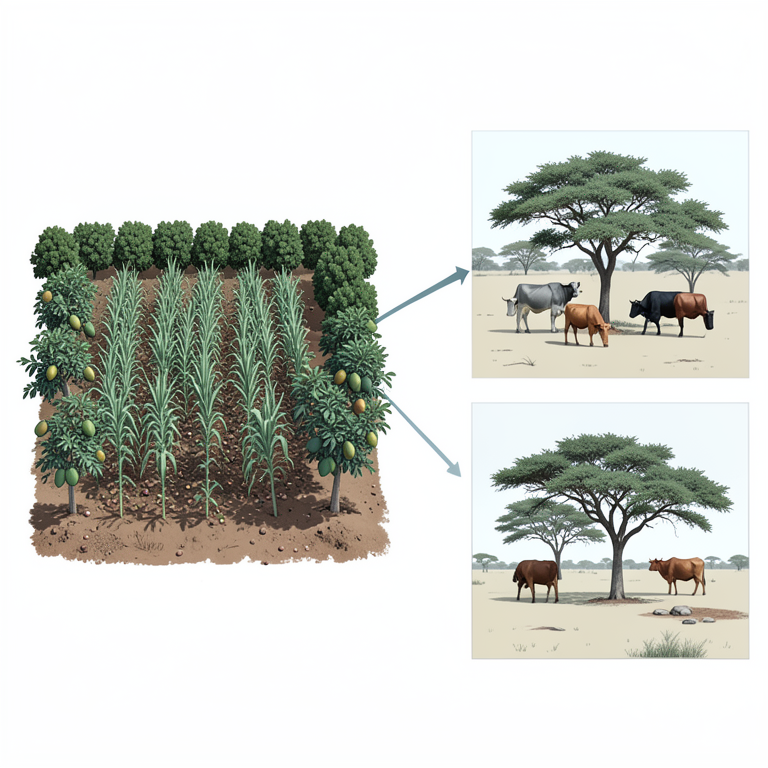
Sustainable Farming Integration
AI-generated conceptual illustration (Kenyan rural farmland with maize, beans, avocado trees, and livestock). It explains the idea and does not show study data.
View source evidence ↗Introduction
The economy of Kenya and the livelihoods of Kenyan people fundamentally associated with natural resource utilization. Before 18 th and 19 th century, it was considered that women were avoided in all major sphere of social life. But now large number of studies on women and environment relation shown that women are substantial actor in environmental conservation as well as farming sectors. As farmers and gatherers of water and firewood, women have a deep connection to their local environment and often experience the most direct impacts of environmental challenges. Cultural knowledge of Embu rural women of Kenya is very rich. The women play as a knowledgeable person in agricultural sector in Kenya and the methods is useful of the environmental conservation. Sustainable agricultural practices are crucial for the development of rural communities, particularly in regions like Embu in Kenya, where agriculture forms the backbone of the economy. In Embu, a county in the Eastern Province of Kenya, rural women play a vital role in agriculture and are often at the forefront of implementing and adapting sustainable farming practices.
Data source and methodology
The main purpose of the present study is to determine the involvement of Embu rural women in environmental conservation in Kenya. The study based upon secondary data sources. The data was analysed by various quantitative and qualitative statistical techniques. Methods was descriptive, historical, analytical and case study method. Descriptive as well as explanatory research used in this study, in order to describe the role of Embu women in environmental conservation. To achieve these, different methods of qualitative as well as quantitative data through different sources.
Sustainable Agricultural Practices and Embu Women "Let's sit down here…. lets us have no blankets to sit on but feel the ground with our bodies, the earth, the yielding shrubs. Listen to the air. Yu can hear it, feel it, smell it, taste it…. we sit together, don't touch, but something here, we feel it between us, as presence." -An embu tribe proverb This is a not too bad approach to begin pondering nature, talk about nature, rather converse with it, converse with streams, to the lakes, to the breezes as to our relatives. Rural women in Embu have adopted several sustainable agricultural practices to enhance productivity and environmental stewardship. Key practices include:
Agroforestry: In the verdant hills of Embu, Kenya, where the interplay of fertile volcanic soils and rainfall creates a lush agricultural landscape, rural women are at the forefront of transformative agroforestry practices. Agroforestry, the integration of trees into agricultural landscapes, is a cornerstone of sustainable farming in this region. The practices adopted by these women are not merely agricultural techniques but are deeply intertwined with environmental stewardship, economic resilience, and cultural preservation.
One of the most prevalent agroforestry practices among rural women in Embu is the integration of fruit trees into traditional crop farming systems. Women plant fruit-bearing trees such as avocados, guavas, and mangoes alongside staple crops like maize and beans. Tree-based cropping systems are another key practice. In this system, trees such as Grevillea robusta and Calliandra calothyrsus are planted in and around crop fields. These trees are valued for their ability to fix nitrogen, which naturally enriches the soil and improves its fertility. Agro-silvopastoral systems, where trees are integrated with livestock grazing areas, are also practiced. Women in Embu plant trees like Acacia and Leucaena in pastures, which provide shade and fodder for livestock. This practice improves the health and productivity of animals by offering them protection from extreme temperatures and additional forage.
Conservation Tillage: In Embu, women have embraced minimum tillage techniques by using hand tools that disturb the soil less compared to traditional plowing methods. This practice has been shown to enhance soil fertility and productivity over time.
Case Study: Jane Njeri's Farm Jane Njeri, a farmer in Embu, adopted reduced tillage practices on her farm to combat soil erosion. Instead of plowing her fields extensively, she now uses a no-till method where she plants directly into the residue of previous crops. This approach has not only reduced soil erosion but also improved soil moisture retention, leading to better crop yields and reduced labor costs. a) Organic Farming: Organic farming has emerged as a practical alternative to traditional agricultural methods, emphasizing environmental sustainability, soil health, and the reduction of synthetic inputs. In Kenya's Embu region, rural women are at the forefront of adopting organic farming techniques, driven by a commitment to sustainable agriculture, improved health outcomes, and economic resilience.
b) Water Harvesting and Management: Women have implemented rainwater harvesting techniques such as building rooftop rainwater collection systems and small earth dams. These initiatives have improved access to water for irrigation, thus enhancing crop yields. By capturing and storing rainwater and runoff, these women have ensured a more reliable water supply for their households and farms. This has reduced their dependency on unpredictable rainfall and external water sources. c) Crop Diversification: In the Embu region of Kenya, agricultural practices are significantly influenced by the need to adapt to changing environmental conditions, market demands, and socio-economic challenges. Rural women in Embu have increasingly turned to crop diversification as a key strategy to enhance agricultural resilience, improve food security, and boost economic stability. Women in Embu have diversified their crops by incorporating legumes and vegetables into their traditional maize and beans fields. This has improved food security and income stability.
Socio-Economic Aspects of Embu Women -
The Embu are an important tribal community in Kenya, residing near Mount Kenya. Embu women have a deep connection to their environment. The cosmology or belief systems of ancient indigenous Africans play a crucial role for many African communities, especially for rural women in Embu, in shaping their understanding of ecology, environmental changes, and conservation today. For these women, agricultural production is the primary source of wealth and social security in Kenya. However, traditional gender roles often force rural women in Africa to depend on men. These gendered beliefs perpetuate female subordination and restrict women's access to agricultural rights and economic resources.
In the Embu community, crop cultivation is divided along gender lines. Men primarily grow cash crops such as sugar cane, yarns, and bananas, while women focus on a range of crops, including various potatoes, cassava, millet, and legumes like cowpeas, pigeon peas, garden peas, kidney beans, white beans, and lentils. Women also grow maize for household consumption; however, when maize is cultivated for commercial purposes, it becomes classified as a "male" crop, requiring both partners to manage it together. Likewise, vegetables intended for sale are categorized as "male" crops, while those grown for home use are deemed "female" crops. All fruits, such as oranges, mangoes, papayas, avocados, passion fruit, pears, lemons, and strawberries, are considered part of the family's produce unless they are grown in excess for trade, in which case they are labeled as "male" crops. Despite the gendered ownership of crops, women carry out the majority of tasks within the food production cycle. The efficiency demonstrated by Embu women comes from experience and practice. They perform their tasks at a manageable pace, understanding how long it takes for a water pot to dry and how long a tire will burn before needing to be rekindled. They also know the right times for harvesting and when to add natural preservatives to food. From a young age, girls learn that women rarely have idle time.
In Kenya, British colonizers established a hierarchical social structure rooted in race, gender, and class. By allocating the best lands to themselves, confining local populations to designated areas, and recruiting male laborers to work away from home, the colonialists solidified their economic control. For the Kenyan women who tended the land, the migration of men to towns and cities resulted in a shift in responsibilities. Tasks that had traditionally been performed by men-such as planting, producing, and harvesting-now fell to the women. In post-colonial African countries, rural Embu women remain largely invisible due to the prevailing patriarchal structure that dominates social, economic, and political spheres. Despite their hard work in planting, producing, and harvesting agricultural products, their countless contributions and roles go unacknowledged, both by local governments and external organizations. The inequities between male and female participation in agricultural production are among the continuing legacies of the colonial era. Embu women who have lost their men to the towns and cities remain the primary agricultural producers. Although these rural women contribute as agriculturists, they constitute an unrecognized body that is bereft of any decision-making power to improve their status in society. showcasing the advantages of sustainable practices through successful case studies can help address resistance.
Challenges and Solutions
Challenges and Solutions
Conclusion
When a woman is empowered, the entire nation benefits, and this impact extends to the regions. While not all women may be politically, economically, or socially empowered, progress begins with a single step. women need to be encouraged to have the thrill and want to empower themselves and also, they should receive support and assistance from the society so that they are motivated to do this. The new constitution of Kenya provides the Kenyan women including Embu rural women with more opportunities but they need to have the determination and desire to empower themselves. The government needs to put a lot of emphasis on the need to empower women especially by allowing them freedom rights just like men have, either, at educational levels, employment levels and the political grounds.
Men also need to change their attitudes about women being empowered, they need to stop female violations, discrimination and abort some cultural beliefs which are not helpful, and in fact they deny women their freedom rights as a human. Media needs to also broadcast more about women empowerment and environmental sustainability. Women play a crucial and dynamic role in agriculture and development in Kenya. Their active participation is essential for achieving environmental sustainability as well.
References
5 in the original paper- Aditya K, Kumar S. Role of Women in Environmental Conservation. Int J Polit Sci Dev. 2016;4(4):140-145.
- Jackson C. Doing What Comes Naturally? Women and Environment in Development. World Dev. 1993;21(12):1947-1963.
- National Environment Management Authority (NEMA). Kenya State of the Environment and Outlook 2010. Malta: Progress Press Co. Ltd; c2010.
- Mwangi E. Indigenous Knowledge and Environmental Conservation in East Africa. [Internet]. 1998. Available from: edu/dlc/bitstream/handle
- Nyangena W. The Kenya Vision 2030 and the Environment: Issues and Challenges; c2014. Available from: https://www.researchgate.net/publication