
Research article · 2024 · Full text
International Journal of Biology SciencesGrowth of water adaptive strategy in Drosophila nepalensis in Himalayan region of Nepal
Volume 6(2) · Pages 243–245 · DOI: 10.33545/26649926.2024.v6.i2d.260 ↗
Research areasInsect behavior and control techniques
Abstract
Author-writtenThe growth of water strategy in Drosophila species has not been studied clearly in Nepal. So, an investigation was carried out to understand the growth mechanisms of water adaptive strategy in D. nepalensis. Samples of D. nepalensis (100-150) collected from different parts of high Himalayas during November 2018-January 2019. The study was carried out in the Entomology laboratory of Agriculture and Forestry University, Chitwan, Nepal. The cultures of the insects were based at low density (60-70 eggs per vial; egg vials were 40 × 100 mm in size) with the cornmeal-yeast-agar medium at 15°, 21°, and 25°C and 65±1% relative humidity in a temperature-and humidity-controlled incubator for five generations before experimental analysis. Required data for climatic variation were obtained from the meteorological department, Nepal government. Study revealed that the relative abundance of D. nepalensis has a transformation in relative humidity along an altitudinal gradient in the Western Himalayas. Thus, dehydration tolerance evolved as a common physiological mechanism to support survival under desiccation stress in D. nepalensis.
Summary
Source-checkedPlain-language reading of the full paper, prepared with AI and checked against the text. Each point links to the authors' own words.
Why it matters
- Climate change is influencing the physiological limits and susceptibility of organisms, often forcing insect species to move to higher latitudes and altitudes. View evidence ↗
- Climate warming has led to a significant loss of Drosophila nepalensis in lower ranges and a transfer of its range within the Western Himalayas. View evidence ↗
- Drosophila species in the high Himalayas possess desiccation-linked traits that allow them to adapt to harsh climatic conditions. View evidence ↗
The question
- The study aimed to understand the growth mechanisms of the water adaptive strategy in Drosophila nepalensis. View evidence ↗
- The researchers sought to evaluate how growth temperatures of 15°C versus 25°C affect the development of phenotypic plasticity in desiccation-related traits. View evidence ↗
What they did
- Between November 2018 and January 2019, 100-150 samples of D. nepalensis were collected from various parts of the high Himalayas. View evidence ↗
- Insects were cultured for five generations on cornmeal-yeast-agar medium at 15°C, 21°C, and 25°C with 65±1% relative humidity at a low density of 60-70 eggs per vial. View evidence ↗
- Desiccation resistance was measured as the time to lethal dehydration (LT100) by placing week-old flies in vials maintained at 0-5% relative humidity using silica gel. View evidence ↗
- Total body water content and dehydration tolerance were calculated using 10 flies from each of 20 ISO female lines. View evidence ↗
What they found
- D. nepalensis showed higher relative abundance in highland localities (~43.5%) compared to lowland localities (~21%). View evidence ↗
- Highland localities were colder and drier (average temperature 15.2°C, relative humidity 43.5%) than lowland localities (average temperature 27.6°C, relative humidity 62.8%). View evidence ↗
- Compared to a mid-range temperature of 21°C, desiccation resistance was approximately 1.5-fold higher at 16°C and 2.5-fold lower at 26°C. View evidence ↗
- Hemolymph water content showed a ~2.5-fold rise at 15°C and a ~2.5-fold decrease at 25°C when compared to the 21°C group. View evidence ↗
- The study found increased dehydration tolerance at 17°C compared to 22°C, aligning with observed differences in desiccation resistance. View evidence ↗
What it means
- The authors conclude that the evolution of dehydration tolerance is a common physiological mechanism that supports the survival of D. nepalensis under desiccation stress. View evidence ↗
Visual summary
1 visualsIllustrations explain the paper; they do not show study data.
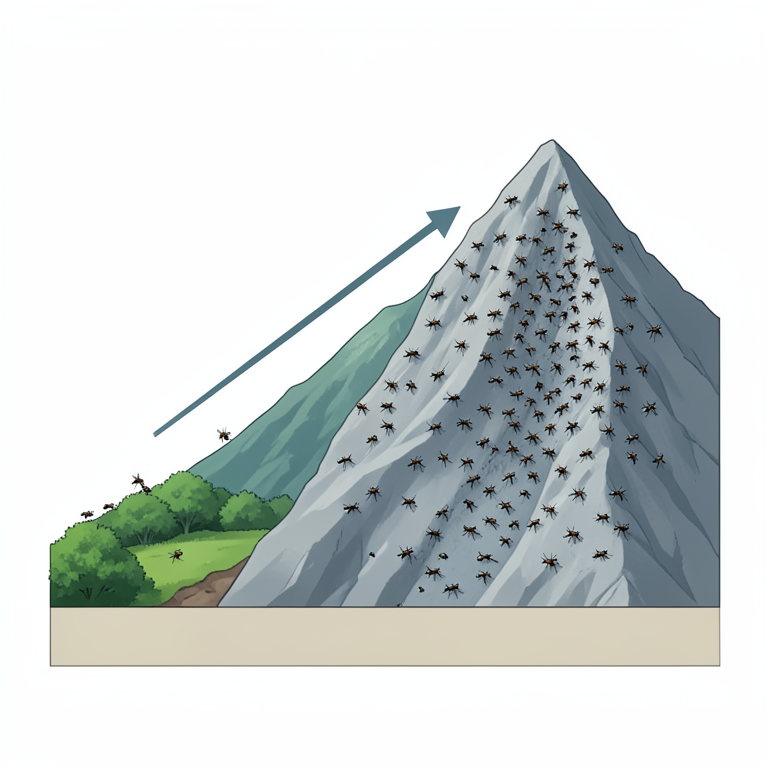
Altitudinal Gradient and Abundance
AI-generated conceptual illustration (Drosophila nepalensis flies on a Himalayan mountain slope). It explains the idea and does not show study data.
View source evidence ↗Introduction
We observe physiological scarcity when the abiotic conditions of an organism's environment become pressurized, reducing fitness to survive, potentially resulting to the loss of populations and even species (Hoffmann and Parsons, 1991) [13] . Due to the changing climate the physiological limits can be seen influencing susceptibility of organisms. Climate change have created numerous insect species to move from one place to another that may ranges to higher latitudes and altitudes (Parmesan et al., 1999; Parmesan and Yohe, 2003; Hill et al., 2011) [19,20,12] . The insects having specific limit of thermal tolerances (Addo-Bediako et al., 2000; Deutsch et al., 2008) [1,6] are seen specifically sensitive to temperature variation. There is a significant loss in the number of Drosophila nepalensis from lower ranges, and climate warming results its range transfer in the Western Himalayas (Singh, 2012; Parkash et al., 2013) [16,23] . Most of the Drosophila species including D. nepalensis could be observe din the western high Himalayas. D. nepalensis was initially investigated from the collections made from Nepal by Okada (Okada, 1955) [26] . Subsequently, Parshad and Paika (1964) [21] informed that the diversity of D. nepalensis (70-80%) could be observed with lower temperature at cooler environment of 16-20 0 c and humidity ~43-45% at Manali, India (2050 m). The species of Drosophila found in this region have desiccation-linked traits with variable quantitative traits resulting in adaptation to harsh climatic conditions in the high Himalayas. Therefore, the contrast that D. nepalensis induces its physioclogial mechanisms affecting the evolving of adaptive capacity in drier climatic conditions was investigated. D. nepalensis might employ phenotypic plasticity as a strategy to cope with colder and drier conditions in temperate regions, but this aspect has not been tested so far. Species distribution and diversity pattern is the reason why insect maintains water balance in their body (Willmer et al., 2000) [25] . Staying and growing in different habitats the e of Drosophila has reflected substantial variation desiccation resistance (Gibbs and Matzkin, 2001; Gibbs et al., 2003) [10,9] . It has been described that insect can incline their desiccation resistance through three different methods of water balance:
1) Higher bulk water 2) Reduced rate of water loss, and 3) Greater dehydration tolerance (Hadley, 1994; Gibbs et al., 1997) [8,11] Laboratory-identified desiccation-resistant strains of D. melanogaster has resulted a 300% growth in hemolymph water content compared with control strains (Folk et al., 2001) [7] . If laboratory selection responses result in increases in the bulk water mass, then it would be potential to compare the water budget of Drosophila species differing in their desiccation resistance levels. Further, water balance related traits have been investigated in Indian populations of D. nepalensis reared at 21°C, but not at 15 and 25°C (Parkash et al., 2012) [18] . Thus, the water balance for D. nepalensis is still unclear with the plasticity for evolving physiological mechanisms. The study in acclimation to desiccation stress has found lesser attention (Hoffmann, 1990, 1991; Bazinet et al., 2010) [13,14,2] . It was decided to investigate the acclimation potentiality of D. nepalensis abundance in Western Himalayas. This study was concerned with the relative abundance of D. nepalensis as a measure of transformation in relative humidity along an altitudinal gradient in the Western Himalayas. The desiccation related traits were evaluated that effect the development of phenotypic plasticity (15° versus 25°C growth temperatures) on desiccation-related traits.
Materials and Methods
Samples of D. nepalensis (100-150) were collected from different parts of high Himalayas during November 2018-January 2019. The study was carried out in the Entomology laboratory of Agriculture and Forestry University, Chitwan, Nepal. The cultures of the insects were based at low density (60-70 eggs per vial; egg vials were 40 × 100 mm in size) with the cornmeal-yeast-agar medium at 15°, 21°, and 25°C and 65±1% relative humidity in a temperature-and humidity-controlled incubator for five generations before experimental analysis. All assays were experimented on 7day-old female flies, as the trait values remain similar as a measure of age between 6 and 21 days (Gibbs and Matzkin, 2001; Parkash et al., 2008) [10] . Required data for climatic variation were obtained from meteorological department, Nepal government. The resistance of desiccation was analyzed as the time to lethal dehydration (LT100) effect at dry air. A week-old flies were placed out and kept individually in dry plastic vials (40 × 100 mm) in which the open end was covered with muslin cloth. These vials were kept on top of another vial containing 2 g of silica gel at the bottom the experiment was maintained at 0-5% relative humidity. The mass of immobile flies was recorded after every one-hour interval, and LT100 values in dry air were analyzed. The total body water content and dehydration tolerance (%) was calculated from 10 flies of each ISO female line (20 I.F lines × 10 replicates each) were used. Firstly, the individual flies were weighed on Sartorius microbalance (Model-CPA26P; 0.001 mg precision) and then reweighed after drying overnight at 60°C. Until death the mild anesthesia (one minute) with solvent ether after flies were weighed on a Sartorius microbalance both before and after desiccation stress. Total body water content (m) was calculated as the difference between wet (f) and dry mass (d), i.e., m = f -d. Individual flies were weighed and placed at 0-5% relative humidity for a specified time at one-hour intervals (1 to 8 h) and reweighed. The rate of water loss was determined from the slope of regression line on a plot of ln (mt / m0) against time according to Wharton's exponential equation (Wharton, 1985) [24] mt = m0e-kt, where mt is the water mass at time t, and m0 is the initial water content. Rate (kt) is the slope of the regression line and was expressed as % per hour.
Results and Discussion
D. nepalensis was found abundant (~43.5%) in highland localities but occurs less frequently in lowland localities (~21%). The highland localities observed with average colder and drier (Tave = 15.2°C; RH = 43.5%), while lowland localities are warm and less desiccating (Tave = 27.6°C; RH = 62.8%). Therefore, significant reduction in Tave (~2°C per 200 m) as well as relative humidity (~3.9% per 200 m) along an elevational gradient may act as selection factors for affecting its relative abundance. Thus, D. nepalensis was regarded appropriately adapted under colder and drier conditions in highland localities. The raise in body melanisation from ~2-fold at 17°C and ~16-fold at 24°C from mid thermal range temperature and we observed constant change in epicuticular mass due to thermal plastic effects (melanisation: p<0.001; epicuticular lipids: 15°C = 22.10±0.37 μg cm-2; 25°C = 22.00±0.27 μg cm-2) in D. nepalensis. We observed ~1.5-fold higher desiccation resistance at 16°C and ~2.5-fold lower desiccation resistance at 26°C from mid thermal range temperature, i.e., 21°. So, we found the plastic responses for desiccation related traits changes in D. nepalensis. Later the application of ten sets of independent experiments to detect he variation in the rate of body water loss in control versus flies exposed to different durations (1 to 9 h) of desiccation stress in D. nepalensis reared at 17°, 22°, and 26°C. We found relative growth of water loss in adult flied reared at 26°C, 22°, and 17 0 c I adult flies. These findings on rate of water loss provide the evidence of greater desiccation resistance of D. nepalensis when grown at 17°C. In a comparative analysis of body mass it was evaluated consistent variation in alter content and body weight studied at multiple measures in D. nepalensis (wet mass: F2, 18 = 253.63; p<0.001; dry mass: F2, 18 = 195.50; p<0.001; body water content: F2, 18 =229.47; p<0.001) when reared at three variable temperatures, i.e., 17°, 22°, and 26°C. Similarly, the content of hemolymph including hemolymph water content have shown ~2.5-fold rise and decrease at 15°C than 25°C, respectively, as compared to 21°C. It was found that there was rise in ~2 fold in tissue water, it was because of the change in temperature that was increased (F2, 18 = 265.94, p<0.001). Even the temperature varied at 170c and 260c the dehydration tolerance did not change significantly as compared with 21°C (F2, 18 = 1.86, ns) It was found that longer survival under the dehydration condition supported by hemolymph, which is a major source for changes in higher level of body in insects (Hadley, 1994; Folk et al., 2001; Chown and Nicolson, 2004; Folk and Bradley, 2005) [11,7,4] . In contrast, numerous studies on wild populations of various Drosophila species have not sensitively studied through the changes in hemolymph content to enhance survival under desiccation stress (Gibbs and Matzkin, 2001; Gibbs et al., 2003; Parkash et al., 2010) [10, 9, 17] . In our study we observed the changes in hemolymph content due to the result of developmental plastic effects (i.e., 17°, 22°, and 26°C). D. nepalensis has shown changes in hemolymph content consistent with their different levels of desiccation resistance potential. Further, most arthropods can tolerate ~30-50% loss of body water, but some taxa adapted to drier habitats have evidenced higher dehydration tolerance (Hadley, 1994; Willmer et al., 2000; Benoit et al., 2005) [11,25,3] . In the present study, we found increased dehydration tolerance at 17°C as compared with 22°C, which is consistent with differences in desiccation resistance. Thus, the evolving of dehydration tolerance regarded as a common physiological mechanism to support survival under desiccation stress in D. nepalensis.
Conclusion
Samples of D. nepalensis (100-150) were collected from different parts of high Himalayas during November 2018-January 2019. The cultures of the insects were based at low density (60-70 eggs per vial; egg vials were 40 × 100 mm in size) with the cornmeal-yeast-agar medium at 15°, 21°, and 25 °C and 65±1% relative humidity in a temperature-and humidity-controlled incubator for five generations before experimental analysis. Required data for climatic variation were obtained from the meteorological department, Nepal government. It was found that dehydration tolerance evolved as a common physiological mechanism to support survival under desiccation stress in D. nepalensis.
Acknowledgement
AcknowledgementsI would like to express my sincere gratitude to my supervisor, Asst. Prof. Suraj Karki for his insightful support, invaluable guidance & supervisions. I always keep in mind the kind support I got from the staff of Agriculture and Forestry University (AFU), Chitwan, Nepal. I think this entire work was impossible without the support of my family. I am indebted to my parents for all kinds of desired support. I am highly thankful to my teammates and colleagues who have consistently supported me during the research and article preparation process. Lastly, I must express my thanks to all known and unknown helping hands from my organization, and all others respected persons. The research was carried without any financial support from external bodies. Both the authors have no conflict of interest.
References
23 in the original paper- Addo-Bediako A, Chown SL, Gaston KJ. Thermal tolerance, climatic variability, and latitude. Proc R Soc Lond. 2000;267:739-745.
- Bazinet AL, Marshall KE, MacMillan HA, Williams CM, Dros BJ, Sinclair BJ. Inf. Serv. 96. J Insect Physiol. 2013;56:2006-2201.
- Benoit JB, Yoder JA, Rellinger EJ, Ark JT, Keeney GD. Growth and development of insects. J Insect Physiol. 2005;51:565-573.
- Chown SL, Nicolson SW. Environmental Physiology of Animals. Oxford: Oxford University Press; 2004.
- Cohen AC, March RB, Pinto JD. Comparative biochemistry and physiology. Comp Biochem Physiol A. 1986;85:743-746.
- Deutsch CA, Tewksbury JJ, Huey RB, Sheldon KS, Ghalambor CK, Haak DC, et al. Impacts of climate warming on terrestrial ectotherms across latitude. Proc Natl Acad Sci U S A. 2008;105(18):6668-6672.
- Folk DG, Han C, Bradley TJ. Regulatory, integrative and comparative physiology. J Exp Biol. 2001;204(1):3323-3331.
- Gibbs AG, Chippindale AK, Rose MR. Physiological mechanisms of evolved desiccation resistance in Drosophila melanogaster. J Exp Biol. 1997;200(12):1821-1832.
- Gibbs AG, Fukuzato F, Matzkin LM. Evolution of water conservation mechanisms in Drosophila. J Exp Biol. 2003;206(7):1183-1192.
- Gibbs AG, Matzkin LM. Evolution of water balance in the genus Drosophila. J Exp Biol. 2001;204:2331-2338.
- Hadley NF. Physical properties of insect cuticular hydrocarbons: The effects of chain length, methylbranching, and unsaturation. Insect Biochem. 1977;7:227-283.
- Hill JK, Griffiths HM, Thomas CD. Climate change and evolutionary adaptations at species' range margins. Annu Rev Entomol. 2001;56:143-159.
- Hoffmann AA. Acclimation for desiccation resistance in Drosophila melanogaster and the association between acclimation responses and genetic variation. J Insect Physiol. 1990;36(11):885-891.
- Hoffmann AA. Acclimation for desiccation resistance in Drosophila: Species and population comparisons. J Insect Physiol. 1991;37(10):757-762.
- Parkash R, Aggarwal D, Ranga P, Singh D. Divergence of water balance mechanisms and acclimation potential in body color morphs of Drosophila ananassae. J Comp Physiol B. 2013;182:751-769.
- Parkash R, Kalra B, Sharma V. Impact of body melanisation on contrasting levels of desiccation resistance in a circumtropical and a generalist Drosophila species. Evol Ecol. 2010;24:207-225.
- Parkash R, Ramniwas S, Kajla B. Cold tolerance of insects and other arthropods. J Asia Pac Entomol. 2012;16:147-153.
- Parmesan C, Ryrholm N, Stefanescu C, Hill JK, Thomas CD, Descimon H, et al. Poleward shifts of species' ranges associated with regional warming. Nature. 1999;399(6736):579-583.
- Parmesan C, Yohe G. A globally coherent fingerprint of climate change impacts across natural systems. Nature. 2003;421:37-42.
- Parshad R, Paika IJ. Resident Bulletin of Punjab University. 1964;15:225-252.
- Rourke BC. Geographic and altitudinal variation in water balance and metabolic rate in a California grasshopper, Melanoplus sanguinipes. J Exp Biol. 2000;203(17):2699-2712.
- Singh S. Ecological conservation and restoration in the Indian Himalaya region. Entomol Stud. 2012;1:100118.
- Okada TS. Experimental Studies on the Differentiation of the Endodermal Organs in Amphibia (III): The Relation between the Differentiation of Pharynx and Head-Mesenchyme. Memoirs of the College of Science, University of Kyoto. Series B. 1955 Dec 20;22(1):1722.