
Research article · 2024 · Full text
International Journal of Veterinary Sciences and Animal HusbandryDiversity of eggs from the parent generation (G0) of Kokok Balenggek Chickens
Volume 9(6) · Pages 641–646 · DOI: 10.22271/veterinary.2024.v9.i6j.1954 ↗
Research areasLivestock and Poultry ManagementAnimal Nutrition and Physiology
Abstract
Author-writtenThis research aims to examine the variability of Kokok Balenggek chicken (KBC) eggs from the parental generation (G0). Six laying cycles yielded a cumulative total of 160 eggs. We employed an observational research approach using purposive sampling. The observed parameters comprise egg weight, egg index, and eggshell color. The employed data analysis is descriptive statistical analysis, involving the calculation of the mean, standard deviation, and coefficient of variation. The research findings indicate that Black hens produced the heaviest eggs (39.73±1.01 g), whereas Lurik hens produced the lightest (36.76±1.53 g). The maximum egg index was observed in Black hens (79.10±1.90%) and the minimum in Jalak hens (75.10±1.59%). The prevailing eggshell color is white. The research concludes that egg weight, egg index, and eggshell color exhibit relative uniformity.
Summary
Source-checkedPlain-language reading of the full paper, prepared with AI and checked against the text. Each point links to the authors' own words.
Why it matters
- Indigenous Kampung chickens are a significant genetic resource in Indonesia that requires conservation efforts. View evidence ↗
- The Kokok Balenggek Chicken (KBC) population has declined due to sales outside their native regions, the emergence of Newcastle disease, and a lack of competitions. View evidence ↗
- Studying the diversity of hatching eggs is considered a key initiative to ensure the long-term sustainability of the KBC breed. View evidence ↗
The question
- The study aims to examine the variability of eggs produced by the parent generation (G0) of Kokok Balenggek chickens. View evidence ↗
What they did
- The researchers analyzed a sample of 160 eggs from KBC hens, categorized into four feather types: White, Black, Barred, and Jalak. View evidence ↗
- The eggs used in the study were collected across six distinct gathering phases. View evidence ↗
- Egg weight, egg index, and eggshell color were measured using a digital scale and calipers. View evidence ↗
- The data were analyzed using descriptive statistics, specifically calculating the mean, standard deviation, and coefficient of variation. View evidence ↗
What they found
- The overall mean egg weight for the Kokok Balenggek chickens was 38.16±4.46 g. View evidence ↗
- The highest average egg index was found in Black hens (79.10±1.90%), and the lowest was in Jalak hens (75.10±1.59%). View evidence ↗
- The overall mean egg index for the KBC eggs was 76.72±4.30%. View evidence ↗
- The most common eggshell color observed in the study was brownish white. View evidence ↗
What it means
- The authors conclude that the egg weight, egg index, and eggshell color of the KBC parent generation are relatively uniform. View evidence ↗
- The findings are intended to provide insights that will assist researchers and the public in the conservation and population enhancement of KBC. View evidence ↗
Visual summary
2 visualsIllustrations explain the paper; charts are replotted from the paper's own table values.
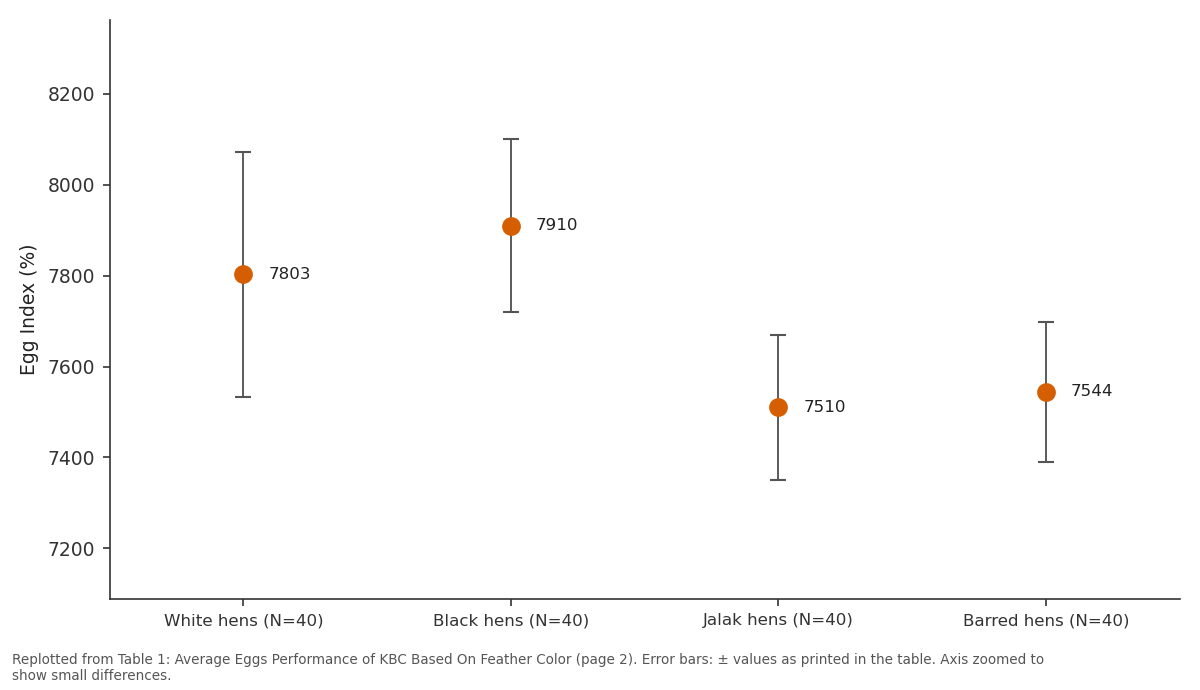
Egg Index (%): White hens (N=40) vs Black hens (N=40) vs Jalak hens (N=40) vs Barred hens (N=40)
Replotted from Table 1 (page 2) of the original paper. Every bar is the paper's own table value.
View source evidence ↗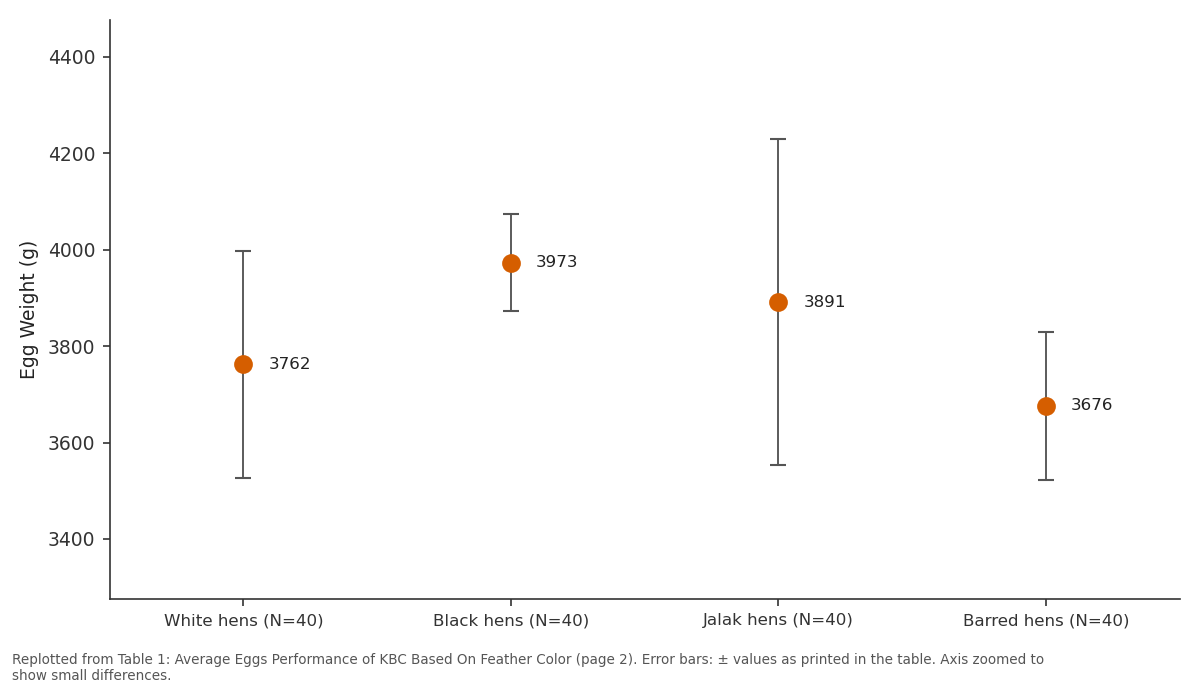
Egg Weight (g): White hens (N=40) vs Black hens (N=40) vs Jalak hens (N=40) vs Barred hens (N=40)
Replotted from Table 1 (page 2) of the original paper. Every bar is the paper's own table value.
View source evidence ↗Figures & tables
From the original paper Table 1
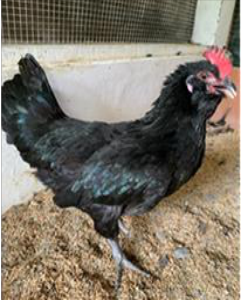 Figure 1
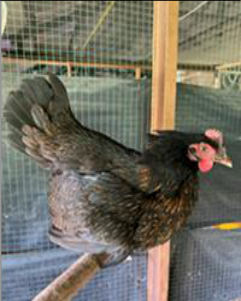 Figure 1
Introduction
Kampung chicken is a local chicken prevalent throughout Indonesian communities. Indigenous chickens represent a genetic resource in poultry that requires conservation. KBC is a native chicken breed from Solok Regency, West Sumatra. Extensive research on KBC has been conducted by various researchers, encompassing investigations into the characteristics of crowing sounds (Rusfidra et al. 2014; Rusfidra and Arlina, 2015; Arlina et al., 2020) [14,15,14,2] , assessments of KBC semen and fertility (Ananda et al., 2024) [1] , the viability of KBC as meat chickens (Husmaini et al., 2023) [5] , analysis of sperm quality in KBC (Ananda et al., 2024) [1] , reproductive dynamics of KBC post-artificial insemination (Jaswandi et al., 2023) [8] . KBC is a progeny of the hybridization between the Red Junglefowl (Gallus gallus) and indigenous chickens from the Central Region. We base this hypothesis on the assumption that only G. gallus lives on the Sumatera Island (Nishida et al., 1982; Fumihito et al., 1994) [12,4] . Weigend and Romanov (2001) [17] assert that G. gallus is the progenitor of all contemporary domestic chicken breeds. KBC encompasses the "singing chicken" variety, characterized by a harmonious, multi-layered crowing sound that is enjoyable to hear (Rusfidra and Arlina, 2015) [14] . The Parent generation (G0) constitutes the inaugural generation of the KBC population, attaining sexual maturity at approximately 6 months of age. The objective of the parent generation (G0) is to augment and sustain the KBC population for five to six generations. Eggs are a compilation of nutrients supplied by avian parents for embryonic development into a chick. Eggs consist of three primary components: the eggshell (11%), egg white (57%), and egg yolk (32%). The preservation of KBC is imperative due to the declining numbers in central population centers, as many KBC are being sold outside these regions. Even KBCs with prolonged crowing noises (many syllables) are hardly encountered in their native habitat in Tigo Lurah District, Solok Regency. Furthermore, the KBC population has significantly diminished owing to the emergence of Newcastle disease and the absence of KBC competitions. In light of these circumstances, we must implement measures to conserve the KBC and prevent its extinction. One initiative to ensure the sustainability of KBC is focusing on the diversity of its hatching eggs.
The diversity of eggs is crucial for livestock preservation initiatives, since comprehending this variation aids in the selection of superior breeds and the effective preservation of KBC. Selection may be conducted according to factors including egg weight, egg index, and eggshell pigmentation. This research aims to assess the diversity of KBC eggs. This study's findings aim to furnish researchers and the public with insights into the diversity of KBC eggs, hence aiding in population enhancement and conservation efforts for KBC.
Materials and Methods
This study used a sample of 160 eggs from KBC hens categorized by distinct feather types: White, Black, Barred, and Jalak hens. The male-to-female ratio is 1:5. Eggs were gathered during six distinct phases of collecting KBC eggs. The instruments employed were calipers and a digital scale. A pan mating system of KBC house. Figure 1 illustrates four varieties of female hens utilized as breeders. This research utilizes an observational approach through purposive sampling. The assessed factors include egg weight, egg index, and eggshell color. We determine the weight of the eggs by using a digital scale for measurement. The egg index is the ratio of the width diameter to the length diameter of the egg. Direct observation can determine the eggshell's color. We employ descriptive statistical analysis, which involves calculating the mean, standard deviation, and coefficient of variation (Steel and Torrie, 1991) [16] . Kurnianto (2009) [10] classifies the coefficient of variation as follows: low (< 5%), moderate (6-14%), and high (> 15%).
Results and Discussion
Egg diversity is crucial for livestock preservation, as comprehending this diversity aids in selecting superior breeds and effectively conserving KBC. Table 1 presents the mean, standard deviation, and coefficient of variation of the eggs from the Kokok Balenggek chicken generation (G0) categorized by feather color.
| No. | KBC Strains | Egg Weight (g) | Egg Width (cm) | Egg Length (cm) | Egg Index (%) |
|---|---|---|---|---|---|
| 1. | White hens (N=40) | 37,62±2,35 | 3,73±0,07 | 4,80±0,12 | 78,03±2,70 |
| 2. | Black hens (N=40) | 39,73±1,01 | 3,80±0,03 | 4,81±0,11 | 79,10±1,90 |
| 3. | Jalak hens (N=40) | 38,91±3,38 | 3,70±0,10 | 4,93±0,06 | 75,10±1,59 |
| 4. | Barred hens (N=40) | 36,76±1,53 | 3,66±0,07 | 4,87±0,08 | 75,44±1,54 |
Table text extracted from the original PDF; superscript letters are shown inline. The original table image is below.
View original table image
Weight of Eggs
The mean egg weight of KBC is 38.16±4.46 g. Black hens generate the highest average egg weight (39.73±1.01 g), while Lurik hens produce the lowest average egg weight (36.76±1.53 g). The Indonesian National Standard (SNI) states that an optimal egg weight ranges from 36 to 45 grams, indicating that the egg weights obtained from this investigation are satisfactory. Jull (1951) asserts that several genes that affect egg size pass on egg weight from progenitors to their descendants. The research findings are inferior to those of Irawan (2017) [7] , which reported an average weight of KBC eggs at 39.79±2.81 g.
Egg Index
The egg index is the ratio of the egg's width diameter to its length diameter. The maximum average egg width was observed in Black hens (3.80±0.03 cm) and the minimum in Lurik hens (3.66±0.07 cm). The maximum average egg length was observed in Jalak hens (4.93±0.06 cm), while the minimum was recorded in White hens (4.8±0.12 cm). The greatest average egg index was seen in Black hens (79.10±1.90%), while the lowest was recorded in Jalak hens (75.10±1.59%). The research findings indicate that the mean KBC egg index is 76.72±4.30%. The average KBC egg index surpasses the egg index documented by Asifa et al. (2020) [3] for Kampung chickens in Tongkuno District, which was 75.99±5.58%. In comparison to Irawan (2017) [7] research, which reported an average egg index of 76.19±2.10%. Murtidjo (1992) [11] asserted that an optimal egg index falls between 70% and 79%. A greater egg index value signifies a more rounded egg, whereas an elongated egg possesses a diminished egg index. States that the standard range for the egg index is 70 to 74%.
Eggshell Color
The predominant eggshell color in the study is brownish white. In comparison to the findings of Asifa et al. (2020) [3] , village chicken eggs in the Tongkuno and Tongkuno Selatan Districts exhibit three shell colors: white, brown, and cream. Romanoff and Romanoff (1963) categorize chicken eggshell colors into two primary hues: white and brown. Each chicken's genetic makeup determines the variations in hue.
Acknowledgement
Acknowledgment This research was funded by LPPM Universitas Andalas dengan Skema Penelitian Jalur Unggulan Kepakaran sesuai SK. No. 93/UN16.19/KPT/PT.01.00/2024 Tanggal 15 Juli 2024 dan Surat Kontrak Tanggal 17 Juli 2024. No. 370/UN16.19/PT.01.03/PUJK/2024.
References
17 in the original paper- Ananda J, Rusfidra, Anggraini L, Arlina F. Sperm quality and daily fecal testosterone among six phenotypes of Kokok Balenggek rooster. Int J Vet Sci. 2024;13(4):527536.
- Arlina F, Rusfidra, Andriano D, Sumatri C. The type and sound diversity of Kukuak Balenggek chicken (Gallus gallus domesticus) reared in West Sumatra, Indonesia. Biodiversitas. 2020;21(5):1914-9.
- Asifa Y, Nafiu LO, Indi A. Karakteristik telur ayam kampung pada pemeliharaan tradisional di Kecamatan Tongkuno dan Tongkuno Selatan. J Ilm Peternakan Halu Oleo. 2020;2(3):291-299.
- Fumihito A, Miyake T, Sumi S, Takada M, Ohno S. One subspecies of the red jungle fowls (Gallus gallus gallus) suffices as the matriarcheic ancestor of all domestic breeds. Proc Natl Acad Sci USA. 1994;91:12505-9.
- Husmaini, Suhartati L, Rusfidra. Qualitative and quantitative characteristics of G0 Kokok Balenggek chicken: the formation of superior local meat-type chicken. Int J Vet Sci. 2023;12(4):554-8. DOI: 10.47278/journal.ijvs/2023.001.
- Hutt FB. Genetics of the fowl. 1949. New York: McGraw-Hill Book Co. Inc.
- Irawan S. Identifikasi kualitas telur ayam Kokok Balenggek di UPT Fakultas Peternakan Universitas Andalas. [Skripsi], 2017. Padang: Fakultas Peternakan Universitas Andalas.
- Jaswandi A, Ananda, Rusfidra, Subekti K, Gusdinal H, Wahyuni RZ, et al. Fertility rate, fertility period, and doc sex ratio of Kokok Balenggek chicken after artificial insemination. Anim Vet Sci. 2023;11(5):795-801. DOI: http://dx.doi.org/10.17582/journal.aavs/2023/11.5.795.80 1.
- Jull MA. Poultry breeding. 1 st Ed, New York: McGrawHill Book Company, 1951.
- Kurnianto E. Ilmu pemuliaan ternak, Yogyakarta: Graha Ilmu, 2009.
- Murtidjo BA. Mengelola ayam buras, Yogyakarta: Penerbit Kanisius, 1992.
- Nishida T, Hayashi Y, Hashiguchi T, Mansjoer SS. Distribution and identification of jungle fowl in Indonesia: the origin and phylogeny of Indonesian native livestock (Part III). 1982;85-95.
- Romanoff AI, Romanoff AJ. The avian egg. 1963. New York: John Wiley and Sons, Inc.
- Rusfidra, Arlina F. A review of "long crower chickens" as poultry genetic resources in Indonesia. Int J Poultry Sci. 2015;13(11):665-9. DOI: 10.3923/ijps.2014.665.669.
- Rusfidra, Tumatra YY, Abbas MH, Heryandi Y, Arlina F. Characterization of number of crow and qualitative marker of Kokok Balenggek song fowl inside a captive breeding farm in Solok Regency, West Sumatera Province, Indonesia. Int J Poultry Sci. 2014;13(6):343346. DOI: 10.3923/ijps.2014.343.346.
- Steel RGD, Torrie JH. Prinsip dan prosedur statistika: suatu pendekatan biometrik. (Terjemahan: Bambang Sumantri), Jakarta: Gramedia, 1991.
- Weigend S, Romanov MN. Current strategies for assessment and evaluation of genetic diversity in chicken resources. World Poultry Sci J. 2001;57:275-288.