
Research article · 2024 · Full text
International Journal of Agriculture and Food ScienceA geographical study of agriculture productivity analysis in Chhatrapati Sambhajinagar district using Sapre and Deshpande methods
Volume 6(2) · Pages 194–198 · DOI: 10.33545/2664844x.2024.v6.i2c.227 ↗
Research areasAgricultural Economics and PracticesAgricultural risk and resilience
Abstract
Author-writtenThe basis of India's economy, agriculture is vital to revenue production, food security, and economic expansion. This research uses Sapre and Deshpande's Weighted Average Index for 2021–2022 to assess agricultural production throughout the tehsils of Chhatrapati Sambhajinagar District. Tehsils are categorized into high, moderate, and low productivity zones based on index values, revealing notable differences in productivity. to evaluate the levels of agricultural production, spot regional differences, and emphasize the main crops that influence output in various tehsils. Sillod and Phulambri are high productivity zones (index below 3.51), which are bolstered by effective production of oilseeds, pulses, wheat, and maize. With balanced crop diversification, Soegaon, Vaijapur, Kannad, and Khuldabad exhibit moderate production (3.52–4.74). In Gangapur, Chhatrapati Sambhajinagar, and Paithan, low productivity zones (over 4.74) draw attention to resource constraints and less-than-ideal methods. The results serve as a foundation for resource optimization and focused agricultural planning aimed at increasing output.
Summary
Source-checkedPlain-language reading of the full paper, prepared with AI and checked against the text. Each point links to the authors' own words.
Why it matters
- Agriculture is fundamental to India's economy, playing a critical role in food security, economic growth, and revenue generation. View evidence ↗
- Agriculture serves as the primary source of income for approximately 60% of the Indian population. View evidence ↗
- Agricultural efficiency is used to evaluate land fertility, capacity, and production per unit of land. View evidence ↗
The question
- The study aims to assess agricultural productivity levels and identify which crops contribute most to that productivity. View evidence ↗
What they did
- The research analyzed nine main crops in the Chhatrapati Sambhajinagar district for the 2021–2022 period. View evidence ↗
- Data was gathered from secondary sources, including the Chhatrapati Sambhajinagar District Handbook and the Department of Economics and Statistics. View evidence ↗
- The study used the Sapre and Deshpande Weighted Average Index to categorize tehsils into high, moderate, and low productivity zones. View evidence ↗
What they found
- Sillod (index 3.20) and Phulambri (index 3.51) were identified as high productivity zones, defined as having an index below 3.51. View evidence ↗
- In the high-productivity Sillod tehsil, the primary contributors to output are pulses, oilseeds, maize, and wheat. View evidence ↗
- Moderate productivity (index 3.52 to 4.74) was found in Soegaon (4.74), Khuldabad (4.33), Vaijapur (4.27), and Kannad (3.70). View evidence ↗
- Low productivity zones (index above 4.74) include Paithan (5.28), Chhatrapati Sambhajinagar (4.94), and Gangapur (4.85). View evidence ↗
What it means
- The authors conclude that low-productivity tehsils require targeted interventions to address resource scarcity and inadequate irrigation. View evidence ↗
- The authors recommend customized agricultural policies and infrastructural development to ensure sustainable and equitable growth across the district. View evidence ↗
Visual summary
2 visualsIllustrations explain the paper; charts are replotted from the paper's own table values.
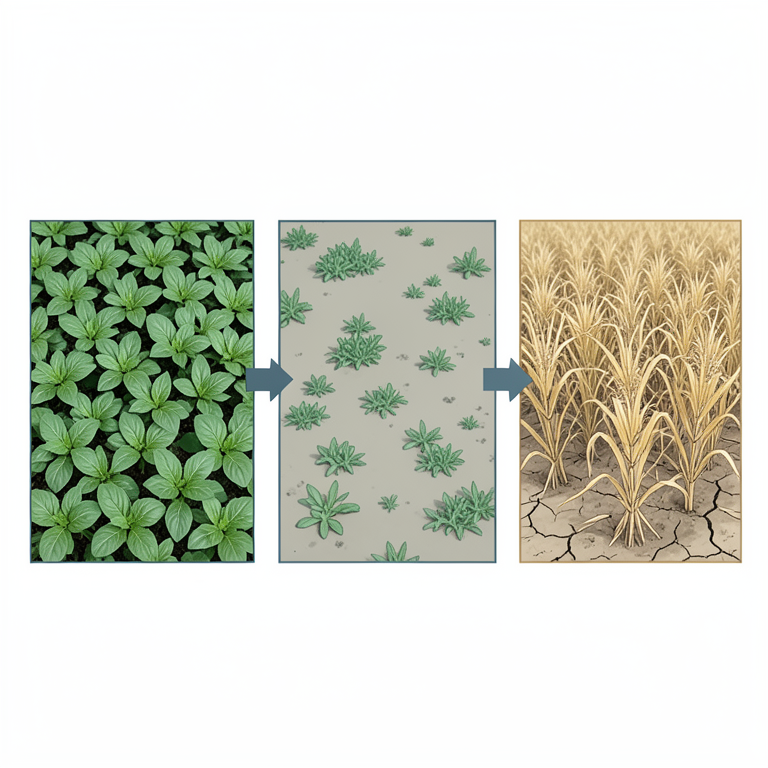
Productivity Zonation
AI-generated conceptual illustration (Agricultural landscapes of the Chhatrapati Sambhajinagar district). It explains the idea and does not show study data.
View source evidence ↗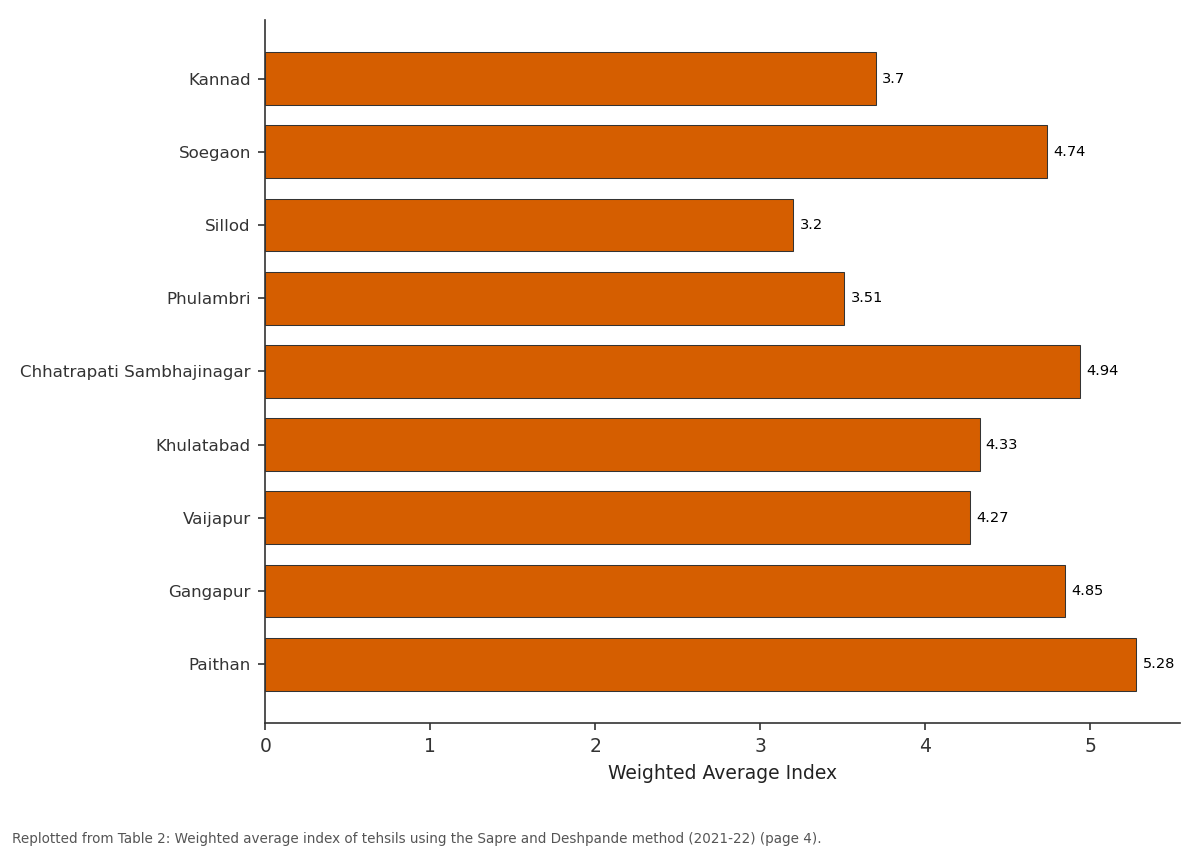
Weighted Average Index: Kannad vs Soegaon vs Sillod vs Phulambri vs Chhatrapati...
Replotted from Table 2 (page 4) of the original paper. Every bar is the paper's own table value.
View source evidence ↗Figures & tables
From the original paper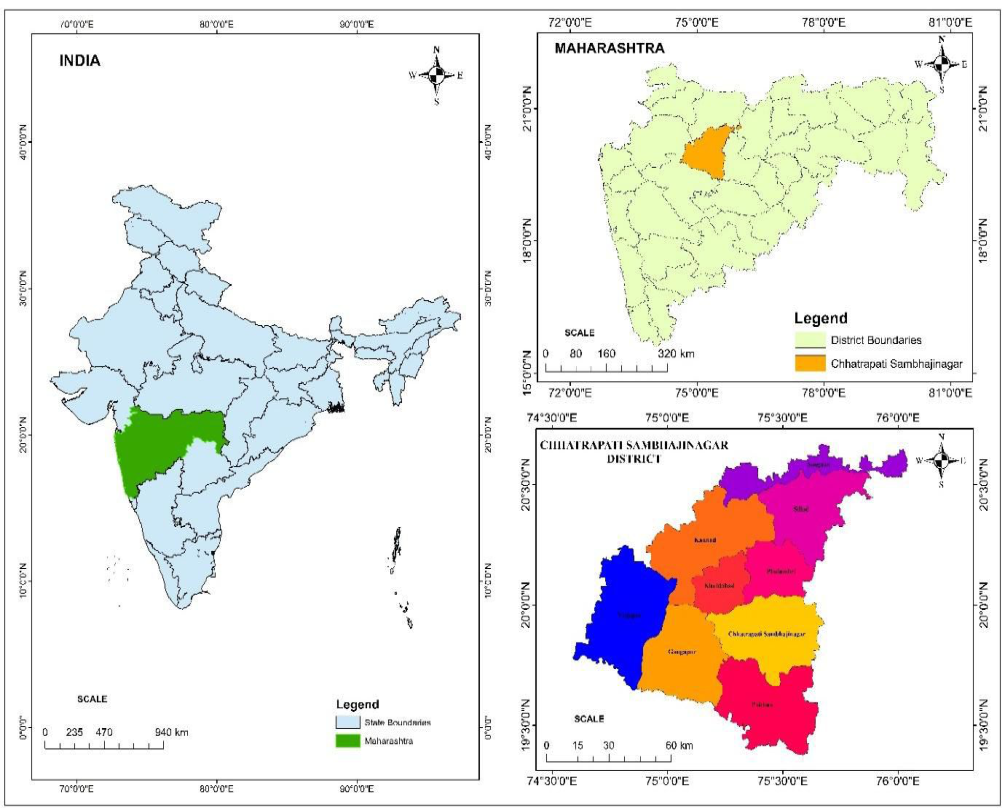 Figure 1
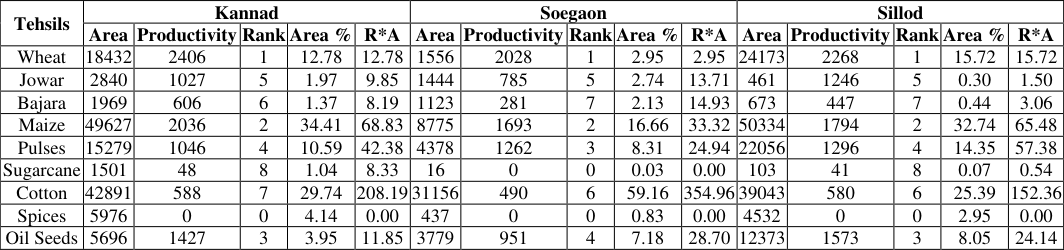 Table 1
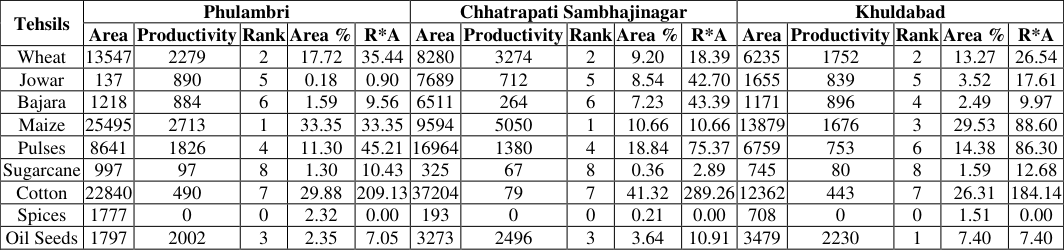 Table 1
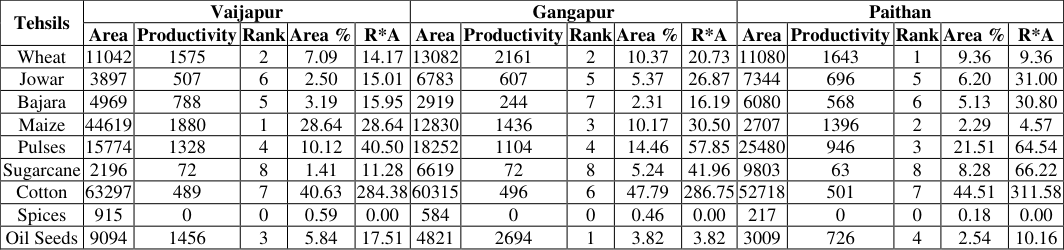 Table 1
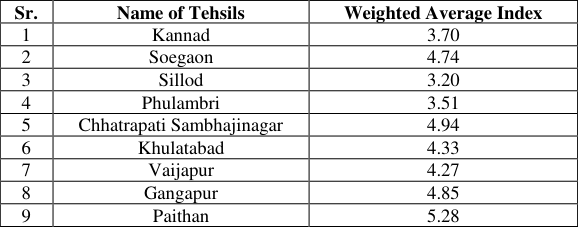 Table 2
 Table 3
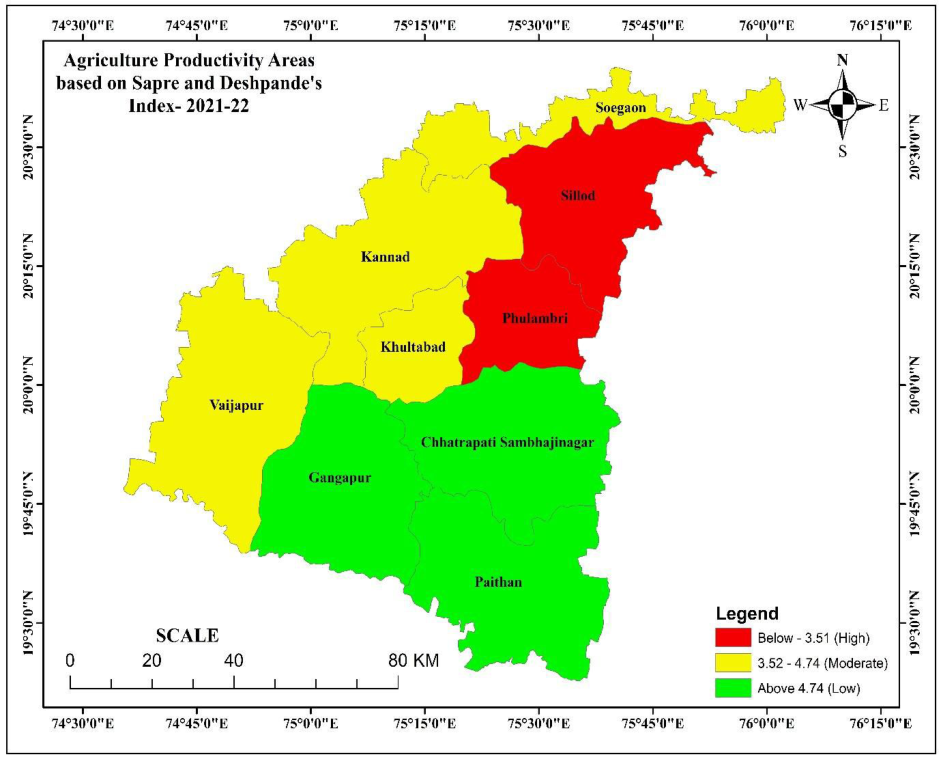 Figure 2
Introduction
The primary occupation of Indians, practiced across the Indian states, is agriculture, which is regarded as the foundation of our economy. Both the evolution of our civilization and the shift in socioeconomic level may be attributed to agriculture. Agriculture is a dynamic activity that is influenced by a variety of meteorological conditions, technical inputs, and socioeconomic infrastructure, which leads to its diversity. There are several techniques to gauge agricultural progress. One of the most crucial agronomic concepts to comprehend during the entire agricultural growth process is agricultural efficiency. In addition to being a source of food, agriculture is the main source of income for 60% of Indians. Food and nutrition security, health, and the elimination of poverty are all directly impacted by agricultural development, which also has several indirect consequences on the economy as a whole. Agriculture is biggest sector and provides substantial portion GDP of India. Crops and agricultural methods have changed significantly as the agriculture industry has grown. The results of farming are the output of agriculture. The agricultural efficiency evaluates the production of a certain unit of land. It examines the land's capacity, production, and fertility. Verifying future plans for the usage of agricultural land is beneficial. Agricultural efficiency is caused by a variety of factors. In the research area, the agricultural production of several crops is fluctuating. The research emphasizes crop yield and efficiency in agriculture. relation to input or output-input ratio. According to Sapre-Deshpande (1964) [14] and Bhatia (1967) [2] , productivity is determined by allocating weight to the ranking order of output per unit area with the percentage share under each crop. Buck (1967) [20] used his method to calculate Uttar Pradesh's agricultural efficiency. Furrow irrigation is widely used because it may be applied to a wide range of soil types and land slopes, according to Cantor's (1967) [21] research. Both big and tiny streams of irrigated water may be used with it. According to Singh (1975) [22] , land in emerging nations is too small to support any growth in the cultivated area, and the growing population strain on available land forces geographers and agricultural scientists to consider ways to increase agricultural productivity. Hussain (1976) [23] calculated the productivity value per unit area in monetary terms. The correlated yield and concentration index ranking coefficient approach, developed by Jasbir Singh in 1976 [24] , is used; it assigns appropriate weight to the per hectare yield area occupied and the ranking of the many crops he also researched. Murthy (1976) [25] asserts that irrigation, a fundamental input on the majority of our nation's farmed land, has been essential in increasing food production since other inputs, like as fertilizers, better seeds, etc., only give their fair share when a reliable supply of water is available.
Objective 1) To Assess the agriculture productivity levels 2) To identify crop contributions to productivity.
Study area
With the exception of a tiny area in the north and northwest that is under the Tapi drainage system, the majority of Aurangabad District, which is in the state's central elevated region, is located inside the Godavari Basin. In the southern part of the district, the Godavari River and its tributaries define the area. Latitudes 19°17'N to 20°40'N and longitudes 74°39'E to 76°40'E are its geographic coordinates. The districts of Jalgaon to the north, Jalna to the east, Ahmednagar to the south and southwest, and Nashik to the west enclose it. It also has smaller borders with Buldhana district in the northeast and Beed district in the south. With a total size of 10,100 square kilometers, the district makes up 3.28 percent of Maharashtra. Just 1.40% of this is urban, with the rest 98.60% being rural. The population of Aurangabad district, as reported in the 2011 Census, is 3,695,928, which is equivalent to the population of Liberia. It is ranked 72nd out of 640 districts in India. The district's population increased by
Materials and Methods
Evaluating the district's agricultural output index for the years 2021-2022 is the main goal of this study. Nine of the main crops grown in the area were specifically selected for in-depth examination in order to accomplish this goal. Secondary sources provided the information used in this study. The Department of Economics and Statistics, the Chhatrapati Sambhajinagar District Handbook, and the district's socioeconomic overview were the specific sources of the data required for the research. These resources provide in-depth analyses of the productivity and agricultural performance of the chosen crops, guaranteeing a strong basis for the research. This method seeks to provide a precise evaluation of the district's agricultural production over the given time frame. In 1964, V.D. Deshpande and S.G. Sapre proposed a minor modification to Kendall's "ranking coefficient" approach. Instead of using the "simple average of ranks," "weighted average rankings" were used. The weighted rankings of the various crops show the proportion of cropland dedicated to each crop. The formula used to calculate the productivity index can look like this: Weighted average of ranks = ∑(𝑅 ×𝐴 )+ ∑ 𝐴 Whereas, R = Ranking of yield of individual crops A = Crop land share in %
Results and Discussion
This research uses the Sapre and Deshpande approach to assess agricultural crop productivity for 2021-2022 across different tehsils in the region. Key crops including wheat, maize, legumes, and cotton are taken into account, along with crop acreage, production, and ranking across tehsils. Tehsils are categorized into high, moderate, and low production levels using a Weighted Average Index, which offers information on the performance of the local agricultural sector.
High productivity areas
Sapre and Deshpande's Weighted Average Index offers a thorough evaluation of agricultural productivity in the Chhatrapati Sambhajinagar District. The importance of agriculture is highlighted by the fact that the district's net sown area makes up 23.87% to 22.22% of its entire geographic area. A number below 3.51 is classified as high productivity according to the measure. Sillod (3.20) and Phulambri (3.51), two of the tehsils with the highest levels of production, are notable for their efficient use of resources and agricultural practices. Wheat, maize, oilseeds, and pulses are the main crops in Sillod tehsil that contribute to this high level of production. A strong yield is guaranteed by these crops' suitable climate and sufficient soil fertility. The main crops grown in Phulambri tehsil are oilseeds, wheat, and maize.
Moderate productivity areas
The net sown area of Chhatrapati Sambhajinagar District accounts for 41.43% to 44.44% of the total area, according to Sapre and Deshpande's Weighted Average Index, which measures agricultural production in the district. A balanced agricultural production with room for improvement is indicated by moderate productivity numbers, which fall between 3.52 and 4.74. This group of tehsils includes Soegaon (4.74), Vaijapur (4.27), Kannad (3.70), and Khuldabad (4.33). Thanks to ideal climate and diverse crop production, these tehsils demonstrate consistent agricultural success. The main sources of agricultural output in Kannad tehsil include oilseeds, bajra, pulses, wheat, and maize. Similar trends can be seen in Vaijapur tehsil, where the mainstays of the agricultural sector are wheat, maize, oilseeds, bajra, and pulses.
Low productivity areas
Despite making up a sizable portion of the net sown area 34.69% and 33.33% of the district's total area, respectively areas with agricultural productivity values above 4.74 are categorized as having low productivity levels according to Sapre and Deshpande's Weighted Average Index. Gangapur (4.85), Chhatrapati Sambhajinagar (4.94), and Paithan tehsils (5.28), are included in this group. These poor production levels point to underlying issues that restrict output, such a lack of resources, inadequate irrigation, or less-than-ideal farming methods. The main crops of Gangapur tehsil that contribute to output are pulses, oilseeds, wheat, and maize. The main crops grown in Chhatrapati Sambhajinagar tehsil are pulses, oilseeds, wheat, and maize. The same group of crops, including oilseeds, pulses, maize, and wheat in the Paithan Tehsil.
Conclusion
The research identifies notable differences in agricultural output among the Chhatrapati Sambhajinagar District's tehsils, which are divided into zones of high, moderate, and poor productivity. Tehsils with high levels of production, such as Sillod and Phulambri, demonstrate effective farming methods and ideal circumstances that may be used as templates for other regions. Tehsils with moderate production show steady performance, although there is potential for development with better resource management and contemporary methods. Targeted interventions are necessary since the low productivity tehsils continue to confront issues like insufficient irrigation and scarce resources. For growth to be fair and sustainable, these inequities must be addressed through infrastructural development and customized agriculture policy. In the end, raising productivity in regions that aren't functioning well can boost the district's total agricultural production and financial stability.
Figures and tables from the paper
| Tehsils | Kannad | — | — | — | — | Soegaon | — | — | — | — | Sillod | — | — | — | — |
|---|---|---|---|---|---|---|---|---|---|---|---|---|---|---|---|
| Area | Productivity | Rank | Area % | R*A | Area | Productivity | Rank | Area % | R*A | Area | Productivity | Rank | Area % | R*A | |
| Wheat | 18432 | 2406 | 1 | 12.78 | 12.78 | 1556 | 2028 | 1 | 2.95 | 2.95 | 24173 | 2268 | 1 | 15.72 | 15.72 |
| Jowar | 2840 | 1027 | 5 | 1.97 | 9.85 | 1444 | 785 | 5 | 2.74 | 13.71 | 461 | 1246 | 5 | 0.30 | 1.50 |
| Bajara | 1969 | 606 | 6 | 1.37 | 8.19 | 1123 | 281 | 7 | 2.13 | 14.93 | 673 | 447 | 7 | 0.44 | 3.06 |
| Maize | 49627 | 2036 | 2 | 34.41 | 68.83 | 8775 | 1693 | 2 | 16.66 | 33.32 | 50334 | 1794 | 2 | 32.74 | 65.48 |
| Pulses | 15279 | 1046 | 4 | 10.59 | 42.38 | 4378 | 1262 | 3 | 8.31 | 24.94 | 22056 | 1296 | 4 | 14.35 | 57.38 |
| Sugarcane | 1501 | 48 | 8 | 1.04 | 8.33 | 16 | 0 | 0 | 0.03 | 0.00 | 103 | 41 | 8 | 0.07 | 0.54 |
| Cotton | 42891 | 588 | 7 | 29.74 | 208.19 | 31156 | 490 | 6 | 59.16 | 354.96 | 39043 | 580 | 6 | 25.39 | 152.36 |
| Spices | 5976 | 0 | 0 | 4.14 | 0.00 | 437 | 0 | 0 | 0.83 | 0.00 | 4532 | 0 | 0 | 2.95 | 0.00 |
| Oil Seeds | 5696 | 1427 | 3 | 3.95 | 11.85 | 3779 | 951 | 4 | 7.18 | 28.70 | 12373 | 1573 | 3 | 8.05 | 24.14 |
Table text extracted from the original PDF; superscript letters are shown inline. The original table image is below.
View original table image
| Tehsils | Phulambri | — | — | — | — | Chhatrapati Sambhajinagar | — | — | — | — | Khuldabad | — | — | — | — |
|---|---|---|---|---|---|---|---|---|---|---|---|---|---|---|---|
| Area | Productivity | Rank | Area % | R*A | Area | Productivity | Rank | Area % | R*A | Area | Productivity | Rank | Area % | R*A | |
| Wheat | 13547 | 2279 | 2 | 17.72 | 35.44 | 8280 | 3274 | 2 | 9.20 | 18.39 | 6235 | 1752 | 2 | 13.27 | 26.54 |
| Jowar | 137 | 890 | 5 | 0.18 | 0.90 | 7689 | 712 | 5 | 8.54 | 42.70 | 1655 | 839 | 5 | 3.52 | 17.61 |
| Bajara | 1218 | 884 | 6 | 1.59 | 9.56 | 6511 | 264 | 6 | 7.23 | 43.39 | 1171 | 896 | 4 | 2.49 | 9.97 |
| Maize | 25495 | 2713 | 1 | 33.35 | 33.35 | 9594 | 5050 | 1 | 10.66 | 10.66 | 13879 | 1676 | 3 | 29.53 | 88.60 |
| Pulses | 8641 | 1826 | 4 | 11.30 | 45.21 | 16964 | 1380 | 4 | 18.84 | 75.37 | 6759 | 753 | 6 | 14.38 | 86.30 |
| Sugarcane | 997 | 97 | 8 | 1.30 | 10.43 | 325 | 67 | 8 | 0.36 | 2.89 | 745 | 80 | 8 | 1.59 | 12.68 |
| Cotton | 22840 | 490 | 7 | 29.88 | 209.13 | 37204 | 79 | 7 | 41.32 | 289.26 | 12362 | 443 | 7 | 26.31 | 184.14 |
| Spices | 1777 | 0 | 0 | 2.32 | 0.00 | 193 | 0 | 0 | 0.21 | 0.00 | 708 | 0 | 0 | 1.51 | 0.00 |
| Oil Seeds | 1797 | 2002 | 3 | 2.35 | 7.05 | 3273 | 2496 | 3 | 3.64 | 10.91 | 3479 | 2230 | 1 | 7.40 | 7.40 |
Table text extracted from the original PDF; superscript letters are shown inline. The original table image is below.
View original table image
| Tehsils | Vaijapur | — | — | — | — | Gangapur | — | — | — | — | Paithan | — | — | — | — |
|---|---|---|---|---|---|---|---|---|---|---|---|---|---|---|---|
| Area | Productivity | Rank | Area % | R*A | Area | Productivity | Rank | Area % | R*A | Area | Productivity | Rank | Area % | R*A | |
| Wheat | 11042 | 1575 | 2 | 7.09 | 14.17 | 13082 | 2161 | 2 | 10.37 | 20.73 | 11080 | 1643 | 1 | 9.36 | 9.36 |
| Jowar | 3897 | 507 | 6 | 2.50 | 15.01 | 6783 | 607 | 5 | 5.37 | 26.87 | 7344 | 696 | 5 | 6.20 | 31.00 |
| Bajara | 4969 | 788 | 5 | 3.19 | 15.95 | 2919 | 244 | 7 | 2.31 | 16.19 | 6080 | 568 | 6 | 5.13 | 30.80 |
| Maize | 44619 | 1880 | 1 | 28.64 | 28.64 | 12830 | 1436 | 3 | 10.17 | 30.50 | 2707 | 1396 | 2 | 2.29 | 4.57 |
| Pulses | 15774 | 1328 | 4 | 10.12 | 40.50 | 18252 | 1104 | 4 | 14.46 | 57.85 | 25480 | 946 | 3 | 21.51 | 64.54 |
| Sugarcane | 2196 | 72 | 8 | 1.41 | 11.28 | 6619 | 72 | 8 | 5.24 | 41.96 | 9803 | 63 | 8 | 8.28 | 66.22 |
| Cotton | 63297 | 489 | 7 | 40.63 | 284.38 | 60315 | 496 | 6 | 47.79 | 286.75 | 52718 | 501 | 7 | 44.51 | 311.58 |
| Spices | 915 | 0 | 0 | 0.59 | 0.00 | 584 | 0 | 0 | 0.46 | 0.00 | 217 | 0 | 0 | 0.18 | 0.00 |
| Oil Seeds | 9094 | 1456 | 3 | 5.84 | 17.51 | 4821 | 2694 | 1 | 3.82 | 3.82 | 3009 | 726 | 4 | 2.54 | 10.16 |
Table text extracted from the original PDF; superscript letters are shown inline. The original table image is below.
View original table image
| Sr. | Name of Tehsils | Weighted Average Index |
|---|---|---|
| 1 | Kannad | 3.70 |
| 2 | Soegaon | 4.74 |
| 3 | Sillod | 3.20 |
| 4 | Phulambri | 3.51 |
| 5 | Chhatrapati Sambhajinagar | 4.94 |
| 6 | Khulatabad | 4.33 |
| 7 | Vaijapur | 4.27 |
| 8 | Gangapur | 4.85 |
| 9 | Paithan | 5.28 |
Table text extracted from the original PDF; superscript letters are shown inline. The original table image is below.
View original table image
| Sr. No. | Index value | Level of productivity | No. of tehsils | Tehsils | % of Area |
|---|---|---|---|---|---|
| 1 | Below 3.51 | High | 2 | Sillod, Phulambri | 22.22 |
| 2 | 3.51 to 4.74 | Moderate | 4 | Kannad, Vaijapur, Khuldabad, Soegaon | 44.44 |
| 3 | Above 4.74 | Low | 3 | Gangapur, Chh. Sambhajinagar, Paithan | 33.33 |
Table text extracted from the original PDF; superscript letters are shown inline. The original table image is below.
View original table image
References
25 in the original paper- Akhtar N. Agricultural productivity and productivity region in West Bengal. The NEHU Journal. 2015;XIII(2):45-61.
- Bhatia SS. A new approach to measure agricultural efficiency in Uttar Pradesh. Economic Geography. 1967;43:224-260.
- Bravo BE, et al. Efficiency in agricultural production: The case of peasant farmers in East Paraguay. Agricultural Economics. 1993;10:27-37.
- Dey CK, Mistri T. Changing trends of agricultural efficiency (Ei) in Purba Bardhaman District, West Bengal, India. JETIR. 2018;5(6):1-8.
- Chaskar KS, Lai S, Calla O, Mohave SH. Agricultural efficiency of Vidarbha Region (Maharashtra). The National Geographical Journal of India. 1987;33:154159.
- Chatterjee A, Maitry P. Some aspects of regional variation in agricultural productivity and development in West Bengal. Indian Journal of Agricultural Economics. 1964;19(1):207-212.
- Christensen LR. American Journal of Agricultural Economics. 1975;57(5):910-915.
- Darku AB, et al. Sources and measurement of agricultural productivity and efficiency in Canadian provinces: crops and livestock. Canadian Journal of Agricultural Economics. 2015 Feb 28;63(1):1-22.
- Husain M. Systematic agricultural geography. Jaipur: Rawat Publications; 2015.
- Kendall MG. The geographical distribution of crop productivity in England. Journal of the Royal Statistical Society. 1939;CII:21-48.
- Peterson JC, K. Bengal District Gazetteers. Calcutta: Government of West Bengal; 1997.
- Shafi M. Measurement of agricultural efficiency in Uttar Pradesh. Economic Geography. 1960;36:296-305.
- Rehman H. Energy use in agricultural productivity. New Delhi: Concept Publishing Company; 2003, p. 3841.
- Sapre SG, Deshpande VD. Interdistrict variation in agricultural efficiency in Maharashtra State. Indian Journal of Agricultural Economics. 1964;19(1):242252.
- Sharma RP. Spatial characteristics of land use and its efficiency: A case study of Chhattisgarh region. National Geographer. 1978;XIII(1):1-8.
- Singh S, Chauhan VS. Measurement of agricultural productivity: A case study of Uttar Pradesh, India. Geographical Review of India. 1977;39(3):222-231.
- Stamp LD. The measurement of agricultural efficiency with special reference to India. Silver Jubilee Volume, Indian Geographical Society. 1952;177-178.
- Siddiqui SH. Pattern of agricultural productivity in Bihar. The Geographer. 1999;46(1):107-117.
- Khusro AM. Returns to scale in Indian agriculture. Indian Journal of Agricultural Economics. 1964;19:5180.
- Buck AL. Effects of the atmosphere on laser beam propagation. Applied optics. 1967 Apr 1;6(4):703-708.
- Cantor HM, Dumont AE. Hepatic suppression of sensitization to antigen absorbed into the portal system. Nature. 1967 Aug 12;215(5102):744-745.
- Singh A, Whittington G. The size and growth of firms. The Review of Economic Studies. 1975 Jan 1;42(1):1526.
- Hussain AK, Ramjee V. Effects of the axisymmetric contraction shape on incompressible turbulent flow; 1976, p. 58-68.
- Tewari BS, Singh J. Microfossils and the Age of the Supathu Formation of Dogadda, Garhwal Himalayas. Geological Society of India. 1976 Sep 1;17(3):409-411.
- Murthy CR. Horizontal diffusion characteristics in Lake Ontario. Journal of physical oceanography. 1976 Jan;6(1):76-84.