
Research article · 2024 · Full text
International Journal of Agriculture and NutritionThe impact of adding organic (More crop) fertilizer on the growth of two types of young palm trees (Phoenix dactylifera L.)
Volume 6(2) · Pages 113–117 · DOI: 10.33545/26646064.2024.v6.i2b.193 ↗
Research areasDate Palm Research StudiesPlant Physiology and Cultivation Studies
Abstract
Author-writtenThe study examined the effects of adding organic fertiliser (more crop) on the characteristics of vegetative growth in the palm field of the Agricultural Research and Experiments Station in the Sayada area of the Department of Horticulture and Landscape Engineering / College of Agriculture, University of Kirkuk. The experiment ran from January 11, 2022, to January 5, 2023. Regarding two varieties of juvenile palm trees: (Al-Khadrawi and Al-Khastawi). Fertilizer was added at the beginning of March 2023, and the data was examined using a table for analysis of variance, testing the coefficients and their interactions using the SAS program, and the averages were compared using the Duncan multinomial test under the probability level of 0.05. The results showed that treatment 3 (800 gm/tree) achieved the highest averages in tree height characteristics. The length of the fronds and the length of the wicker (2.76 m - 1.97 m - 5.00 cm) sequentially, while treatment 2 achieved the highest average in the number of fronds, reaching 6.5 fronds1. As for the varieties, there are no significant differences in the studied characteristics, except for the number of fronds, as the Khastawi variety excelled. 2 and achieved 6.11 fronds/tree.
Summary
Source-checkedPlain-language reading of the full paper, prepared with AI and checked against the text. Each point links to the authors' own words.
Why it matters
- The date palm (Phoenix dactylifera L.) is a critical monocot tree widely grown across tropical and subtropical regions. View evidence ↗
- Organic fertilizers are used to enhance plant growth by providing high concentrations of nutrients and improving soil properties. View evidence ↗
- Organic fertilizers are viewed as environmentally safe options that avoid polluting the atmosphere, water, or soil. View evidence ↗
The question
- The study aimed to investigate the effects of rapidly soluble organic fertilizers on the vegetative growth of young palm trees to accelerate their transition to the fruiting stage. View evidence ↗
What they did
- The researchers used two homogeneous varieties of young palm trees: Al-Khastawi and Al-Khadrawi. View evidence ↗
- The study employed a split-plot design with three replicates, totaling 18 young trees. View evidence ↗
- Three levels of 'More crop' organic fertilizer were tested: 0 gm/tree (control), 400 gm/tree, and 800 gm/tree. View evidence ↗
- The researchers measured tree height, frond length, number of fronds, and the length and width of the wicker. View evidence ↗
What they found
- The 800 g/tree fertilizer treatment resulted in the highest average tree height (2.76 m) compared to the control (1.86 m). View evidence ↗
- The highest average frond length (1.97 m) was achieved with the 800 gm/tree treatment, which was significantly better than the control (1.56 m) but similar to the 400 gm/tree treatment. View evidence ↗
- The 400 gm/tree treatment produced the highest average number of fronds (6.50 fronds/tree), while the control had the lowest (4.50 fronds/tree). View evidence ↗
- The 800 g/tree treatment significantly increased wicker length to 5.00 cm, compared to 2.17 cm in the control group. View evidence ↗
- No significant differences were found between treatments or varieties regarding the width of the wicker. View evidence ↗
What it means
- The authors concluded that applying 800 gm/tree of 'More crop' organic fertilizer was the most effective for most studied vegetative traits. View evidence ↗
- The authors noted that the only significant difference between the two palm varieties was the number of fronds. View evidence ↗
- The authors recommend further research on other palm varieties, the use of major nutrients, and the response of other fruit trees to organic fertilization. View evidence ↗
Visual summary
3 visualsIllustrations explain the paper; charts are replotted from the paper's own table values.
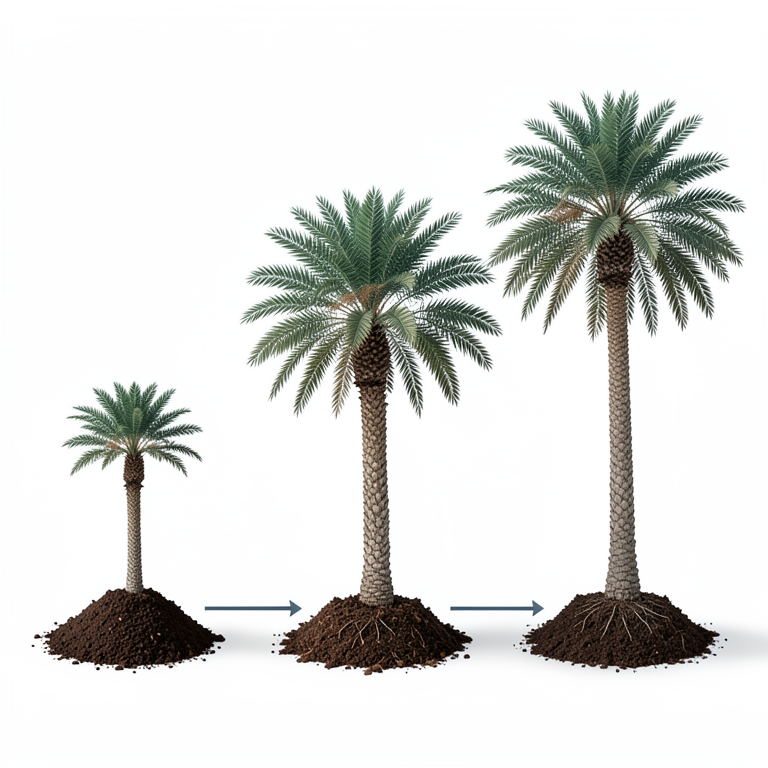
Fertilizer Dose vs. Growth Metrics
AI-generated conceptual illustration (young date palm trees (Phoenix dactylifera L.)). It explains the idea and does not show study data.
View source evidence ↗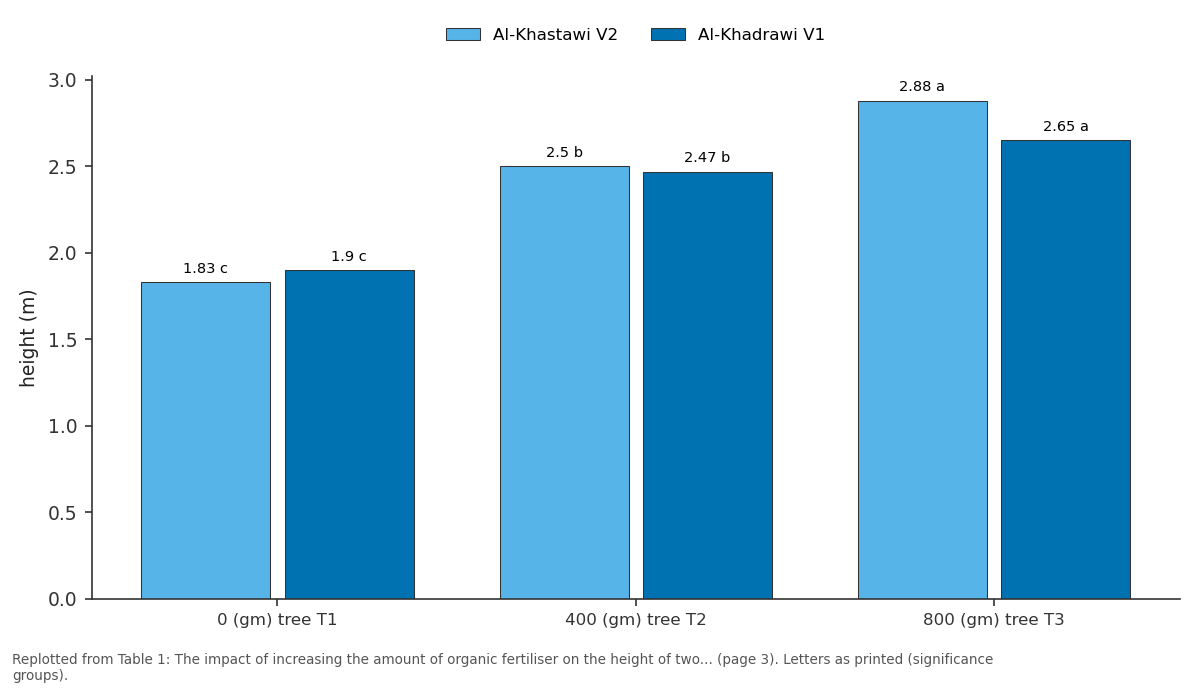
Al-Khastawi V2 and Al-Khadrawi V1: 0 (gm) tree T1 vs 400 (gm) tree T2 vs 800 (gm) tree T3
Replotted from Table 1 (page 3) of the original paper. Every bar is the paper's own table value.
View source evidence ↗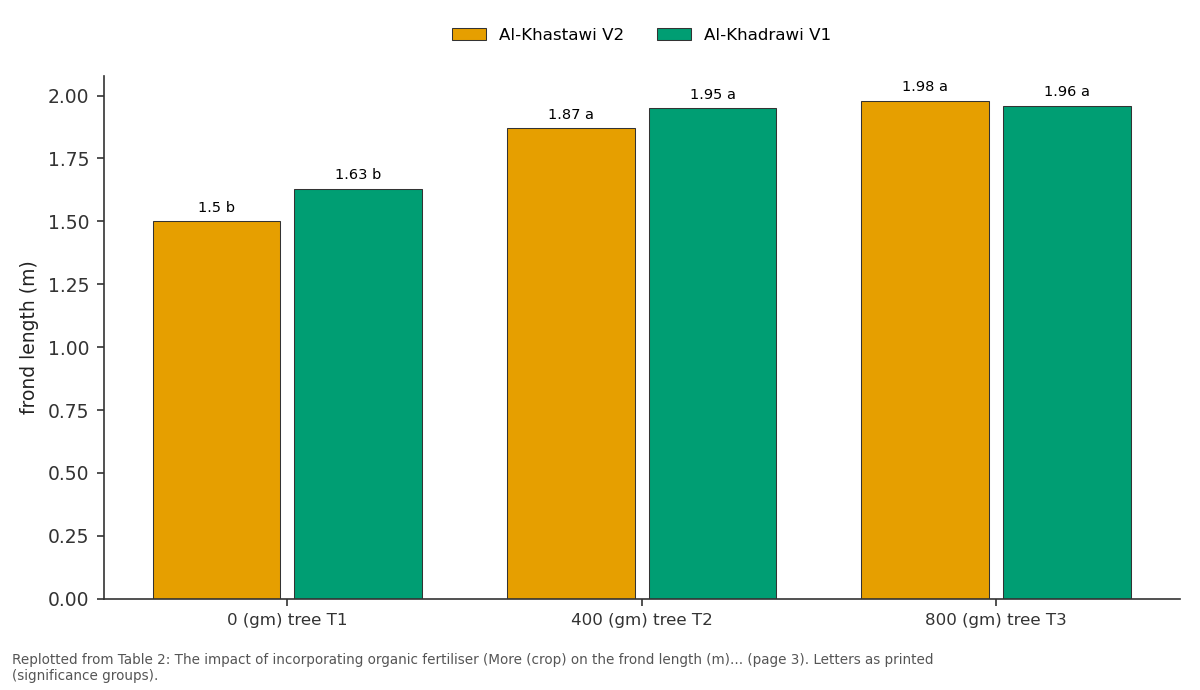
Al-Khastawi V2 and Al-Khadrawi V1: 0 (gm) tree T1 vs 400 (gm) tree T2 vs 800 (gm) tree T3
Replotted from Table 2 (page 3) of the original paper. Every bar is the paper's own table value.
View source evidence ↗Figures & tables
From the original paper Table 1
 Table 2
 Table 3
 Table 4
 Table 5
Introduction
The date palm (Phoenix dactylifera L.) belongs to the palm family Arecaceae, which includes various palm species, the most important of which is the date palm, which is one of the most important monocot trees widely cultivated in tropical, subtropical and subtropical regions, and some of them have the ability to live in temperate regions (Ibrahim and Khalif 1998) [3] . There are large numbers of date palm varieties. In Iraq alone, there are more than 600 varieties, and the variety is a botanical term that includes wild varieties.Of all economic agricultural types (Al-Hamdani et al. 2022) [4] . Al khadrawi variety, it is one of the most important varieties of the date palms they are grown in Iraq's central regions. It's among the better and more appealing types. It is active fast-growing, and some of the fronds deviate inward in a visible manner, even near the frond, and the basal fronds deviate suddenly, giving the top of the palm a look of tangled fronds. This is considered The variety is a late-maturing variety, (Al-Hamdani et al. 2022) [4] . Regarding Khastawi, it is a commercial variety that is well-known for being grown in the central area. Its trunk is medium in size, the fronds are green, slightly or medium-bent, and the stems of the fronds are medium-width, green, dotted with chestnut spots and fronds.It is erect in modern fronds, and some of them are drooping, according to the age of the frond, (Al-Hamdani et al. 2022) [4] . Organic fertilizers are necessary to increase plant growth because they contain nutrients in large proportions in addition to improving the soil's physical and chemical characteristics. They are also considered environmentally safe as they do not lead to pollution of the soil, water or atmosphere (Emirates Center for Environmental Information / 2008). Organic acids are formed In nature, organic materials, whether plant or animal, are found in the soil Due to natural biological and chemical processes in the soil, organic acids are an essential component of humus, along with some organic materials.(Abu Nuqtah and Batha, 2010) [6] .
Among these organic fertilizers is More Crop fertilizer (which is its trade name), which consists of the following substances (6, 6, Na, 0.001% Cl. 0.001% Mo, 0.003% B, 0.015% Cu 0.55% 1.7% 2.5% F3 Ca 0.11%, Solid 93.8%, organic matter 67%, organic carbon 37% / carbon to nitrogen ratio (1:7). (Rancho Dominguez, California, U.S.A / www Morecrop.com)(more crop) The effect of organic fertilizer. It showed through studies conducted on fruit trees. The addition of organic fertilizers improves the vegetative growth qualities of fruit trees )Abbas et al. 2013) [15] when studying on young date palm trees aged one year during the 2012-2013 seasons for two varieties of Nersi and Sultan palm excels For palm trees, the length of the shoots' leaves and the quantity of new leaves are two traits of vegetative growth for both varieties when adding liquid humic acid concentration of 12% ground addition with four coefficients (0, 2, 4, 8) ml of humic acid and the superiority at the amount of humic acid in 8 ml was obtained 12% per seedling per month in the above traits compared to the comparison treatment. (Al-Hamdani 2015) [16] concluded, when he studied three varieties of palm trees (Barhi, Al-Saif plant, and Al-Hilali) at the age of three years, grown in the Fallujah palm station, affiliated with the Department of Horticulture -Ministry of Agriculture, for the 2013 agricultural season, that the Al-Barhi variety outperformed the Al-Saif plant and Al-Hilali variety in the width of the fronds and the length of its fronds. The number of palm leaves was recorded as 2.32 cm, 133.80 cm, and 13.99 leaves) respectively. (Al-Hamdani 2016) [7] noted that the Khastawi variety palm trees at 8 years of age showed a significant increase in the following characteristics when 2 g/l of humic acid was sprayed on the entire vegetation and 4 g/liter was added to the soil. The visit took place when humic acid was added to the soil at a rate of 4 g/l, amounting to (54.00 -282) cm, as opposed to the comparison treatment, which recorded the lowest rate of (37.67 -240) cm. (Al-Hamdani and Al-Janabi, 2017) [17] found, when they experimented with two three-year-old varieties of date palm trees, Sukkari and Ashrasi, at the Nakheel Latifiya station for the 2016-2017 agricultural season, that the Ashrasi variety was significantly superior in the number of leaves, with an increase rate of 36.03% over the Sukkari variety, which gave the lowest rate, reaching %. 33.92. (Abdul Aziz and Khalaf 2022) [18] The yellow Shwaithi variety outperformed the two Khadrawi and Khastawi varieties in certain aspects when they examined three types of young date palm trees cultivated in the Al-Sayadah neighbourhood of the College of Agriculture, University of Kirkuk, in Kirkuk Governorate, for the 2021-2022 growing season.The studied vegetative growth, shoot height, and number of fronds gave an average of (2.43 m, 7.27) frond/shoot, respectively. Due to the lack of study in the effect of varieties of rapidly soluble organic fertilizers from fruit trees, including palms, as we decided to conduct this research in order to improve the vegetative growth qualities of young trees to speed up reaching the fruiting stage.
Materials and Methods
In cooperation with the Agricultural Research and Experiments Station-Al-Sayadah region, the Department of Horticulture and Landscape Engineering, College of Agriculture, University of Kirkuk, carried out a study to investigate the effects of using organic fertiliser from January 11, 2022, to January 5, 2023. Additional crops on the growth of two types of palm trees. The growing bushes were removed and the field was cleaned in the fall. After that, the basins around the trees were maintained, after which a drip irrigation system was installed, and the growth of the bushes was continued to be monitored and cleaned whenever necessary. Two types of young palm trees, Al-Khastawi and Al-Khadrawi, were chosen, provided that they were as homogeneous trees as possible. Possibility of vegetative growth -planted in September 2019, planted in a quadrilateral method of 8 x 8 m. Organic fertilizer was added on 1/3/2023. The experiment was designed The split plot design system states . The two varieties were in the main plot and the treatments were in the sub plot. There were three replicates and each young tree represented 3 experimental units. Thus, the total number of young trees was 18 trees. The treatments were added in March 2023 and the data was analyzed. According to the statement, the means were compared using the Duncan multinomial test at a probability level of 0.05 using an analysis of variance table and testing the coefficients and their interactions using the SAS program. (Al-Mohammadi and Al-Mohammadi 2012) [1] .
Study factors
Study factors
The results
The results of Table No. (1) showed that there were significant differences between the levels of addition, as treatment 3 (800 g/tree) outperformed the comparison treatment, which gave the highest value, reaching 2.76 m, while the comparison treatment gave the lowest value, reaching 1.86 m. As for the effect of the types, there are no significant differences between the two types. As for the interactions between the treatments and the two varieties, the table shows that there are significant differences, as the highest rate in tree height at the level of 3 (800) grams/tree) was 2.88 m in the Khastawi variety, while the lowest level was 1.83 m in the comparison treatment in the Khastawi variety. 2) indicated that there were significant differences between the tre atments in the frond length characteristic, as treatment 3 (800 gm/tree) fared better than the comparative treatment and showed no discernible difference from the therapy. 2 (400 gm/tree), where the highest rate was 1.97 m, while The lowest rate was 1.56 m in the comparison treatment. As for the types, there are no significant differences between the two types. As for the interaction between the treatments and the two varieties, the highest average frond length was obtained in the treatment (8003 g/tree) in the Khastawi variety and reached 1.98 m, while the lowest average frond length was in the comparison treatment in the Khastawi variety and reached 1.50 m. 3) showed that there were significant differences between the treatments, as the 400 gm/tree treatment was significantly superior to the comparison treatment and 3,800 gm/tree, as the highest average number of fronds was 6.50 fronds/tree, However, the comparator treatment had the lowest average for this feature, which was 4.50 fronds per tree. Regarding the varieties, the Khastawi variety did better than the Al-Khadrawi variety because it had the highest average number of fronds (6.11 fronds/tree), whereas the Al-Khadrawi variety had the lowest average number of fronds (4.67 fronds/tree). The Khastawi variety had the highest average trait number of fronds among the types and treatments (7.00 fronds/tree when treated with 3,800 grams/tree), while the veggie variety had the lowest average (3.33) when treated with 3,800 grams/tree.. 4 indicate that the treatment of 3 (800) grams / tree significantly increased the length of fronds over all the treatments amounted to 5.00 cm, and the lowest average for this trait was in the comparison treatment and amounted to 2.17 cm. As for the effect of the varieties on the length of the fronds, the results in Table 4 indicated that the varieties did not differ significantly from one another, but the binary interaction coefficients between the study components and the variety in the same table demonstrated a considerable improvement in frond length, with the treatment (8003 g/tree) and the variety outperforming. Al-Khastawi on the Al-Khastawi variety and the control treatment attained 1.92 cm and 5.50 cm, respectively. (5) showed that there were no significant differences between the treatments and varieties, as well as in the interaction between them in the width of the wicker.
| Transactional impact | Al-Khastawi V2 | Al-Khadrawi V1 | Varieties transaction |
|---|---|---|---|
| 2.17 c | 1.92 d | 2.42 d | 0 (gm) tree T1 |
| 3.98 b | 4.33 b | 3.67 c | 400 (gm) tree T2 |
| 5.00 a | 5.50 a | 4.50b | 800 (gm) tree T3 |
| 3.91 a | 3.53 a | Influence of varieties |
Table text extracted from the original PDF; superscript letters are shown inline. The original table image is below.
View original table image
The discussion
The effect of organic fertilizer More crop on vegetative traits The findings presented in Tables 1,2, and 4 show that, in comparison to the control treatment, ground fertilisation with the More crop organic fertiliser significantly impacted the tree's height, the quantity and length of fronds, and the frond length. This is because it contains important and necessary minerals for growth, like nitrogen. Phosphorus, potassium, and organic materials that have a significant impact on the plant's vital activities (Osman and Abd El-Rahmen 2010) [12] , and thus increasing the plant's absorption of these elements leads to an increase in vegetative growth, and this leads to an increase in the number of fronds, the length of the fronds, and the length of the shoots.(Taiz and Zeiger 2006) [2] . The cause is ascribed to The superiority in a few of the vegetative growth characteristics above demonstrates the part this organic fertiliser plays in boosting the plant's metabolic activity or activating the enzymes involved in chlorophyll synthesis, which is essential for photosynthesis and the production of sugars, proteins, and energy compounds. These factors all contribute to the growth and size of the plant, which in turn leads to an increase in growth characteristics. Al-Khudari researched the aforementioned (Martin 2012) [11] . Sugars act as a driving force for opening and closing stomata, and the organic compounds and mineral elements that organic fertiliser contains particularly potassium are responsible for its superiority in improving the characteristics of vegetative growth. Potassium plays an effective role in most physiological processes, including controlling the function of stomata, and its accumulation in guard cells affects osmotic pressure. (Dumas and others 2004) [13] . Water relations within the plant, including the uptake of water and nutrients from the soil, are subsequently directly impacted by this process. In other words, using organic fertiliser increases both nutrient absorption and cell membrane permeability (Karmegam and Daniel 2008) [14] . These results are in line with the findings of (Diab, 2006) [9] on date palms (Al-wasfy and El-khawga 2008) [8] on date palms, (Balaket AL.Himidaaawi 2015) [10] on palm trees.
The impact of varieties on vegetative growth
Table 3 demonstrated that artistic date palm trees were significantly impacted. The phenotypic differences between these types, which are caused by their genetic architecture, may be the cause of their impact on growth characteristics. These differences may be attributed to the genetic structures between the varieties and the difference in the nature of their growth, which It leads to phenotypic differences in the number of fronds and their adaptation to the conditions prevailing in the growing season. The differences can be due to physiological effects, as well as differences between varieties in terms of their ability to absorb water and nutrients from the soil, which directly affects increased vegetative growth (Al-Araji 1998) and these results are consistent with the findings of (Al-Hamdani, 2017) [17] when he studied two types of palm trees, and are also consistent with the results of (Abdel Aziz 2022) [18] on three types of palm trees.
| Transactional impact | Al-Khastawi V2 | Al-Khadrawi V1 | Varieties transaction |
|---|---|---|---|
| 4.50 c | 5.00 b | 4.00 c | 0 (gm) tree T1 |
| 6.50 a | 6.33 a | 6.67 a | 400 (gm) tree T2 |
| 5.16 b | 7.00 a | 3.33 d | 800 (gm) tree T3 |
| 6.11 a | 4.67 b | Influence of varieties |
Table text extracted from the original PDF; superscript letters are shown inline. The original table image is below.
View original table image
Conclusion and recommendations Conclusion
We conclude from the study that organic fertilizer played an effective role in most of the vegetative traits studied for two varieties of palm trees under Area conditions are as follows: 1. Adding 800 gm/tree of organic fertilizer was superior to More crop in most of the vegetative traits studied. 2. The difference between the two varieties is only in the number of fronds. 3 -With regard to the bilateral interaction between the two factors of the study, the two types differ in the extent of their response to different levels of fertilizer Organically, the best results of interaction were at high levels with the two varieties.
Recommendations
1. We recommend conducting a number of different studies on fertilizing palm cuttings with major nutrients and organic fertilizers. 2. We recommend conducting experiments on other varieties. 3. Conducting studies on the response of fruit trees to fertilization with organic fertilizers.
Figures and tables from the paper
| Transactional impact | Al-Khastawi V2 | Al-Khadrawi V1 | Varieties transaction |
|---|---|---|---|
| 1.86 c | 1.83 c | 1.90 c | 0 (gm) tree T1 |
| 2.48 b | 2.50 b | 2.47 b | 400 (gm) tree T2 |
| 2.76 a | 2.88 a | 2.65 a | 800 (gm) tree T3 |
| 2.40 a | 2.34 a | Influence of varieties |
Table text extracted from the original PDF; superscript letters are shown inline. The original table image is below.
View original table image
| Transactional impact | Al-Khastawi V2 | Al-Khadrawi V1 | Varieties transaction |
|---|---|---|---|
| 1.56 b | 1.50 b | 1.63 b | 0 (gm) tree T1 |
| 1.91 a | 1.87 a | 1.95 a | 400 (gm) tree T2 |
| 1.97 a | 1.98 a | 1.96 a | 800 (gm) tree T3 |
| 1.78 a | 1.85 a | Influence of varieties |
Table text extracted from the original PDF; superscript letters are shown inline. The original table image is below.
View original table image
| Transactional impact | Al-Khastawi V2 | Al-Khadrawi V1 | Varieties transaction |
|---|---|---|---|
| 1.92 a | 1.82 a | 2.02 a | 0 (gm) tree T1 |
| 2.40 a | 2.84 a | 1.97 a | 400 (gm) tree T 2 |
| 2.11 a | 1.98 a | 2.33a | 800 (gm) tree T3 |
| 2.18 a | 2.10 a | Influence of varieties |
Table text extracted from the original PDF; superscript letters are shown inline. The original table image is below.
View original table image
References
12 in the original paper- Abu Nuqta F, Batha M. The role of fertilization of potassium humate solution in the productivity of grapes Halwani variety. J Damascus Univ Agric Sci. 2010;26(1):15-31.
- Al-Hamadani KhA. Effects of humic acid and Khumate treatment on vegetative growth, fruit quantitative characters, and nutrient content of date palm cv. Khastawi grown in gypsiferous soil. Diyala J Agric Sci. 2016;8(1):218-231.
- Al-Wasfy MM, El-Khawaga AS. Effect of organic fertilization on growth, yield, and fruit quality of Zaghloul date palm grown in sandy soil. Assiut J Agric Sci. 2008;39(1):121-133.
- Balaket RTM, Al-Himidawi AMS. Effect of humus organic acids (humic and fulvic) and irrigation water quality on some vegetative growth indicators of young date palm (Phoenix dactylifera L.) trees cv. Barhee. AlKufa J Agric Sci. 2015;7(1):22-40.
- Martin J. Impact of marine extracts applications on CV. Syrah grape (Vitis vinifera L.) yield components, harvest juice quality. California Polytechnic State University, San Luis Obispo; 2012. p. 65.
- Osman SM, Abd El-Rhman IE. Effect of organic and bio N-fertilization on growth and productivity of fig tree (Ficus carica L.). Res J Agric Biol Sci. 2010;6(3):319-28.
- Dumas Y, Smail S, Benamara A. Effect of potassium fertilization on the behavior of three processing tomato cultivars under various watering levels. Acta Hortic. 2004;13(2):71-83.
- Karmegam N, Daniel T. Effect of vermicompost and chemical fertilizer on growth and yield of hyacinth bean (Lablab purpureus sweet). Dynamic Soil Dynamic Plant. 2008;2(2):77-81.
- Abbas JA, Blacket RT, Erian AH. Effect of humic acid on some vegetative growth indicators of date palm offshoots irrigated with well water. Int J Sci Technol. 2013;8(3):126-135.
- Al-Hamdani KAS. Response of three cultivars of date palm offshoots propagated by tissue culture and planted in gypsiferous soil to the chemical fertilizer. Iraqi J Agric Sci. 2015;46(5):819-831.
- Al-Hamdani ASA, Al-Janabi AA. The effect of spraying with organic fertilizer and nutrient solution on the growth of seedlings of two varieties of date palm. Iraqi Agric Res J. 2017;22(9):12-23.
- Abdel Aziz NA, Khalaf JM. The effect of salicylic acid and the organic nutrient (Desper chlorophyll) on the chemical characteristics of three varieties of date palm Phoenix dactylifera L. Kirkuk Univ J Agric Sci. 2022;13(3):287-301.