
Research article · 2024 · Full text
International Journal of Agriculture and NutritionApplication of therapeutic nutrition for controlling gout: An overview
Volume 6(2) · Pages 110–112 · DOI: 10.33545/26646064.2024.v6.i2b.192 ↗
Research areasGout, Hyperuricemia, Uric AcidDiet, Metabolism, and DiseaseNutrition, Health and Food Behavior
Abstract
Author-writtenAdding such ingredients in food items increases their nutritional value, texture, and other sensory properties. Although fruits and vegetables waste have a great potential, there are still some concerns such as variability of raw materials, processing intensification and acceptability by the consumers. For their successful implementation into the market, it is crucial to set proper regulatory frameworks and to secure food safety. This review also shows evidence that interdisciplinary approaches are crucial to improve the valorization of agricultural waste specifically fruits and vegetables. Converting these fumes into high performance functional materials aids in the environmental cause of strengthening the development of healthy and green food systems.
Summary
Source-checkedPlain-language reading of the full paper, prepared with AI and checked against the text. Each point links to the authors' own words.
Why it matters
- Gout is a condition caused by a combination of genetic, cultural, dietary, and lifestyle factors. View evidence ↗
- Poor nutrition is frequently identified as the primary cause of high uric acid levels, which leads to gout. View evidence ↗
- The high prevalence of gout in developed nations is attributed to poor lifestyle choices and diets. View evidence ↗
The question
- The paper aims to discuss clinical treatment techniques and recent advances in the diagnosis and management of gout. View evidence ↗
What they did
- The review examines gout as a metabolic disorder where hyperuricemia causes Monosodium Urate (MSU) crystals to deposit in tissues, causing inflammation. View evidence ↗
- The inflammatory response in gout is driven by MSU crystals activating the NLRP3 inflammasome, which releases pro-inflammatory cytokines such as IL-1β. View evidence ↗
What they found
- Allopurinol and febuxostat, which are xanthine oxidase inhibitors, serve as the primary pharmacological therapies for gout. View evidence ↗
- Acute gout attacks are typically treated using colchicine, corticosteroids, or nonsteroidal anti-inflammatory drugs (NSAIDs). View evidence ↗
- Adopting a low-purine diet reduces uric acid production, leading to a significant reduction in serum uric acid levels. View evidence ↗
- Increasing dairy intake helps decrease gout flares by increasing the excretion of uric acid through the kidneys. View evidence ↗
- Vitamin C supplementation is associated with lowered serum uric acid concentrations by promoting renal excretion. View evidence ↗
- Restricting alcohol intake reduces the frequency of gout attacks by limiting the overproduction of uric acid. View evidence ↗
- Reducing body weight through diet and exercise is correlated with lower serum urate levels and fewer gout flares. View evidence ↗
What it means
- The authors conclude that combining pharmacological treatments with lifestyle changes and new therapeutic agents will improve patient outcomes. View evidence ↗
- The authors recommend increasing the availability of advanced therapies and further studying gout pathology to develop more targeted treatments. View evidence ↗
Visual summary
1 visualsIllustrations explain the paper; they do not show study data.
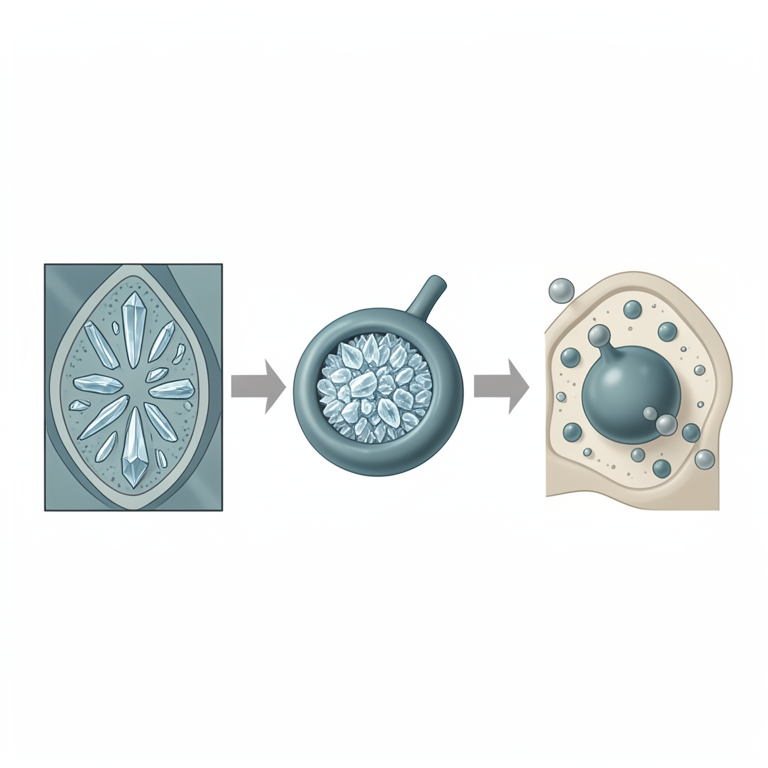
Gout Inflammatory Pathway
AI-generated conceptual illustration (human joint tissue and macrophages). It explains the idea and does not show study data.
View source evidence ↗Figures & tables
From the original paper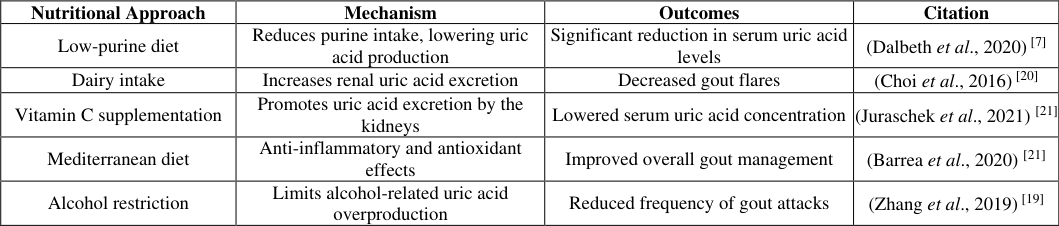 Table 1
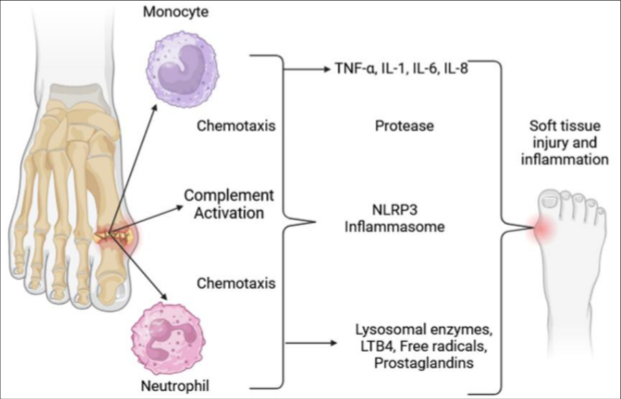 Figure 1
Introduction
Gout is defined as the result of various factors including genes, culture, diet and way of living among others. Out of these, a history of poor nutrition tends to be always highlighted as the underlying cause of High Uric Acid (HUA) levels and consequent linkage to gouts (Qi et al, 2024) [12] . Similarly, the results of the study add weight to other reports that ingestion of certain types of food and drinks lead to increase levels of uric acid which causes the deposition of urate crystals. Gout is highly prevalent in advanced nations of the world owing to poor diets and lifestyle choices, which have been the primary reasons for the high slopes of prevalence curves (Dalbeth et al, 2021 and Sur et al, 2024) [5,4] . In most of the cases the disorder will start with sudden flares of inflammation in the joints which in case is left unchecked may go to the stage of chronic tophaceous gout. To be able to effectively manage this disease the aim should always be to reduce serum urate levels so as to avoid the chances of flaring up and future distress. In this paper, clinical techniques for treatment and some advances in the field of diagnosis and management of gout are discussed.
Pathophysiology of gout
Gout is a metabolic disorder characterized by hyperuricemia, leading to the deposition of Monosodium Urate (MSU) crystals in joints and surrounding tissues, triggering inflammation and acute arthritis (Ragab et al., 2017) [13] . The pathogenesis begins with an overproduction or underexcretion of uric acid, often influenced by genetic predisposition, lifestyle factors, and comorbidities such as obesity, hypertension, and renal impairment. MSU crystals activate the NLRP3 inflammasome in macrophages, promoting the release of pro-inflammatory cytokines like interleukin-1β (IL-1β), which orchestrates the acute inflammatory response. Persistent hyperuricemia contributes to chronic tophaceous gout, joint damage, and reduced mobility if untreated (Dalbeth et al., 2016) [6] . [10] .
Pharmacological interventions
1. Xanthine oxidase inhibitors allopurinol and febuxostat are pointed out as the mainstay of therapy for patients with gout. The main challenge posed by allopurinol, the first line is the gradual titration of dose to reduce urate levels while eliminating our risk of hypersensitivity (Stamp et al., 2016) [16] . Febuxostat has been utilized in the patients who are intolerant to allopurinol, however, the patients having cardiovascular risk factors need careful evaluation for admitting such a drug (White et al., 2018) [18] . 2. Uricosuric agents uricosuric agents like probenecid promotes the urate excretion through kidney. These especially help those patients who are underexcreters of uric acid but should not be prescribed to those with renal impairment (Perez-Ruiz et al., 2020) [11] . Recent researches have shown the emerging role of lesinurad a selective urate reabsorption drug as an adjunctive agent in the management of resistant cases (Saag et al., 2017) [14] . 3. Anti-inflammatory medications nonsteroidal antiinflammatory drugs, corticosteroids, or colchicine are used to treat acute attacks, while NSAIDs are prescribed to bolster therapy. Colchicine, a conventional remedy, can work by preventing the polymerisation of microtubules. One important factor that should be remembered is the fact that it has a small therapeutic window and that precision dosing should be undertaken (Terkeltaub et al., 2019) [17] . 4. Biologic therapies sinon the two IL-1 inhibitors anakinra and canakinumab biopharmaceuticals emerge as favorable targeted therapy alternatives for patients with refractory or intolerant gout. These therapies have shown efficacy in reducing inflammation during acute episodes but are limited by cost and accessibility (So et al., 2018) [15] .
Non-pharmacological approaches 1. Dietary interventions the management of gout
throughout history has mainly relied on the advice of the individual not to adopt a diet rich in purines along with a reduction in fructose and alcohol intake. The evidence shows some effectiveness of adopting a Mediterranean diet and the consumption of low fat dairy products in urate lowering (Choi et al., 2020) [3] . 2. Weight management and physical activity given the impact of obesity as a risk factor for most of the disease prevalence's gout included increased body weight through consumption reduction and habituation of workouts is correlated with decreased serum urate levels and less frequent flare up of gout (Dessein et al., 2017) [8] . 3. Emerging therapies pegloticase is uric acid specific enzyme therapeutic that in nutshell converts uric acid into uricase that has come up in current therapeutic option for gout treatment. They remain effective in cases that are chronic and severe but barriers to adoption are immunogenicity and price Becker et al., (2019) [2] . This research will provide blueprints for the next generation of agents that target multiple urate transporters and pathways that contribute to crystal formation and ultimately help in regaining complete control over gout. [7] Dairy intake Increases renal uric acid excretion Decreased gout flares (Choi et al., 2016) [20] Vitamin C supplementation Promotes uric acid excretion by the kidneys Lowered serum uric acid concentration (Juraschek et al., 2021) [21] Mediterranean diet Anti-inflammatory and antioxidant effects Improved overall gout management (Barrea et al., 2020) [21] Alcohol restriction Limits alcohol-related uric acid overproduction Reduced frequency of gout attacks (Zhang et al., 2019) [19]
Conclusion
The therapeutic management of gout has changed profoundly paving way to a good management of both acute attacks and chronic disease. While available drugs will always be the focus, adding correct life-style changes and novel therapeutic agents will improve the outcome. There should be an emphasis on improving availability of more advanced therapies and reiterating the gout mechanisms of pathology to devise gout-oriented therapies.
Figures and tables from the paper
| Nutritional Approach | Mechanism | Outcomes | Citation |
|---|---|---|---|
| Low-purine diet | Reduces purine intake, lowering uric acid production | Significant reduction in serum uric acid levels | (Dalbeth et al., 2020) [7] |
| Dairy intake | Increases renal uric acid excretion | Decreased gout flares | (Choi et al., 2016) [20] |
| Vitamin C supplementation | Promotes uric acid excretion by the kidneys | Lowered serum uric acid concentration | (Juraschek et al., 2021) [21] |
| Mediterranean diet | Anti-inflammatory and antioxidant effects | Improved overall gout management | (Barrea et al., 2020) [21] |
| Alcohol restriction | Limits alcohol-related uric acid overproduction | Reduced frequency of gout attacks | (Zhang et al., 2019) [19] |
Table text extracted from the original PDF; superscript letters are shown inline. The original table image is below.
View original table image
References
17 in the original paper- Barrea L, Muscogiuri G, Annunziata G, Laudisio D, de Alteriis G, Tenore GC, et al. From gut microbiota dysfunction to obesity: Could short-chain fatty acids stop this dangerous relationship? World J Gastroenterol. 2020;26(15):1890-1901. DOI:10.3748/wjg.v26.i15.1890.
- Becker MA, et al. Uricase-based treatments for chronic gout. N Engl J Med. 2019;381(5):483-491.
- Choi HK, et al. Diet and risk of gout. Curr Rheumatol Rep. 2020;22(8):15.
- Sur M, Ray S, Pattanayak A, Tewari S, Pramanik P. Effect of diet and physiotherapy for reducing gout associated symptoms. J Curr Res Food Sci. 2023;4(1):91-94.
- Dessein PH, et al. Lifestyle factors and gout: A systematic review. J Rheumatol. 2017;44(4):521-528.
- Juraschek SP, Gelber AC, Choi MJ, Appel LJ, Miller ER. Effects of oral vitamin C supplementation on serum uric acid: A meta-analysis of randomized controlled trials. Arthritis Care Res. 2021;73(1):33-42. DOI:10.1002/acr.24333.
- Patil T, Soni A, Acharya S. A brief review on in vivo models for Gouty Arthritis. Metabolism Open. 2021;11:100100.
- Perez-Ruiz F, et al. Uricosuric drugs in the management of hyperuricemia. Arthritis Res Ther. 2020;22(1):12.
- Qi CW, Mohd Nordin UU, Mahmood S, Karusan NR, Khalid R, Nordin N, et al. Gout management using nanocarrier systems: A review. ACS Appl Nano Mater. 2024;7(9):9816-9846.
- Ragab G, Elshahaly M, Bardin T. Gout: An old disease in new perspective-A review. J Adv Res. 2017;8(5):495-511.
- Saag KG, et al. Lesinurad for refractory gout: A phase 3 trial. Arthritis Rheumatol. 2017;69(5):902-911.
- So A, et al. IL-1 inhibitors in gout management. Nat Rev Rheumatol. 2018;14(5):265-275.
- Stamp LK, et al. Allopurinol hypersensitivity: Pathophysiology and risk factors. Curr Rheumatol Rep. 2016;18(5):34.
- Terkeltaub R, et al. Colchicine for gout flares: Safety and efficacy. Semin Arthritis Rheum. 2019;48(2):331337.
- White WB, et al. Cardiovascular safety of febuxostat versus allopurinol. N Engl J Med. 2018;378(13):12001210.
- Zhang Y, Chen C, Choi H, Chaisson C, Hunter DJ, Niu J, Neogi T. Alcohol consumption as a trigger of recurrent gout attacks. Am J Med. 2019;122(9):811818. DOI:10.1016/j.amjmed.2019.03.025.
- Choi HK, Willett W, Curhan G. Dairy consumption and risk of incident gout in men: Prospective study. Arthritis Rheumatol. 2016;64(3):1022-1030. DOI:10.1002/art.33394.