
Research article · 2024 · Full text
International Journal of Geography Geology and EnvironmentHarmful effect of recycling: Its not a silver bullet as we think
Volume 6(2) · Pages 214–216 · DOI: 10.22271/27067483.2024.v6.i2c.309 ↗
Research areasNuclear and radioactivity studies
Abstract
Author-writtenRecycling is one of the first eco-friendly moves that people like to make for the environment sustainability but when it comes to what items can be recycled and how that often leads to lots of confusion. Recycling aids in combating climate change while also conserving raw materials, reducing litter and the need for landfill space, as well as generating jobs, lowering greenhouse gas emission, reduces energy use and promoting community involvement. Even though we know various advantages of recycling but it is not carried out on large scale. In addition to global problems we’re seeing with waste today, the production and mismanagement of consumer goods is a major source of greenhouse gas emissions, which contribute to climate change and on the other hand it is also an expensive process. The cost of recycling can vary depends on the efficiency of the recycling program and on demand for recycled materials. In some cases, the cost of recyclable materials also exceeds the cost of raw materials. Sometimes the recycling of waste equipment can create a significant amount of pollution. Thus the process isn’t as helpful as we think, Recycling alone isn’t enough to say, fight climate change or eliminate pollution and not a quick solution of a complicated problem.
Summary
Source-checkedPlain-language reading of the full paper, prepared with AI and checked against the text. Each point links to the authors' own words.
Why it matters
- Recycling is widely viewed as an eco-friendly practice that helps combat climate change, conserve raw materials, and reduce landfill use. View evidence ↗
- The production and poor management of consumer goods are significant contributors to greenhouse gas emissions and climate change. View evidence ↗
- Recycling can be an expensive process, and in certain instances, the cost of recycled materials is higher than that of raw materials. View evidence ↗
The question
- The author aims to demonstrate that recycling alone is not a sufficient or quick solution for eliminating pollution or fighting climate change. View evidence ↗
What they did
- The paper defines recycling as the collection and conversion of waste materials into new products. View evidence ↗
- The author uses energy consumption comparisons, such as the 40% energy reduction when making paper from recycled pulp versus virgin wood, to illustrate recycling benefits. View evidence ↗
What they found
- According to a 2022 OECD report, less than 10% of global plastic is recycled, while nearly 50% goes to sanitary landfills. View evidence ↗
- Plastics have a limited lifespan in recycling because they degrade with each use, typically meaning they cannot be reused more than once or twice. View evidence ↗
- Improperly processed plastics can release volatile organic compounds (VOCs) during melting, posing risks to the environment and human health. View evidence ↗
- Regarding plastic resin codes, only those labeled 1 and 2 are highly recyclable, while codes 3 through 7 are not profitable to recycle. View evidence ↗
- Waste generation is predicted to accelerate at a rate faster than the implementation of available solutions. View evidence ↗
What it means
- The author concludes that the 'Reduce, Reuse, Recycle' hierarchy is the most effective order of action for waste minimization. View evidence ↗
- The author states that reducing waste is far more beneficial for the planet than recycling, meaning recycling is not a 'silver bullet' solution. View evidence ↗
- The author notes that complete recycling is practically impossible because recovering highly dispersed waste requires excessive energy. View evidence ↗
Visual summary
1 visualsIllustrations explain the paper; they do not show study data.
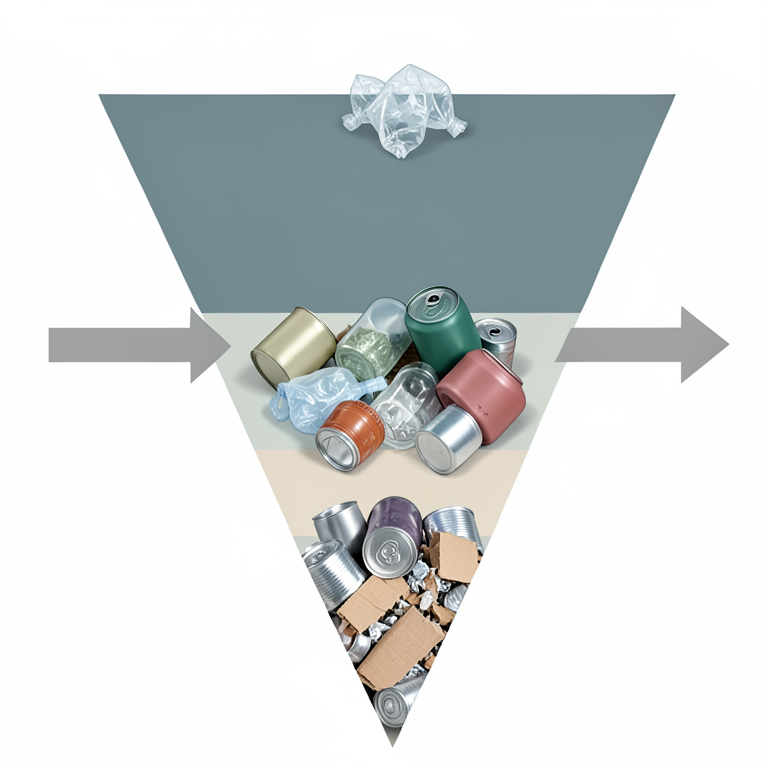
The Waste Hierarchy
AI-generated conceptual illustration (household waste materials (plastic bottles, glass jars, aluminum cans, and cardboard boxes)). It explains the idea and does not show study data.
View source evidence ↗Introduction
The world increasing demand for new stuff has led to increase in waste generation that causes the harmful disruption and damage being done to the natural world. Waste reduction through recycling is a fundamental strategy. Recycling is the process of collecting and converting waste materials (that would otherwise be thrown away as trash) into new products. The recyclability of a material depends on its ability to reacquire the properties it had in its original state that also includes the recovery of energy from waste materials (Villalba et al., 2002) [9] . People believe that recycling is a good habit for the environment but are confused about what items can be recycled and how. This often leads to recyclables going in the trash. While recycling is generally known as being good for the environment, there are plenty of different pros and cons to recycling. In ideal implementations, recycling a material produces a fresh supply of the same material. Recycling helps conserve natural resources, reduce greenhouse gas emissions, prevent pollution, and create jobs and industries. Natural resources, or materials that arise naturally and are utilized to create products, the world has finite natural resources and we run the risk of exhausting (using up) our natural resources if we don't recycle and reuse them. For example 1. Recycling paper saves trees and the forests. [6] . Furthermore, plastics can only be recycled a limited number of times as it degrades each time it is reused, meaning it can't be reused more than once or twice and if not processed well, releases VOCs, volatile organic compound when they melt, that pose a risk to both human health and environment (Geyer et al., 2017) [2] . Another disadvantage of recycling is that the quality of the material produced is often not as good as products created from raw materials.
Recycling has long been promoted as a sustainable wastemanagement strategy, but current levels of trash generation have grown to unsustainable rates. In fact, waste over generation is predicted to accelerate, and the rate of acceleration is projected to be much faster than solutions can be put into place (Barnett, 2023) [5] . The only way to truly benefit from recycling is to take plastic out of the picture. The plastic industry stop lying to the public about plastic recycling, it does not work, it never will work and no amount of false advertising will change that. In early 1989, some oil and gas companies began a quiet campaign to lobby almost 40 states to mandate the "chasing arrows" symbol appear on all plastic products, despite the fact that many items adorned with chasing arrows can't be recycled at all. Some environmentalists also supported the symbol, thinking it would help separate plastic but it's a misleading or deceptive logo with some numbers or code (1 to 7) written inside it. The code is creating "unrealistic expectations" about how much plastic can actually be recycled. Only 1 and 2 numbers written with inside the logo are highly recyclable whereas 3 to 7 aren't profitable yet this product has recycle logo. So, the Environmental Protection Agency (EPA) recommended that the Federal Trade Commission to scrap the symbol and move those numbers inside a triangle and chasing arrows can appear on those plastic packaging only if the maker of the packaging has proven that it can be easily recyclable (Sullivan, 2020) [7] . Most people agree that recycling has significant benefits; even it isn't a perfect solution to our environmental problems. Though it can be a bit of an inconvenience, recycling has empowered households and business to feel like they are doing something to make their community and their country a more ecofriendly place. Recycling is a word loaded with meaning, and one that evokes sometimes drastically diverse opinions and responses from different people. While the actual definition and process of recycling is relatively straightforward, there is often a lot of contention surrounding overall effectiveness and whether it's the best solution for managing waste. So, we really need to be a lot more intentional with the goods we consume and the action we take, we should always remember the popular phrase "Reduce -Reuse -Recycle" that is already in the correct order, the three R's by which actions are most effective. First, reduce waste habit of using less stuff. Second, reuse instead of buying something new. Third, Recycle waste (Lienig et al., 2017) [3] . Reducing waste generation is far more sustainable than managing waste after it has been created. That's because if you consume fewer items you are doing more for environment than if you consume more and then recycle what you can and it also takes more energy to manufacture products from recycled materials. Additionally, there can be inconsistency in recycling policies and enforcement across regions. Varying regulation and a lack of standarised practices make it difficult for business and individual to navigate recycling requirements. This lack of uniformity can hinder progress in establishing effective recycling systems.
Conclusion
Recycling is hard, due to issue with contamination.
Recycling is not always easy or efficient, as some materials are contaminated, mixed, or difficult to separate and process and much of the difficulty inherent in recycling comes from the fact that most products are not designed with recycling in mind. While recycling diverts waste from entering directly into landfill sites, current recycling misses the dispersive components. Complete recycling is impossible from a practical standpoint as highly dispersed wastes become so diluted that the energy needed for their recovery becomes increasingly excessive. The "three r" policy (reduce, reuse, recycle) was proposed for waste minimization. This is also known as tackling "at source" than adopting "end-of-pipe" approach. Taking into consideration the method of disposal even before purchase (life-cycle thinking) of any item will help in selecting less wasteful materials (green purchasing). Simply, reducing waste is far better for the planet than recycling so it is not a silver bullet as we think.
References
8 in the original paper- Andrew E. Why is recycling so confusing? You can blame big oil. September 2020.
- Geyer R, Jambeck JR, Law KL. Production, use, and fate of all plastics ever made. July 2017.
- Hess L. Pros and cons of recycling. September 2024.
- Barnett M. A harmful bias towards recycling over reduction and reuse. July 2023.
- Organisation for Economic Co-operation and Development. Global plastic outlook. February 2022.
- Sullivan L. How big oil misled the public into believing plastic would be recycled. NPR's Planet Money. September 2020.
- Duong T. The myth about recycling plastic? It works. September 2020.
- Villalba G, Segarra M, Fernandez AI, Chimenos JM, Espiell F. A proposal for quantifying the recyclability of materials. Resour Conserv Recycl. 2002;37(1):39-53.