
Research article · 2023 · Full text
International Journal of Agriculture and Food ScienceQuality of cassava flours from low and high PPD clones
Volume 5(2) · Pages 148–150 · DOI: 10.33545/2664844x.2023.v5.i2b.225 ↗
Research areasCassava research and cyanide
Abstract
Author-writtenCassava (Manihot esculenta Crantz) is a vital food security crop, especially in tropical and subtropical regions. However, post-harvest physiological deterioration (PPD) limits its shelf life and processing quality. This study investigates the quality of cassava flours produced from low and high PPD clones by analyzing their physicochemical, functional, and sensory properties. Results indicate that low-PPD clones outperform high-PPD clones in preserving functional and nutritional qualities, highlighting their industrial significance.
Summary
Source-checkedPlain-language reading of the full paper, prepared with AI and checked against the text. Each point links to the authors' own words.
Why it matters
- Cassava is a critical crop for food security in tropical and subtropical areas. View evidence ↗
- The shelf life and quality of processed cassava are limited by post-harvest physiological deterioration (PPD). View evidence ↗
- While low-PPD clones have been bred to combat deterioration, their specific impact on the quality of the resulting flour is not well understood. View evidence ↗
The question
- The study aims to compare the physicochemical, functional, and sensory properties of flours made from low-PPD and high-PPD cassava clones. View evidence ↗
What they did
- The researchers used specific cassava clones, such as TMS 30572 for low-PPD and TMS 90257 for high-PPD. View evidence ↗
- To simulate real-world conditions, high-PPD clones were processed within 24 hours, while low-PPD clones were processed after a 48-hour delay. View evidence ↗
- The flour production process involved peeling, grating, sun-drying, and milling the tubers. View evidence ↗
- Standard AOAC methods were used to analyze physicochemical properties, including fiber, protein, starch, and moisture content. View evidence ↗
What they found
- Low-PPD flours had higher starch content (78% vs 70%) and better pH stability (6.2 vs 4.8) than high-PPD flours. View evidence ↗
- Protein levels were similar (2.1% for low-PPD vs 2.3% for high-PPD), though high-PPD flours had slightly more fiber (2.0% vs 1.5%). View evidence ↗
- Low-PPD flours showed better functional properties, with a swelling index of 6.5 (vs 5.2) and water absorption capacity of 4.8 g/g (vs 3.9 g/g). View evidence ↗
- In sensory tests, low-PPD flours scored higher for texture (8.5 vs 7.2), flavor (8.2 vs 6.8), and color (8.1 vs 7.0) on a 10-point scale. View evidence ↗
- Low-PPD flours may be safer for consumption due to a reduction in cyanogenic glycosides during their delayed processing. View evidence ↗
What it means
- The authors conclude that low-PPD cassava clones produce flours with superior sensory, functional, and physicochemical qualities. View evidence ↗
- The study recommends the breeding and adoption of low-PPD varieties to improve the usability and quality of cassava after harvest. View evidence ↗
- Further research is needed to determine if these low-PPD clones are economically feasible and scalable across different production systems. View evidence ↗
Visual summary
3 visualsIllustrations explain the paper; charts are replotted from the paper's own table values.
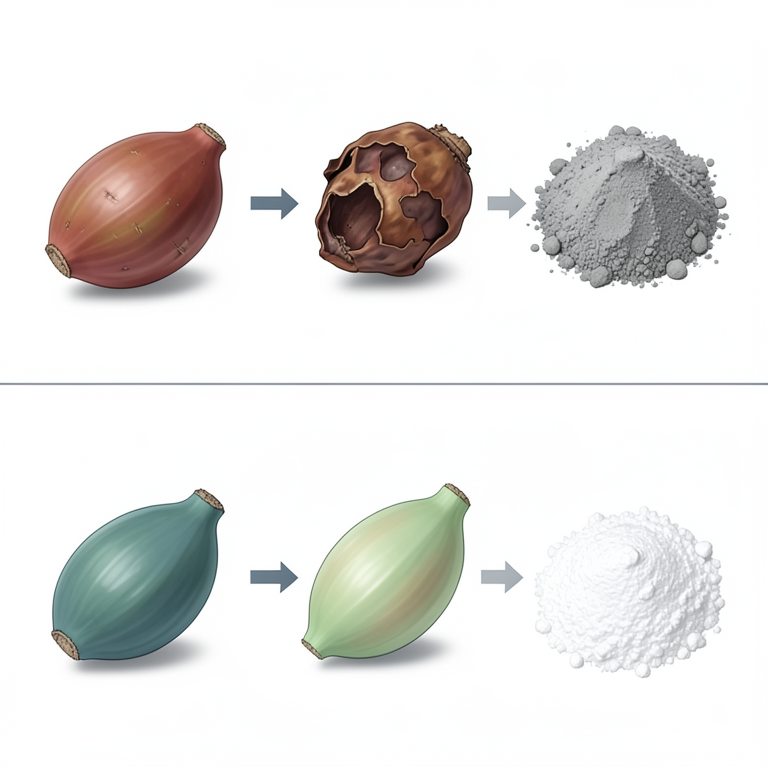
Impact of PPD on Flour Quality
AI-generated conceptual illustration (cassava tubers and cassava flour). It explains the idea and does not show study data.
View source evidence ↗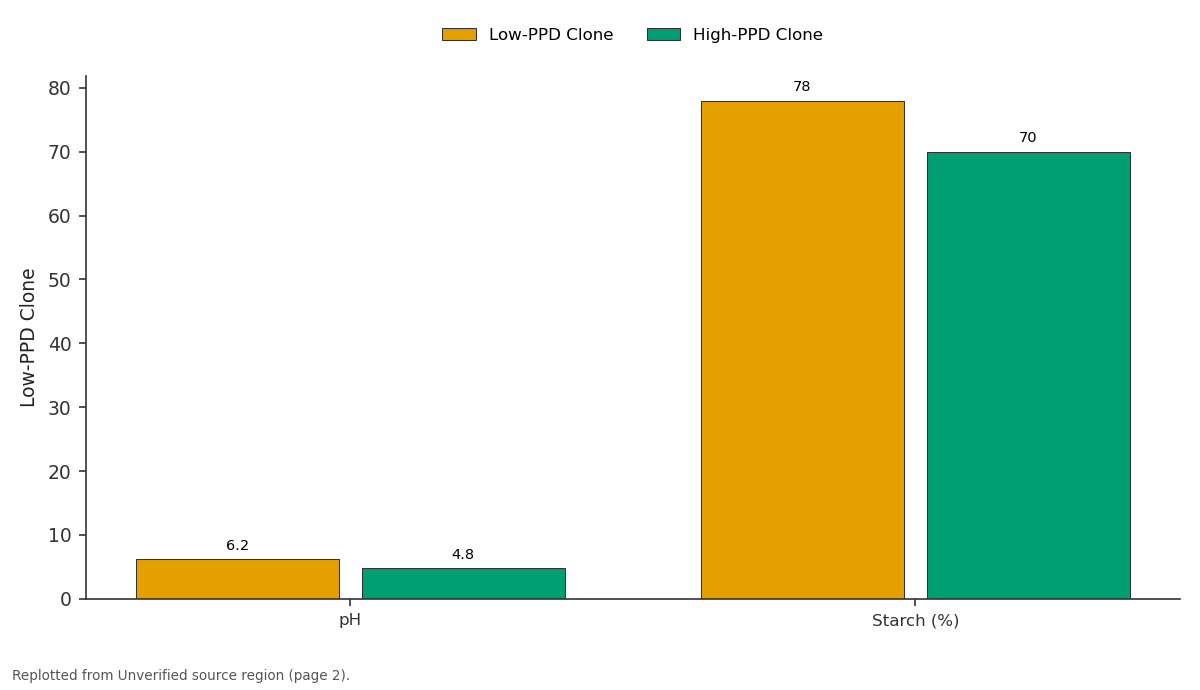
Low-PPD Clone and High-PPD Clone: pH vs Starch (%)
Replotted from a table (page 2) of the original paper. Every bar is the paper's own table value.
View source evidence ↗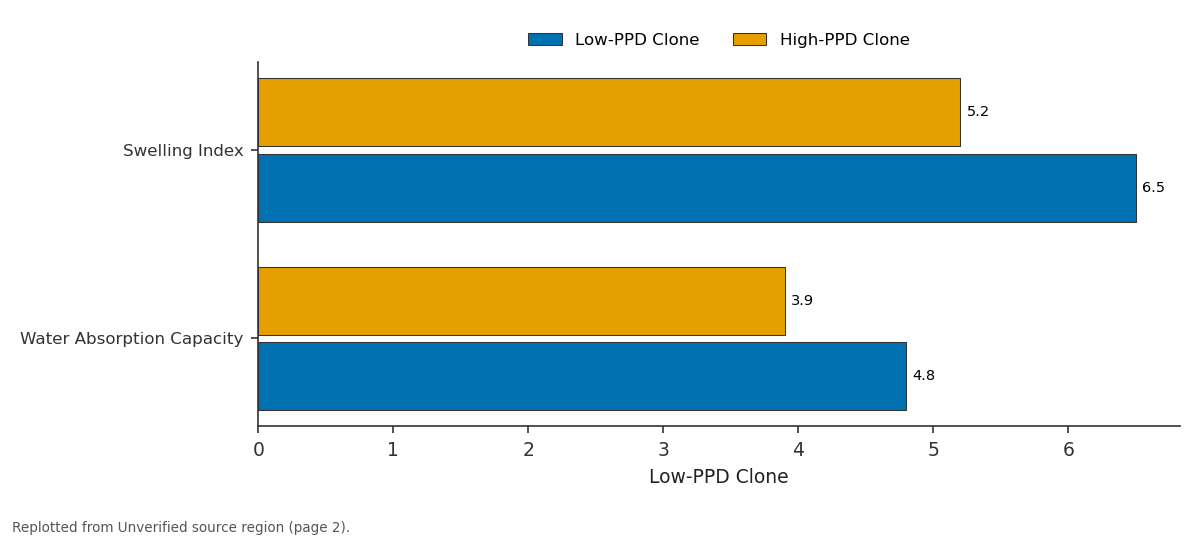
Low-PPD Clone and High-PPD Clone: Swelling Index vs Water Absorption...
Replotted from a table (page 2) of the original paper. Every bar is the paper's own table value.
View source evidence ↗Introduction
Cassava is a staple for millions in the Global South due to its high caloric yield. Despite its adaptability, the crop faces a critical limitation in the form of PPD, which compromises postharvest utility. Breeding programs have introduced low-PPD clones to address this challenge, but the implications of PPD on flour quality remain underexplored. This study evaluates the quality of cassava flours from low and high PPD clones, aiming to establish their suitability for diverse applications.
Main Objectives
The main objectives of this paper are to evaluate the quality of cassava flours derived from low and high PPD clones by analyzing their physicochemical, functional, and sensory properties, and to determine their suitability for various industrial and culinary applications.
Materials and Methods
Cassava tubers were harvested from selected low-PPD (e.g., TMS 30572) and high-PPD (e.g., TMS 90257) clones. Post-harvest processing was conducted within 24 hours for high-PPD clones and after a 48-hour delay for low-PPD clones to simulate practical scenarios. Tubers were peeled, grated, sun-dried, and milled into flour. Physicochemical properties, including moisture content, starch, protein, and fiber, were analyzed using standard AOAC methods. Functional properties, such as swelling index and water absorption capacity, were determined to assess the flours' performance in industrial applications. Cyanogenic glycosides were quantified to ensure safety standards. Sensory evaluation involved panellists scoring baked and thickened products for attributes such as texture, flavor, and color.
Results
Results
Physicochemical Properties
Low-PPD flours showed higher pH stability (6.2) and starch content (78%), while high-PPD flours exhibited lower values (4.8 pH and 70% starch). Protein content was similar across both, but high-PPD flours had slightly higher fiber content.
Physicochemical Properties
Physicochemical Properties
Discussion
The findings of this study provide compelling evidence for the superiority of low-PPD cassava clones in producing higher-quality flours compared to high-PPD clones. These results align with previous research on the detrimental effects of PPD on cassava quality and emphasize the significance of breeding low-PPD clones for commercial and household use.
Physicochemical Properties
The higher pH and starch content in flours derived from low-PPD clones indicate better preservation of the tubers' biochemical integrity during processing. The delayed onset of PPD allows enzymatic and oxidative reactions to be minimized, preserving key nutrients such as starch. This is particularly important for industries that rely on cassava flour for its high starch content and neutral flavor. On the other hand, the higher acidity and lower starch content in high-PPD flours suggest rapid metabolic changes and degradation during PPD. This limitation restricts the application of high-PPD flours in areas where long processing times or storage are required.
Functional Properties
Low-PPD flours demonstrated superior functional properties, including swelling index and water absorption capacity. These attributes are critical for industrial applications such as baking, where these properties affect dough consistency and product texture. The reduced functional quality of high-PPD flours can be attributed to starch degradation caused by PPD, which breaks down structural components, leading to reduced water binding and swelling capacities. While high-PPD flours might still find use in applications where these properties are less critical, their limited functional range reduces their market competitiveness.
Nutritional and Safety Considerations
The study showed minimal differences in protein content between the two clones, underscoring that PPD primarily affects starch and structural components rather than proteins. However, the reduction of cyanogenic glycosides during the delayed processing of low-PPD clones suggests an added safety benefit, making these flours safer for consumption. High-PPD flours processed under time constraints retained higher levels of these compounds, posing potential health risks if not adequately detoxified.
Sensory Evaluation
Sensory attributes such as texture, flavor, and color were consistently rated higher for products made from low-PPD flours. This aligns with the preservation of starch and the minimized biochemical degradation seen in these flours.
The inferior sensory qualities of high-PPD flours can be attributed to discoloration and off-flavors that develop as a result of PPD, reducing their acceptability for consumer markets and culinary uses.
Balancing the Implications
While the findings favour low-PPD clones for most quality parameters, it is important to consider the context of use. High-PPD flours may still have value in regions where cassava is processed immediately after harvest, bypassing the effects of PPD. Additionally, the economic and logistical factors involved in cultivating low-PPD clones need to be addressed, as their widespread adoption requires substantial investment in breeding programs, seed systems, and farmer training. Moreover, the nutritional profiles of both flours were broadly similar, suggesting that the primary differentiation lies in functional and sensory attributes rather than macronutrient content. This presents an opportunity to optimize the use of high-PPD flours in applications where functional properties are less critical, thereby reducing postharvest losses and maximizing the utilization of available cassava.
Conclusion
In conclusion, this study demonstrates that low-PPD cassava clones produce flours with superior physicochemical, functional, and sensory qualities compared to high-PPD clones. The delayed onset of PPD in low-PPD clones preserves key attributes such as starch content, pH stability, and water absorption capacity, making their flours more suitable for diverse industrial and culinary applications. High-PPD flours, while nutritionally comparable, suffer from rapid biochemical degradation that limits their functionality and sensory acceptability. These findings underscore the value of breeding and adopting low-PPD cassava varieties to enhance post-harvest quality and usability. However, the economic feasibility and scalability of these clones in different production systems warrant further investigation to ensure widespread benefits for farmers, processors, and consumers.
References
6 in the original paper- Oluwole OB, Olatunji OO. Functional properties of cassava-based flours: A review. Afr J Food Sci Technol. 2020;11(2):45-53.
- International Institute of Tropical Agriculture (IITA). Advances in breeding for low-PPD cassava varieties. [Internet]. 2023 [cited 2024 Dec 13]. Available from: https://www.iita.org
- Wheatley C, Gomez G. Post-harvest deterioration of cassava roots. Acta Hortic. 1985;123:195-209.
- Uarrota VG, Moresco R, Nunes ED. Metabolomics and biochemical approaches reveal storage time-dependent changes in cassava roots. Food Chem. 2016;203:126135.
- Alimi JP, Ahemen SA, Alimi JO, Ngunoon TP, Bitrus YN. Comparative study on chemical and functional properties of flours produced from selected clones of low and high postharvest physiological deterioration cassava (Manihot esculenta Crantz). J Curr Res Food Sci. 2022;3(1):51-57.
- Burns A, Gleadow R, Cliff J, Zacarias A, Cavagnaro T. Cassava: The drought, war, and famine crop in a changing world. Sustainability. 2010;2(11):3572-3607.