
Research article · 2024 · Full text
International Journal of Agriculture and Food ScienceProlonging mushroom and tomato freshness using irradiation technology
Volume 6(1) · Pages 159–161 · DOI: 10.33545/2664844x.2024.v6.i1b.223 ↗
Research areasPlant Physiology and Cultivation StudiesPostharvest Quality and Shelf Life ManagementFlowering Plant Growth and Cultivation
Abstract
Author-writtenMushrooms and tomatoes are highly perishable due to their susceptibility to microbial spoilage and rapid physiological changes. This study examines the potential of irradiation technology as a non-thermal method to prolong the freshness of these commodities. By using ionizing radiation, including gamma rays, electron beams, and X-rays, this technology reduces microbial load, delays ripening, and maintains the quality attributes of mushrooms and tomatoes. The paper analyzes the mechanisms, efficacy, and impact of irradiation on sensory and nutritional qualities, supported by recent studies and data. Additionally, it discusses the challenges of implementation, regulatory considerations, and consumer acceptance, emphasizing irradiation's role in sustainable food preservation.
Summary
Source-checkedPlain-language reading of the full paper, prepared with AI and checked against the text. Each point links to the authors' own words.
Why it matters
- Mushrooms and tomatoes suffer from high perishability, resulting in global post-harvest losses estimated between 30% and 40%. View evidence ↗
- Mushrooms are especially prone to spoilage, such as discoloration and sliminess, because of their porous structure and high moisture content. View evidence ↗
- As climacteric fruits, tomatoes continue to ripen and soften after harvest, which increases their susceptibility to spoilage and microbial invasion. View evidence ↗
The question
- The study aims to evaluate how irradiation technology can extend the freshness of mushrooms and tomatoes by delaying ripening and reducing microbial spoilage while maintaining quality. View evidence ↗
- The paper also seeks to assess the environmental and economic advantages of irradiation and the obstacles to its implementation. View evidence ↗
What they did
- The preservation method utilizes ionizing radiation, specifically X-rays, electron beams, and gamma rays, to maintain quality and reduce microbial loads. View evidence ↗
- The analysis is based on a review of recent data and studies regarding the efficacy and mechanisms of irradiation on nutritional and sensory attributes. View evidence ↗
What they found
- In mushrooms, gamma irradiation at doses of 1-2 kGy can extend refrigerated shelf life by up to 10 days by reducing microbial loads by as much as 90%. View evidence ↗
- Irradiation helps mushrooms maintain their white color and marketability by inhibiting polyphenol oxidase activity, which suppresses enzymatic browning. View evidence ↗
- For tomatoes, the optimal irradiation dose to extend freshness while preserving quality is between 0.3 and 0.5 kGy. View evidence ↗
- Irradiation preserves tomato firmness by inhibiting ethylene production and the enzymatic activities that cause cell wall degradation. View evidence ↗
- The safety of tomatoes is improved through irradiation, which significantly reduces pathogens including Escherichia coli and Salmonella. View evidence ↗
- Appropriate irradiation doses do not significantly change proteins, B vitamins, or fiber in mushrooms, though higher doses may cause minor reductions in vitamin C. View evidence ↗
- Lycopene, a key antioxidant in tomatoes, remains stable under irradiation, preserving the fruit's health benefits. View evidence ↗
- Reducing food waste via irradiation helps lower the carbon footprint, as the FAO estimates that food waste contributes roughly 8% of global greenhouse gas emissions. View evidence ↗
What it means
- The authors conclude that irradiation is an innovative and powerful tool for post-harvest management because it reduces contamination and delays ripening while maintaining quality. View evidence ↗
- A major limitation is the high initial cost of specialized equipment and safety measures required to establish irradiation facilities. View evidence ↗
- Widespread adoption is hindered by consumer misconceptions regarding the safety and nutritional impact of irradiated foods. View evidence ↗
Visual summary
1 visualsIllustrations explain the paper; they do not show study data.
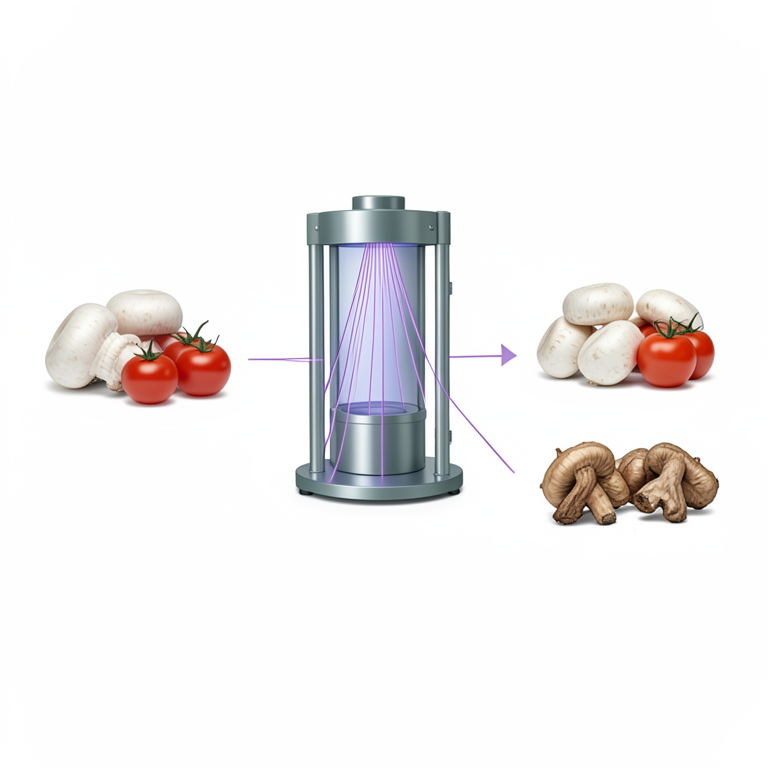
Irradiation Process Flow
AI-generated conceptual illustration (fresh white button mushrooms and red vine tomatoes). It explains the idea and does not show study data.
View source evidence ↗Introduction
The perishability of mushrooms and tomatoes leads to significant post-harvest losses, estimated to reach 30-40% globally, with higher losses in developing countries lacking adequate storage facilities. Mushrooms are particularly vulnerable due to their high moisture content and rapid microbial colonization, leading to sliminess and discoloration. Tomatoes, as climacteric fruits, ripen and soften post-harvest, making them prone to microbial invasion and spoilage. These losses not only cause economic setbacks but also contribute to global food waste and environmental issues. Irradiation technology has emerged as a promising tool to address these challenges. By exposing food to ionizing radiation, this method disrupts microbial DNA, inhibits enzymatic activities, and delays physiological changes, thereby extending shelf life and maintaining quality. Unlike thermal preservation methods (Ibrahim, 2023) [19] , irradiation does not involve heat, preserving the fresh-like characteristics of produce. This paper explores the application of irradiation to mushrooms and tomatoes, focusing on its impact on freshness, microbial safety, sensory attributes, and economic implications.
Objective
The objective of this paper is to explore the effectiveness of irradiation technology in prolonging the freshness of mushrooms and tomatoes by reducing microbial spoilage, delaying ripening, and preserving sensory and nutritional qualities. Additionally, the paper aims to evaluate the economic and environmental benefits of this preservation method while addressing challenges and limitations associated with its implementation.
Irradiation in freshness preservation
Irradiation is a ground-breaking non-thermal preservation technique that uses ionizing radiation to address the challenges of spoilage in perishable foods. This technology effectively prolongs freshness by reducing microbial contamination, delaying physiological changes, and maintaining the sensory and nutritional qualities of food products. For highly perishable items like mushrooms and tomatoes, irradiation offers a unique approach to mitigating post-harvest losses. By targeting the DNA of spoilage microorganisms, irradiation prevents their replication and growth, effectively controlling bacterial, fungal, and viral contamination.
This reduction in microbial load significantly decreases spoilage, ensuring the safety and quality of food during extended storage and transportation. In addition to microbial inactivation, irradiation also affects the enzymatic and physiological processes in fruits and vegetables. For instance, it inhibits ethylene production in climacteric fruits like tomatoes, delaying the ripening process and preventing over-softening. This delay in ripening preserves the firmness and texture of tomatoes, making them suitable for prolonged storage (Khan et al., 2023) [10] . Similarly, in mushrooms, irradiation suppresses enzymatic browning by reducing polyphenol oxidase activity, thereby maintaining their white color and marketable appearance. The technology's ability to preserve physical and sensory attributes without the use of chemicals aligns with growing consumer demand for natural and minimally processed foods. Furthermore, the application of irradiation as a preservation method has been extensively validated by scientific research and regulatory bodies, confirming its safety and efficacy.
Impact of irradiation on mushrooms
Mushrooms are particularly susceptible to spoilage due to their high moisture content and porous structure, which makes them an ideal substrate for microbial growth. Spoilage in mushrooms often manifests as sliminess, discoloration, and textural degradation, all of which significantly reduce their shelf life and marketability. Irradiation has been demonstrated to effectively address these challenges by reducing microbial contamination and delaying physiological changes. Studies have shown that gamma irradiation at doses of 1-2 kGy can reduce microbial loads by up to 90%, extending the shelf life of mushrooms by up to 10 days under refrigerated conditions. The effect of irradiation on the physical quality of mushrooms is particularly notable. The suppression of enzymatic browning through the inhibition of polyphenol oxidase activity helps maintain their natural white color, a critical factor in consumer acceptance. Irradiation also preserves the firmness of mushrooms by stabilizing cell wall structures, preventing the mushiness typically associated with spoilage. These effects enhance the visual appeal and texture of mushrooms, making them more attractive to consumers. From a nutritional perspective, irradiation at appropriate doses does not significantly alter the key nutrients in mushrooms, such as proteins, fiber, and B vitamins. However, minor reductions in sensitive compounds like vitamin C have been reported at higher doses. Despite this, the overall nutritional profile of irradiated mushrooms remains comparable to that of fresh, untreated produce. The use of irradiation in mushrooms thus offers a practical and effective solution to extend their shelf life while maintaining their quality, addressing both consumer and market needs.
Impact of irradiation on tomatoes
Tomatoes, as climacteric fruits, continue to ripen after harvest, making them highly perishable and prone to microbial spoilage. The rapid softening, discoloration, and microbial invasion characteristic of tomato spoilage result in significant post-harvest losses. Irradiation has proven to be an effective method for addressing these issues by delaying ripening, controlling microbial growth, and preserving sensory and nutritional qualities. Research has shown that irradiation doses of 0.3-0.5 kGy are optimal for extending the freshness of tomatoes while maintaining their quality. One of the most significant effects of irradiation on tomatoes is its ability to delay the ripening process. By inhibiting ethylene production and enzymatic activities associated with cell wall degradation, irradiation slows down softening and textural changes, preserving the firmness of tomatoes for extended periods. This delay in ripening is particularly beneficial for tomatoes harvested at the mature green stage, as it allows for uniform ripening during distribution and retail display. Microbial safety is another critical benefit of irradiation in tomatoes. Studies have demonstrated significant reductions in pathogens such as Salmonella and Escherichia coli, enhancing the safety of irradiated tomatoes for consumption. Additionally, irradiation preserves the characteristic red color and flavor of ripe tomatoes, ensuring that their sensory attributes remain intact. Nutritional analyses reveal that key antioxidants like lycopene are stable under irradiation, contributing to the health benefits of irradiated tomatoes. Minor losses in vitamin C have been observed at higher doses, but these do not significantly impact the overall nutritional value. Irradiation thus provides a reliable method for extending the shelf life and improving the safety of tomatoes while preserving their quality.
Economic and environmental benefits
The application of irradiation in prolonging the freshness of mushrooms and tomatoes offers significant economic and environmental benefits. Post-harvest losses of these commodities account for a substantial portion of global food waste, leading to economic losses for farmers, distributors, and retailers. By extending the shelf life of mushrooms and tomatoes, irradiation minimizes waste and enhances profitability, particularly for perishable products destined for export. The extended marketability of irradiated produce allows for better price realization and reduces the frequency of harvesting and transportation, lowering operational costs. From an environmental perspective, reducing food waste through irradiation contributes to sustainability by decreasing the carbon footprint associated with discarded produce. The Food and Agriculture Organization (FAO) estimates that food waste accounts for approximately 8% of global greenhouse gas emissions, with fruits and vegetables being major contributors. By preserving the freshness of mushrooms and tomatoes, irradiation helps reduce the volume of food waste, alleviating pressure on landfills and reducing methane emissions. Furthermore, the use of irradiation reduces the reliance on chemical preservatives and refrigeration, offering an eco-friendly alternative to traditional preservation methods. These combined economic and environmental benefits highlight the potential of irradiation to address key challenges in global food systems.
Challenges and limitations
Despite its numerous advantages, the adoption of irradiation technology faces several challenges and limitations. One of the primary barriers is the high initial cost of establishing irradiation facilities, which include specialized equipment and safety measures for handling ionizing radiation. This cost can be prohibitive for small-scale producers and developing countries, limiting access to the technology. Additionally, the infrastructure required for large-scale irradiation, such as transportation and storage systems, is often lacking in regions with high rates of post-harvest losses. Consumer acceptance of irradiated foods also remains a significant hurdle. Misconceptions about the safety and nutritional impact of irradiation persist, despite extensive scientific evidence supporting its safety and efficacy. Many consumers associate irradiation with radioactivity, leading to reluctance in purchasing irradiated products. Transparent labeling, education campaigns, and endorsements from regulatory bodies are essential to address these concerns and build consumer trust. Regulatory challenges further complicate the widespread adoption of irradiation. Different countries have varying guidelines for permissible doses, labeling requirements, and approved applications, creating barriers to international trade. Harmonizing these regulations and promoting global standards for food irradiation can facilitate its acceptance and implementation. Additionally, overexposure to radiation during the treatment process can lead to quality degradation, underscoring the importance of dose optimization and stringent quality control measures.
Conclusion
Irradiation is a powerful and innovative technology for preserving the freshness of mushrooms and tomatoes. By effectively reducing microbial contamination, delaying ripening, and maintaining sensory and nutritional qualities, irradiation addresses critical challenges in post-harvest management. The economic and environmental benefits of reducing food waste further underscore its potential as a sustainable solution for modern food systems. However, challenges such as high costs, infrastructure limitations, regulatory hurdles, and consumer acceptance must be addressed to maximize the impact of irradiation. Continued research, technological advancements, and public education are crucial to overcoming these barriers and enhancing the adoption of irradiation technology. As global food demand continues to rise, irradiation offers a scientifically validated and sustainable approach to ensuring the availability of high-quality produce while minimizing waste and environmental impact.
References
11 in the original paper- Fan X, Sommers CH. Food Irradiation Research and Technology: Current Advances and Future Directions. Annual Review of Food Science and Technology. 2020;11:109-129. DOI:10.1146/annurev-food-032519051705.
- Gómez-López VM, Devlieghere F, Bonduelle V, Debevere J. Postharvest Applications of Irradiation in Fresh Produce: Extending Shelf Life and Ensuring Safety. Food Microbiology. 2019;75:196-204. DOI:10.1016/j.fm.2018.12.005.
- López-Gálvez F, Peiser G, Nie X, Cantwell MI. Quality Changes in Fresh-Cut Tomatoes Irradiated at Different Doses. Postharvest Biology and Technology. 2019;47(1):44-51. DOI:10.1016/j.postharvbio.2018.11.004.
- Tajkarimi MM, Ibrahim SA, Cliver DO. Impact of Food Irradiation on Microbial Decontamination and Nutritional Quality. Critical Reviews in Microbiology. 2021;47(3):234-245. DOI:10.1080/1040841X.2020.1870563.
- Codex Alimentarius Commission. General Standard for Irradiated Foods (CXS 106-1983). Rome: FAO/WHO; c2021.
- Ibrahim SS, Sayed RM. Gamma-ray irradiation's effects on several biological and biochemical processes of Spodoptera frugiperda (Lepidoptera: Noctuidae). Acta Entomol Zool. 2023;4(1):15-22. DOI: 10.33545/27080013.2023.v4.i1a.91
- Khan A, Soni BK, Gupta S, Mukherjee S. Emerging technologies in food processing and preservation. J Curr Res Food Sci. 2023;4(2):57-63.
- Tripathi P, Dubey NK, Banerjee A. Impact of Gamma Irradiation on the Microbial Safety and Sensory Quality of Perishable Produce. Journal of Food Science and Technology. 2021;58(3):453-461. DOI:10.1007/s13197-020-04623-9.
- O'Bryan CA, Crandall PG, Ricke SC, Olson DG. The Role of Irradiation in Enhancing the Microbiological Safety of Fresh Produce. Food Control. 2018;30(2):221-226. DOI:10.1016/j.foodcont.2018.08.010.
- European Food Safety Authority (EFSA). Scientific Opinion on the Safety and Nutritional Impact of Irradiated Foods. EFSA Journal. 2020;18(4):e04578. DOI:10.2903/j.efsa.2020.04578.
- Kalyani B, Manjula K. Shelf life studies of irradiated mushrooms and tomatoes. J. Curr. Res. Food Sci. 2021;2(2):21-26.