
Research article · 2024 · Full text
International Journal of Agriculture and NutritionNutritional enhancement of soybean through agronomic practices: A review
Volume 6(1) · Pages 138–140 · DOI: 10.33545/26646064.2024.v6.i1b.189 ↗
Research areasSoybean genetics and cultivation
Abstract
Author-writtenSoybean (Glycine max) is a globally significant crop known for its high protein and oil content. However, achieving its nutritional potential requires strategic agronomic practices. This review investigates soil fertility management, biofertilizer applications, crop rotation, irrigation practices, and stress management strategies to enhance soybean’s nutritional profile. These methods, supported by emerging technologies like precision agriculture and sustainable inputs, highlight pathways for improving crop quality. This comprehensive analysis underscores the critical role of agronomic interventions in boosting soybean nutrition while addressing environmental and economic sustainability.
Summary
Source-checkedPlain-language reading of the full paper, prepared with AI and checked against the text. Each point links to the authors' own words.
Why it matters
- The seeds of soybean are essential for global nutrition because they contain high levels of oil (18-20%) and high-quality protein (36-40%). View evidence ↗
- Nutrient deficiencies, specifically zinc and nitrogen, can negatively impact protein content and decrease soybean yields by as much as 30%. View evidence ↗
The question
- The study aims to evaluate how various sustainable agronomic practices can be used to improve the oil, protein, and micronutrient content of soybean. View evidence ↗
What they did
- The authors conducted a review focusing on five key areas: stress management, irrigation, crop rotation, biofertilizers, and soil fertility management. View evidence ↗
What they found
- Combining the application of potassium and phosphorus with elite rhizobia strains can increase seed protein levels by up to 15% over untreated controls. View evidence ↗
- In soils where phosphorus is low, supplementing this nutrient significantly improves the oil content of the seeds and overall plant growth. View evidence ↗
- Integrating balanced fertilization with organic amendments can improve both oil and protein content in seeds by 10-12%. View evidence ↗
- Applying lime to acidic soils in Brazil improved seed protein content by increasing nitrogen fixation efficiency and nodulation. View evidence ↗
- Using deficit irrigation during the vegetative stages can increase oil accumulation without reducing the overall yield. View evidence ↗
- The use of potassium-based and silicon foliar applications helps reduce the negative effects of abiotic stresses on the crop. View evidence ↗
What it means
- The authors conclude that managing soil fertility, stress, irrigation, crop rotation, and biofertilizers is essential for enhancing the micronutrient, oil, and protein content of soybean. View evidence ↗
- The implementation of these nutritional enhancements is limited by resource constraints, climate change unpredictability, and a lack of awareness among farmers. View evidence ↗
Visual summary
1 visualsIllustrations explain the paper; they do not show study data.
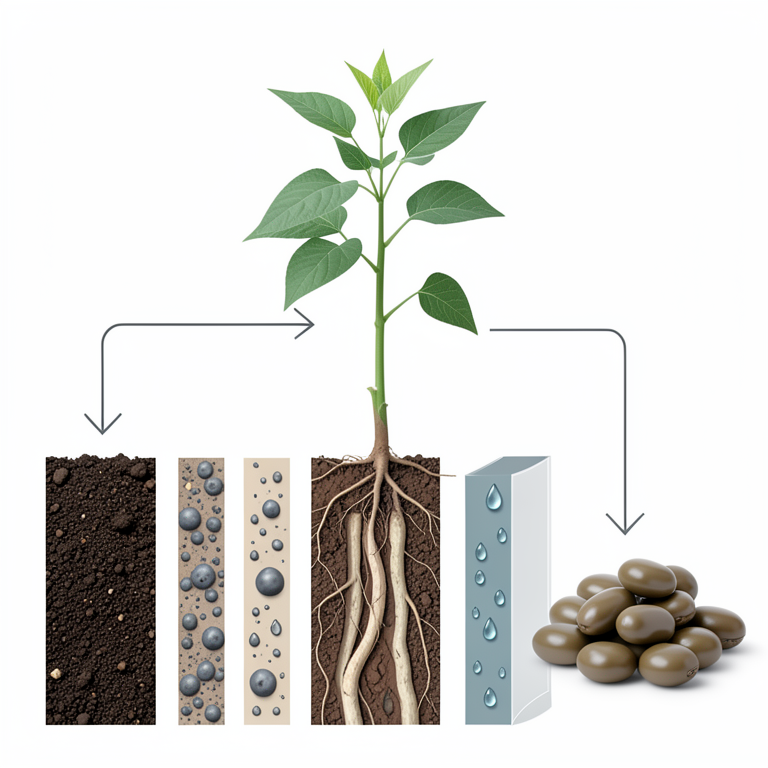
Agronomic Pillars for Soybean Nutrition
AI-generated conceptual illustration (soybean plants). It explains the idea and does not show study data.
View source evidence ↗Introduction
Soybean (Glycine max), often referred to as the "king of legumes," is a staple crop cultivated worldwide for its versatile use in food, feed, and industrial products. Globally, soybean production reached approximately 366 million metric tons in 2023, with the United States, Brazil, and Argentina leading production [1] . Its seeds are a rich source of high-quality protein (36-40%) and oil (18-20%), making it a cornerstone for addressing global nutritional needs [2] . The increasing global population, projected to surpass 9.7 billion by 2050, emphasizes the importance of nutrient-rich crops like soybean to ensure food security. However, challenges such as soil degradation, climate change, and fluctuating nutrient availability have posed significant hurdles to optimizing the nutritional quality of soybean. For instance, studies have revealed that nutrient deficiencies, particularly in nitrogen and zinc, can reduce soybean yield by up to 30% and adversely affect its protein content [3] . In addition to its macro-nutritional contributions, soybean is a critical source of micronutrients like zinc, iron, and selenium, as well as bioactive compounds like isoflavones, which are linked to numerous health benefits, including reduced risks of cardiovascular diseases and improved bone health [4] . Despite its potential, the nutritional quality of soybean remains inconsistent due to environmental and agronomic factors, necessitating interventions at the farm level. Agronomic practices offer promising solutions to enhance the nutritional profile of soybean. Optimized soil fertility management, the use of biofertilizers, crop rotation, and stress mitigation strategies can significantly improve seed protein, oil, and micronutrient content⁵.
Moreover, advancements in precision agriculture, including site-specific nutrient management and smart irrigation systems, provide tools for sustainable intensification of soybean production.
Main objective
The main objective of this paper is to explore and evaluate the role of agronomic practices in enhancing the nutritional quality of soybean, focusing on strategies to improve its protein, oil, and micronutrient content sustainably.
Soil fertility management
Soil fertility management plays a crucial role in determining the nutritional quality of soybean, as it directly influences the availability of essential nutrients required for growth and seed development. The nutritional composition of soybean seeds, particularly protein and oil content, is heavily reliant on the efficient uptake and assimilation of macro and micronutrients from the soil. Studies have consistently shown that soil fertility management strategies, including the application of organic and inorganic fertilizers, are vital for optimizing the crop's nutrient use efficiency and enhancing its nutritional profile. Nitrogen, a key macronutrient, is critical for protein synthesis in soybean. While soybean is capable of biological nitrogen fixation through its symbiotic relationship with rhizobia, the efficiency of this process depends on soil conditions. Poor soil fertility, particularly low organic matter and imbalanced pH, can significantly reduce nitrogen fixation, leading to lower protein content in seeds. A study by Hungria demonstrated that inoculating soybean with elite strains of rhizobia, combined with phosphorus and potassium application, increased seed protein levels by up to 15% compared to untreated controls. Phosphorus is another vital nutrient influencing energy transfer and root development, which are essential for nutrient absorption. Deficiency in phosphorus has been linked to reduced oil synthesis in soybean seeds. Research by Vance highlights that phosphorus supplementation in low-phosphorus soils significantly improves seed oil content and enhances plant growth parameters. Micronutrients, such as zinc, iron, and molybdenum, also play pivotal roles in soybean nutrition. Zinc is critical for enzyme activation and protein metabolism, while iron is essential for chlorophyll synthesis and overall plant vigor. Foliar application of zinc and iron has been shown to increase their concentrations in soybean seeds, addressing issues of hidden hunger in human diets. For instance, a study by Cakmak demonstrated that zinc biofortification through soil and foliar applications not only improved seed zinc content but also enhanced seed germination and vigor, indirectly improving crop quality. Soil organic amendments, such as compost and manure, are highly effective in enhancing soil fertility while contributing to sustainable agricultural practices. These amendments improve soil structure, water-holding capacity, and microbial activity, creating a conducive environment for nutrient uptake. Long-term field trials conducted by Lal (2010) [3] revealed that integrating organic amendments with balanced fertilization strategies improved seed protein and oil content by 10-12%, while also reducing dependency on chemical inputs. The role of soil pH in nutrient availability cannot be overstated. Acidic or alkaline soils often limit the availability of phosphorus, molybdenum, and other nutrients essential for soybean growth. Lime application in acidic soils has been widely recognized as a method to neutralize pH and enhance nutrient availability. Studies in acidic soils of Brazil have demonstrated that lime application increased nodulation and nitrogen fixation efficiency, thereby improving seed protein content.
Biofertilizers
Biofertilizers offer a sustainable alternative to chemical fertilizers, promoting better nutrient uptake and stress resistance in soybean. Rhizobia inoculation enhances biological nitrogen fixation, boosting protein synthesis. Similarly, mycorrhizal fungi establish symbiotic relationships with soybean roots, increasing phosphorus availability, which is essential for energy metabolism and oil biosynthesis. Plant Growth-Promoting Rhizobacteria (PGPR) further enhance nutrient use efficiency by facilitating root growth and nutrient uptake. These microbial interventions not only improve seed quality but also reduce dependency on chemical inputs, contributing to sustainable agricultural practices [2] .
Crop rotation and intercropping
Crop rotation improves soil health and nutrient availability by breaking pest and disease cycles while maintaining soil organic matter. When soybean is rotated with cereals or legumes, it benefits from enhanced nitrogen availability, which is crucial for higher protein content. Intercropping systems, such as soybean with maize or millet, optimize resource utilization, reducing competition for water, nutrients, and light. These systems ensure improved nutrient partitioning and seed composition, enhancing soybean's nutritional profile. Long-term crop rotation strategies can also reduce the accumulation of soil-borne pathogens, indirectly improving crop quality [3] .
Irrigation practices
Water availability is a crucial determinant of soybean growth and nutrient accumulation. Optimal irrigation during critical growth stages, such as pod development and seed filling, ensures adequate translocation of nutrients into seeds. Water stress, particularly during these phases, can significantly reduce protein and oil content. On the other hand, excessive water can lead to nutrient leaching and poor seed quality. Controlled irrigation practices, such as deficit irrigation during vegetative stages, have been shown to improve oil accumulation without compromising yield. Modern irrigation techniques, such as drip and sprinkler systems, facilitate uniform water distribution, improving nutrient uptake and overall seed quality [4] .
Stress management
Biotic and abiotic stresses adversely impact soybean's nutritional quality. Pests and diseases, if unmanaged, can lead to significant crop losses and reduced seed quality. Integrated Pest Management (IPM) strategies, including resistant cultivars and biological controls, are effective in minimizing such losses. Abiotic stresses such as drought, heat, and salinity require adaptive agronomic measures like mulching and the use of stress-tolerant varieties. Foliar application of anti-stress compounds, such as silicon and potassium-based products, helps mitigate the impact of abiotic stresses. These practices ensure consistent nutrient accumulation in seeds, maintaining the nutritional integrity of soybean [5] .
Challenges and future perspectives
Agronomic practices for enhancing soybean nutrition face several challenges, including limited farmer awareness, resource constraints, and the unpredictability of climate change. Future efforts should focus on integrating these practices with advanced technologies like precision agriculture and bioinformatics. Research on region-specific agronomic packages tailored for different soil types and climatic conditions can further optimize soybean nutrition. Combining agronomic strategies with genetic engineering may offer synergistic benefits, paving the way for more resilient and nutrient-rich soybean varieties⁶.
Conclusion
Agronomic practices are pivotal in improving the nutritional quality of soybean. Soil fertility management, biofertilizers, crop rotation, irrigation practices, and stress management significantly contribute to enhancing soybean's protein, oil, and micronutrient content. These methods, combined with sustainable and advanced agricultural technologies, offer promising pathways for meeting the global demand for high-quality soybean. Continued research and farmer training will be crucial for realizing the full potential of these strategies.
References
7 in the original paper- Hartman GL, West ED, Herman TK. Crops that feed the world 2. Soybean-worldwide production, use, and constraints caused by pathogens and pests. Food Secur. 2011;3(1):5-17.
- Sharma A, Shankhdhar D, Shankhdhar SC. Enhancing micronutrient accumulation and seed yield in soybean through agronomic biofortification. Legume Res. 2017;40(4):692-697.
- Lal R. Enhancing crop yields in the developing world through improved soil management. Adv Agron. 2010;109:113-152.
- Tehulie NS, Ayehu A, Nuru AS. Review on the effect of phosphorus fertilizer rates on growth and yield of soybean (Glycine max L.). J Curr Res Food Sci. 2021;2(1):31-34.
- Subramanian KS, Charest C, Dwyer LM, Hamilton RI. Arbuscular mycorrhizas and water relations in maize under drought stress at tasselling. New Phytol. 1995;129(4):643-650.
- Mahajan S, Tuteja N. Cold, salinity and drought stresses: An overview. Arch Biochem Biophys. 2005;444(2):139-158.
- Tilman D, Cassman KG, Matson PA, Naylor R, Polasky S. Agricultural sustainability and intensive production practices. Nature. 2002;418(6898):671-677.