
Research article · 2024 · Full text
International Journal of Agriculture and Food ScienceHarnessing digital and Omics technologies for precision fertilization of cranberries in Quebec: A pathway to sustainable agriculture
Volume 6(2) · Pages 176–177 · DOI: 10.33545/2664844x.2024.v6.i2c.222 ↗
Research areasGreenhouse Technology and Climate Control
Abstract
Author-writtenCranberry cultivation in Quebec faces significant challenges in nutrient management due to the introduction of new varieties with unknown nutritional needs. Traditional fertilization practices often lead to over-fertilization, escalating both economic costs and environmental degradation. This review discusses how digital and omics technologies can revolutionize cranberry cultivation by optimizing nitrogen use efficiency (NUE) and ensuring precise nutrient management. The integration of genomics, proteomics, and metabolomics insights with real-time monitoring systems offers a sustainable pathway to enhance productivity while reducing the environmental impact.
Summary
Source-checkedPlain-language reading of the full paper, prepared with AI and checked against the text. Each point links to the authors' own words.
Why it matters
- Cranberry farming in Quebec is currently challenged by the introduction of new crop varieties whose specific nutritional requirements are not yet known. View evidence ↗
- Conventional fertilization methods often result in over-application, which increases costs for farmers and causes environmental issues like soil degradation and phosphorus runoff into water. View evidence ↗
- Precision agriculture combines digital tools (like IoT sensors and drones) with omics technologies (like genomics) to better understand and meet specific crop needs. View evidence ↗
The question
- The paper aims to explore how the integration of digital and omics technologies can optimize Nitrogen Use Efficiency (NUE) and enable precise nutrient management for cranberries. View evidence ↗
What they did
- The authors recommend using a Randomized Complete Block Design (RCBD) for future experiments to ensure reliable comparisons and account for environmental variability. View evidence ↗
- The authors propose six treatment levels (T1-T6) to test different combinations of Nitrogen, Phosphorus, Potassium, and organic manure to evaluate NUE and cost efficiency. View evidence ↗
- Soil analysis for pH, organic carbon, and NPK content is proposed using flame photometry and the Olsen method. View evidence ↗
- The proposed digital framework involves using drones and sensors for real-time monitoring of plant health and soil moisture, combined with predictive analytics to forecast nutrient needs. View evidence ↗
- The proposed omics approach uses genomics to identify high-NUE varieties and proteomics/metabolomics to study nutrient metabolism pathways. View evidence ↗
What they found
- The study defines Nitrogen Use Efficiency (NUE) as the ratio of crop yield (kg/ha) to the amount of nitrogen applied (kg/ha). View evidence ↗
- The authors expect that improving NUE will lead to higher yields without increasing nitrogen input, lower fertilizer costs, and a reduced environmental footprint. View evidence ↗
What it means
- The authors conclude that integrating digital and omics technologies is a groundbreaking approach to achieving sustainable cranberry agriculture. View evidence ↗
- The authors state that data-driven nutrient management can enhance productivity and protect the environment, potentially positioning Quebec as a leader in sustainable farming. View evidence ↗
Visual summary
2 visualsIllustrations explain the paper; charts are replotted from the paper's own table values.
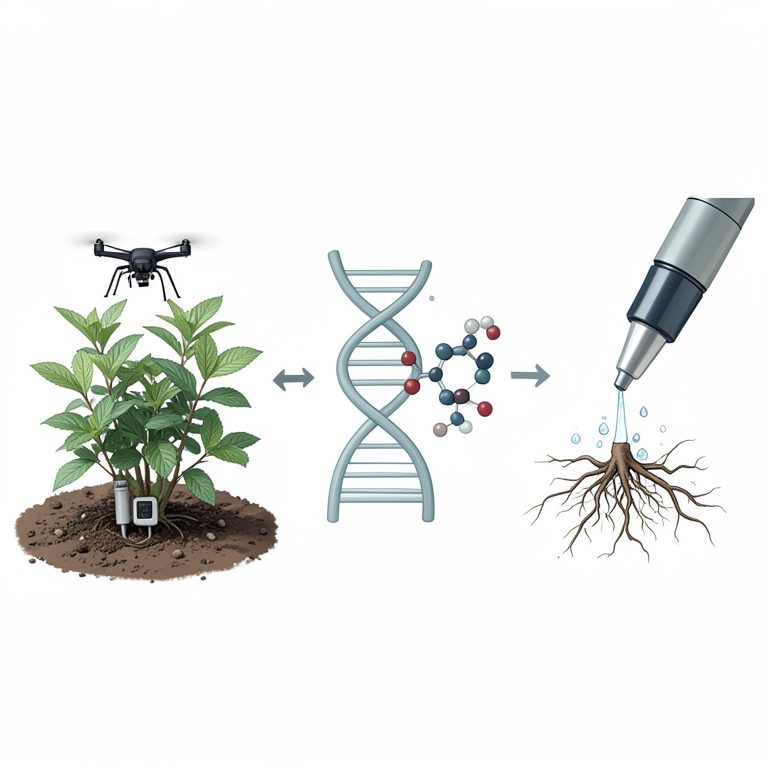
Precision Fertilization Framework
AI-generated conceptual illustration (Cranberry plants in a bog field). It explains the idea and does not show study data.
View source evidence ↗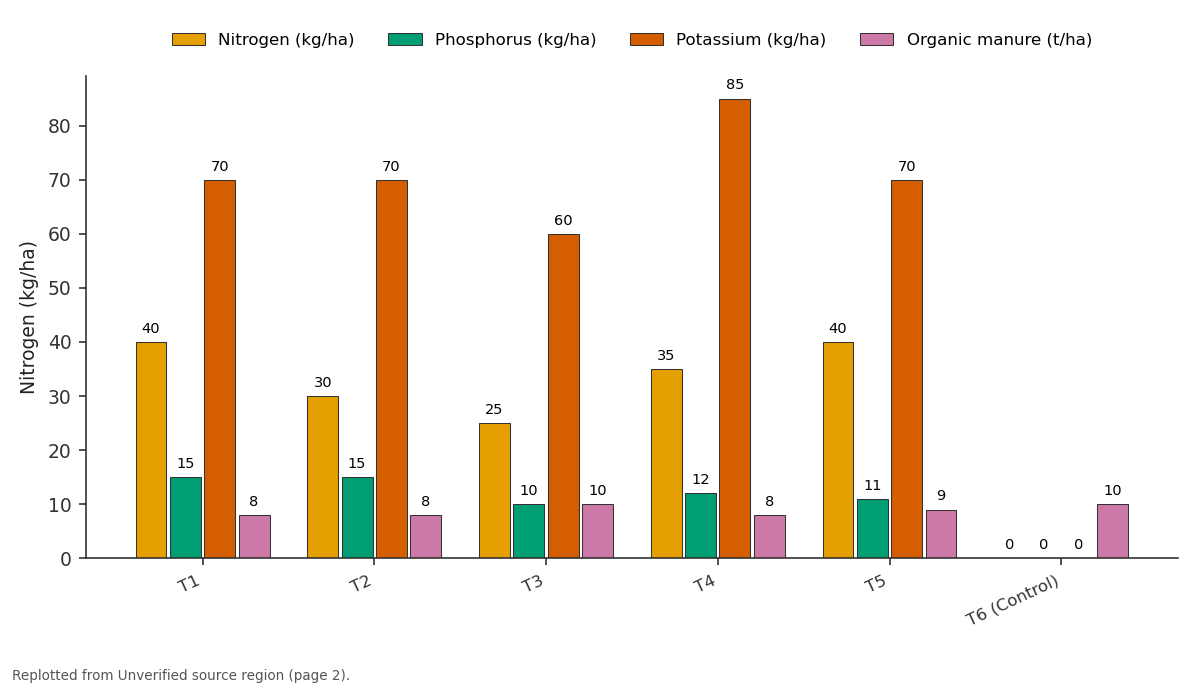
Nitrogen (kg/ha) and Phosphorus (kg/ha) and more: T1 vs T2 vs T3 vs T4 vs T5
Replotted from a table (page 2) of the original paper. Every bar is the paper's own table value.
View source evidence ↗Introduction
of new varieties with unknown nutritional needs. Traditional fertilization practices often lead to over-fertilization, escalating both economic costs and environmental degradation. This review discusses how digital and omics technologies can revolutionize cranberry cultivation by optimizing Nitrogen Use Efficiency (NUE) and ensuring precise nutrient management. The integration of genomics, proteomics, and metabolomics insights with real-time monitoring systems offers a sustainable pathway to enhance productivity while reducing the environmental impact.
Keywords: Nitrogen Use Efficiency (NUE), digital technologies, Omics technologies, genomics, proteomics, metabolomics
Introduction
Precision agriculture represents a revolutionary shift in cranberry cultivation, particularly for high-value varieties such as Crimson Queen, DeMoranville, and Mullica Queen, predominantly grown in Quebec, Canada. These varieties have distinct nutrient and water requirements that traditional farming methods have struggled to address, often resulting in inefficient fertilizer use, environmental degradation, and suboptimal yields. Precision agriculture leverages cutting-edge digital technologies, including IoT sensors, drones, GIS mapping, and data analytics, alongside omics approaches such as genomics and metabolomics, to create a more nuanced understanding of crop needs. By integrating real- time data with predictive modeling, this paradigm enables farmers to apply nutrients and water more precisely, minimizing waste and environmental impact while maximizing crop health and productivity.
As a result, precision agriculture holds the potential to enhance sustainability and profitability in cranberry farming by aligning agronomic practices with the specific requirements of each variety and their unique growing conditions. IJAFS 2024; 6(2): 176-177 Mayukh Bhattacharyya Cost of Cultivation, Economics, Statistics and Evaluation Division, Ministry of Agriculture and Farmers Welfare, Govt. of India, India Avimanyu Palit Ph.D. Research Scholar, Department of Agronomy, Bidhan Chandra Krishi Viswavidyalaya, Mohanpur, Nadia, West Bengal, India Arijit Karmakar Ph.D. Research Scholar, Department of Agronomy, Bidhan Chandra Krishi Viswavidyalaya, Mohanpur, Nadia, West Bengal, India Mayukh Bhattacharyya Cost of Cultivation, Economics, Statistics and Evaluation Division, Ministry of Agriculture and Farmers Welfare, Govt. of India, India https://www.agriculturaljournals.com Potassium (K): 56-90 kg/ha, enhancing fruit development and plant resilience.
However, these blanket recommendations often fail to consider site-specific variability, necessitating a shift towards precision fertilization.
Methodology
Optimizing fertilization through digital and omics integration Proposed treatment designs A comprehensive experimental design using a Randomized Complete Block Design (RCBD) is recommended to mitigate environmental variability and ensure reliable comparisons. The following treatments (T) are proposed: The cranberry cultivation challenge in Quebec Quebec’s cranberry industry is grappling with two critical issues Environmental impact: Overuse of fertilizers, especially nitrogen and phosphorus, has led to soil degradation and water pollution, notably phosphorus runoff. Economic inefficiency: High fertilizer costs without proportional yield increases strain profitability. Nutrient recommendations in Quebec typically range from Nitrogen (N): 22-56 kg/ha, primarily for vegetative growth. Phosphorus (P): 11-22 kg/ha, focused on root development. climatic conditions, and fertilization timing are critical in NUE optimization. Expected outcomes and benefits 1.
Enhanced crop yield: Improved NUE will lead to higher yields without increasing nitrogen input. 2. Cost reduction: Efficient nutrient use will lower fertilizer expenses, enhancing profitability. 3. Sustainability: Reduced nitrogen runoff and minimized environmental footprint will promote long-term ecological balance.
Conclusion
The future of sustainable cranberry farming The integration of digital tools and omics technologies in cranberry cultivation is a groundbreaking step towards sustainable agriculture. By enabling precise, data-driven nutrient management, these innovations promise to enhance productivity, reduce costs, and protect the environment, making Quebec a leader in sustainable cranberry farming.
Methods
Nitrogen: Modified Kjeldahl method. Phosphorus: Molybdophosphoric blue color method. Potassium: Wet digestion. Soil samples will be analyzed for pH, organic carbon, and available NPK content using techniques like the Olsen method and flame photometry. Digital and omics technologies: A new horizon in cranberry cultivation Real-time monitoring with digital tools Drones and sensors: Monitor soil moisture, nutrient levels, and plant health in real-time. Predictive analytics: Use historical and real-time data to forecast nutrient requirements, enabling timely adjustments to fertilizer applications. Omics technologies for molecular-level insights Genomics: Identify cranberry varieties with superior NUE traits, facilitating the development of low-input, high-yield varieties. Proteomics and metabolomics: Investigate nutrient metabolism pathways, offering insights into nitrogen interaction with other nutrients and enhancing fertilizer formulation.
Nitrogen Use Efficiency (NUE): A key metric for success NUE quantifies the efficiency of nitrogen input conversion into crop yield, calculated as: NUE = Crop Yield (Kg/ha) / N applied (Kg/ha) Improving NUE can simultaneously increase productivity and reduce environmental impact. Factors such as soil type,
References
5 in the original paper- Piper CS. Soil and Plant Analysis. New York: Interscience Publishers; c1966.
- Jackson ML. Soil Chemical Analysis. New Delhi: Prentice Hall of India; c1973.
- Liu D. Root developmental responses to phosphorus nutrition. J Integr Plant Biol. 2021;63(8):1065-1090.
- Srivastava AK, Hu C, editors. Fruit crops: Diagnosis and management of nutrient constraints. Elsevier; 2019 Nov 30.
- Newell-McGloughlin M. Impact of Biotechnology on Food Supply and Quality. In Fennema's Food Chemistry; c2007 Sep 18. p. 1063-1116. CRC Press. Treatment Nitrogen (kg/ha) Phosphorus (kg/ha) Potassium (kg/ha) Organic manure (t/ha) Objective T1 40 15 70 8 Standard fertilization T2 30 15 70 8 Reduced nitrogen T3 25 10 60 10 Higher organic manure T4 35 12 85 8 Increased potassium T5 40 11 70 9 Reduced phosphorus T6 (Control) 0 0 0 10 Organic manure only These treatments aim to evaluate NUE, environmental impact, and cost efficiency. Plant and soil nutrient analysis Nutrient uptake will be measured using established