
Research article · 2024 · Full text
International Journal of Veterinary Sciences and Animal HusbandryEffect of different extruded feeds varying in ingredient composition on the performance of laboratory rats
Volume 9(6) · Pages 268–270 · DOI: 10.22271/veterinary.2024.v9.i6e.1879 ↗
Research areasAnimal Nutrition and PhysiologyRabbits: Nutrition, Reproduction, Health
Abstract
Author-writtenThis study evaluated the impact of five different extruded feed formulations on body weight gain and feed intake in laboratory rats. The formulations (T1-T5) were prepared using ingredients such as maize, soybean meal, rice flour, roasted Bengal gram, and de-oiled rice bran. The chemical compositions of the raw materials were analysed. A 21-day feeding trial was conducted on 25 male Albino rats divided into five groups, each fed ad libitum with one of the feed formulations. Results showed significant variation in weight gain and feed intake among the groups, with T4 (+21.80%) and T5 (+17.40%) exhibiting superior performance compared to T1 (+8.77%) and T2 (+5.54%). T4 and T5, which included roasted Bengal gram and reduced broken rice, outperformed maize-soybean-dominant diets (T1 & T2). The findings highlight the importance of incorporating diverse ingredients such as roasted Bengal gram and de-oiled rice bran alongside maize and soybean for better palatability and weight gain in laboratory rats. This study underscores the potential for optimizing extruded feed formulations to enhance laboratory animal nutrition and suggests broader applications in cost-effective feed production.
Summary
Source-checkedPlain-language reading of the full paper, prepared with AI and checked against the text. Each point links to the authors' own words.
Why it matters
- Proper feed formulation is essential for laboratory rats because their nutritional intake directly affects their growth and overall health. View evidence ↗
- Variations in animal diets can be an uncontrolled parameter that leads to inconsistent data across different research studies. View evidence ↗
- Common feed ingredients like maize, soybean, rice flour, and roasted Bengal gram provide the energy and protein necessary for animal growth. View evidence ↗
The question
- The study aimed to evaluate how five different feed formulations affect the feed intake and body weight maintenance of laboratory rats. View evidence ↗
What they did
- The researchers conducted a 21-day trial using 25 male Albino rats, split into five groups and fed one of five different formulations ad libitum. View evidence ↗
- The feeds were produced using a double screw extruder at 120°C and then dried at 90°C to ensure moisture levels were below 8%. View evidence ↗
- The study used healthy male Albino rats with an average starting body weight exceeding 200 g. View evidence ↗
- To monitor changes, rats were weighed on an empty stomach at the start of the study and then at weekly intervals. View evidence ↗
What they found
- The crude protein levels across all five experimental feeds ranged between 18.34% and 19.67%. View evidence ↗
- All groups gained weight, with the highest increase seen in group T4 (+21.80%) and the lowest in group T2 (+5.54%). View evidence ↗
- Diets including roasted Bengal gram and de-oiled rice bran (T4, T5, T3) resulted in better weight gain and palatability than diets based solely on maize and soybean (T1, T2). View evidence ↗
- Replacing maize with rice flour in the T2 group led to lower weight gain, which the authors attribute to the increased density and consistency of the feed. View evidence ↗
- The feed intake across all treatment groups was comparable to the NRC (1995) maintenance standard of 15 g/day/head for adult rats. View evidence ↗
What it means
- The authors conclude that adding roasted Bengal gram and de-oiled rice bran to maize and soybean meal improves the performance of extruded rat feed. View evidence ↗
- The authors suggest that future research should focus on optimizing the ingredient balance and testing other additives to further improve nutritional outcomes. View evidence ↗
Visual summary
3 visualsIllustrations explain the paper; charts are replotted from the paper's own table values.
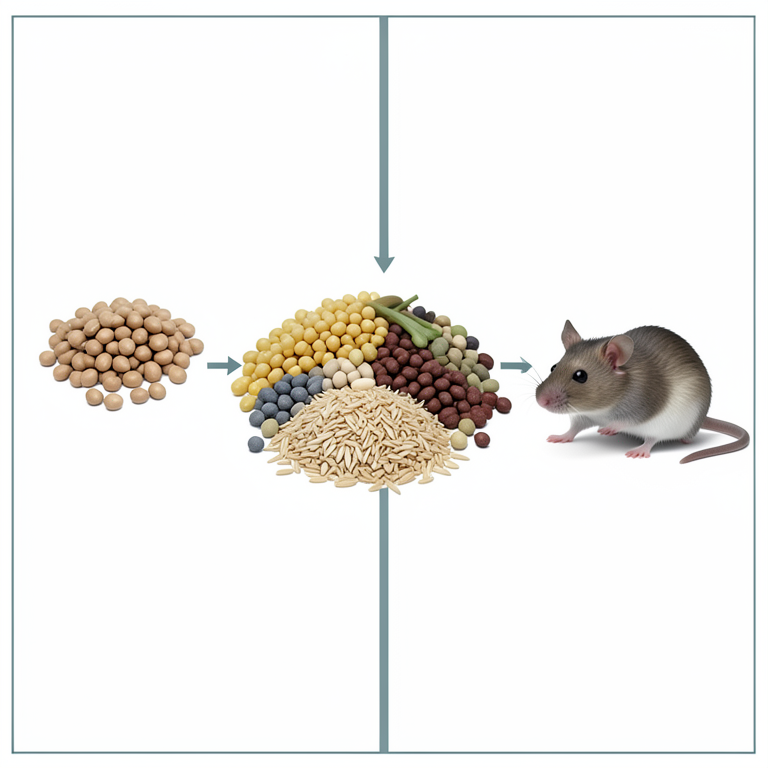
Comparison of Feed Components
AI-generated conceptual illustration (laboratory rats and extruded feed ingredients). It explains the idea and does not show study data.
View source evidence ↗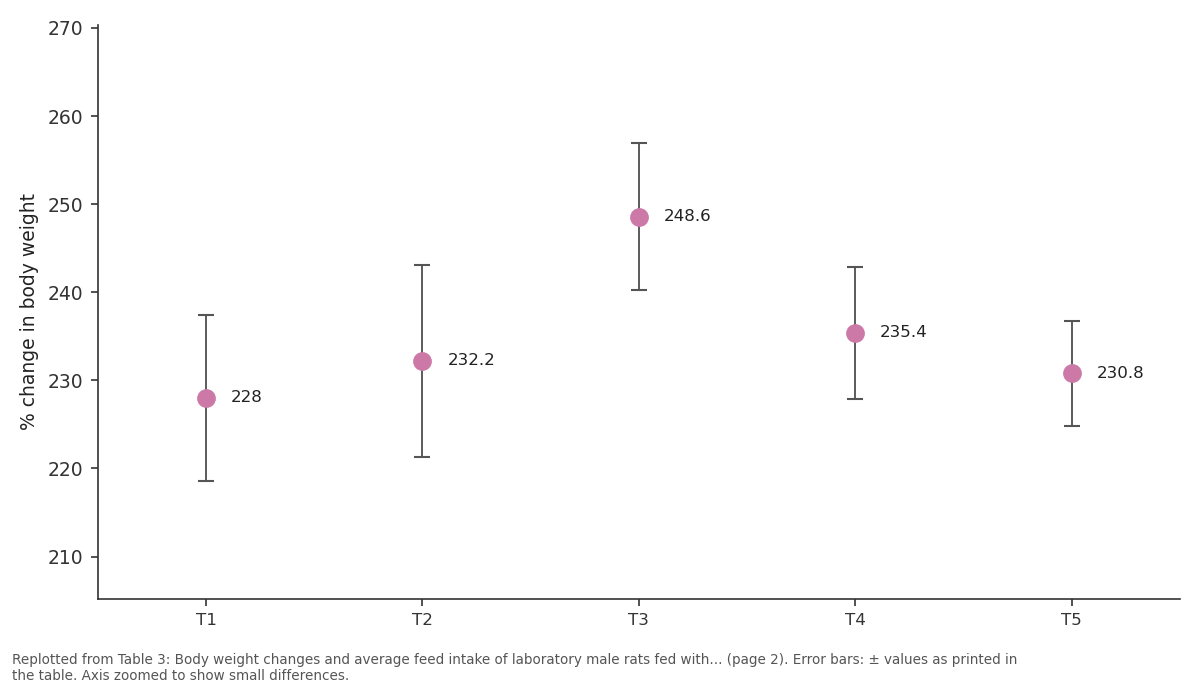
Final body weight (g): T1 vs T2 vs T3 vs T4 vs T5
Replotted from Table 3 (page 2) of the original paper. Every bar is the paper's own table value.
View source evidence ↗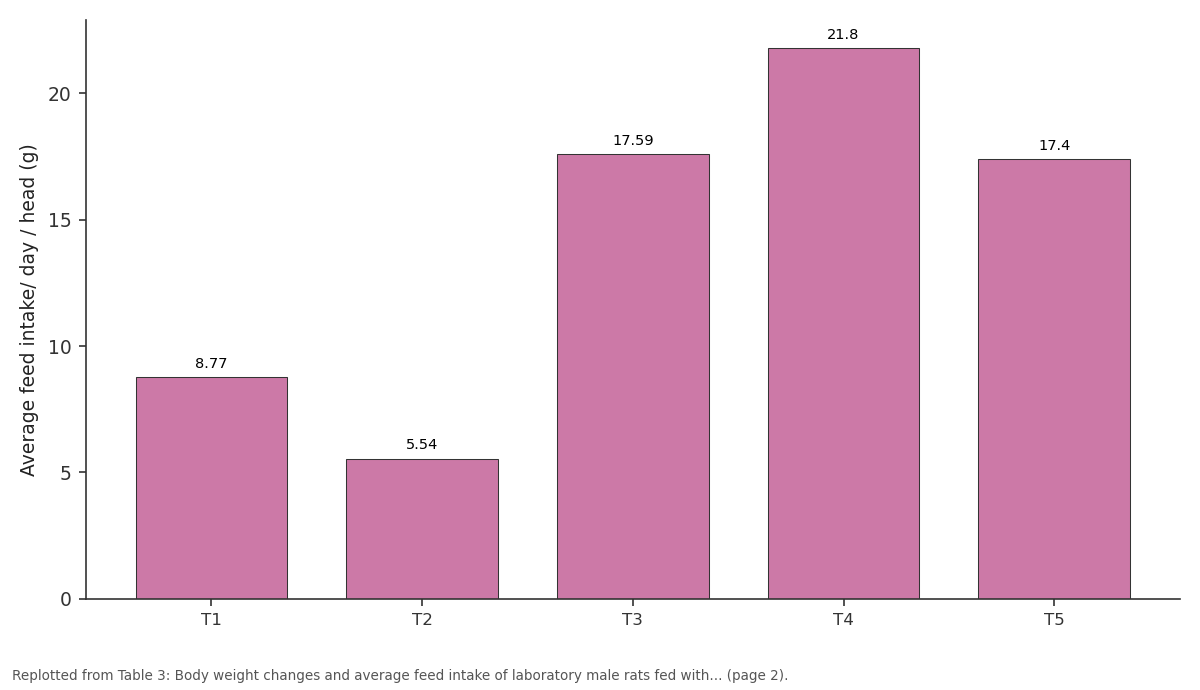
% change in body weight: T1 vs T2 vs T3 vs T4 vs T5
Replotted from Table 3 (page 2) of the original paper. Every bar is the paper's own table value.
View source evidence ↗Figures & tables
From the original paper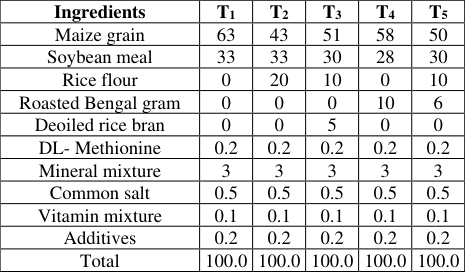 Table1
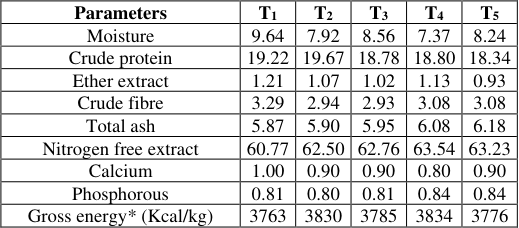 Table 2
 Table 3
Introduction
Animal feed formulation is critical in research involving laboratory rats, as nutritional intake directly influences the health and growth. In experiments, the design and composition of animal diets can significantly impact results, particularly in studies focused on weight gain and health outcomes. Maize, soybean, rice flour, roasted bengal gram, and various supplements are commonly used as ingredients in animal feeds. These components not only provide essential nutrients but also serve as sources of energy and protein, which are crucial for growth. Very few feeding experiments were conducted in laboratory animals. A balanced ration is necessary for the normal life of laboratory animals, and it is important for the researcher to make sure that the experimental results are not influenced by factors caused by nutrition (Kozul et al., 2008) [4] . The nature of the feeding diet of laboratory animals is one of the most uncontrolled parameters that affects the experimental work and leads to differences between the data obtained by different authors in similar studies (Keenan et al., 1996) [3] . Hence the objective of this study was designed to evaluate the impact of five different feed formulations on body weight maintenance and feed intake in laboratory rats. Each formulation varied in the proportion of maize, soybean meal, rice flour, and other key ingredients. Understanding the optimal balance of these ingredients can contribute to better animal nutrition and overall health, which is essential for laboratory animal research and pave way for broader applications in laboratory animal feed production.
Materials and Methods
Materials and Methods
Preparation of extruded feed
Five different types of laboratory animal feed (T 1 -T 5 ) were formulated as per the ingredient composition given in Table 1. All feed ingredients were ground to pass through 1 mm sieve and mixed well. During mixing conditioning was done by adding portable water to increase the moisture content to 25.0%. Extruded feed was prepared using double screw extruder at the temperature of 120 degree Celcius through 6 mm die and dried in an electrical dryer at 90 degree Celcius to bring the moisture content to less than 8%. The feed formulation was done to meet nearly the BIS (1970) [2] specification.
| Ingredients | T1 | T2 | T3 | T4 | T5 |
|---|---|---|---|---|---|
| Maize grain | 63 | 43 | 51 | 58 | 50 |
| Soybean meal | 33 | 33 | 30 | 28 | 30 |
| Rice flour | 0 | 20 | 10 | 0 | 10 |
| Roasted Bengal gram | 0 | 0 | 0 | 10 | 6 |
| Deoiled rice bran | 0 | 0 | 5 | 0 | 0 |
| DL- Methionine | 0.2 | 0.2 | 0.2 | 0.2 | 0.2 |
| Mineral mixture | 3 | 3 | 3 | 3 | 3 |
| Common salt | 0.5 | 0.5 | 0.5 | 0.5 | 0.5 |
| Vitamin mixture | 0.1 | 0.1 | 0.1 | 0.1 | 0.1 |
| Additives | 0.2 | 0.2 | 0.2 | 0.2 | 0.2 |
| Total | 100.0 | 100.0 | 100.0 | 100.0 | 100.0 |
Table text extracted from the original PDF; superscript letters are shown inline. The original table image is below.
View original table image
Chemical composition analysis
The crude protein, crude fibre, crude fat, ash, soluble carbohydrates including moisture content were analysed as per AOAC ( 2006) [1] .
Feeding trial
A total of 25 healthy laboratory male Albino rats with average body weight of above 200 g were selected and randomly allotted into five groups, with five rats in each group. Each group was assigned a different feed formulation (T 1 -T 5 ). The rats were housed in individual cages and were fed ad libitum (free feeding) for 21 days. During the feeding period, the rats' body weights were measured weekly to monitor changes. Each rat was weighed in empty stomach before feeding at the beginning of the study and then at weekly intervals.
Results
The analysis reports of five different extruded feeds fed to rats is presented in Table 2. The moisture content of extruded feed was less than 10%. The crude protein content of all the experimental extruded rat feed ranged from 18.34 to 19.67% on as fed basis. The crude fibre content (3.5%) was less than the BIS (1970) [2] maximum permissible level of 6%. Rats in all five groups experienced weight gain throughout the feeding period, with gains ranged from +21.80% (T 4 ) to +5.54% (T 2 ) of their initial body weight. The weight gain was poor in T 2 followed by T 1 . In T 5 , T 3 and T 4 , the body weight gain is higher. The same trend was also observed in feed intake.
| Parameters | T1 | T2 | T3 | T4 | T5 |
|---|---|---|---|---|---|
| Moisture | 9.64 | 7.92 | 8.56 | 7.37 | 8.24 |
| Crude protein | 19.22 | 19.67 | 18.78 | 18.80 | 18.34 |
| Ether extract | 1.21 | 1.07 | 1.02 | 1.13 | 0.93 |
| Crude fibre | 3.29 | 2.94 | 2.93 | 3.08 | 3.08 |
| Total ash | 5.87 | 5.90 | 5.95 | 6.08 | 6.18 |
| Nitrogen free extract | 60.77 | 62.50 | 62.76 | 63.54 | 63.23 |
| Calcium | 1.00 | 0.90 | 0.90 | 0.80 | 0.90 |
| Phosphorous | 0.81 | 0.80 | 0.81 | 0.84 | 0.84 |
| Gross energy* (Kcal/kg) | 3763 | 3830 | 3785 | 3834 | 3776 |
Table text extracted from the original PDF; superscript letters are shown inline. The original table image is below.
View original table image
Discussion
The results indicated that the feed composition plays a significant role in the weight gain of laboratory rats. Formulations with a higher proportion of energy sources (maize and broken rice) as in T 1 and T 3 , showed poor performance in terms of body weight and palatability in terms of feed intake as% of its body weight. Better results in terms of weight gain and feed palatability observed in T 4 followed by T 5 and T 3 suggested that inclusion of roasted Bengal gram and less proportion of broken rice with de oiled rice bran improved the performance in rats compared to only maize and soybean based diets (T 1 & T 2 ). The substitution of maize with rice flour in T 2 resulted lower weight gain, likely due to the more consistency and density of the extruded feed compared to other treatments. However, the feed intake in all the treatment groups were comparable with NRC (1995) [5] quoted dietary intake quantity for adult rat at maintenance (15 g/d/h).
Overall, the results of this study demonstrated that a combination of maize and soybean with less proportion of broken rice, de-oiled ricebran, roasted Bengal gram in the diet of rat promoting better performance. However, the results also highlight the importance of inclusion of variety of feed ingredients other than maize-soybean based formulation.
Conclusion
This study provides insight into the role of extruded feed ingredients composition for laboratory rats in maintaining the body weight and palatability in laboratory rats. The results suggested that in addition to maize and protein-rich ingredients like soybean meal, roasted Bengal gram, de-oiled rice bran are the key components in rat extruded feed for better performance. Future studies may focus on optimizing the balance of these ingredients and exploring the impact of other additives to further enhance the outcomes in laboratory animal's nutrition research. Such research can also have practical applications in the development of cost-effective and nutritionally balanced feeds for other laboratory animals.
Acknowledgements
The authors are thankful to the Tamil nadu Veterinary and Animal Sciences University, Chennai, India for funding and providing facility to carry out this research work.