
Research article · 2024 · Full text
International Journal of Biology SciencesAddressing Myopia progression in children: The role of occupational optometrist, a narrative review
Volume 6(2) · Pages 95–99 · DOI: 10.33545/26649926.2024.v6.i2b.238 ↗
Research areasOphthalmology and Visual Impairment Studies
Abstract
Author-writtenBackground: Myopia, or near sightedness, is a rapidly growing public health concern, particularly among children. The global prevalence of myopia has been increasing at an alarming rate, with a significant rise in early onset and progression during school years. This trend is attributed to a combination of genetic, environmental, and behavioral factors, including prolonged near work, limited outdoor activities, and increased use of digital devices. If left unaddressed, progressive myopia in childhood can lead to high myopia, which is associated with severe ocular complications in adulthood, including retinal detachment, glaucoma, and myopic maculopathy. Objective: This review aims to explore the potential role of occupational optometry in mitigating myopia progression in children, particularly within school and recreational environments. It focuses on how optometric interventions and environmental modifications can be integrated into daily routines to reduce the risk factors associated with myopia development and progression. Methods: A comprehensive review of the literature was conducted, examining studies related to the epidemiology of myopia, risk factors contributing to its onset and progression, and the effectiveness of various optometric and environmental interventions. The review also considers the specific demands placed on children's visual systems in school and recreational settings and how occupational optometry can address these challenges. Results: The findings indicate that environmental factors such as reduced outdoor time, increased near work, and digital screen exposure are significant contributors to myopia progression in children. Occupational optometry, with its focus on diagnostic procedures along with follow-ups and optimizing visual performance and comfort in specific environments, offers a valuable approach to managing these risk factors. Interventions such as promoting outdoor activities, implementing visual ergonomics in classrooms, encouraging regular visual breaks, and using specialized optical devices (e.g., multifocal lenses, orthokeratology) have shown promise in slowing myopia progression. Additionally, collaborative efforts between optometrists, educators, and parents are crucial for creating supportive environments that foster healthy visual habits in children. Conclusion: As the prevalence of myopia continues to rise globally, particularly among school-aged children, there is an urgent need for targeted interventions that address the unique visual demands of modern educational and recreational environments. Occupational optometry plays a critical role in this effort by providing evidence-based strategies to reduce myopia progression and improve visual outcomes. Integrating these strategies into school and recreational settings could significantly impact public health by reducing the long-term burden of myopia and its associated complications.
Summary
Source-checkedPlain-language reading of the full paper, prepared with AI and checked against the text. Each point links to the authors' own words.
Why it matters
- Myopia, also known as near sightedness, is a public health issue that is increasing rapidly, especially in children. View evidence ↗
- If childhood myopia progresses without intervention, it can lead to high myopia and serious adult complications like glaucoma, retinal detachment, and myopic maculopathy. View evidence ↗
- The rise in myopia is linked to a mix of genetics, behavior, and environment, specifically digital device use, limited time outdoors, and extended near-work activities. View evidence ↗
The question
- The review seeks to determine how occupational optometry can help slow the progression of myopia in children within their recreational and school settings. View evidence ↗
What they did
- The authors conducted a narrative review using search engines such as PubMed, Science Direct, and Google Scholar with keywords related to myopia, children, and occupational optometry. View evidence ↗
- The review included studies published between the years 2010 and 2024. View evidence ↗
What they found
- Genetic risk is significant; children with two myopic parents have over six times the risk of developing myopia compared to those with no myopic parents. View evidence ↗
- Near work increases risk, with one study finding a 2% increase in the likelihood of myopia development for every additional hour of near work per week. View evidence ↗
- Increasing outdoor activity has been shown to reduce the progression of myopia by 23% to 50%. View evidence ↗
- Maintaining a working distance of less than 30 cm during near-work tasks is associated with a higher risk of developing myopia. View evidence ↗
- In some populations, increasing time spent outdoors can reduce the progression of myopia by up to 50%. View evidence ↗
- Orthokeratology (Ortho-K) lenses can reduce the progression of myopia in children by 40% to 60%. View evidence ↗
What it means
- The authors conclude that occupational optometry is critical for providing evidence-based strategies to improve visual outcomes and reduce myopia progression. View evidence ↗
- Integrating optometric strategies into recreational and school settings could significantly reduce the long-term public health burden of myopia and its complications. View evidence ↗
Visual summary
1 visualsIllustrations explain the paper; they do not show study data.
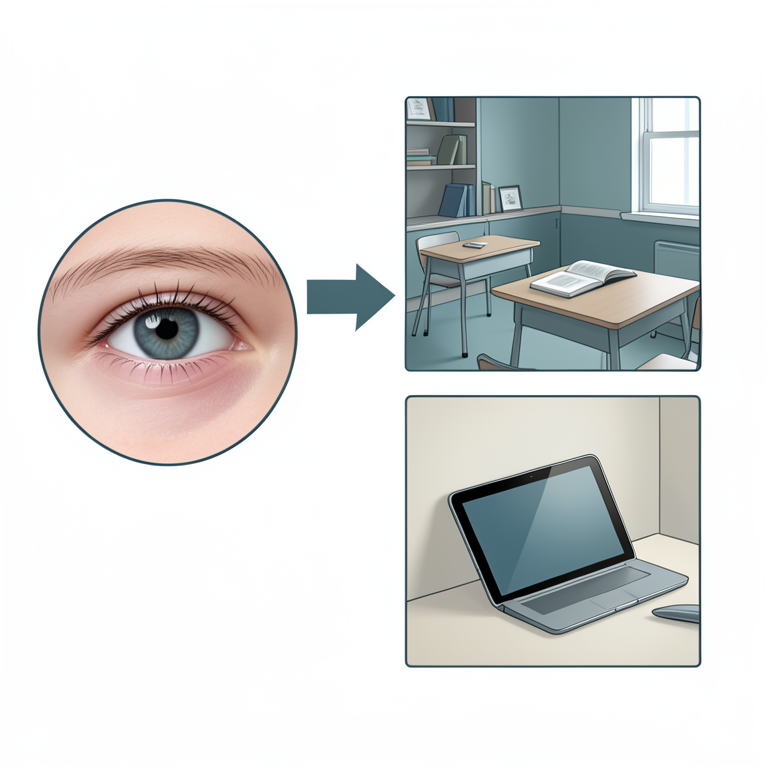
Study overview
AI-generated conceptual illustration (Children's eyes and school/home environments). It explains the idea and does not show study data.
View source evidence ↗Introduction
Myopia, commonly known as near sightedness, is rapidly becoming a global public health concern, particularly among children. The condition is characterized by the elongation of the eyeball, which results in light rays focusing in front of the retina, leading to blurred distance vision. Over the past few decades, there has been a significant rise in myopia prevalence worldwide, with some regions, such as East Asia, experiencing particularly high rates [2] . This surge in myopia is especially alarming in children, as the early onset of the condition can lead to more severe progression throughout childhood and adolescence. If left unmanaged, progressive myopia can result in high myopia a severe form of the condition that increases the risk of serious ocular complications in adulthood, such as retinal detachment, glaucoma, cataracts, and myopic maculopathy [2] .
Historically, myopia was thought to be predominantly driven by genetic factors. Children with one or both parents affected by myopia were considered at higher risk of developing the condition themselves [4] . However, recent studies indicate that environmental factors, including increased near work, reduced time spent outdoors, and prolonged exposure to digital screens, play an equally, if not more, significant role in the development and progression of myopia [8,6] . As modern lifestyles have shifted toward greater reliance on digital technology and more indoor activities, especially among school-aged children, the prevalence of myopia has surged. This phenomenon is commonly referred to as the "myopia epidemic" [1] . One of the critical periods for myopia development and progression is during the school years. Children today are exposed to greater visual demands than ever before, with long hours spent on near tasks such as reading, writing, and using digital devices in both educational and recreational settings. These activities place significant strain on the visual system, particularly on accommodation and convergence, which are required for prolonged near work [7] . Moreover, the reduction in outdoor activities due to increased academic pressures and the growing appeal of screen-based entertainment has been associated with an increased risk of developing myopia (Rose et al., 2016) [7] . Studies suggest that spending more time outdoors may protect against the onset of myopia, potentially due to the exposure to natural light and the engagement of distance vision [11] . Given the multifactorial nature of myopia, managing its progression requires a comprehensive approach that addresses both genetic and environmental risk factors. Occupational optometry, which focuses on optimizing visual performance and comfort in specific environments, offers a promising strategy for mitigating myopia progression in children. This specialized field of optometry is uniquely positioned to provide targeted interventions that can be integrated into school and recreational environments, where children spend a significant portion of their day. By focusing on visual ergonomics, environmental modifications, and preventive strategies, occupational optometrists can help reduce the strain on children's visual systems and promote healthier visual habits. Visual ergonomics is an essential component of this approach, as it involves designing environments that minimize visual discomfort and prevent excessive eye strain. In schools, this could involve optimizing classroom lighting, reducing glare from digital screens, and ensuring that desks and chairs are ergonomically designed to promote proper posture and reduce visual stress [7] . Additionally, promoting outdoor activities and incorporating visual hygiene practices, such as regular visual breaks during near work, are key strategies that can help mitigate the risk of myopia progression [8] . Moreover, optometrists can offer specific optical interventions, such as multifocal lenses, orthokeratology, and low-dose atropine eye drops, which have been shown to slow myopia progression in children [9] . These interventions, when combined with environmental modifications and behavioral changes, provide a holistic approach to managing myopia in school-aged children. As the prevalence of myopia continues to rise globally, especially among children, there is an urgent need for coordinated efforts to address this growing public health issue. The role of occupational optometry in mitigating myopia progression is particularly important in school and recreational environments, where the majority of visual demands are placed on children. By integrating evidencebased strategies and fostering collaboration between optometrists, educators, and parents, occupational optometry has the potential to significantly reduce the burden of myopia and its associated complications. This review aims to explore the potential role of occupational optometry in mitigating myopia progression in children, particularly within school and recreational environments. It focuses on how optometric interventions and environmental modifications can be integrated into daily routines to reduce the risk factors associated with myopia development and progression.
Methodology
This narrative review has been done using the keywords Myopia, children, occupational optometry, visual ergonomics, school environments, recreational environments, myopia progression, public health etc on various search engine like google scholar, Science Direct PubMed etc. studies published between 2010 to 2024 are included for this narrative review. Studies which describe about the environmental changes for myopia progression control are mainly mentioned in this study.
Risk factors for myopia progression
Myopia progression in children is influenced by a combination of genetic, environmental, and behavioral factors. Understanding these risk factors is critical for developing effective strategies to slow the progression of myopia and prevent the development of high myopia, which is associated with serious ocular complications later in life. Below is a detailed discussion of the main risk factors contributing to myopia progression: a) Genetic factors Genetic predisposition plays a significant role in the development and progression of myopia. Children with one or both parents affected by myopia have a significantly higher risk of developing the condition themselves. Parental myopia: Research has shown that children with two myopic parents have a much higher likelihood of developing myopia compared to those with nonmyopic parents. In a study by, [6] children with two myopic parents had a more than six-fold increased risk of developing myopia compared to children with no myopic parents. Heritability: Twin studies have demonstrated a strong genetic component in myopia, with heritability estimates as high as 80-90% (Hammond et al., 2001). Specific genes related to ocular development, axial length, and refractive error have been identified, further confirming the genetic basis of myopia [14] .
However, genetics alone cannot explain the rapid rise in myopia prevalence, suggesting that environmental and lifestyle factors also play a crucial role in myopia progression.
b) Environmental and behavioral factors
Environmental and lifestyle factors are increasingly recognized as key contributors to the development and progression of myopia. The modern lifestyle, characterized by increased near work, reduced outdoor activity, and extensive screen time, has been implicated in the global surge in myopia cases.
c) Increased near work
Near work, including activities such as reading, writing, and using digital devices, has long been associated with the development of myopia. Prolonged near work puts significant strain on the eye's accommodative system, potentially leading to axial elongation and myopia progression.
Mechanism: Sustained near tasks require the eyes to maintain a high level of accommodation (focusing effort), which increases the risk of myopia, especially if proper visual hygiene practices, such as regular breaks, are not followed. Evidence: A study by Ip et al., (2008) [13] found that children who spent more time on near work activities had a higher risk of developing myopia. The study indicated that for every additional hour spent on near work per week, there was a 2% increased likelihood of myopia development.
d) Prolonged digital screen time
With the proliferation of digital devices such as smartphones, tablets, and computers, children are spending more time on screens. This has emerged as a major risk factor for myopia progression, as screen use often involves near viewing distances and prolonged accommodative stress. Mechanism: Extensive screen time, especially at close distances, induces excessive near focus and may cause eye strain, leading to elongation of the eyeball over time. Evidence: Research by Lanca and Saw [8,16] suggests that excessive screen use, particularly in the form of recreational digital device use, is linked to a higher risk of developing and progressing myopia. The study highlights that the increased use of digital devices in educational settings may exacerbate this problem.
e) Reduced outdoor activity
There is strong evidence that spending time outdoors, particularly in natural light, has a protective effect against myopia onset and progression. The exact mechanism remains unclear, but it is hypothesized that exposure to bright light stimulates dopamine release in the retina, which inhibits excessive eye growth. Mechanism: Bright light exposure, and the associated dopamine release, is believed to slow the axial elongation of the eye, thus reducing the risk of myopia. Evidence: A landmark study by Rose et al., (2016) [7] demonstrated that children who spent more time outdoors had a significantly lower risk of developing myopia compared to those who spent most of their time indoors. Follow-up studies by [17] confirmed these findings, showing that increasing outdoor activity reduced the progression of myopia by 23-50%.
Axial elongation and eye growth
Myopia is primarily driven by the elongation of the eyeball, known as axial elongation. During childhood and adolescence, when the eye is still growing, axial elongation occurs more rapidly, making children particularly susceptible to myopia progression. Mechanism: Axial elongation results in light rays focusing in front of the retina, rather than on it, causing blurred distance vision. This process is influenced by both genetic and environmental factors, particularly near work and limited outdoor exposure. Evidence: Studies indicate that interventions targeting axial elongation, such as orthokeratology and low-dose atropine, are effective in slowing the progression of myopia by reducing the rate of eye growth [1] .
Urbanization and socioeconomic factors
Living in urban environments has been associated with a higher risk of myopia development and progression, likely due to lifestyle factors such as reduced outdoor space, increased academic pressures, and greater use of digital devices.
Mechanism: Urban living often leads to reduced exposure to natural light and more time spent indoors, both of which are linked to higher rates of myopia. Additionally, the emphasis on academic achievement in urban areas may lead to more near work and screen use. Evidence: Research by Morgan et al., (2012) [15] suggests that children in urban environments are at a higher risk for myopia compared to their rural counterparts, due to environmental and behavioral differences. In particular, children in cities tend to spend less time outdoors, which is a known protective factor against myopia.
Educational pressure
High academic pressure, particularly in countries where there is a strong focus on academic achievement, has been identified as a contributing factor to myopia progression. This is particularly evident in East Asian countries where intense study habits and long hours of near work are common.
Mechanism: Educational systems that demand prolonged study hours, frequent near work, and minimal outdoor play may exacerbate the risk of myopia progression in children. Evidence: In East Asian populations, where academic pressure is particularly high, myopia prevalence is significantly greater compared to other regions [8] .
Studies have shown that reducing educational demands and encouraging balanced lifestyles can mitigate this risk.
Occupational optometry's role in myopia management
Occupational optometry focuses on optimizing visual performance in specific environments, such as workplaces, educational settings, and recreational spaces. This field plays a crucial role in managing myopia progression by addressing visual ergonomics, reducing visual stress, and encouraging healthy visual habits, particularly in children.
Given that children spend a significant amount of time in school environments and engaging in recreational activities, occupational optometry offers tailored interventions that can mitigate myopia progression. Below is a detailed discussion of how occupational optometry contributes to myopia management.
Visual ergonomics in school environments
Children in modern educational settings are frequently
International Journal of Biology Sciences https://www.biologyjournal.net engaged in near-vision tasks such as reading, writing, and using digital devices for prolonged periods. These activities can contribute to visual strain, which is a known risk factor for myopia progression. Occupational optometrists can assess school environments and implement strategies to improve visual ergonomics, ensuring that students maintain healthy visual behaviors.
a) Optimizing lighting conditions
Adequate and well-positioned lighting is critical in reducing eye strain. Insufficient or overly harsh lighting can lead to glare and increased accommodative demand, contributing to myopia development.
Mechanism: Occupational optometrists ensure classrooms have optimal lighting conditions to reduce glare, enhance contrast, and minimize visual discomfort. Natural lighting is preferred, and when artificial lighting is used, it should mimic daylight as closely as possible. Evidence: Studies suggest that poor lighting conditions can exacerbate visual stress and contribute to eye strain, potentially increasing the risk of myopia progression [17] Proper lighting has been shown to improve reading performance and reduce visual fatigue, which may help prevent excessive axial elongation in children [16] .
b) Workstation setup and posture
Occupational optometrists can recommend appropriate desk heights, screen positioning, and seating arrangements to ensure students maintain proper posture while performing near work. Incorrect posture, such as leaning forward to view a screen or reading material, can increase accommodative stress and promote myopia progression. Mechanism: By promoting proper posture and ensuring that the working distance is neither too close nor too far, optometrists can reduce accommodative demand and decrease the likelihood of myopia progression. Evidence: Research indicates that children who maintain a working distance of less than 30 cm during near work are at a higher risk of developing myopia [19] . Occupational optometrists can help ensure that children maintain an optimal working distance to reduce eye strain.
a) Implementing the 20-20-20 rule
The "20-20-20" rule encourages children to take breaks from near work every 20 minutes by looking at something 20 feet away for at least 20 seconds. This practice helps reduce visual fatigue and prevents accommodative stress, which contributes to myopia progression. Mechanism: Taking regular breaks from near work reduces strain on the eye's accommodative system, which is crucial for controlling myopia progression. Evidence: Studies show that regular breaks from near work significantly reduce visual fatigue and may help slow myopia progression in children [16] . Occupational optometrists can integrate this rule into school policies and educate teachers on its importance. [7] found that children who spent more time outdoors had significantly lower rates of myopia progression compared to those who spent most of their time indoors. Follow-up studies confirmed that outdoor activity is one of the most protective factors against myopia progression [16] .
Promoting outdoor activities
Promoting outdoor activities
b) Integrating outdoor activities into curricula
Occupational optometrists can work with schools to integrate outdoor activities into the regular curriculum, ensuring that students have sufficient time outside, which may contribute to better visual health. Mechanism: By incorporating outdoor activities into school schedules, occupational optometrists help counterbalance the excessive near work that students are exposed to during academic tasks. Evidence: Increasing time spent outdoors has been shown to reduce myopia progression by up to 50% in some populations (Wu et al., 2013). Schools that have adopted outdoor activity programs, as guided by occupational optometrists, have reported a reduction in myopia progression rates [16] .
Use of specialized optical devices
Occupational optometrists can prescribe specialized optical devices designed to slow myopia progression. These include multifocal lenses, orthokeratology lenses, and spectacles designed to induce peripheral defocus. These interventions can be integrated into a child's daily routine to reduce the risk of myopia progression.
a) Multifocal spectacles and contact lenses
Multifocal lenses, both in the form of spectacles and contact lenses, have been shown to reduce the progression of myopia by altering the focus of peripheral vision. These lenses provide clear vision for near and distance tasks while inducing myopic defocus, which is thought to slow the elongation of the eye. Mechanism: By correcting central vision and simultaneously creating peripheral defocus, these lenses reduce the eye's stimulus for elongation, which is a primary factor in myopia progression. Evidence: Studies, such as those conducted by Cheng et al., (2014) [18] , demonstrate that children wearing multifocal lenses experience slower myopia progression compared to those wearing standard single-vision lenses [18] .
b) Orthokeratology (Ortho-K) Ortho-K lenses are worn overnight to temporarily reshape the cornea, providing clear vision during the day without the need for glasses. These lenses have been shown to slow axial elongation in children and are a popular intervention in myopia management. Mechanism: Orthokeratology reshapes the cornea to correct vision and creates peripheral defocus, which helps control myopia progression. Evidence: Research by Cho and Cheung, (2012) [19] has shown that Ortho-K can reduce myopia progression by 40-60% in children. Occupational optometrists can recommend Ortho-K for children with rapidly progressing myopia [18,19] .
Parental and teacher education
Occupational optometrists play a key role in educating parents and teachers about the importance of managing visual stress and promoting healthy visual habits. Parental awareness and involvement are crucial in ensuring that children adhere to visual hygiene practices at home, while teachers can help implement these strategies in the classroom.
a) Parental involvement
Parents play a crucial role in managing their children's screen time, ensuring regular outdoor activities, and encouraging proper posture during homework or recreational activities.
Mechanism: By educating parents on the risk factors for myopia progression and providing practical tips for managing them, occupational optometrists can ensure that children receive consistent support at home. Evidence: Studies show that parental involvement in managing screen time and promoting outdoor activities significantly impacts myopia progression [8] .
Conclusion
As the prevalence of myopia continues to rise globally, particularly among school-aged children, there is an urgent need for targeted interventions that address the unique visual demands of modern educational and recreational environments. Occupational optometry plays a critical role in this effort by providing evidence-based strategies to reduce myopia progression and improve visual outcomes. Integrating these strategies into school and recreational settings could significantly impact public health by reducing the long-term burden of myopia and its associated complications.
References
16 in the original paper- Flitcroft DI. The complex interactions of retinal, optical and environmental factors in myopia aetiology. Prog Retin Eye Res. 2012;31(6):622-660. DOI: 10.1016/j.preteyeres.2012.06.004.
- Goss DA, Grosvenor T. Myopia and near work: relaxing the accommodation: implications for prevention of myopia. J Am Optom Assoc. 2014;65(2):135-140.
- Holden BA, Fricke TR, Wilson DA, et al. Global prevalence of myopia and high myopia and temporal trends from 2000 through 2050. Ophthalmology. 2016;123(5):1036-1042. DOI: 10.1016/j.ophtha.2016.01.006.
- Mutti DO, Mitchell GL, Moeschberger ML, Jones LA, Zadnik K. Parental myopia, near work, school achievement, and children's refractive error. Invest Ophthalmol Vis Sci. 2002;43(12):3633-3640.
- Rose KA, Morgan IG, Ip J, et al. Outdoor activity reduces the prevalence of myopia in children. Ophthalmology. 2016;115(8):1279-1285. DOI: 10.1016/j.ophtha.2007.12.019.
- Saw SM, Gazzard G, Shih-Yen EC, Chua WH. Myopia and associated pathological complications. Ophthalmic Physiol Opt. 2005;25(5):381-391. DOI: 10.1111/j.14751313.2005.00298.x.
- Walline JJ, Lindsley KB, Vedula SS, et al. Interventions to slow progression of myopia in children. Cochrane Database Syst Rev. 2020;1(1):CD004916.
- Wu PC, Huang HM, Yu HJ, et al. Epidemiology of myopia and prevention of myopia progression in children in East Asia: A review. Taiwan J Ophthalmol. 2016;6(1):3-9.
- Xiong S, Sankaridurg P, Naduvilath T, et al. Time outdoors and myopia progression over 2 years in Chinese children: The Anyang Childhood Eye Study. Invest Ophthalmol Vis Sci. 2017;58(8).
- Hammond CJ, et al. The heritability of refractive error: The twin eye study. Invest Ophthalmol Vis Sci. 2001;42(6):1234-1239.
- Ip JM, et al. The influence of near work and time spent outdoors on myopia in children. Ophthalmology. 2008;115(8):1279-1285.
- Lanca C, Saw SM. The association between digital screen time and myopia: A systematic review. Ophthalmic Physiol Opt. 2020;40(2):216-229.
- Tedja MS, et al. Genome-wide association metaanalysis highlights light-induced signaling as a driver for refractive error. Nat Genet. 2019;50(6):834-848.
- Wu PC, et al. Myopia prevention and outdoor light intensity in a school-based cluster randomized trial. Ophthalmology. 2013;120(5):1080-1085.
- Cheng D, Woo GC, Drobe B, Schmid KL. Effect of bifocal and prismatic bifocal spectacles on myopia progression in children: Three-year results of a randomized clinical trial. JAMA Ophthalmol. 2014;132(3):258-264.
- Cho P, Cheung SW. Retardation of myopia in orthokeratology (ROMIO) study: A 2-year randomized clinical trial. Invest Ophthalmol Vis Sci. 2012;53(11):7077-7085.