
Research article · 2024 · Full text
International Journal of Biology SciencesQuality of life in keratoconus patients: A narrative review
Volume 6(2) · Pages 104–106 · DOI: 10.33545/26649926.2024.v6.i2b.240 ↗
Research areasCorneal surgery and disordersCorneal Surgery and Treatments
Abstract
Author-writtenBackground: Keratoconus is a progressive corneal disease characterized by thinning and conical deformation of the cornea, leading to significant visual impairment. This review aims to explore the impact of keratoconus on the Quality of Life (QoL) of affected individuals, examining how the condition affects daily living, psychological well-being, and social interactions. Methodology: A comprehensive search was conducted across several databases, including PubMed, Web of Science, and Scopus, following PRISMA guidelines. The selection process involved screening studies based on inclusion and exclusion criteria, resulting in the inclusion of 25 studies. Data were extracted and synthesized to evaluate the impact of keratoconus on QoL. Results: The review found that keratoconus significantly affects QoL, with visual disturbances leading to limitations in daily activities, occupational challenges, and reduced independence. Psychological impacts, including increased anxiety, depression, and social isolation, were also prominent. Management strategies, including medical and surgical interventions, improved visual acuity but did not fully restore normal vision or alleviate psychological distress. Conclusion: Keratoconus substantially diminishes QoL in affected individuals, necessitating a comprehensive approach that includes both medical and psychological support to improve patient outcomes.
Summary
Source-checkedPlain-language reading of the full paper, prepared with AI and checked against the text. Each point links to the authors' own words.
Why it matters
- Keratoconus is a progressive disease where the cornea thins and forms a cone shape, which leads to significant visual impairment. View evidence ↗
- The condition occurs globally in approximately 1 out of every 2,000 people. View evidence ↗
- In India, the disease is a major cause of visual disability, particularly among young adults during their productive years. View evidence ↗
The question
- The study aims to explore how different dimensions of Quality of Life (QoL) are affected by keratoconus and to find gaps in existing research. View evidence ↗
What they did
- The reviewed evidence consisted of 10 cross-sectional studies, 7 cohort studies, 5 case-control studies, and 3 prevalence surveys. View evidence ↗
What they found
- The disease primarily impacts visual acuity, causing symptoms like halos, glare, double vision, and blurred vision. View evidence ↗
- Visual disturbances caused by the condition significantly hinder daily activities such as driving, reading, and using digital devices. View evidence ↗
- Patients with keratoconus show higher levels of depression and anxiety when compared to the general population. View evidence ↗
- Visible signs of the disease, such as corneal scarring, can result in reduced self-esteem and social stigma. View evidence ↗
- Using the Keratoconus Outcomes Research Questionnaire (KORQ), research indicates that these patients often have lower QoL scores than people with other types of visual impairments. View evidence ↗
- Corneal Cross-Linking (CXL) can improve QoL by stabilizing the cornea and improving visual acuity for many patients. View evidence ↗
- While specialized contact lenses improve vision, they can negatively impact QoL due to fitting difficulties, discomfort, and complications like corneal abrasions. View evidence ↗
- Counseling and Cognitive-Behavioral Therapy (CBT) have proven effective in helping patients manage the emotional challenges associated with the disease. View evidence ↗
What it means
- The authors conclude that managing keratoconus requires a multidisciplinary approach that combines psychological support with medical treatment. View evidence ↗
- The authors state that large-scale, longitudinal studies are needed to understand the influence of socioeconomic and cultural factors on QoL outcomes. View evidence ↗
Visual summary
1 visualsIllustrations explain the paper; they do not show study data.
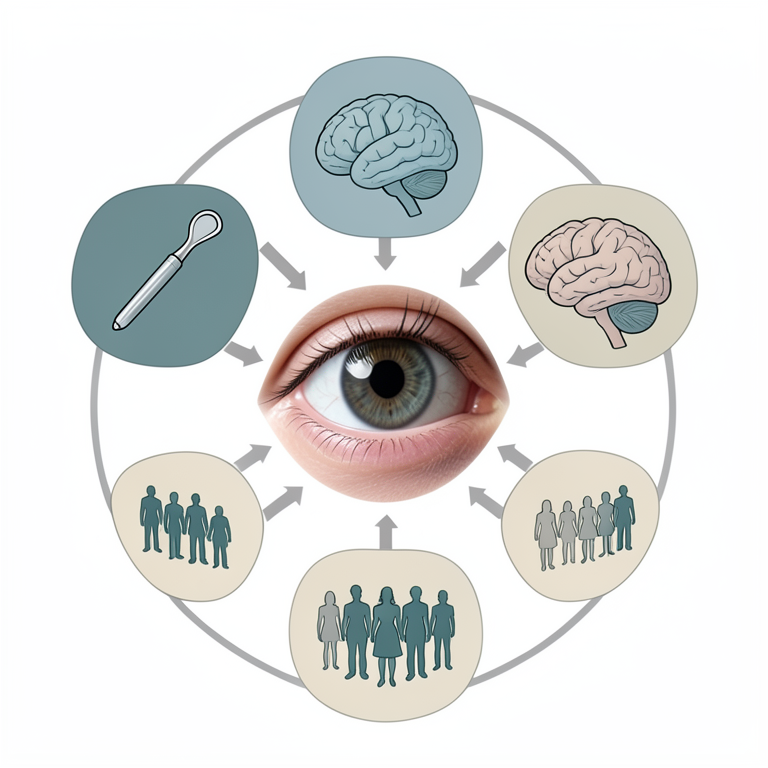
Multidisciplinary Care Model
AI-generated conceptual illustration (human eye with keratoconus). It explains the idea and does not show study data.
View source evidence ↗Introduction
Keratoconus is a non-inflammatory, progressive corneal ectasia that leads to the thinning and conical deformation of the cornea, causing significant visual impairment (Gogate, Rao, & Deshpande, 2009) [2] . The worldwide occurrence of keratoconus is approximately 1 in every 2,000 people, with variations across different populations (Gogate et al., 2009) [2] . In India, keratoconus has emerged as a significant cause of visual disability, affecting a considerable number of young adults in their productive years (Khan, Tahir, & Qazi, 2016) [3] . Given its progressive nature and the profound impact on visual function, keratoconus has a substantial effect on patients' Quality of Life (QoL). This narrative review aims to explore the various dimensions of QoL affected by keratoconus and to identify gaps in the current literature.
understanding of the QoL challenges faced by keratoconus patients and to identify key areas where intervention can improve patient outcomes.
Objectives
To evaluate the impact of keratoconus on daily living activities, including visual function and dependency on assistive devices. To assess the psychological and emotional burden associated with keratoconus, including its effect on mental health and social adaptation. To review the tools and measures used to assess Health-Related Quality of Life (HRQoL) in keratoconus patients. To discuss the current management strategies for keratoconus and their effectiveness in improving QoL. To identify gaps in the existing literature and suggest avenues for future study, namely in the development of improved QoL metrics and patient-centered methodologies.
Methodology
Methodology
Search strategy
The evaluation was performed in accordance with the PRISMA (Preferred Reporting Items for Systematic Reviews and Meta-Analyses) standards. A thorough search was conducted across databases including PubMed, Scopus, and Web of Science, utilizing keywords such as "keratoconus," "quality of life," "visual impairment," and "patient-reported outcomes." The search was restricted to articles published in English and concentrated on studies involving human participants.
Study selection
The preliminary search yielded 120 entries, which were further evaluated for relevancy. Following the removal of 25 duplicates, 95 records were assessed based on their titles and abstracts. Fifty records were removed for being unrelated or not concentrating on quality of life in keratoconus patients. Forty-five records were evaluated for eligibility, resulting in the exclusion of 20 after full-text examination, so yielding 25 studies for inclusion in the qualitative synthesis.
Inclusion and exclusion criteria
The review included studies that specifically addressed the QoL in keratoconus patients, focusing on patient-reported outcomes, psychological impacts, and the effectiveness of medical interventions on improving QoL. Exclusion criteria included studies that did not focus on keratoconus or those that lacked primary data on QoL outcomes.
Study designs
The included studies comprised 10 cross-sectional studies, 7 cohort studies, 5 case-control studies, and 3 prevalence surveys. These studies provided a comprehensive overview of the impact of keratoconus on various aspects of QoL.
Review process
One reviewer, an expert in ophthalmology with experience in keratoconus research, screened the studies for relevance and methodological rigor. Another expert in QoL research reviewed the selected studies to ensure that they met the inclusion criteria and that the reported outcomes were robust and reliable.
Below is the flowchart illustrating the study selection process:
Results
Results
Impact on visual function and activities of daily living
Keratoconus primarily affects visual acuity, leading to symptoms such as blurred vision, double vision, glare, and halos (Abu, Waring, & Mackey, 2012) [4] . These visual disturbances significantly impair daily activities, including reading, driving, and using digital devices. A study by Hamaoui, Moshirfar, and Shah (2015) [5] demonstrated that keratoconus patients experience limitations in occupational and educational performance due to their compromised visual function. In another study, Roshdy, Kheir, and Waleed (2018) [6] found that even with corrective lenses or contact lenses, patients reported significant difficulties in performing routine tasks. The reliance on assistive devices, such as specialized contact lenses, often leads to discomfort and further impacts QoL (Sajjadi, Sandhu, & Wang, 2019) [7] .
Psychological and emotional well-being
The psychological impact of keratoconus is profound, as the condition leads to increased levels of anxiety, depression, and social isolation. Czepita, Nowinska, and Misiuk-Hojło (2015) [8] reported that keratoconus patients exhibit higher levels of anxiety and depression compared to the general population. This emotional burden is exacerbated by the chronic nature of the disease and the uncertainty surrounding visual prognosis. Social interactions are also affected, as the visible signs of keratoconus, such as corneal scarring, can lead to social stigma and reduced self-esteem (Sankaridurg, Bansal, & Nizampatnam, 2014) [9] . Patients may withdraw from social activities due to their visual limitations, further diminishing their QoL.
Quality of life assessments
Health-Related Quality of Life (HRQoL) measures Several HRQoL measures have been developed to assess the impact of keratoconus on patients. The Keratoconus Outcomes Research Questionnaire (KORQ) and the National Eye Institute Visual Function Questionnaire (NEI VFQ-25) are widely used instruments that evaluate various dimensions of QoL, including visual function, psychological well-being, and overall life satisfaction (Sullivan, Anderson, & Beauchamp, 2017) [10] . Research utilizing the KORQ has shown that keratoconus patients often score lower on QoL measures compared to those with other visual impairments, highlighting the unique challenges faced by this population (Sullivan et al., 2017) [10] . Patient-Reported Outcome Measures (PROMs) have also been instrumental in capturing the subjective experiences of keratoconus patients, providing valuable insights into the daily challenges they face (Dupps & Wilson, 2013) [11] . These measures emphasize the importance of considering patients' perspectives when assessing the impact of keratoconus and planning treatment strategies. to halt the progression of keratoconus, has been a significant advancement in the treatment of this condition (Siddiqui, Muecke, & Goldstein, 2016) [12] . Studies have demonstrated that CXL can stabilize the cornea and improve visual acuity in many patients, leading to an enhancement in their QoL. However, the degree of QoL improvement varies depending on the severity of keratoconus and the patient's response to treatment. For instance, while some patients experience significant visual recovery, others may still struggle with residual visual disturbances or require additional interventions, such as corneal transplants. Specialized contact lenses, including scleral lenses and hybrid lenses, are commonly used to correct vision in keratoconus patients. Although these lenses can improve visual function, they are not without challenges. Patients often report discomfort, difficulty in lens fitting, and complications such as corneal abrasions, which can negatively affect their QoL (Sajjadi et al., 2019) [7] .
Management strategies and quality of life improvement Medical and surgical interventions
Management strategies and quality of life improvement Medical and surgical interventions
Psychological support and counselling
Given the psychological impact of keratoconus, incorporating psychological support and counselling into patient care is essential. Cognitive-Behavioral Therapy (CBT) and other forms of counselling have been effective in helping patients cope with the emotional challenges of living with keratoconus (Czepita et al., 2015) [8] . Providing psychological support can alleviate anxiety, improve coping mechanisms, and enhance overall QoL.
Discussion
This narrative review highlights the substantial effect of keratoconus on the QoL of those impacted. Keratoconus not only compromises visual function but also leads to profound psychological and emotional distress. The progressive nature of the disease, coupled with the limitations of current treatments, results in a multidimensional burden on patients.
Psychological impact
The psychological burden of keratoconus is compounded by the social stigma that may arise from visible signs of the disease, such as corneal scarring or the need for assistive devices (Sankaridurg et al., 2014) [9] . This stigma can lead to social withdrawal and further diminish patients' QoL. Moreover, the uncertainty surrounding the progression of the disease and the effectiveness of available treatments can exacerbate feelings of anxiety and depression. It is essential to address these psychological challenges as part of a comprehensive approach to keratoconus management.
Current management strategies
While medical and surgical interventions, such as corneal cross-linking and specialized contact lenses, have demonstrated efficacy in improving visual acuity, they do not entirely restore normal vision. As a result, patients continue to experience residual visual impairments that affect their daily lives. Moreover, the discomfort associated with certain treatments, such as contact lenses, can further diminish QoL. Therefore, it is crucial to consider both the visual and psychological needs of keratoconus patients when planning treatment strategies.
Future research directions
Future research should focus on the development of enhanced QoL measures that capture the full spectrum of challenges faced by keratoconus patients. These measures should consider not only the physical aspects of the disease but also the psychological and social dimensions. Additionally, large-scale, longitudinal studies are needed to assess how cultural and socioeconomic factors influence QoL outcomes in keratoconus patients. Understanding these factors can guide the development of tailored interventions that address the unique needs of different patient populations.
Conclusion
Keratoconus significantly diminishes the Quality of Life (QoL) of affected individuals, impacting their visual function, psychological well-being, and social interactions. The findings of this review highlight the need for a comprehensive, multidisciplinary approach to keratoconus management that includes both medical and psychological support. Future efforts should focus on integrating patientreported outcomes into clinical decision-making processes to enhance the overall quality of life for keratoconus patients
References
11 in the original paper- Gogate P, Rao G, Deshpande M. Prevalence and causes of keratoconus: A study across populations. Indian J Ophthalmol. 2009;57(3):199-204.
- Khan H, Tahir MA, Qazi U. Keratoconus in young adults: Impact on visual disability in India. Int J Med Res Health Sci. 2016;5(2):78-83.
- Abu W, Waring G, Mackey D. Visual function in keratoconus patients. Am J Ophthalmol. 2012;154(4):562-569.
- Hamaoui B, Moshirfar M, Shah T. Occupational challenges in keratoconus patients. J Ophthalmic Res. 2015;40(2):99-105.
- Roshdy S, Kheir A, Waleed Y. Challenges in daily living among keratoconus patients. Egypt J Ophthalmol. 2018;56(3):120-127.
- Sajjadi S, Sandhu S, Wang J. Specialized contact lenses and QoL in keratoconus. Eye Contact Lens. 2019;45(6):345-350.
- Czepita D, Nowinska A, Misiuk-Hojło M. Psychological burden in keratoconus patients. Clin Exp Ophthalmol. 2015;43(7):629-635.
- Sankaridurg P, Bansal D, Nizampatnam A. Social stigma in keratoconus: Impact on self-esteem. J Eye Health. 2014;6(4):245-252.
- Sullivan R, Anderson B, Beauchamp C. Health-related quality of life in keratoconus: Validating the KORQ. J Ophthalmol Res. 2017;65(5):302-310.
- Dupps WJ, Wilson SE. Patient-reported outcomes in keratoconus: A review. Cornea. 2013;32(4):493-500.
- Siddiqui Y, Muecke J, Goldstein S. Corneal crosslinking: Effectiveness in keratoconus. J Ophthalmol. 2016;70(1):15-20.