
Research article · 2024 · Full text
International Journal of Biology SciencesDigital screen exposure and its influence on dry eye syndrome among young adults
Volume 6(2) · Pages 100–103 · DOI: 10.33545/26649926.2024.v6.i2b.239 ↗
Research areasErgonomics and Musculoskeletal DisordersOcular Surface and Contact Lens
Abstract
Author-writtenAim: To explore the impact of various digital screen usage patterns, including duration and content, on the occurrence and severity of dry eye syndrome among adults. Methodology: It was an observational cross-sectional study that was held at ASG Eye Hospital, Agarpara. It was a convenience sampling. There were 36 patients in this study. Following these, the study period was 4 months, and patients’ belonging the age group was 25-35 years. Patients were asked to fill out the consent form. The visual acuity of the selected patient was measured with Snellen’s chart. Patients were asked to fill out the SPEED questionnaire along with their digital screen use timing. Afterwards, the Schirmers test I was performed for the participants. All the data was collected and added to Microsoft Excel with coding. Data analysis was done with the appropriate statistical analysis method. Result: A connection between screen usage and dry eye syndrome has been demonstrated in earlier research. 36 patients in all, of whom 21 were female and 15 were male, participated in the study. Individuals who use digital gadgets for longer than eight hours must be between the ages of 25-35 years were included in this study. As opposed to this, 52.8% of women and 80% of men had Dry Eye Syndrome (DES). The association between SVT and SPEED was then examined using linear regression. This instance has a positive relationship because the p value is 0.1098, which is higher than 0.05 and it is called weak positive relationship Using the regression line to measure the association between SVT and DED, it was shown that the p value is 0.0243, which is less than 0.05. Conclusion: My research aims to determine whether there is a correlation between screen time and dry eye. My research revealed that the likelihood of developing dry eye syndrome increases with screen time. Therefore, the null hypothesis is being rejected. As well as acknowledging the alternative theory's significance relationship. Everyone needs to be more mindful because screen time is linked to dry eyes. I believe that these behavioural factors blink rate, break, and screen brightness can be included in future research to obtain more information.
Summary
Source-checkedPlain-language reading of the full paper, prepared with AI and checked against the text. Each point links to the authors' own words.
Why it matters
- Dry Eye Syndrome (DES) occurs when the eyes produce poor-quality or insufficient tears, which can cause visual disturbances and damage the ocular surface. View evidence ↗
- The use of digital devices may lead to dry eye because it reduces the rate at which a person blinks. View evidence ↗
- Accurate diagnostic testing is critical because incorrect diagnoses can lead to treatments, such as certain antibiotics or antiallergic medications, that worsen dry eye. View evidence ↗
The question
- The study aimed to investigate how different digital screen usage patterns, specifically duration and content, affect the severity and occurrence of dry eye syndrome in adults. View evidence ↗
What they did
- This was a 4-month observational cross-sectional study conducted at ASG Eye Hospital in Agarpara, Kolkata. View evidence ↗
- The study used convenience sampling to recruit 36 participants aged 25-35 who used digital devices for more than 8 hours daily. View evidence ↗
- Tear quantity was measured using the Schirmer test I, where 5mm x 30mm filter paper strips were measured for wetness after 5 minutes. View evidence ↗
- Symptom severity was qualitatively assessed using the SPEED questionnaire, which scores eight different symptoms on a scale from 0 to 28. View evidence ↗
- The researchers used descriptive analysis and linear correlation regression to analyze the relationship between screen time and dry eye syndrome. View evidence ↗
What they found
- The study group consisted of 36 participants (21 female, 15 male) with a mean age of 27.92 ± 3.392 years. View evidence ↗
- The prevalence of Dry Eye Disease (DED) was higher in men (80%) than in women (52.38%). View evidence ↗
- Regression analysis showed a statistically significant positive linear relationship between screen time and dry eye disease (p = 0.02423). View evidence ↗
- The relationship between screen time and dry eye disease was characterized as a moderate positive relationship, with a correlation coefficient of 0.375. View evidence ↗
- There was no statistically significant linear relationship found between screen time (SVT) and the SPEED questionnaire scores (p = 0.1098). View evidence ↗
What it means
- The authors concluded that the probability of developing dry eye syndrome increases as screen time increases. View evidence ↗
- The authors suggest that future research should include behavioral factors such as screen brightness, breaks, and blink rate to provide more detailed information. View evidence ↗
Visual summary
1 visualsIllustrations explain the paper; they do not show study data.
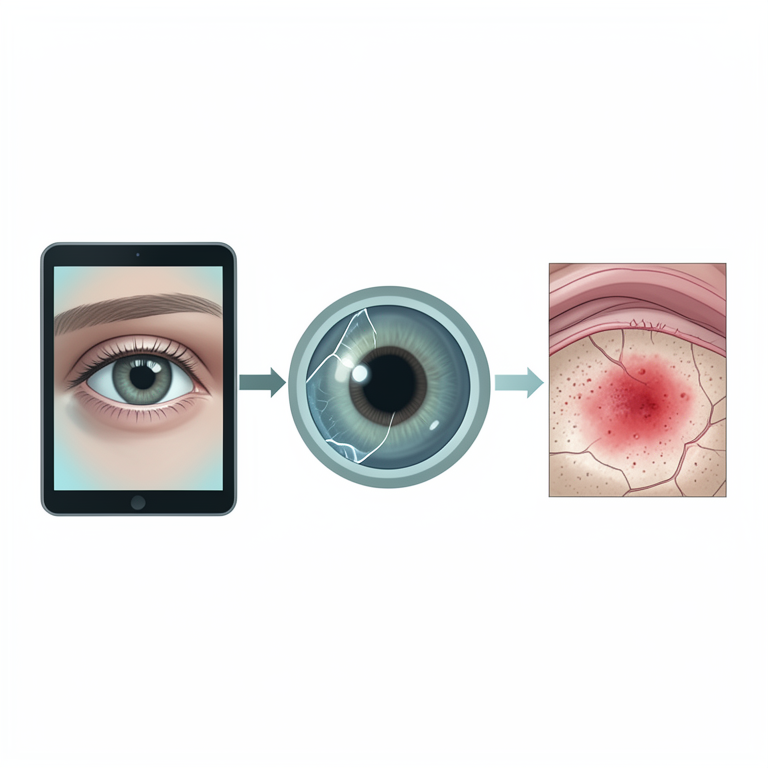
Mechanism of Digital Dry Eye
AI-generated conceptual illustration (human eye and digital screen). It explains the idea and does not show study data.
View source evidence ↗Introduction
In today's digital age, screens are ubiquitous, playing a pivotal role in communication, education, work, and entertainment. Young adults, in particular, are immersed in digital environments, often spending hours each day in front of various screens. While the advantages of digital technology are vast, there is a growing concern about its potential negative impact on ocular health, specifically regarding Dry Eye Syndrome (DES). DES is a condition where the eyes fail to produce sufficient tears or produce poor-quality tears, leading to discomfort, visual disturbances, and potential damage to the ocular surface. The link between digital eye strain and dry eye: One common sign of digital eye strain is dry eye. According to "The link between digital eye strain and dry eye", dry eye was one of the symptoms mentioned by 27.2% of those with digital eye strain. Our blink rate reduces when using digital devices, which might cause dry eye [1] . A common illness known as dry eye disease arises when our tears are insufficient to lubricate our eyes adequately. For a variety of reasons tears may not be sufficient or steady. For instance, inadequate tear production or low-quality tear production might lead to dry eye. The instability of tears causes inflammation and surface damage to the eye. Symptoms include -dryness, irritation, redness, blurred vision, foreign body sensation, watering. Dry eye impairs functional vision, especially while doing the near activities [2] . According to article "Dry eye in the digital age" by Ernie Bowling, OD, MS, FAAO, FNAP, it has been stated that the percentage of global population with internet access 16% in 2005, 30% in 2010, 51% in 2017, 58.8% in 2019 [3] . From these various studies it is seen that the prevalence is increasing as the new generation are more into the digital device. According to a 2016 study "Smartphone use is a risk factor for pediatric dry eye disease according to region and age"children who use their smartphones more frequently suffer from dry eye syndrome [4] . So, to investigate the prevalence of the dry eye among adults in a tertiary eye care centre population. To differentiate between dry eye, infections, and allergies which can present clinically similarly but need different treatments diagnostic testing is essential. Dry eye may get worse if an inaccurate clinical diagnosis is established and antiallergic medications or epitheliotoxic antibiotics are provided. Patients can be categorised into the "aqueousdeficient" or "hyperevaporative" treatment-based categories depending on the results of the diagnostic tests. The Dry Eye Workshop released diagnostic guidelines in 2007 [5,6] . Aim of this study is to explore the impact of various digital screen usage patterns, including duration and content, on the occurrence and severity of dry eye syndrome among adults. The patient may close their eyes or continue to blink frequently. After 5 minutes, the examiner removes the strips and measures the length of the wet strip [7] . Korb and Blackie created the SPEED questionnaire with the goal of rapidly monitoring the evolution of dry eye symptoms over time. This questionnaire evaluates the frequency and severity of symptoms using eight items that result in a score ranging from 0 to 28. The following symptoms are evaluated: burning, watering, pain, dryness, grittiness, itching, irritation, and eye fatigue [8] .
Methodology
Methodology
Assessment process
The dry eye has been checked by using Schirmer's test I as that was available at that time. Dry eye severity has been assessed in two categories: 1. Qualitatively 2. Quantitatively
In qualitative method, speed questionnaire has been used for data collection. 0-4: Mild dry eye syndrome 5-7: Moderate dry eye syndrome 8+: Severe dry eye syndrome [9] .
In quantitative method, we have used Schirmer's strip for Schirmers test I. 0-5 mm: Extremely dry eyes.
5-10 mm: Moderately dry eyes 10-15 mm: Possible dry eyes Longer than 15 mm: Normal tear function [10] .
Data analysis
The data collected were coded and entered in Microsoft Excel Sheet. The data was analysed using MS Excel software and Primer application.
The result is represented in tabular and graphical format. The mean was used to describe the measured parameters. Linear correlation regression and descriptive analysis are used to analyse the relation between screen time and dry eye syndrome. p-value < 0.05 was considered as significant, negative value states the relation between two variables is inversely proportional. In this study, dry eye syndrome is taken as dependent variable and screen time is taken as independent variable.
Results
Out of 36 participants with mean age of 27.92 ±3.392, 21 were female and 15 were male. In this study it is shows that the prevalence of DED among male is 80% and the Prevalence of DED among female is 52.38%. It also shows in Fig: 1.
Relation between SVT and SPEED with linear regression
The regression analysis suggests that there is no statistically significant linear relationship between the independent variable X and the dependent variable Y, given the p-value of 0.1098 is greater than 0.05. The slope of 0.4546 indicates a weak positive relationship, but this is not strong enough to be considered statistically significant. The correlation coefficient of 0.2711 further indicates a weak positive correlation between the variables. It shows in Fig: 2 Relationship between SVT and DED The regression analysis suggests a statistically significant positive linear relationship between the independent and dependent variables, given the p-value of 0.02423 is less than 0.05. The slope indicates that for every one-unit increase in the independent variable, the dependent variable increases by 0.375 units. The correlation coefficient of 0.375 indicates a moderate positive relationship. It is shows in Fig. 3 Discussion A connection between screen usage and dry eye syndrome has been demonstrated in earlier research. 36 patients in all, of whom 21 were female and 15 were male, participated in the study. Individuals who use digital gadgets for longer than eight hours must be between the ages of 25-35 years were included in this study. I noticed that the Schirmer test and the SPEED Questionnaire varied in how severe the dry eye was. As opposed to this, 52.8% of women and 80% of men had dry eye illness. The association between SVT and SPEED was then examined using linear regression. This instance has a positive relationship because the p value is 0.1098, which is higher than 0.05 and it is called weak positive relationship Using the regression line to measure the association between SVT and DED, it was shown that the p value is 0.0243, which is less than 0.05. For that, it is known as moderate positive relationship. I can therefore conclude that prolonged screen time may cause dry eyes.
Conclusion
Rejecting the null hypothesis my research aims to determine whether there is a correlation between screen time and dry eye. My research revealed that the likelihood of developing dry eye syndrome increases with screen time. Therefore, the null hypothesis is being rejected. As well as acknowledging the alternative theory's significance relationship. Everyone needs to be more mindful because screen time is linked to dry eyes. I believe that these behavioural factors blink rate, break, and screen brightness can be included in future research to obtain more information.
References
9 in the original paper- Javadi MA, Feizi S. Dry eye syndrome. J Ophthalmic Vis Res. 2011 Jul;6(3):192-198. PMID: 22454735; PMCID: PMC3306104.
- Ohashi Y, Ishida R, Kojima T, Goto E, Matsumoto Y, Watanabe K, et al. Abnormal protein profiles in tears with dry eye syndrome. Am J Ophthalmol. 2003;136:291-299.
- Al-Mohtaseb Z, Schachter S, Lee BS, Garlich J, Trattler W. The relationship between dry eye disease and digital screen use. Clin Ophthalmol. 2021 Sep 10;15:38113820. DOI: 10.2147/OPTH.S321591. PMID: 34531649; PMCID: PMC8439964.
- Moon JH, Kim KW, Moon NJ. Smartphone use is a risk factor for pediatric dry eye disease according to region and age: a case-control study. BMC Ophthalmol. 2016;16(1):188. DOI: 10.1186/s12886-016-0364-4.
- The definition and classification of dry eye disease: report of the Definition and Classification Subcommittee of the International Dry Eye Workshop. Ocul Surf. 2007;5:75-92.
- Messmer EM. The pathophysiology, diagnosis, and treatment of dry eye disease. Dtsch Arztebl Int. 2015;112(5):71-82. DOI: 10.3238/arztebl.2015.0071.
- Brott NR, Zeppieri M, Ronquillo Y. Schirmer test. In: StatPearls. Treasure Island (FL): StatPearls Publishing; 2024 Feb 24. Available from: https://www.statpearls.com. PMID: 32644585.
- Real D, Hwang FS, Bunya VY, et al. Article initiated by: Daniel Real, Frank S. Hwang, MD, All contributors: Frank S. Hwang, MD, Vatinee Y. Bunya, MD, MSCE. Assigned editor: Vatinee Y. Bunya, MD, MSCE. Review: Assigned status Update Pending by Vatinee Y. Bunya, MD, MSCE on October 3, 2023.
- Hashmani N, Munaf U, Saleem A, Javed SO, Hashmani S. Comparing SPEED and OSDI questionnaires in a non-clinical sample. Clin Ophthalmol. 2021 Oct 19;15:4169-4173. DOI: 10.2147/OPTH.S332565. PMID: 34703203; PMCID: PMC8541762.
Cited by 11
From OpenAlex, OpenCitations and reference lists read by Scinovex
- Understanding early-onset cataracts: A rare case of hereditary influence without metabolic disorders ↗
Yangson Lee, Shivkumar Vikasbhai Patel, Shivani Sureshchandra Thaker, Srija Reddy Kesireddy, Srijamya Srijamya, Munawar Izhar · Journal of Case Reports and Scientific Images · 2025
Background: Early-onset cataract is a rare clinical presentation, particularly in the absence of systemic comorbidities. This case emphasizes the interaction between familial predisposition and environmental factors in a 57-year-old woman who has no history of diabetes mellitus, hypertension, or significant systemic illness. Case Presentation: A South Asian school teacher reported occasional blurriness and watery eyes because of protracted digital screen
- The influence of screen usage on the physical and social wellbeing of Indian Youth: A descriptive survey study ↗
Anita Sehrawat · International Journal of Advanced Academic Studies · 2025
The rapid conclusion of digital platforms and devices into daily life has notably changed adolescent lifestyles, prompting concerns about the potential implications of excessive screen exposure on their overall wellbeing. This in depth survey study examined the relationship between various screen usage patterns and the physical and social wellbeing of adolescents. A stratified random sample of 300 students aged 18
- Prevalence of computer vision syndrome among final year medical students ↗
Vaishali Prajapati, K. S. Patel., Rincal Totlani, Yashvi Patel, Pallavi Gandhi, Deepika Singhal · International Journal of Research in Medical Science · 2025
Introduction: Computer Vision Syndrome (CVS) has emerged as a growing public health concern, particularly among students, due to increased screen time and widespread reliance on digital devices, especially following the COVID-19 pandemic. CVS encompasses a range of visual and musculoskeletal symptoms resulting from prolonged use of digital screens. Aim: To evaluate the prevalence of CVS among final year medical students
- Clinicians' perspectives on the management of dry eye disease in India Settings ↗
S Manjula, Krishna Kumar M · International Journal of Ophthalmology and Optometry · 2025
Objective: To gather clinicians' perspectives on diagnostic approaches, treatment preferences, and influencing factors in the management of dry eye disease (DED) in routine Indian settings. Methodology: This cross-sectional study gathered the perspectives of clinicians managing DED in routine practice across India. The study questionnaire included 23 questions on DED burden, diagnosis, risk factors, treatment preferences, clinical scenarios, follow-up practices, and
- Impact of excessive use of screen time on child development: A review
Anuradha, Rudra Prasanna Mishra, Arti, Shweta Sachan, Shashi Yadav · International Journal of Agriculture Extension and Social Development · 2025
This review examines the extensive impact of excessive screen time on child development, encompassing language, social-emotional, physical, and cognitive domains, and its contribution to developmental disabilities. The COVID-19 pandemic has significantly escalated children's screen usage by approximately 52%, intensifying concerns, particularly in regions like India, where it is linked to brain development issues and an obesity epidemic due to reduced physical activity. Research consistently demonstrates negative correlations between excessive screen time and critical developmental milestones.
- Screen time exposure and behavioural disorders in preschool children: A community survey ↗
John Stevens, Emily A. Harris, Michael Carter · International Journal of Research in Psychiatry · 2025
The proliferation of digital devices and their integration into early childhood environments have raised concerns about the potential adverse effects of screen time exposure on young children’s behaviour. Studies indicate that preschool-aged children may be particularly vulnerable to the cumulative effects of extended screen viewing, with links being drawn to attention problems, emotional dysregulation, sleep disturbances, and other behavioral disorders.
- Effect of netratarpaṇa with ghṛita-based formulation in dry eye syndrome (śuṣka netraroga): A randomized controlled trial ↗
Emily Thompson, Maite Rivera, Sophia L Carter · Journal of Shalya and Shalakya Vigyan · 2025
Background: Dry eye disease (DED), corresponding to śuṣka netraroga in Ayurveda, is increasingly prevalent in digitally active populations and is associated with significant visual discomfort and impaired quality of life. Conventional management with artificial tears, particularly hyaluronic acid preparations, often provides incomplete or short-lived relief. Classical Ayurvedic texts advocate netratarpaṇa (retention of medicated ghṛita over the eyes) as a localized
- A descriptive study to assess the health impact of online learning among the Schoolers in a selected community area, Coimbatore ↗
SP Latha, Annal Jebarathinam G, Malarvizhi S · International Journal of Research in Paediatric Nursing · 2025
Online learning became the primary mode of education during and after the COVID-19 pandemic, significantly influencing the physical, mental, and social health of school students. This study aimed to assess the health impact of online learning among school students. A descriptive research design was adopted, and 100 school students were selected through convenient sampling. Data were collected using a structured
- Virtual autism: A review of the literature and current understanding ↗
Garima Yadav · International Journal of Autism · 2025
The term Virtual Autism is used to describe a form of developmental disorder that might appear as a result of excessive screen time or exposure to digital media during crucial early childhood development period. Although its precise description and clinical status are still up for debate, a number of studies indicate that excessive screen time may impact children's neurological and
- Comparison of subjective and objective refraction in a population of healthy young adults ↗
Prabirendra Nath Sinha · International Journal of Applied Research · 2024
Subjective refraction and objective refraction are essential techniques used by optometrists to provide accurate eyeglass prescriptions and identify underlying conditions. These methods are crucial for young adults to meet their visual needs and prevent vision problems from worsening over time. A mixed-methods approach will be used to assess the effectiveness of optometrists in promoting proactive eye care among young adults.
- The impact of contemporary technology on daily existence and visual expression ↗
Arup Saha, Bulti Saha Debnath, Debatosh Debnath · International Journal of Multidisciplinary Trends · 2024
Technology dependence becomes so great in our daily routines and lifestyle demands that it negatively impacts our day-to-day health. Regular use of laptop computers for work purposes negatively impacts eye health, deteriorates eyesight, and starts an aging process that alters the physiology of the refractive surface and raises the risk of retinal degeneration. In addition, prolonged indoor work during business