
Research article · 2024 · Full text
International Journal of Agriculture and Food ScienceClimate change: A growing threat to food security
Volume 6(2) · Pages 102–107 · DOI: 10.33545/2664844x.2024.v6.i2b.211 ↗
Research areasClimate change impacts on agriculture
Abstract
Author-writtenThe impact of climate change on food security is increasingly severe, posing significant risks to the stability of global food systems. Rising temperatures, altered precipitation patterns, and more frequent extreme weather events disrupt agricultural productivity, leading to reduced crop yields and livestock performance. These changes threaten the availability of food and exacerbate malnutrition, particularly in vulnerable populations across developing nations. Additionally, climate-induced stressors such as soil degradation, water scarcity, and increased pest and disease prevalence further compromise agricultural sustainability. Economic instability caused by fluctuating food prices intensifies the challenge, making it difficult for low-income households to access nutritious food. Effective adaptation strategies, including the development of climate-resilient crops, sustainable farming practices, and enhanced food distribution networks, are essential to mitigate these adverse effects. Coordinated global efforts and robust policy measures are crucial to address the multifaceted challenges posed by climate change and to ensure long-term food security for all populations.
Summary
Source-checkedPlain-language reading of the full paper, prepared with AI and checked against the text. Each point links to the authors' own words.
Why it matters
- Hunger is a complex problem driven by multiple factors, including rising food demand and extreme weather. View evidence ↗
- Global demand for agricultural products is projected to grow by approximately 50% by 2030 due to population growth. View evidence ↗
- Food insecurity is widespread, affecting roughly two billion people for at least some portion of the year. View evidence ↗
The question
- The authors aim to examine the climate change situation in North Africa and explore how projected global climate changes impact agriculture and food security in that region. View evidence ↗
What they did
- The paper synthesizes existing research and literature to analyze the relationship between economic-driven climate change and agricultural productivity. View evidence ↗
What they found
- By 2100, climate change could cause substantial agricultural losses in Africa, potentially accounting for up to 47% of total losses. View evidence ↗
- Certain countries, such as Niger, Chad, Burkina Faso, Togo, and Zambia, may lose more than 70% of their agricultural areas. View evidence ↗
- In Sub-Saharan Africa, aggregate production is predicted to decline by 22% for maize, 18% for groundnut, 17% for sorghum and millet, and 8% for cassava. View evidence ↗
- Irrigation requirements are estimated to increase by 45% by 2080, which may intensify water shortages. View evidence ↗
- Wheat production in South Asia could drop by 50% by 2050, representing approximately 7% of the global wheat output. View evidence ↗
- Without mitigation, agricultural production in some developing nations could decrease by as much as 40%. View evidence ↗
- Conversely, rising temperatures are expected to lower yields in tropical and subtropical regions where crops are already near their temperature limits. View evidence ↗
What it means
- The authors recommend comprehensive strategies that include risk management for climate, improved food storage and distribution, and robust monitoring systems. View evidence ↗
- The authors note that the total impact of climate change on food security is not fully understood because many effects are hard to quantify and rely on various assumptions. View evidence ↗
Visual summary
1 visualsIllustrations explain the paper; they do not show study data.
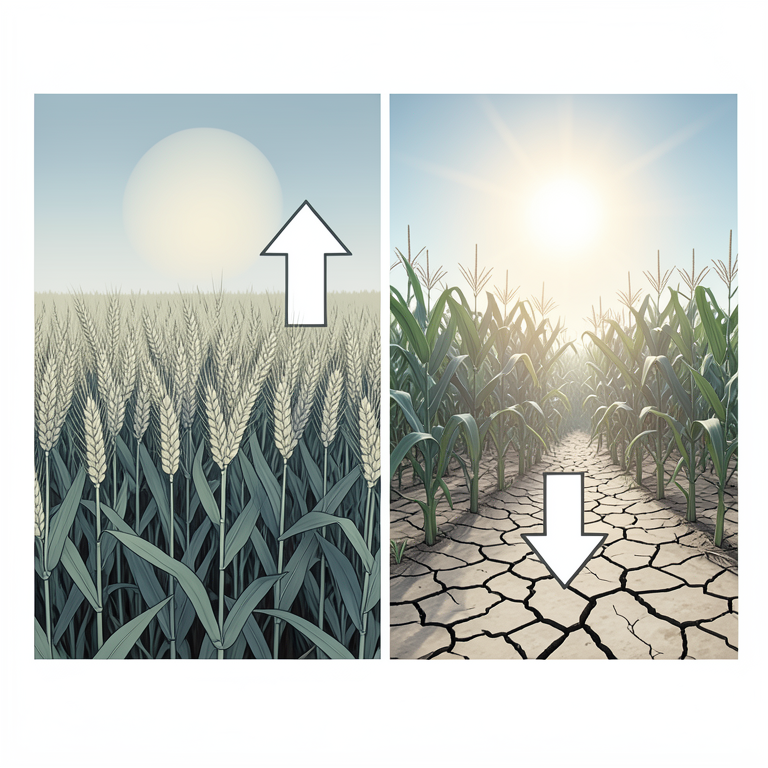
Regional Impact Divergence
AI-generated conceptual illustration (Wheat and maize crops in temperate and tropical landscapes). It explains the idea and does not show study data.
View source evidence ↗Introduction
Addressing hunger remains one of the critical challenges of our era (Ban, 2012) [5] . Hunger is a multifaceted issue with numerous causes, such as increasing food demand, dietary changes, and extreme weather events, among other factors. Additionally, pressure on the global food system is anticipated to grow further. For instance, with the world population projected to rise, demand for agricultural products is expected to increase by roughly 50% by 2030 (Bruinsma, 2003) [12] . This shift will necessitate a move toward more sustainable intensification of food production systems (Garnett et al., 2013) [30] . Despite the fact that current global food production can theoretically meet global caloric needs, food insecurity remains widespread. Approximately two billion people experience food insecurity for at least part of the year (Gleadow et al., 2009) [31] , and about 815 million people, mostly in developing countries-with 60% in Sub-Saharan Africa and South Asia-suffer from diets lacking adequate calories (FAO, 2017) [27] . Climate change, largely driven by economic activities, is directly impacting agricultural production and, by extension, food security (Easterling et al., 2007; Schmidhuber & Tubiello, 2007; Thornton et al., 2009) [22,48] . However, adapting to climate change through both agricultural interventions and shifts in social and institutional frameworks offers potential to alleviate food insecurity (Easterling et al., 2007; Howden et al., 2007) [25,34] . Agriculture is estimated to account for around 14% of annual greenhouse gas (GHG) emissions (Johnson et al., 2007; Cohen et al., 2008; Nelson, 2009; Sarris, 2009), while changes in land use, including deforestation, add another 19% (Cohen et al., 2008; Nelson, 2009) [35,19,29] . Consequently, adjustments within the agricultural sector could significantly contribute to climate change mitigation and have implications for food security. In this chapter, we will focus on the climate change situation in North Africa, a region where studies on climate variability are limited. We will also explore the potential impacts of projected global climate changes on various aspects of agriculture in this region and, in turn, the implications for food security.
However, agricultural practices are also the primary driver of many land-use impacts (Tilman et al., 2001; Green et al., 2005) [47,32] . Roughly 40% of the Earth's available land surface is now used for agriculture, much of which has replaced grasslands, savannas, and forests. Human-driven land use changes have significantly altered Earth's landscape, diminishing ecosystems' abilities to provide essential resources such as freshwater, forest products, and food, as well as vital services like water and air quality regulation, climate moderation, and soil preservation (Foley et al., 2005) [29] . Deforestation of tropical forests for agriculture or grazing contributes between 12% and 26% of global CO2 emissions (Houghton, 2003) [33] , and land use changes can also alter regional and global climates (Pielke et al., 2002) [39] . Additionally, 20-30% of accessible surface water is currently used for irrigation, and human-driven nitrogen fixation through crop production and fertilizers now equals or exceeds natural nitrogen fixation processes (Cassman & Wood, 2005) [16] . Agricultural expansion has had significant environmental impacts, including biodiversity loss, tropical deforestation, habitat fragmentation, soil degradation due to erosion and salinization, greenhouse gas emissions, and negative effects on regional climates, air quality, and water resources. Furthermore, the intensification of agriculture has been linked to an increase in infectious diseases. However, despite these environmental challenges, agricultural expansion and intensification have been crucial in meeting the food demands of a rapidly growing population, creating a trade-off between environmental health and food security (Cassman & Wood, 2005) [16] . Although projections from different General Circulation Models (GCMs) vary, there is a consensus that climate change will significantly impact agriculture. Changes in crop productivity and yields due to climate change will differ across regions, reshaping agricultural production patterns. A rise in global temperatures of less than 2 °C over the next century may bring benefits to temperate regionssuch as milder winters, longer growing seasons, and increased yields for certain crops. However, the ability to adapt to warming depends heavily on access to technology and economic resources. In contrast, in subtropical and tropical regions, where dryland agriculture is common and crops are near their temperature limits, rising temperatures are expected to reduce yields. Overall, global agricultural productivity may decline over the next century, particularly affecting vulnerable areas, leading to greater food insecurity, especially in droughtprone regions of Africa. Although current research suggests that agricultural technology and practices have not yet fully adapted to these climate shifts, incorporating adaptive strategies could improve resilience. Furthermore, higher CO2 concentrations may enhance crop productivity, though the complex interactions between elevated CO2 levels and climate change create additional uncertainties (Choudhary, 2018) [17] . Numerous studies have investigated the global distribution of arable land under both current and future climate conditions, focusing on biophysical factors (Cramer & Solomon, 1993; Xiao, 1997; Bot et al., 2000; Ramankutty et al., 2002) [20,50,8,40] . However, these studies often overlook uncertainties in land classification and climate projections (Ahamed et al., 2000) [2] . To improve land availability assessments, it is essential to address these uncertainties, particularly when evaluating land on a global scale using international datasets. Recently, Cai et al., (2011) [13] proposed a logic-based model to assess global agricultural land availability by using probability-based land suitability values. Understanding the environmental and socio-economic impacts of agriculture on the Earth requires accurate global datasets on arable land distribution and vegetation cover change (Bauer et al., 2003; Donner & Kucharik, 2003) [22,23] . Advances in data collection, such as combining satellitederived vegetation data with soil-based agricultural inventories, have contributed to improved agricultural land cover datasets (Donner, 2003; Leff et al., 2004; Ramankutty, 2004) [22,23,36,40] . Projections indicate that several African countries may face substantial agricultural losses by 2100 due to climate change, affecting up to 47% of total losses in Africa. Countries like Algeria, Morocco, Nigeria, Cameroon, and South Africa are predicted to experience significant reductions in agricultural areas. Another group, including Zambia, Niger, Chad, Burkina Faso, and Togo, may suffer losses exceeding 70% of their agricultural areas, with severe impacts on GDP, particularly in Niger, Chad, and Burkina Faso (Mendelsohn et al., 2000) [37] . Different methodologies assess climate change impacts on crop yields, such as using empirical models that correlate crop growth with climate. Schlenker and Lobell (2010) [42] used weather and crop production data to predict yield changes in Sub-Saharan Africa by the mid-21 st century. They estimated declines in aggregate production of -22% for maize, -17% for sorghum and millet, -18% for groundnut, and -8% for cassava. While most crops showed sensitivity to climate variables, cassava was less affected, likely due to its resilience as a root crop with a variable growing season. Overall, addressing uncertainties in land classification and climate impacts is essential for accurate agricultural projections, as climate change is likely to exacerbate food insecurity, particularly in vulnerable regions of Africa.
Impact of climate change on the agricultural industry impact on soil
Soil is a fundamental part of terrestrial ecosystems, influencing agriculture through its physical, chemical, and biological properties (Singh & Gupta, 1977) [44] . Soil structure stability, which supports vital agronomic and environmental functions, can be enhanced by incorporating organic matter-a practice that boosts microbial activity and strengthens soil composition (Six et al., 2004). However, climate change significantly impacts soil health, leading to issues like land degradation, especially in arid and semi-arid regions (Verchot et al., 2007; IPCC, 2014) [42] . Changes in temperature, precipitation, and moisture affect the decomposition and availability of organic matter, which disrupts soil's biological activity and reduces productivity.
Frequent climate-related events such as drought, salinization, and erosion exacerbate soil degradation, undermining its physical and chemical integrity (Zhang et al., 2005) [51] . As soil organic matter reserves diminish, climate change effects intensify, causing reductions in vegetation cover and impacting local microclimates by reducing air humidity and increasing soil temperature. Reduced vegetation also increases the earth's albedo (reflectivity), which slightly cools the soil surface yet generally contributes to adverse ecological outcomes. These climate-driven changes have far-reaching consequences, leading to desertification, erosion, silting, and increased soil salinity and acidity, all of which impair agricultural productivity and ecosystem stability.
Impact on water
Water resources are essential to ecosystems, but climate variability is disrupting water availability, especially in arid and semi-arid regions. Long periods of drought and irregular rainfall have critical effects on the hydrological cycle, water availability, and socio-economic activities (Bouziani, 2006) [9] . In regions with arid, semi-arid, and sub-Saharan climates, rising temperatures and decreasing rainfall are particularly severe, causing prolonged droughts and reduced water resources. Increased CO2 levels, along with temperature rises and reduced precipitation, accelerate land degradation by intensifying drought conditions and reducing vegetation cover. This decrease in plant cover reduces water infiltration into groundwater and contributes to soil erosion. Periods of consecutive years with low rainfall significantly reduce water flow and contribute to hydrological deficits, largely due to declining contributions from groundwater sources (Mahé & Olivry, 1995; Bricquet et al., 1997) [10] . Since the 1970s, these trends have worsened, with groundwater levels decreasing as rainfall deficits persist. The resulting shortage of water resources, coupled with reduced vegetation cover, places additional stress on agricultural systems, limits crop yields, and challenges food security in vulnerable areas.
Impact on air
The air we breathe is essential to life on Earth, yet its quality is compromised by pollution, which has become one of the foremost health and environmental issues of this century. Air is composed primarily of nitrogen, oxygen, and carbon dioxide, all of which are crucial for physiological functions, plant growth, and crop yield, affecting the maturity and quality of fruits and seeds. Any disturbance in air quality can thus have direct and indirect impacts on plants and their needs (Zhu et al., 2018) [52] . Today, climate change and air pollution are intensifying greenhouse gas levels, including nitrous oxide (N₂O). The widespread use of nitrogen-based fertilizers has further contributed to rising atmospheric N₂O emissions (Cai et al., 1997) [14] . Over recent decades, pollution from human activities and natural events has become a major environmental challenge. Growing populations and human activities alter the atmospheric composition, leading to significant degradation of the Earth's atmosphere (Aghamohammadi et al., 2018) [1] . The combined threats of climate change and pollution present serious risks both now and in the future (Cairncross et al., 2018) [15] . As air pollution rises, it continues to contribute to the prevalence of unpredictable respiratory and circulatory illnesses.
Impact on seed quality
Agriculture, vital to economic development, depends on components like soil, air, water, nutrients, and organic matter-all of which require stable, favorable conditions. Climate conditions also play a crucial role, particularly in seed germination, which depends on both internal factors (seed health) and external environmental factors like moisture, temperature, light, and aeration (Bonner, 2008) [7] . Optimal germination occurs at temperatures between 20-25 °C, while lower or higher temperatures reduce germination rates. Climate change, especially in arid and semi-arid regions, has introduced more extreme conditions such as rising temperatures, drought, and increased climate variability, severely impacting seed germination and crop productivity (Al-karaki et al., 2004) [3] . Drought and salinity particularly limit agricultural yields, and unpredictable climate shifts, with fluctuating wet and dry periods, disrupt the factors essential for seed germination and plant growth. Moreover, shorter winters due to global warming can cause seeds to remain dormant longer, requiring more time for spring germination. Consequently, climate change may delay or hinder seed regeneration, with germination success increasingly influenced by species-specific dormancy responses to warming.
Effect of climate change on food security
Food security defined by the FAO as consistent access to sufficient, safe, and nutritious food for a healthy life-is a key concern for developing countries. It comprises four main components: food availability, stability, access, and utilization. Factors affecting food security include population growth, urbanization, land and water use changes, economic trends, and climate change (FAO, 2012; Von Braun, 2007) [49] . Approximately 2 billion people worldwide are food insecure, with the highest rates in regions like sub-Saharan Africa and South Asia, which face poverty, fragile markets, and low agricultural productivity (FAO, 2017) [27] . Climate change is expected to have significant impacts on the food system and food security, especially in vulnerable areas (Wheeler & Von Braun, 2013) [49] . As climate variables change, they affect agricultural productivity, water resources, and food supply chains. For instance, reduced rainfall and increased drought can lower crop yields, raising food prices and affecting economic access to food. The impact of climate change on water resources further exacerbates these issues, especially in arid regions (Alcamo et al., 2007) [4] . Global food production could suffer unevenly distributed impacts, with developing countries in Africa and South Asia expected to be among the hardest hit. These regions are less capable of adapting to climate-related challenges like changing rainfall patterns, extreme weather, and rising temperatures, which threaten both food production and local economies. Climate change may disrupt precipitation patterns, reduce available land, and increase water scarcity, which would affect food security for a global population expected to reach 9 billion by 2050. Model projections by the International Institute for Applied Systems Analysis (IIASA) estimate that irrigation needs could rise by 45% by 2080, further intensifying water shortages (Fischer et al., 2007) [28] . Some studies suggest that global warming could initially boost crop yields due to increased atmospheric CO2, but this effect may primarily benefit developed countries with adaptive capacity. In equatorial regions, however, warming is likely to reduce crop yields, especially in countries with high poverty levels. Sub-Saharan Africa and South Asia are particularly vulnerable to food production declines due to drought and water scarcity (Droogers & Aerts, 2005) [24] .
The International Water Management Institute projects that South Asia's wheat production could decline by 50% by 2050, equal to around 7% of global wheat output (de Fraiture et al., 2008) [21] . Reduced rainfall and higher temperatures are also expected to increase water needs for irrigation due to higher evapotranspiration rates. Areas already experiencing water scarcity, such as parts of Africa and South Asia, are likely to face intensified food security challenges as water demands outpace supply, leading to worsened malnutrition and poverty (Brown & Funk, 2008) [11] . In some developing countries, agricultural production could fall by up to 40% if climate change remains unmitigated (Cline, 2007) [18] .
Conclusion
Ensuring food security and sustainability remains a pressing global challenge. Many countries struggle to provide adequate, nutritious food to support healthy lives for all their citizens. Climate change is widely recognized as a serious threat to food security, particularly for the world's most vulnerable populations, highlighting the need for urgent adaptation measures. However, the overall impact of climate change on food security is complex and not fully understood, as many effects are difficult to quantify and depend on various assumptions. Current research suggests that climate change will likely decrease crop yields and reduce arable land, with tropical regions-already facing high levels of food insecurityexpected to experience the most severe impacts. Although global food production could theoretically meet global demand, issues in distribution, management, and access prevent equitable food availability. To address these challenges, comprehensive food security strategies are essential. These should include measures for managing climate-related risks, securing food storage and distribution, and implementing robust monitoring systems. While climate change is a significant factor influencing food systems, it is one among many drivers, and its effects vary widely across regions. Adaptation strategies aimed at enhancing food availability, access, stability, and utilization can mitigate some impacts of climate change on food security. However, these adaptations must be carefully assessed for their long-term effects on the global ecosystem to ensure sustainable progress.
References
38 in the original paper- Ahamed TN, Rao KG, Murthy JSR. GIS-based fuzzy membership model for crop-land suitability analysis. Agric Syst. 2000;63(2):75-95. DOI: 10.1016/S0308521X(99)00036-0.
- Al-Karaki G, McMichael BZA, Zak J. Field response of wheat to arbuscular mycorrhizal fungi and drought stress. Mycorrhiza. 2004;14(4):263-269. DOI: 10.1007/s00572-003-0265-2. PMID: 12942358.
- Alcamo J, Dronin N, Endejan M, Golubev G, Kirilenko A. A new assessment of climate change impacts on food production shortfalls and water availability in Russia. Glob Environ Change. 2007;17(3-4):429-444. DOI: 10.1016/j.gloenvcha.2006.12.006.
- Bauer E, Claussen M, Brovkin V, Huenerbein A. Assessing climate forcings of the Earth system for the past millennium. Geophys Res Lett. 2003;30(6):1-4. DOI: 10.1029/2002GL016639.
- Bricquet J, Bamba F, Mahe G, Toure M, Olivry J. Evolution récente des ressources en eau de l'Afrique atlantique. Rev Sci Eau. 1997;10(3):321-337.
- Bruinsma J. World agriculture: Towards 2015/2030-an FAO perspective. London: Earthscan; c2003.
- Cai X, Zhang X, Wang D. Land availability for biofuel production. Environ Sci Technol. 2011;45(1):334-339. DOI: 10.1021/es103338e. PMID: 21142000.
- Cai Z, Xing G, Yan X, Xu H, Tsuruta H, Yagi K, et al. Methane and nitrous oxide emissions from rice paddy fields as affected by nitrogen fertilisers and water management. Plant Soil. 1997;196(1):7-14. DOI: 10.1023/A:1004263405020.
- Cairncross E, Dalvie A, Euripidou R, Irlam J, Naidoo RN. Climate Change, Air Pollution and Health in South Africa. In: Climate Change and Air Pollution. Cham: Springer; 2018, p. 327-347. DOI: 10.1007/978-3-31961346-8_20.
- Cramer WP, Solomon AM. Climatic classification and future global redistribution of agricultural land. Clim Res. 1993;3:97-110. DOI: 10.3354/cr003097.
- Donner S. The impact of cropland cover on river nutrient levels in the Mississippi River Basin. Glob Ecol Biogeogr. 2003;12(4):341-355. DOI: 10.1046/j.1466-822X.2003.00032.x. International Journal of Agriculture and Food Science https://www.agriculturaljournals.com
- Donner SD, Kucharik CJ. Evaluating the impacts of land management and climate variability on crop production and nitrate export across the Upper Mississippi Basin. Glob Biogeochem Cycles. 2003;17(3):n/a. DOI: 10.1029/2001GB001808.
- Droogers P, Aerts J. Adaptation strategies to climate change and climate variability: A comparative study between seven contrasting river basins. Phys Chem Earth. 2005;30(6-7):339-346. DOI: 10.1016/j.pce.2005.06.015.
- Easterling WE, Aggarwal PK, Batima P, Brander KM, Erda L, Howden SM, et al. Food, Fibre and Forest Products. In: Climate Change 2007: Impacts, Adaptation and Vulnerability. Contribution of Working Group II to the Fourth Assessment Report of the Intergovernmental Panel on Climate Change. Cambridge: Cambridge University Press; c2007.
- FAO. The state of food insecurity in the world 2012. Economic growth is necessary but not sufficient to accelerate reduction of hunger and malnutrition. Rome: FAO; c2012.
- FAO, IFAD, UNICEF, WFP, WHO. The State of Food Security and Nutrition in the World 2017. Building resilience for peace and food security. Rome: FAO; c2017.
- Fischer G, Tubiello FN, Van Velthuizen H, Wiberg DA. Climate change impacts on irrigation water requirements: Effects of mitigation, 1990-2080. Technol Forecast Soc Change. 2007;74(7):1083-1107. DOI: 10.1016/j.techfore.2006.05.021.
- Foley JA, DeFries R, Asner GP, Barford C, Bonan G, Carpenter SR, et al. Global consequences of land use. Science. 2005;309(5734):570-574. DOI: 10.1126/science.1111772. PMID: 16040698.
- Garnett T, Appleby MC, Balmford A, Bateman IJ, Benton TG, Bloomer P, et al. Sustainable intensification in agriculture: Premises and policies. Science. 2013;341(6141):33-34. DOI: 10.1126/science.1234485. PMID: 23828927.
- Gleadow RM, Edwards EJ, Evans JR. Changes in nutritional value of cyanogenic Trifolium repens grown at elevated atmospheric CO2. J Chem Ecol. 2009;35(4):476-478. DOI: 10.1007/s10886-009-9617-5. PMID: 19352773.
- Green RE, Cornell SJ, Scharlemann JP, Balmford A. Farming and the fate of wild nature. Science. 2005;307(5709):550-555. DOI: 10.1126/science.1106049. PMID: 15618485.
- Houghton RA. Revised estimates of the annual net flux of carbon to the atmosphere from changes in land use and land management 1850-2000. Tellus B Chem Phys Meteorol. 2003;55(2):378-390.
- Howden SM, Soussana JF, Tubiello FN, Chhetri N, Dunlop M, Meinke H et al. Adapting agriculture to climate change. Proc Natl Acad Sci USA. 2007;104(50):19691-19696. DOI: 10.1073/pnas.0701890104.
- Johnson JM, Franzluebbers AJ, Weyers SL, Reicosky DC. Agricultural opportunities to mitigate greenhouse gas emissions. Environ Pollut. 2007;150(1):107-124. DOI: 10.1016/j.envpol.2007.06.030.
- Leff B, Ramankutty N, Foley JA. Geographic distribution of major crops across the world. Global Biogeochem Cycles. 2004;18(1):n/a. DOI: 10.1029/2003GB002108.
- Pielke RA, Marland G, Betts RA, Chase TN, Eastman JL, Niles JO, et al. The influence of land-use change and landscape dynamics on the climate system: relevance to climate-change policy beyond the radiative effect of greenhouse gases. Philos Trans R Soc Lond A Math Phys Eng Sci. 2002;360(1797):1705-1719.
- Ramankutty N, Foley JA, Norman J, McSweeney K. The global distribution of cultivable lands: Current patterns and sensitivity to possible climate change. Global Ecol Biogeogr. 2002;11(5):377-392. DOI: 10.1046/j.1466-822x.2002.00294.x.
- Sarris A. Evolving Structure of World Agricultural Trade and Requirements for New World Trade Rules. Paper presented at the Expert Meeting on "How to Feed the World in 2050", Rome, Italy; c2009.
- Schlenker W, Lobell DB. Robust negative impacts of climate change on African agriculture. Environ Res Lett. 2010;5(1):014010. DOI: 10.1088/17489326/5/1/014010.
- Schmidhuber J, Tubiello FN. Global food security under climate change. Proc Natl Acad Sci USA. 2007;104(50):19703-19708. DOI: 10.1073/pnas.0701976104.
- Singh JS, Gupta SR. Plant decomposition and soil respiration in terrestrial ecosystems. Bot Rev. 1977;43(4):449-528. DOI: 10.1007/BF02860844.
- Six J, Bossuyt H, Degryze S, Denef K. A history of research on the link between (micro) aggregates, soil biota, and soil organic matter dynamics. Soil Till Res. 2004;79(1):7-31. DOI: 10.1016/j.still.2004.03.008.
- Thornton PK, van de Steeg J, Notenbaert A, Herrero M. The impacts of climate change on livestock and livestock systems in developing countries: A review of what we know and what we need to know. Agric Syst. 2009;101(3):113-127. DOI: 10.1016/j.agsy.2009.05.002.
- Tilman D, Fargione J, Wolff B, D'antonio C, Dobson A, Howarth R, et al. Forecasting agriculturally driven global environmental change. Science. 2001;292(5515):281-284. DOI: 10.1126/science.1057544.
- Verchot LV, Van Noordwijk M, Kandji S, Tomich T, Ong C, Albrecht A, et al. Climate change: Linking adaptation and mitigation through agroforestry. Mitig Adapt Strateg Glob Change. 2007;12(5):901-918. DOI: 10.1007/s11027-007-9105-9106.
- Wheeler T, Von Braun J. Climate change impacts on global food security. Science. 2013;341(6145):508-513. DOI: 10.1126/science.1239402.
- Zhang W, Parker KM, Luo Y, Wan S, Wallace LL, Hu S et al. Soil microbial responses to experimental International Journal of Agriculture and Food Science https://www.agriculturaljournals.com warming and clipping in a tallgrass prairie. Global Change Biol. 2005;11(2):266-277. DOI: 10.1111/j.1365-2486.2005.00902.x.
- Zhu Z, Ge T, Liu S, Hu Y, Ye R, Xiao M, et al. Rice rhizodeposits affect organic matter priming in paddy soil: The role of N fertilization and plant growth for enzyme activities, CO2 and CH4 emissions. Soil Biol Biochem. 2018;116:369-377. DOI: 10.1016/j.soilbio.2017.11.001.