
Research article · 2024 · Full text
International Journal of Agriculture and NutritionThe role of weed control methods in enhancing the nutritional profile of soybean crops
Volume 6(2) · Pages 29–31 · DOI: 10.33545/26646064.2024.v6.i2a.177 ↗
Research areasSoybean genetics and cultivationAgriculture and Biological StudiesAgriculture, Plant Science, Crop Management
Abstract
Author-writtenSoybean (Glycine max) is a globally significant crop, renowned for its high protein content and versatile applications in food, feed, and industry. However, weed infestations pose a substantial challenge to soybean cultivation, competing for essential resources and potentially diminishing both yield and nutritional quality. This paper examines various weed control methods cultural, mechanical, chemical, and biological and their roles in enhancing the nutritional profile of soybean crops. Emphasis is placed on Integrated Weed Management (IWM) as a holistic approach that synergizes multiple strategies to optimize weed suppression and improve soybean quality. By analyzing relevant studies and field data, this paper underscores the necessity of adopting comprehensive weed management practices to achieve sustainable and nutritionally superior soybean production.
Summary
Source-checkedPlain-language reading of the full paper, prepared with AI and checked against the text. Each point links to the authors' own words.
Why it matters
- Soybean is a globally important crop used in industry, feed, and food due to its high protein content. View evidence ↗
- Weeds challenge soybean cultivation by competing for light, water, and nutrients, especially during critical growth phases. View evidence ↗
- Uncontrolled weed growth can significantly lower soybean yield and quality, reducing protein content by as much as 10% in heavily infested fields. View evidence ↗
The question
- The study aims to evaluate how cultural, mechanical, chemical, and biological weed control methods affect soybean nutritional profiles, specifically nutrient uptake, oil composition, and protein content. View evidence ↗
- The research seeks to analyze if Integrated Weed Management (IWM) can effectively combine strategies to optimize soil fertility and sustainably improve soybean quality and yield. View evidence ↗
What they did
- The author analyzed field data and existing studies to determine the impact of different weed management practices on soybean production. View evidence ↗
What they found
- Crop rotation was found to increase soybean protein content by 18% and reduce weed density by 40%. View evidence ↗
- Cover cropping can increase soybean protein content by 12% and reduce weed biomass by up to 70%. View evidence ↗
- Conservation tillage improved soybean seed quality and nutrient availability by increasing soil organic matter by 15%. View evidence ↗
- Compared to unweeded fields, inter-row cultivation increased the protein content of soybeans by 7%. View evidence ↗
- Pre-emergence herbicides can preserve soil nitrogen for the crop by reducing weed biomass by 80%. View evidence ↗
- The use of allelopathic cover crops increased soybean protein content by 10% and reduced weed biomass by 50%. View evidence ↗
- Integrated Weed Management (IWM) was the most effective approach, increasing soybean protein content by 20%, improving soil organic matter by 10%, and reducing weed biomass by 85%. View evidence ↗
What it means
- The author concludes that Integrated Weed Management (IWM) is the most effective strategy for optimizing both soybean nutrition and weed control. View evidence ↗
- The author recommends that farmers adopt comprehensive weed management practices to ensure environmental sustainability and higher-quality soybean production. View evidence ↗
Visual summary
1 visualsIllustrations explain the paper; they do not show study data.
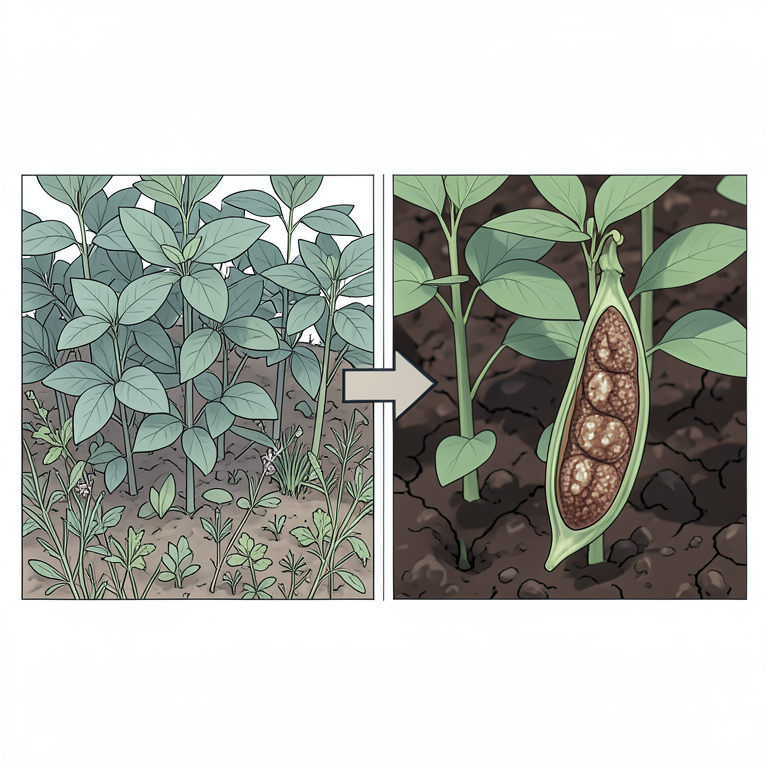
Integrated Weed Management Synergy
AI-generated conceptual illustration (soybean plants). It explains the idea and does not show study data.
View source evidence ↗Introduction
Soybean is a cornerstone of global agriculture, providing a primary source of plant-based protein and oil. Its nutritional profile, characterized by high protein content and a balanced amino acid composition, makes it indispensable in human diets and animal feed. However, achieving optimal nutritional quality in soybean crops is contingent upon effective agronomic practices, among which weed management is paramount. Weeds compete with soybean plants for vital resources such as nutrients, water, and light, particularly during critical growth stages.
This competition can lead to reduced nutrient uptake by soybean plants, adversely affecting seed composition, including protein and oil content. For instance, studies have shown that uncontrolled weed growth can result in significant reductions in soybean yield and quality, with protein content decreasing by up to 10% in heavily infested fields (Buehring et al., 2002). Traditional weed control methods have primarily focused on maximizing yield, often overlooking the implications for crop nutritional quality. However, recent research highlights the importance of integrated weed management strategies that not only suppress weed growth but also enhance the nutritional attributes of soybean seeds.
This paper explores the impact of various weed control methods on the nutritional profile of soybean crops, emphasizing the role of IWM in achieving sustainable and high-quality production. Main objectives 1. To evaluate the impact of various weed control methods, including cultural, mechanical, chemical, and biological approaches, on the nutritional profile of soybean crops, focusing on key quality parameters such as protein content, oil composition, and nutrient uptake. 2. To analyze the effectiveness of Integrated Weed Management (IWM) in combining diverse strategies to enhance weed suppression, optimize soil fertility, and ensure sustainable improvement in soybean yield and nutritional quality.
Weed control methods Cultural weed control Cultural weed control methods rely on agronomic practices that promote crop growth while suppressing weeds. These methods include crop rotation, cover cropping, mulching, and IJAN 2024; 6(2): 29-31 Carlos Roberto Ortega Assistant Professor, Department of Agronomy, Honduras Agricultural College, Tegucigalpa, Honduras Carlos Roberto Ortega Assistant Professor, Department of Agronomy, Honduras Agricultural College, Tegucigalpa, Honduras https://www.agriculturejournal.net optimized planting densities. By improving soil fertility and creating conditions unfavorable for weeds, cultural methods directly enhance soybean nutritional quality. Crop rotation: Crop rotation disrupts weed life cycles by alternating soybean cultivation with other crops, such as cereals or legumes.
Rotating soybean with nitrogen-fixing legumes increases soil nitrogen levels, which supports protein synthesis in soybean seeds. A study by Liebman and Dyck (1993) found that crop rotation reduced weed density by 40% and increased soybean protein content by 18%. Additionally, crop rotation enhances soil organic matter and microbial activity, which improve nutrient availability. Cover cropping: Cover crops like rye, clover, or vetch are planted during fallow periods to suppress weed growth and improve soil structure.
These crops compete with weeds for light and nutrients while releasing nutrients back into the soil upon decomposition. Research by Teasdale et al., (2007) demonstrated that cover cropping reduced weed biomass by up to 70% and increased soybean protein content by 12%. Mulching and planting density: Organic mulches, such as straw or grass clippings, suppress weed germination by blocking sunlight. Optimized planting densities create a dense canopy, shading weeds and reducing competition.
Studies have shown that higher planting densities can improve soybean nitrogen uptake, leading to increased seed protein levels (Knezevic et al., 2003). Mechanical weed control Mechanical weed control methods involve the physical removal of weeds through tillage, inter-row cultivation, and hand weeding. These methods are effective in reducing immediate weed pressure and preserving soil nutrients for soybean plants. Tillage: Tillage disrupts weed root systems and buries weed seeds, preventing their germination.
Conservation tillage
Methods
, which minimize soil disturbance, have been shown to improve soil health while maintaining effective weed control. Triplett and Dick (2008) reported that conservation tillage increased soil organic matter by 15%, enhancing nutrient availability and soybean seed quality. Inter-row cultivation: Inter-row cultivation targets weeds growing between soybean rows during early growth stages. By removing weeds before they establish dominance, this method ensures that essential nutrients remain available for soybean plants.
Research by Knezevic et al., (2002) indicated that inter-row cultivation increased soybean protein content by 7% compared to unweeded fields. Chemical weed control Chemical weed control, involving herbicides, is one of the most widely used methods for managing weeds in soybean fields. Herbicides are classified into pre-emergence and post-emergence types, depending on the timing of application. Pre-emergence herbicides: Pre-emergence herbicides are applied to the soil before weed seeds germinate, creating a chemical barrier that inhibits weed emergence.
These herbicides reduce early competition, allowing soybean seedlings to establish without nutrient stress. Studies have shown that pre-emergence herbicides can reduce weed biomass by 80%, preserving soil nitrogen for crop uptake (Powles & Yu, 2010). Post-emergence herbicides: Post-emergence herbicides are applied to actively growing weeds, targeting species that compete directly with soybean plants. While effective, overreliance on herbicides has led to herbicide-resistant weed populations, necessitating alternative strategies to maintain effectiveness.
Research has highlighted the importance of rotating herbicides with different modes of action to mitigate resistance and ensure sustained nutrient availability for soybeans (Shaner, 2014). Biological weed control Biological weed control leverages natural organisms or processes to suppress weeds. These methods include using allelopathic plants and biocontrol agents, which enhance soil health and nutrient dynamics. Allelopathic plants: Allelopathic plants, such as sorghum and mustard, release biochemicals that inhibit weed germination.
Incorporating these plants into rotations or as cover crops can reduce weed pressure and improve soil nutrient availability. Weston and Duke (2003) found that allelopathic cover crops reduced weed biomass by 50% and increased soybean protein content by 10%. Biocontrol agents: Biocontrol agents, including insects, fungi, and bacteria, target specific weed species without harming soybean plants. These agents improve soil microbial diversity, supporting nutrient cycling and crop quality.
However, their effectiveness is influenced by environmental factors and requires integration with other
Methods
for optimal results. Integrated Weed Management (IWM) IWM combines cultural, mechanical, chemical, and biological methods to achieve comprehensive weed control while optimizing resource use. By integrating diverse strategies, IWM minimizes nutrient competition, enhances soil fertility, and supports sustainable soybean production. Studies by Norsworthy et al., (2012) demonstrated that IWM reduced weed biomass by 85%, increased soybean protein content by 20%, and improved soil organic matter by 10%.
IWM emphasizes adaptive management, tailoring weed control practices to specific field conditions and crop needs.
Conclusion
Weed control methods significantly impact the nutritional profile of soybean crops by influencing nutrient availability and soil health. Cultural practices like crop rotation and cover cropping enrich the soil, while mechanical and chemical methods reduce immediate weed competition. Biological approaches offer sustainable alternatives, enhancing nutrient cycling and crop quality. IWM emerges as the most effective strategy, combining diverse methods to optimize weed control and soybean nutrition.
By adopting comprehensive weed management practices, farmers can achieve higher-quality soybean production while ensuring environmental sustainability. https://www.agriculturejournal.net
References
8 in the original paper- Liebman M, Dyck E. Crop rotation and intercropping strategies for weed management. Ecol Appl. 1993;3(1):92-122.
- Teasdale JR, Devine TE, Mosjidis JA, Bellinder RR, Beste CE. Weed suppression by hairy vetch in no- tillage corn. Weed Sci. 2007;55(3):219-225.
- Knezevic SZ, Evans SP, Mainz M. Row spacing influences the critical timing for weed removal in soybean (Glycine max). Weed Technol. 2002;17(4):666-673.
- Powles SB, Yu Q. Evolution in action: Plants resistant to herbicides. Annu Rev Plant Biol. 2010;61:317-347.
- Weston LA, Duke SO. Weed and crop allelopathy. Crit Rev Plant Sci. 2003;22(3-4):367-389.
- Nuru Seid Tehulie, Tenalem Misgan, Tigist Awoke. Review on weeds and weed controlling methods in soybean (Glycine max L.). J Curr Res Food Sci. 2021;2(1):1-6.
- Triplett GB, Dick WA. No-tillage crop production: A revolution in agriculture! Agron J. 2008;100(3):S-153- S-165.
- Norsworthy JK, Ward SM, Shaw DR, Llewellyn RS, Nichols RL, Webster TM, et al. Reducing the risks of herbicide resistance: Best management practices and recommendations. Weed Sci. 2012;60(1):31-62.