
Research article · 2024 · Full text
International Journal of Veterinary Sciences and Animal HusbandryOptimizing herd performance: The impact of body condition scoring on milk yield dynamics in jersey crossbred dairy cows
Volume 9(6S) · Pages 09–13 · DOI: 10.22271/veterinary.2024.v9.i6sa.1840 ↗
Research areasGenetic and phenotypic traits in livestockEffects of Environmental Stressors on Livestock
Abstract
Author-writtenThe study was conducted January to May 2019 at the Livestock Farm Complex, Dairy farm, CSKHPKV, Palampur, Himachal Pradesh, India to investigate the correlation between BCS and milk yield in Jersey crossbred dairy cows. Utilizing a visual and tactile assessment on a 5-point scale with 0.25-point increments, we conducted a study to elucidate this relationship. Our findings revealed that dairy cows in early lactation stages, characterized by a BCS score of ≤2.5, exhibit higher milk yields compared to those with higher BCS scores (2.75 and ≥3.0). This disparity may be attributed to an accelerated rate of body reserve mobilization in high-yielding cows, leading to a more pronounced loss of body weight during this period. Furthermore, both high and low yielding groups experienced a decline in BCS and milk yield during mid and late lactation. Interestingly, in late lactation, high-yielding cows demonstrated improved BCS relative to their low-yielding counterparts, possibly indicative of a positive energy balance.
Summary
Source-checkedPlain-language reading of the full paper, prepared with AI and checked against the text. Each point links to the authors' own words.
Why it matters
- Body condition scoring (BCS) is used as a non-invasive way to estimate a dairy cow's energy reserves and nutritional status. View evidence ↗
- Accurate BCS assessment is important because it impacts a cow's health, productivity, reproduction, and the overall profitability of the farm. View evidence ↗
- Jersey crossbred cows are valued for efficient feed conversion and high milk fat, but they are susceptible to BCS-related metabolic and reproductive issues. View evidence ↗
What they did
- The research was conducted from January to May 2019 at the CSKHPKV Dairy farm in Himachal Pradesh, India, using 50 Jersey crossbred cows. View evidence ↗
- BCS was measured using a standard 1–5 scale, with evaluations performed across eight anatomical regions, specifically focusing on the tail head, pelvis, and loin. View evidence ↗
- The researchers recorded lactation parameters such as peak production, yield, length, and service period, analyzing the data using Microsoft Excel 2010. View evidence ↗
What they found
- In the overall herd, cows with a BCS of ≥3 had the highest average milk yield at 8.4 litres, compared to 6.15 litres for BCS 2.75 and 5.13 litres for BCS ≤2.5. View evidence ↗
- During early lactation, cows with a BCS of ≤2.5 produced the highest average milk yield at 7.7 litres, followed by 7.6 litres for BCS 2.75 and 7.5 litres for BCS ≥3. View evidence ↗
- In mid-lactation, cows with a BCS of ≥3 showed the highest average milk yield at 9.75 litres, while those with BCS ≤2.5 and 2.75 produced 6.25 and 6 litres, respectively. View evidence ↗
- In late lactation, cows with a BCS of 2.75 had the highest average yield at 5.5 litres, while those with BCS ≤2.5 produced 4.1 litres, and no cows with BCS ≥3 produced milk. View evidence ↗
- High-yielding cows maintained a higher BCS than low-yielding cows across all stages: 2.75 vs 2.67 in early and mid-lactation, and 2.72 vs 2.57 in late lactation. View evidence ↗
What it means
- The authors conclude that cows with a lower BCS (≤2.5) in early lactation produce more milk because they mobilize more body reserves. View evidence ↗
- To optimize milk yield during early lactation, the authors recommend that cows have a higher BCS at the time of calving. View evidence ↗
Visual summary
1 visualsIllustrations explain the paper; they do not show study data.
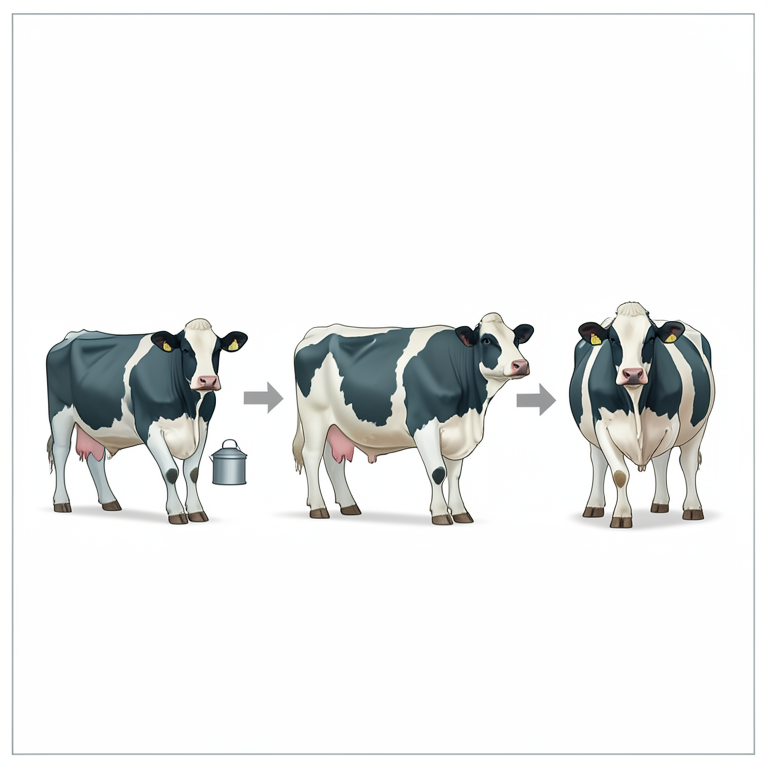
Lactation Cycle BCS Dynamics
AI-generated conceptual illustration (Jersey crossbred dairy cows). It explains the idea and does not show study data.
View source evidence ↗Figures & tables
From the original paper Table 1
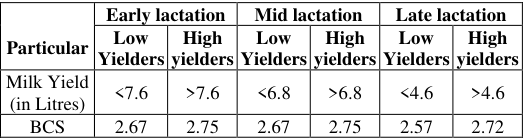 Table 2
 Table 4
 Table 3
 Table 5
Introduction
Body condition scoring (BCS) serves as a crucial measure of the energy reserve and an indirect indicator of the energy balance in dairy cows, offering insights into their nutritional status. This non-invasive, cost-effective method provides a rapid estimation of fatness levels, irrespective of body weight and frame size. India, as an agrarian nation, boasts a rich agricultural landscape intertwined with food production for both humans and animals . [10,11,12,13,14,22,23,25,38]. A cornerstone of this agricultural tapestry is the cultivation of fodder crops essential for sustaining livestock populations [15, 16, 17, 18. 19, 20, 21, 24, 26] by accurately determining the body condition of dairy cows, BCS aids in assessing their health and productivity, with implications for milk production, reproduction, and overall profitability [1,2] . Cows exhibiting low body condition are at risk of reduced milk yield and higher somatic cell counts, indicating potential health issues. While BCS is commonly applied to lactating dairy herds, its significance extends beyond mere nutritional management. Changes in BCS can profoundly impact various aspects of cow management, including reproduction, longevity, and metabolic health [3,4,34,35,37] . An imbalance in body condition, whether excess fat or thinness, predisposes cows to metabolic disorders and reproductive challenge. Thin cows may experience reduced production and milkfat levels due to insufficient energy and protein reserves [5,6] . Moreover, underconditioned cows may exhibit delayed estrus and conception until they regain or maintain body weight. BCS assessment in dairy cattle involves a visual and tactile evaluation of body fat reserves, typically utilizing a 5-point scale with 0.25-point increments. This scoring system ranges from 1 (very thin) to 5 (excessively fat), with a score of 3 representing average body condition [7. 8] . Maintaining a BCS of 2.75-3.0 at calving has been recommended to minimize post-partum BCS losses and optimize lactation performance [9] . Furthermore, the variation in BCS throughout the lactation cycle, along with the BCS level at calving, influences the extent of post-partum BCS decline and subsequent metabolic health. Notably, BCS also correlates with the condition of the cow's claw horn, affecting reproductive success [27, 28] . The objective of this study was to investigate the correlation between BCS and milk yield in Jersey crossbred dairy cows, with a view to elucidating the implications for optimizing herd management strategies. Jersey crossbred cows are particularly valuable in dairy production due to their high milk fat content and efficient feed conversion. However, they are also known for their susceptibility to metabolic and reproductive challenges associated with BCS. This study aimed to provide a comprehensive analysis of how BCS influences milk yield and to identify optimal BCS ranges for maximizing production without compromising cow health. By investigating the relationship between BCS and milk yield, this research seeks to contribute to the development of more effective and sustainable herd management practices that can enhance the productivity and welfare of dairy cows. The findings from this study are expected to offer valuable insights into the management of Jersey crossbred cows, which can be applied to improve the overall efficiency and profitability of dairy farming. This research will provide a scientific basis for developing targeted nutritional and health management strategies that can help dairy farmers achieve better reproductive and lactation outcomes, ultimately leading to more sustainable dairy production systems. By exploring the correlation between BCS and milk yield, this study aims to fill a critical gap in the understanding of dairy cow physiology and management. It underscores the importance of continuous monitoring and adjustment of BCS to enhance dairy herd performance and ensure the welfare of cows, thereby contributing to the advancement of the dairy industry.
Materials and Methods
The Livestock Farm Complex, Dairy farm, CSKHPKV, Palampur, Himachal Pradesh, India served as the setting for this investigation, which enrolled 50 Jersey crossbred dairy cows spanning the period from January 2019 to May 2019. Employing the established 1-5 scale for body condition scoring (BCS) outlined [9,27] , assessments were meticulously conducted across eight anatomical regions, meticulously evaluating the loin, pelvis, and tail head. Concurrently, comprehensive data on lactation parameters including yield, length, peak production, and service period were diligently recorded. Utilizing Microsoft Excel (2010 version) for rigorous statistical analysis, the study endeavors to elucidate the intricate interplay between BCS and milk yield dynamics throughout the lactation cycle. By delving into these relationships, our research seeks to furnish dairy practitioners with actionable insights aimed at refining herd management protocols, thus fostering heightened productivity and profitability within the dairy sector.
Results and Discussion
Results and Discussion
Body condition score and its relation to energy balance and milk yield in dairy cows
Body Condition Score (BCS) is a crucial subjective criterion for evaluating the energy balance in dairy cows and its relationship to milk yield. Researchers examined the relationship between BCS and milk yield in Holstein cows on a commercial dairy farm [28] . The cows were scored weekly for body condition from dry-off until 120 days of lactation. The study found that changes in body condition during the dry period were the most influential factor, followed by lactation number and then BCS at dry-off for multiparous cows. Researchers observed significant variation in BCS at 120 days postpartum, attributing this to the increased size of the animals [29] . They also found a strong correlation between heart girth and BCS. In study identified a correlation between body fat and BCS, noting that variations in BCS could be due to lipolysis of body fat reserves during early lactation, which affects the BCS of dairy cattle [30] . This study highlighted that fat mobilization was more pronounced in cows with a high BCS. In a study demonstrated a significant correlation between BCS and daily milk yield at the 5% level, with higher milk yields observed in cows with high BCS, followed by those with medium and low BCS [29] . Researchers reported that cows with a moderate BCS had higher milk production [30] . Furthermore, in a study found that the body weight of cows with a high BCS decreased rapidly compared to those with medium and low BCS during the first 15 days postpartum [29,30] . These findings collectively underscore the importance of BCS as an indicator of energy balance and its direct impact on milk production in dairy cows.
Body condition score and milk yield in dairy cows
The Body Condition Score (BCS) and milk yield of dairy cows exhibit notable changes throughout the lactation period. Both high and low-yielding cows experience a decrease in BCS and milk yield during mid and late lactation. However, high-yielding cows maintain a better BCS in late lactation compared to low-yielding cows, likely due to a positive energy balance. Researchers found a strong correlation between milk production and BCS, suggesting that BCS is an effective metric for evaluating the nutritional management of dairy cows [1,2] . According to study maintaining an optimal BCS is essential for achieving high milk production and ensuring herd health [3,4] . Cows that are too thin or too fat are at greater risk of reduced milk yield and increased milk somatic cell count (SCC), which are indicators of poor udder health. In a study reported that during the peak of lactation, the energy demands of dairy cows often exceed their energy intake, leading to a negative energy balance (NEB) [5. 6] . To compensate for this energy deficit, cows mobilize their body reserves, resulting in weight loss. Researchers demonstrated that inadequate energy and protein reserves can significantly reduce milk yield. Thus, BCS has a critical impact on dairy cows, particularly during key phases of lactation. These findings emphasize the importance of managing BCS to ensure optimal milk production and overall health of dairy cows [7,8] .
Body condition score during the dry period and at calving
To support early lactation, dairy cows require sufficient body reserves. Both excessive and inadequate body reserves negatively impact animal performance. Over conditioning reduces dry matter intake (DMI) and prolongs the negative energy balance, leading to lower peak yield, poor lactation persistency, and reproductive issues such as retained placenta, calving problems, and metabolic disorders. In a study concluded that cows with lower BCS at calving mobilize less body fat, which reduces milk fat percentage without affecting milk yield, solid-not-fat (SNF) content, DMI, or nutrient utilization [32,33] . The optimal BCS during the dry period is between 3.0 and 3.25. Cows within this range are closer to achieving peak milk yield. Researchers also noted that improving BCS from 2 to 3 significantly enhances milk productivity, whereas a BCS above 3.5 at calving is detrimental to milk production [8,9] . In a study highlighted that calving BCS is likely the most critical moment in a cow's lactation cycle, influencing early-lactation DMI, post-calving BCS loss, milk yield, and immunity [3. 6. 27] . It does not directly affect pregnancy rates but influences reproduction through nadir BCS and BCS loss [8. 9] . A decrease in BCS during the dry period adversely affects animal health, calving, and fat content in subsequent lactations. Researchers also found that increasing BCS during the dry period can enhance milk yield, especially in the first 120 days of lactation [8,9,4] . Additionally, in a study observed that improving BCS at parturition increases milk fat percentage and shortens the anestrous interval post-parturition [2. 29, 30] . In another study reported an optimal calving BCS for milk production of 3.5. Conversely, researchers found that the greatest 305-day milk yield was in cows calving with a BCS of 4.25 units, whereas cows with BCS of 3.25 or 3 produced 50 kg and 114 kg less milk, respectively [4, 29. 31. 8] .
Body condition score in early lactation
In early lactation, dairy cows with a Body Condition Score (BCS) of ≤2.5 exhibit higher milk yields compared to those with higher BCS scores (2.75 and ≥3.0). This is likely due to the greater mobilization of body reserves in high-yielding cows. To optimize milk production, it is essential to focus on maximizing yield during early lactation rather than late lactation. According to a study cow in early lactation utilize tissue reserves to support milk yield because their energy needs exceed what they can obtain from feed intake, leading to a negative energy balance and a loss of BCS. [1.6.4] In another study emphasized that dairy cattle should not lose more than one point in their BCS during the early lactation period. The optimal BCS at calving is around 3.5-3.75. [5.8.9] Researcher also found that cows with a BCS lower than 3.5 during the first month of lactation achieve the highest milk yield in the first five months of lactation, due to high mobilization of body reserves [5.32] . The BCS level in the last month of the dry period significantly influences the subsequent BCS decrease during early lactation. Cows with the highest BCS before parturition tend to maintain a higher BCS during the first five months of lactation, whereas cows with the lowest BCS in the first month of lactation retain the lowest BCS in the subsequent four months. It is crucial that cows do not lose more than one point of body condition during early lactation. Excessive body condition losses can result in irregular heats, extended intervals to the first ovulation, and failure to conceive. In a study also found and concluded that such cows are less persistent in milk production. Additionally, cows with a BCS over 6.5 (3.5 on a 5-point scale) two weeks before calving are prone to depressed intake, weight loss, fatty liver, ketosis, high nonesterified fatty acid (NEFA) levels, and reproductive problems [29. 30, 2] . [3,7,9,2] . Between 200 days of lactation and the date of dry-off, the recommended BCS range is 2.75 to 3.50. Ideally, cows should be dried off with a BCS of 3.25 to 3.5. In research noted that the increase in BCS should occur during late lactation. During this period, the nutritional objective is to replenish body fat reserves completely, avoiding over-conditioning. Proper management of BCS in mid-lactation ensures that cows enter the dry period with sufficient energy reserves, which is critical for their health and productivity in subsequent lactation cycles [4,8,31] .
Body condition score in late lactation
The distribution of Jersey crossbred dairy cows based on their Body Condition Score (BCS) in late lactation, along with corresponding average milk yields. Among the cows observed, the majority (62.9%) had a BCS of ≤2.5, followed by 37.1% with a BCS of 2.75. Interestingly, there were no cows with a BCS of ≥3 in the late lactation stage. In terms of milk yield, cows with a BCS of 2.75 demonstrated the highest average yield at 5.5 liters, while cows with a BCS of ≤2.5 produced an average of 4.1 liters. Notably, cows with a BCS of ≥3 did not produce any milk during this period. The absence of cows with a Body Condition Score (BCS) of ≥3 in late lactation, alongside the higher milk yield observed in cows with a BCS of 2.75 compared to those with a BCS of ≤2.5, may be attributed to multifaceted physiological and management factors inherent in the dairy production system. Cows with a BCS of ≥3 may have undergone strategic management decisions, including early drying off, possibly due to metabolic challenges or health concerns associated with advanced lactation stages. Besides, in a study noted that nutrition is very important in late lactation and during the dry period. Both at drying-off and at calving, the BCS should be about 3.5. [4,31,30] Concurrently, cows with a BCS of 2.75, indicative of moderate body condition, likely maintained optimal physiological equilibrium conducive to sustaining or enhancing milk production in late lactation. This may be attributed to their ability to efficiently mobilize body reserves while preserving sufficient energy for lactogenesis. Conversely, cows with a BCS of ≤2.5, indicative of potential under-conditioning, might have encountered metabolic constraints impeding sustained high-level milk production. Management practices encompassing feed quality, quantity, housing conditions, and healthcare interventions are pivotal determinants shaping both BCS and milk yield outcomes. Hence, elucidating the intricate interplay among physiological, management, and environmental factors holds paramount importance in optimizing dairy herd management practices for enhanced milk production and animal welfare.
Conclusion
Dairy cows with a Body Condition Score (BCS) of ≤2.5 in early lactation produce more milk than those with higher BCS scores (2.75 and ≥3.0), due to greater body reserve mobilization. Both BCS and milk yield decrease in mid and late lactation for all cows. High-yielding cows, however, maintain better BCS in late lactation, likely due to a positive energy balance. For optimal early lactation milk yield, cows should have a higher BCS at calving.
Conflict of Interest Not available
Conflict of Interest Not available
Financial Support
Financial Support
Figures and tables from the paper
| BCS score | ≤2.5 | 2.75 | ≥3 |
|---|---|---|---|
| Proportion of cows (%) | 52.0 | 38.0 | 10.0 |
| Average milk yield (litre) | 5.13 | 6.15 | 8.4 |
Table text extracted from the original PDF; superscript letters are shown inline. The original table image is below.
View original table image
| Particular | Early lactation | — | Mid lactation | — | Late lactation | — |
|---|---|---|---|---|---|---|
| Low Yielders | High yielders | Low Yielders | High yielders | Low Yielders | High yielders | |
| Milk Yield (in Litres) | <7.6 | >7.6 | <6.8 | >6.8 | <4.6 | >4.6 |
| BCS | 2.67 | 2.75 | 2.67 | 2.75 | 2.57 | 2.72 |
Table text extracted from the original PDF; superscript letters are shown inline. The original table image is below.
View original table image
| BCS score | ≤2.5 | 2.75 | ≥3 |
|---|---|---|---|
| Proportion of cows (%) | 40 | 40 | 20 |
| Average milk yield(litters) | 6.25 | 6 | 9.75 |
Table text extracted from the original PDF; superscript letters are shown inline. The original table image is below.
View original table image
| BCS score | ≤2.5 | 2.75 | ≥3 |
|---|---|---|---|
| Proportion of cows (%) | 38.4 | 38.4 | 23 |
| Average milk yield (litre) | 7.7 | 7.6 | 7.5 |
Table text extracted from the original PDF; superscript letters are shown inline. The original table image is below.
View original table image
| BCS score | ≤2.5 | 2.75 | ≥3 |
|---|---|---|---|
| Proportion of cows (%) | 62.9 | 37.1 | 0 |
| Average milk yield(litters) | 4.1 | 5.5 | 0 |
Table text extracted from the original PDF; superscript letters are shown inline. The original table image is below.
View original table image
References
34 in the original paper- Agenäs S, Burstedt E, Holtenius K. Effects of feeding intensity during the dry period. 1. Feed intake, body weight, and milk production. J Dairy Sci. 2003;86(3):870-882.
- Berry DP, Buckley F, Dillon P. Body condition score and live-weight effects on milk production in Irish HolsteinFriesian dairy cows. Anim. 2007;1(9):1351-1359.
- Berry DP, Lee JM, Macdonald KA, Stafford K, Matthews L, Roche JR. Associations among body condition score, body weight, somatic cell count, and clinical mastitis in seasonally calving dairy cattle. J Dairy Sci. 2007;90(2):637-648.
- Domecq JJ, Skidmore AL, Lloyd JW, Kaneene JB. Relationship between body condition scores and milk yield in a large dairy herd of high yielding Holstein cows. J Dairy Sci. 1997;80:101-112.
- Edmonson AJ, Lean IJ, Weaver LD, Farver T, Webster G. A body condition scoring chart for Holstein dairy cows. J Dairy Sci. 1989;72(1):68-78.
- Gallo L, Carnier P, Cassandro M, Dal Zotto R, Bittante G. Test-day genetic analysis of condition score and heart girth in Holstein Friesian cows. J Dairy Sci. 2001;84(10):2321-2326.
- Hussein HA, Westphal A, Staufenbiel R. Relationship between body condition score and ultrasound measurement of backfat thickness in multiparous Holstein dairy cows at different production phases. Aust Vet J. 2013;91(5):185-189.
- Jílek F, Pytloun P, Kubešová M, Štípková M, Bouška J, Volek J, et al. Relationships among body condition score, milk yield and reproduction in Czech Fleckvieh cows. Czech J Anim Sci. 2008;53(9):357-367.
- Mathura (UP): UP Pt. Deen Dayal Upadhaya Pashu Chikitsa Vigyan Vishwavidyalaya Evam Go Anusandhan Sansthan; 2021.
- Kumar R, Goswami M. Exploring palatability in pet food: assessment methods and influential factors. Int J Livest Res. 2024;14(4).
- Kumar R, Goswami M. Feathered nutrition: unlocking the potential of poultry byproducts for healthier pet foods. Acta Sci Vet Sci. 2024; [cited 2024 Oct 12]. Available from: http://dx.doi.org/10.31080/ASVS.2024.06.0868
- Kumar R, Goswami M. Harnessing poultry slaughter waste for sustainable pet nutrition: a catalyst for growth in the pet food industry. J Dairy Vet Anim Res. 2024;13(1):31-33. DOI: 10.15406/jdvar.2024.13.00344
- Kumar R, Goswami M. Optimizing pet food formulations with alternative ingredients and byproducts. Acta Sci Vet Sci. 2024. DOI: 10.31080/ASVS.2024.06.0869
- Kumar R, Sharma A. Deciphering new nutritional substrates for precision pet food formulation. Int J Vet Sci Anim Husbandry. 2024;202(4). Available from: https://doi.org/10.22271/veterinary
- Kumar R, Sharma A. Prebiotic-driven gut microbiota dynamics: enhancing canine health via pet food formulation. Int J Bio-resource Stress Manag. 2024;15(Jun, 6):1-15. DOI: https://doi.org/10.23910/1.2024.5359
- Kumar R, Sharma A. Review of pet food packaging in the US market: future direction towards innovation and sustainability. Annu Res Rev Biol. 2024;39(6):16-30. https://doi.org/10.9734/arrb/2024/v39i62085
- Kumar R, Goswami M, Pathak V. Enhancing microbiota analysis, shelf-life, and palatability profile in affordable poultry byproduct pet food enriched with diverse fibers and binders. J Anim Res. 2023;13(05):815-31. DOI: 10.30954/2277-940X.05.2023.24
- Kumar R, Goswami M, Pathak V. Gas chromatography based analysis of fatty acid profiles in poultry byproductbased pet foods: implications for nutritional quality and health optimization. Asian J Res Biochem. 2024;14(4):117. http://dx.doi.org/10.9734/AJRB/2024/v14i4289
- Kumar R, Goswami M, Pathak V. Innovations in pet nutrition: investigating diverse formulations and varieties of pet food: mini review. MOJ Food Process Technol. 2024;12(1):86-9. DOI: 10.15406/mojfpt.2024.12.00302
- Kumar R, Goswami M, Pathak V. Promoting pet food sustainability: integrating slaughterhouse by-products and fibrous vegetable waste. Acta Sci Vet Sci. 2024;6(5):DOI: 10.31080/ASVS.2024.06.0871
- Kumar R, Goswami M, Pathak V, Singh A. Effect of binder inclusion on poultry slaughterhouse byproducts incorporated pet food characteristics and palatability. Anim Nutr Feed Technol. 2024;24(1):177-191. DOI: 10.5958/0974-181X.2024.00013.1
- Kumar R, Goswami M, Pathak V, Verma AK. Quality improvement of poultry slaughter house byproducts based pet food with incorporation of fiber-rich vegetable powder. Explor Anim Med Res. 2023;13(1):54-61. DOI: 10.52635/eamr/13.1.54-61
- Kumar R, Goswami M, Pathak V, Bharti SK, Verma AK, Rajkumar V, Patel P. Utilization of poultry slaughter byproducts to develop cost-effective dried pet food. Anim Nutr Feed Technol. 2023;23(1):165-74. http://dx.doi.org/10.5958/0974-181X.2023.00015.X
- Kumar R, Thakur A, Sharma A. Comparative prevalence assessment of subclinical mastitis in two crossbred dairy cow herds using the California mastitis test. J Dairy Vet Anim Res. 2023;12(2):98-102. DOI: 10.15406/jdvar.2023.12.00331
- Kumar R, Sharma A. A comprehensive analysis and evaluation of various porcine byproducts in canine diet formulation. Asian J Res Anim Vet Sci. 2024;7(3):23646. https://doi.org/10.9734/ajravs/2024/v7i3308
- Lake SL, Scholljegerdes EJ, Hallford DM, Moss GE, Rule DC, Hess BW. Effects of body condition score at parturition and postpartum supplemental fat on metabolite and hormone concentrations of beef cows and their suckling calves. J Anim Sci. 2006;84(4):1038-47.
- Mishra S, Kumari K, Dubey A. Body condition scoring of dairy cattle: a review. Res Rev J Vet Sci. 2016;2(1):58-65.
- Roche JR, Berry DP, Kolver ES. Holstein-Friesian strain and feed effects on milk production, body weight, and body condition score profiles in grazing dairy cows. J Dairy Sci. 2006;89(9):3532-3543.
- Sharma A, Kumar A, Gangwar S, Sarma G, Kumar R. Antibiotics in poultry: examining alternatives for safer food production. Int J Environ Agric Biotechnol. 2024;9(4).
- Kumar R. Integrating pet nutrition with radiotherapy and nuclear medicine: advancements in veterinary oncology. Adv Radiother Nucl Med. 2024;2(3):3522. https://doi.org/10.36922/arnm.3522
- Kumar R, Sharma A. Innovative approaches to enhance the integrity of meat products using natural antioxidants and encapsulation. Bull Almaty Technol Univ. 2024;145(3):98-104. https://doi.org/10.48184/2304568X-2024-3-98-104
- Roche JR, Friggens NC, Kay JK, Fisher MW, Stafford KJ, Berry DP. Invited review: body condition score and its association with dairy cow productivity, health, and welfare. J Dairy Sci. 2009;92(12):5769-801.
- Roche JR, Lee JM, Macdonald KA, Berry DP. Relationships among body condition score, body weight, and milk production variables in pasture-based dairy cows. J Dairy Sci. 2007;90(8):3802-3815.
- Sharma RK. Advances in artificial intelligence (AI) systems technology -image analysis (IA) for comprehensive quality assessment of pet food. Bull Almaty Technol Univ. 2024;144(2):103-111. https://doi.org/10.48184/2304-568X-2024-2-103-111