
Research article · 2024 · Full text
International Journal of Biology SciencesA review on Acalypha indica linn important medicinal plant and uses
Volume 6(2) · Pages 52–53 · DOI: 10.33545/26649926.2024.v6.i2a.233 ↗
Research areasBotanical Research and ChemistryMedicinal Plants and NeuroprotectionEthnobotanical and Medicinal Plants Studies
Abstract
Author-writtenAcalypha indica is an herbal plant that grows in wet, temperate and tropical region. This plant is considered by most people as a weed and can easily be found in these regions. Although this plant is a weed. Acalypha indica has been acknowledged by local people as a useful source of medicine for several therapeutic treatments. They consume parts of the plant for many therapeutics purposes such as anthelmintic, anti-ulcer, asthma, bronchitis, antimicrobial and wound healing activity.
Summary
Source-checkedPlain-language reading of the full paper, prepared with AI and checked against the text. Each point links to the authors' own words.
Why it matters
- Acalypha indica is an herbal plant commonly found in wet, temperate, and tropical regions, where it is often regarded as a weed. View evidence ↗
- Despite being viewed as a weed, local populations recognize Acalypha indica as a valuable source of medicine for various therapeutic treatments. View evidence ↗
- The spread of skin-related infectious diseases, particularly in highly populated countries like India, creates a need for the development of quick remedies. View evidence ↗
The question
- The objective of this paper is to review the medicinal importance and various uses of the plant Acalypha indica Linn. View evidence ↗
What they did
- The review focuses on Acalypha indica, a flowering plant of the Euphorbiaceae family found in tropical Africa, South Africa, India, Sri Lanka, Yemen, and Pakistan. View evidence ↗
- The plant is characterized as a common herb that typically reaches heights of 40-75 cm and possesses ovate leaves. View evidence ↗
What they found
- Acalypha indica is rich in secondary metabolites, including flavonoids, alkaloids, tannins, and terpenoids. View evidence ↗
- Parts of the plant are used for therapeutic purposes, including wound healing, antimicrobial activity, and treating bronchitis, asthma, ulcers, and parasitic worms (anthelmintic). View evidence ↗
- The whole plant is utilized to treat rheumatism, bronchitis, pneumonia, and asthma, and it is also used for snake bites and skin diseases. View evidence ↗
- Ground leaf extracts, known as 'Charu', are used specifically to treat various fungal skin infections. View evidence ↗
- Extracts of Acalypha indica are reported to have a wide range of pharmacological activities, including anti-inflammatory, anti-hyper lipidemic, anti-fungal, anti-diabetic, antibacterial, and anti-arthritis effects. View evidence ↗
What it means
- The authors conclude that Acalypha indica is an effective herbal medicine for various conditions, particularly skin diseases, and can be used to create ideal formulations for their treatment. View evidence ↗
- The authors state that more sophisticated testing methods are needed for microbiological, toxicological, and pharmacological activities to determine the quality of herbal formulations. View evidence ↗
- While the plant is reported to inhibit some cancer growth, progress in discovering specific anti-cancer lead compounds from Acalypha indica remains limited. View evidence ↗
Visual summary
1 visualsIllustrations explain the paper; they do not show study data.
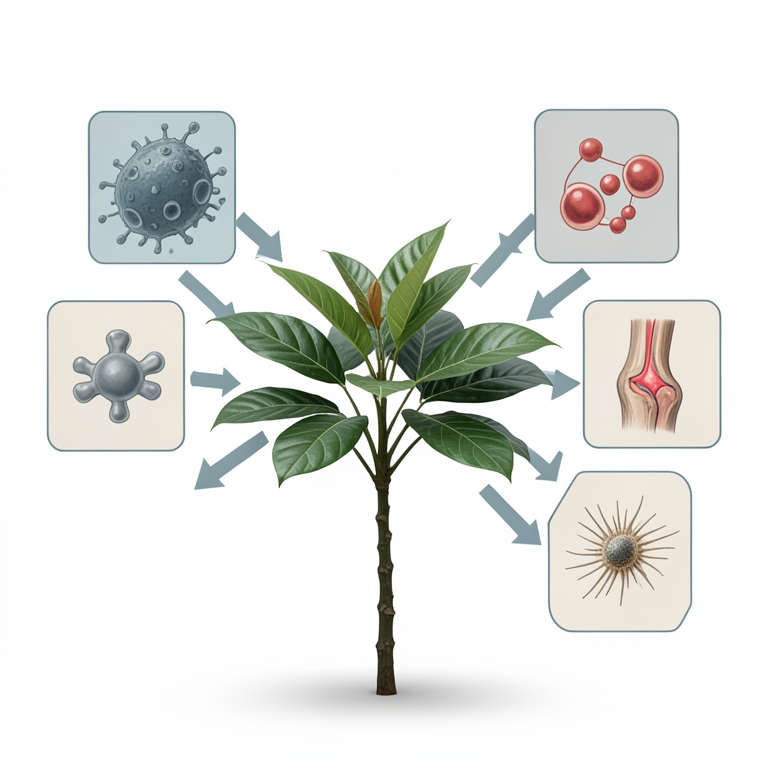
Pharmacological Spectrum of Acalypha indica
AI-generated conceptual illustration (Acalypha indica plant). It explains the idea and does not show study data.
View source evidence ↗Introduction
Acalypha indica a flowering plant belonging to Family Euphorbiaceae. It occurs throughout tropical Africa and South Africa, in India and Sri Lanka, as well as in Yemen and Pakistan. This plant is an erect, simple or branched, slightly hairy annual herb. It is a species of plant having catkin type of inflorescence.
It is a common herb growing up to 40-75 cm tall with ovate leaves. The plant is rich in secondary metabolities such as terpenoids, tannins, alkaloids, flavonoids [1]. The plant root, leaf, flower and stem parts possess antibacterial, anti- fungal properties and to use to treat various diseases and disorders [2]. Taxonomical classification Kingdom: Plantae Super division: Embryophyte Division: Tracheophyta Sub division: Spermatophytina Class: Magnoliopsida Sub order: Rosanae Order: Malpighiales Family: Euphorbiaceae Genus: Acalypha Species: Indica Vernacular Names Bengali: Muktajhuri Stera-basanta Sanskrit: Haritamanjari Malayalam: Kuppameni Tamil: Kuppivaeni, kuppaimeni Kannada: Kuppigida Hindi: Kuppikhoksli, Kuppu, Khokali Telugu: Kuppichettu, Harita-manjiri, kuppinta, muripindi English: Indian acalypha Gujarathi: Vanchi Kanto In traditional Indian medicine, Acalypha indica is known as kuppi or kuppameni [3], and has been used to treat a wide range of ailments for centuries.
The leaves and root of the plant are IJBS 2024; 6(1): 52-53 Dr. S Senthil Kumar Post-Doctoral, Reserach Scholar, Manipur International University, Imphal, Manipur, India Dr. C Kiruba Rani Department of Biochemistry, Vellalar College for Women, Erode, Tamil Nadu, India Dr. S Senthil Kumar Post-Doctoral, Reserach Scholar, Manipur International University, Imphal, Manipur, India https://www.biologyjournal.net used in Ayurvedic Medicine to treat skin disorders, respiratory problems and urinary tract infections [4, 5].
It is also used to relieve pain and inflammation and to reduce fever [6]. Medicinal uses of Acalypha indica Linn The leaves, roots, stalk and flowers of Acalypha indica are used for its medicinal properties. Whole plant is used for asthma, pneumonia, bronchitis and rheumatism [7]. It is useful in treatment of skin disease, snake bite [8, 9].
The leaf extract has been reported to possess various properties such as antimicrobial, antioxidant and anti-diabetic activities [10, pharmacological potential: A review. J Appl Pharm Sci. 2013;3(3):97-101. 5. Chawla R, Arora R, Singh S, Sagar R. Acalypha indica Linn.
A review of its phytochemical and pharmacological profile. J Med Plants Res. 2011;5(8):1296-1301. 6. Das S, Das MK. A review on pharmacological and phytochemical analysis of Acalypha indica.
Int. J Pharm Pharm Sci. 2012;4(2):22-25. 7. Arjun R, Duraisamy AJ, Selvakumar PS, Vijay B. Medicinal plants from the Siddha system of medicine useful for treating respiratory diseases.
Int. J Pharm Anal. 2009;1(2):20-30. 8. Mathur A, Joshi H. Ethnobotanical studies of the Tarai region of Kumaun, Uttarakhand, India.
J Ethnobot Res Appl. 2013;11:175-203. 9. Padal SB, Chandrasekhar P, Vijayakumar Y. Traditional uses of plants by tribal communities of Salugu Panchayat of Paderumandalam, Visakhapatnam district, Andhra Pradesh, India. Inter J Comput Eng Res. 2013;3(5):98-103. 10.
Durga KR, Karthikumar S, Jagatheesan K. Isolation of potential antibacterial and antioxidant compounds from Acalypha indica and Ocimum basilicum. J Med Plant Res. 2009;3(10):703-706. 11. Moreno G, Arenas R.
Other fungi causing onychomycosis. Clin Dermatol. 2010;28:160-163. 12. Shukla SS, Saraf S, Saraf S. Fundamental aspects and basic concepts of Siddha medicines.
Syst Rev Pharm. 2011;2(1):48-54. 13. Zahir Hussain A, Kumaresan S. GC-MS analysis and antibacterial evaluation of Acalypha indica. Asian J Plant Sci Res. 2013;3(6):46-49. 14.
Umate SK, Marathe VR. Nutraceutical evaluation of Acalypha indica L. A potential wild edible plant. Int.
J Green Pharm. 2018;12(3):510-517. 11]. It is an important wild edible plant with prominent nutraceutical values [12]. Extracts of leaves called “Charu” obtained by grinding them and is used in treating different fungal infections of skin [13]. Nowadays many skin related infectious diseases are spreading, specifically the high populated countries like India and hence it is very important to develop quick remedy for such infectious diseases.
Acalypha indica proved to be best herbal medicine for various disease including skin diseases therefore an ideal formulation prepared from this plant is used to treat such skin diseases. There is a need of more sophisticated testing
Methods
for pharmacological, toxicological and microbiological activities, for determining quality of the herbal formulations. It is, therefore, essential that definite and accurate analytical methods be available to follow consistency and quality of herbal drugs, so that these products exhibit the desired medicinal effects. WHO specifies guidelines for the assessment of the efficacy and quality of herbal drugs as a prerequisite for global harmonization [14].
Conclusion
Acalypha indica is a medicinal plant that has been known as a source of traditional medicine for treating several diseases in ethno medicinal practices. The Acalypha indica extracts have been reported to possess many pharmacological activities, such as anti-arthritis, antibacterial, anti-diabetic, anti-fungal, anti-hyper lipidemic, anti-inflammatory and other activities. Furthermore, Scientists have identified the phytochemical constituents of this plant which are included constituents of this plant which are included in the secondary metabolites of alkaloids, flavonoids, phenolics, tannins and steroids. Although Acalypha indica has been reported to inhibit several types of cancer growth and has many phytochemicals, until now, progress in the discovery of anti-cancer lead compounds from this plant is still limited.
References
4 in the original paper- Vigneshkumar P, Bhuvaneshwaran S, Analava M. Phyto pharmacology of Acalypha indica: A review. Int J Biosci Altern Holist Med. 2010;1:27-32.
- Sivasankari B, Aanandharaj M, Gunasekaran P. An ethnobotanical study of indigenous knowledge on medicinal plants used by the village people of Thoppampatti, Dindigul District, Tamil Nadu, India. J Ethnopharmacol. 2014;153:408-423.
- Bhardwaj A, Singh N, Verma PK. Acalypha indica Linn. (Euphorbiaceae): A review. J Pharm Res. 2011;4(9):2959-2963.
- Chakraborty T, Chakraborty A, Mukherjee S, Mukherjee A. Acalypha indica L. and its