
Research article · 2024 · Full text
International Journal of Veterinary Sciences and Animal HusbandryEfficacy of estrous induction protocol with artificial insemination in Osmanabadi goats
Volume 9(6) · Pages 68–71 · DOI: 10.22271/veterinary.2024.v9.i6b.1834 ↗
Research areasReproductive Physiology in LivestockGenetic and phenotypic traits in livestock
Abstract
Author-writtenThis study aimed to evaluate the effectiveness of an estrous induction protocol combined with artificial insemination (AI) in Osmanabadi goats. With increasing demand for goat meat and milk in India, optimizing reproductive efficiency is essential. A total of 48 healthy Osmanabadi does were selected and divided into two groups: a control group and a treatment group. The treated group received intravaginal progesterone sponges for 14 days, followed by an injection of PGF2α. Estrous response, onset and duration of estrus, and conception rates were measured. Results showed a 100% estrous response in the treatment group compared to 25% in the control, with the treatment group also exhibiting a shorter onset time and prolonged estrous duration. The conception rate was significantly higher in the treatment group (75%) compared to the control group (16.67%). These findings suggest that the intravaginal progesterone sponge protocol enhances estrous synchronization and reproductive success in Osmanabadi goats, offering a viable approach for improving productivity in the species.
Summary
Source-checkedPlain-language reading of the full paper, prepared with AI and checked against the text. Each point links to the authors' own words.
Why it matters
- Optimizing reproductive efficiency in goats is essential due to the growing demand for goat milk and meat in India. View evidence ↗
- The seasonal nature of goat reproduction limits the ability to utilize their reproductive capacity throughout the entire year. View evidence ↗
- Estrus synchronization and induction are used as management tools to support artificial insemination and mitigate seasonal reproductive effects. View evidence ↗
The question
- The study aimed to evaluate how effective an estrous induction protocol combined with artificial insemination is for Osmanabadi goats. View evidence ↗
What they did
- The experiment used a sample of 48 healthy female Osmanabadi goats. View evidence ↗
- The goats were split into two groups of 24: a control group (untreated) and a treatment group that received intravaginal progesterone sponges for 14 days followed by a 125 µg injection of PGF2α. View evidence ↗
- Pregnancy was diagnosed using a real-time B-mode portable ultrasonography machine. View evidence ↗
What they found
- The treatment group achieved a 100% estrous response (24/24 goats), whereas the control group only had a 25% response (6/24 goats). View evidence ↗
- The time to onset of estrus was significantly shorter in the treatment group (36.17 ± 0.97 hours) compared to the control group (67.33 ± 1.94 hours). View evidence ↗
- The duration of estrus was significantly longer in the treatment group (38.29 ± 0.61 hours) than in the control group (19.83 ± 1.21 hours). View evidence ↗
- The conception rate was significantly higher in the treatment group (75%, with 18/24 goats) compared to the control group (16.67%, with 1/6 goats). View evidence ↗
What it means
- The authors conclude that the intravaginal progesterone sponge protocol is a viable method for improving productivity in Osmanabadi goats by enhancing reproductive success and estrous synchronization. View evidence ↗
Visual summary
3 visualsIllustrations explain the paper; charts are replotted from the paper's own table values.
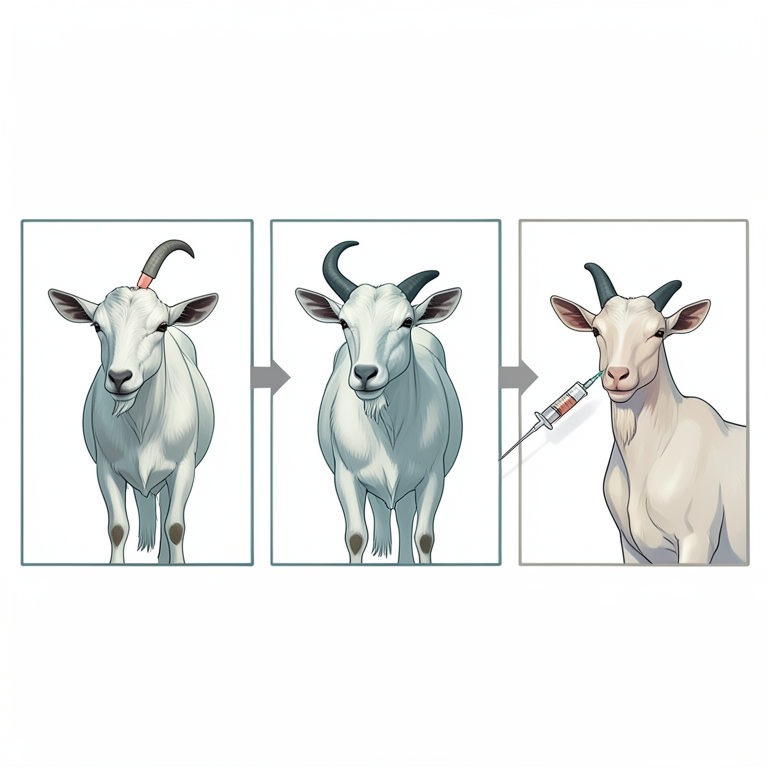
Treatment Protocol Flow
AI-generated conceptual illustration (Osmanabadi goats). It explains the idea and does not show study data.
View source evidence ↗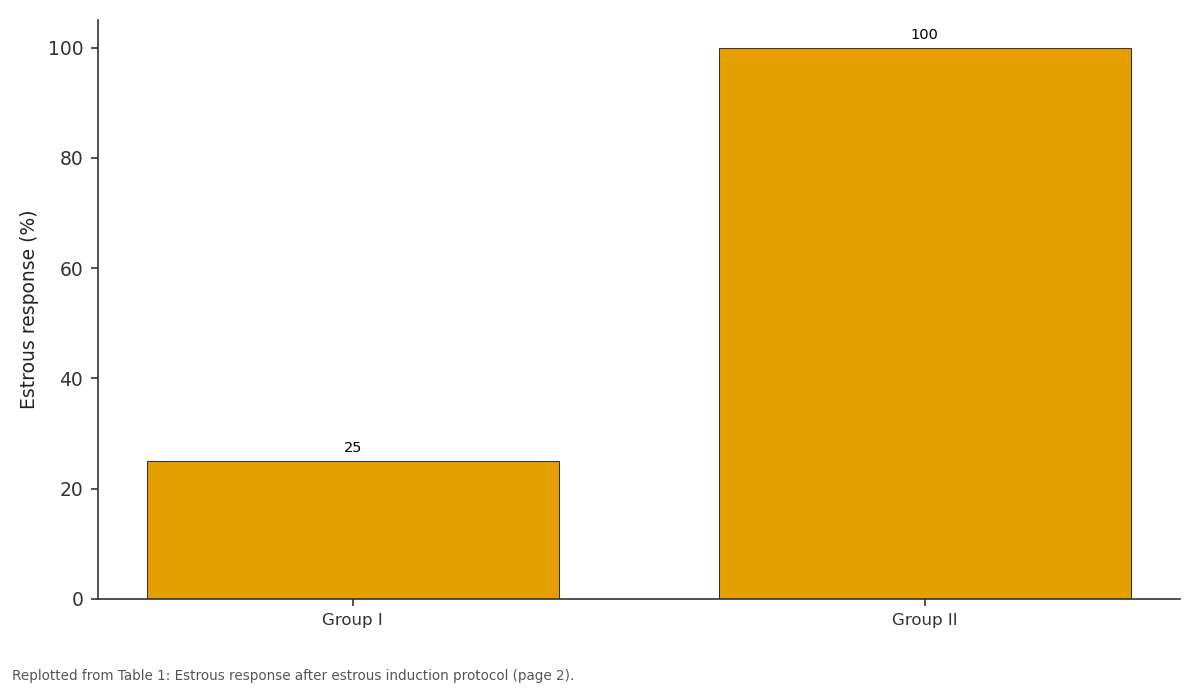
Estrous response (%): Group I vs Group II
Replotted from Table 1 (page 2) of the original paper. Every bar is the paper's own table value.
View source evidence ↗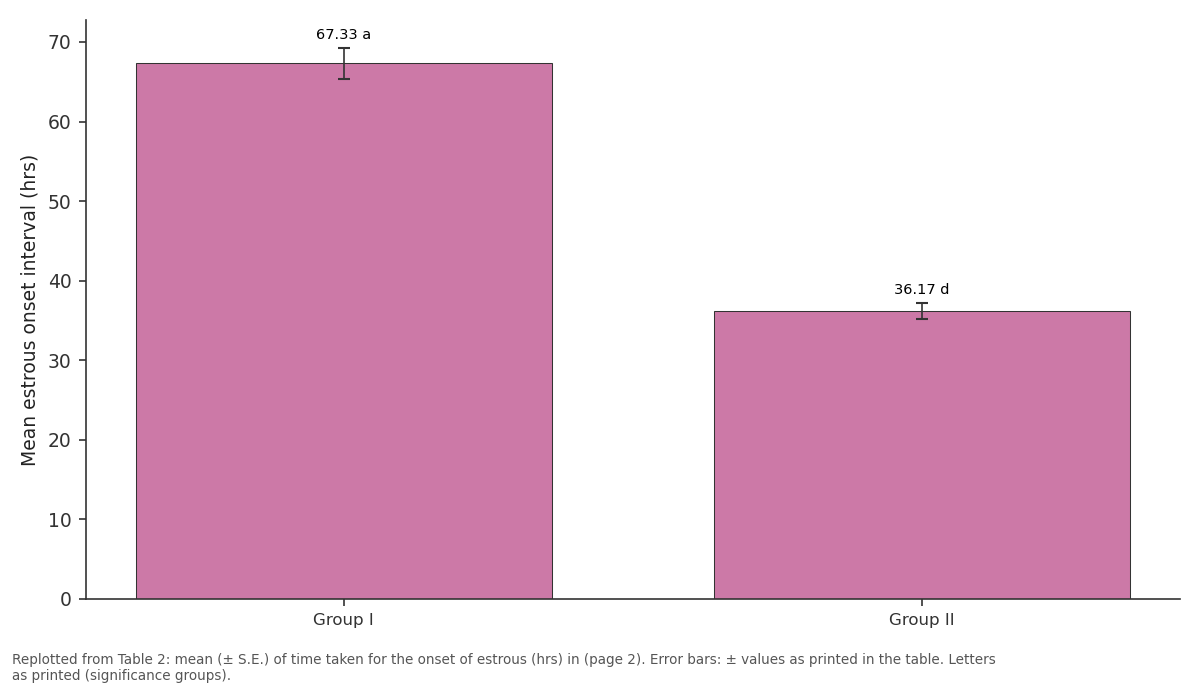
Mean estrous onset interval (hrs): Group I vs Group II
Replotted from Table 2 (page 2) of the original paper. Every bar is the paper's own table value.
View source evidence ↗Figures & tables
From the original paper Table 1
 Table 2
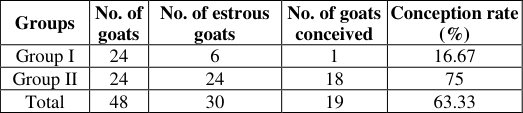 Table 4
 Table 3
Introduction
In India, both demand and production of goat meat has shown steady growth over the last decade, and given the increasing trend in production, country will need to double the number of goats in order to meet the estimated requirement of goat meat for growing human population in the coming decades. Also, the real demand for meat is much higher than the current supply. Therefore, it is obvious that an increase in the production of goat meat is necessary to meet the requirements. The increased production of goat milk is likely to result from growing numbers of goats in areas where goats are a suitable species, and from improving the productivity of individual goats. Seasonality in the reproduction of goats is, however, a significant constraint to harness the such animal's reproductive capacity yearround. Induction and estrus synchronization is an important management method that has been used as an aid to Artificial Insemination (A.I) and to reduce the seasonal effects in dairy goat reproduction. During the estrus synchronization system, the use of A.I is encouraged by applying different estrous synchronization protocol. Essentially, there are two methods for the synchronization of estrus in goats: artificial prolongation of diestrus using exogenous progesterone or progestagen, or shortening this process by using luteolytic agents (Bretzlaff and Madrid, 1989) [4] . Synchronization can be done by using ProstaglandinF2alpha, GnRH or intravaginal progesterone sponges. Progesterone is widely used in goat reproductive management for estrous synchronization together with A.I (Leboeuf et al.,1998) [12] . Controlling goat reproduction provides three key advantages: (1) selecting a kidding cycle at a particular season of the year (determined by the availability of forage or selling of products), (2) coordination of kidding over a limited period of time (labor control, reduction of kid mortality, homogeneous feeding of mothers and kids) and (3) gene management. Therefore, this research trial is taken up with the objectives to study the efficacy of combination of intravaginal progesterone sponges and PGF2alpha in Osmanabadi goats.
Materials and Methods
The present research work was carried on "Efficacy of Estrous Induction protocol with Artificial
Selection of experimental animals
A total of 48 healthy Osmanabadi does were selected as experimental animals for the research work. All the does were selected without any genital abnormality irrespective of the ovarian activity and were screened for ruling out early pregnancy by B-mode ultrasonography either by transabdominally or transrectally.
Schedule of treatment protocol
After selection of experimental animals, total 48 Osmanabadi goats were randomly divided into two groups each comprising of 24 does and were maintained under isolation from the remaining goats. The does from these two groups were treated with control breeding protocol with one control group. A total of 48 Osmanabadi does will be divided into 2 groups, each group consisting of 24 does. Group-I comprises of 24 does termed as control group which will be untreated and in Group-II implanted with AVIKESIL-S intravaginal progesterone sponges for 14 days and administration of 125 µg i.m. injection of PGF2α on the day of sponge removal.
Reproductive Observations
The estrus response was determined by the number of does in estrus divided by the number of does treated and multiplied by 100 and it is expressed in per cent. Time to onset of estrous was calculated from the time of the end of treatment to first appearance of estrous signs. The time for exhibition of estrous in terms of hours. Time of first acceptance of mating to the last acceptance of mating was recorded as duration of estrus and it is expressed in hours. The conception rate was determined by the number of does pregnant divided by the number of goats inseminated multiplied by hundred and it is expressed in per cent after Artificial insemination was carried. For the pregnancy diagnosis, a real time B-mode portable ultrasonography machine (SSD-500 Aloka Co. Ltd., Japan) was used. Ultrasonography scanning was carried out. The does were subjected to pregnancy diagnosis by two different probes with two different approaches. Trans-abdominal scanning was performed by using sector probe having frequency 3.5MHz and trans-rectal scanning was performed by using linear rectal probe having frequency 7.5MHz. All the observations of the experiment were recorded systematically as per protocol. The data was properly tabulated and was statistically analyzed by using one-way Anova followed by Duncan test as post hoc test.
Results and Discussion
In group I (control group) out of 24 does 6 does were exhibited the estrous symptoms and the estrous response was 25%. In group II out of 24 does all does were exhibited the estrous symptoms and the estrous response was 100%. Similar findings of estrous response 100% were observed by Amle et al., (2011) [2] , Bogdan et al., (2016) [3] , Kavitha et al., (2018) [11] , Frietas et al., (1996) [7] , Pietroski, (2013) [14] , Holtz et al., (2008) [10] and Dogan et al., (2004) [5] with co-treatment of eCG. In contrary with the present findings lesser estrous response were also reported by Gupta et al., (2019) [9] and Romano, (1996) [15] as 77.35% and 75% respectively with cotreatment of eCG. From the present findings it is clear that, the estrus response in group II was highest from all the four groups of goats as 100% could be due to the longer period of intra-vaginal progestogen treatment of about 14 days as compared with the reports reported by earlier authors. The fact behind this is that, the amount of steroid actually released from the sponge and the consistency of the release over the treatment period is more important than the dosage impregnated (Greyling and Van der Nest. 2000) [8] .
During the estrus induction process, PGF2a is only effective in cycling animals. In contrary. progesterone promotes dominant follicular development in the absence of corpus luteum. In the present study experimental goats were selected for the trial irrespective of ovarian activity and this may be the reason for the differences in estrus response. Therefore, from the present findings it is clear that, intravaginal progesterone sponges could be more efficient treatment to use for the estrus induction.
Teaser buck was used twice daily for the detection of estrous exhibition and time taken from the end of the treatment to the time for exhibition of estrous was recorded as time taken to onset of estrous in hours. In group I mean (± S.E.) of time taken for the onset of estrous was 67.33 ± 1.94 hrs. In group II mean (± S.E.) of the time taken for onset of estrous was 36.17 ±0.97 hrs while mean (± S.E.) of time taken for the onset of estrous in control group was 67.33 ± 1.94 hrs. The mean (± S.E.) of time taken for the onset of estrous in both the groups varied significantly (p<0.01). Similar findings were also observed by Holtz et al., (2008) [10] and Romano, (1996) [15] who obtained time for the estrous as 37.13 ± 3.0 hrs and 41.5 ± 8.1hrs respectively with cotreatment of eCG.In contrast with the present findings Dogan et al., (2005) [6] , Pietroski, (2013) [14] and Dogan et al., (2004) [5] reported lower mean (± S.E.) time for the onset of estrous as 20.6 ± 0.8 hrs, 25.2 ± 3.3 hrs and 15.8 ± 0.9 hrs respectively with co-treatment of eCG. It is evident from table 2 that mean (± S.E.) of the time taken for onset of estrous was significantly different in all group (p<0.01) From the present findings, it is clear that, the time required for the onset of estrous was lowest in group II (Intravaginal progesterone sponge) does when compared with the other groups. In the present research work, significant differences in the time taken for the onset of estrous between the groups was observed could be due to selection of experimental goats with the irrespective of ovarian activity and age. These differences could also be due to difference in the time of hormonal treatment and different estrous induction protocol. Mean (± S.E.) of duration of estrous was calculated and reported between the first and last acceptance of male within the same estrous period in hours. In group II mean (± S.E.) of the duration of estrous was 38.29 ± 0.61 hrs while the mean duration of estrous in control group was 19.83 ± 1.21hrs. The mean duration of estrous in both the groups varied significantly (p<0.01). Similar findings were observed by Dogan et al., (2004) [5] and Kavitha et al., (2018) [11] who reported mean (± S.E.) of the duration of estrous as 34.0 ± 1.4hrs and 42.20 ± 1.32hrs respectively with cotreatment of eCG. In contrary with the present findings Bogdan et al., (2016) [3] observed a lower mean (± S.E.) of the duration of estrous as 20hrs with co-treatment of eCG. It is evident from table 3 that mean (± S.E.) of the duration of estrous was significantly varied in all group (p<0.01). The variations in the present findings may be due to individual differences within same species, change in the treatment protocol, duration in the administration of hormone protocol timings as well as difference in between the use of single and double prostaglandin in the above-mentioned experiment. The differences in the observation of duration of estrous reported by earlier author may be because of breed variation, seasonal variation, age differences, difference in duration of intravaginal sponge administration, different timings of prostaglandin administration. From the present findings, it is clear that, duration of estrous was observed highest in group IV (intravaginal progesterone sponge) as compared to other group of goats during the research work. Pregnancy conformation was done by using a real time B mode ultrasonography machine by using both transabdominal and transrectal method on day 35 th after artificial insemination to obtain the conception rate. The conception rate was determined by the number of does pregnant divided by the number of goats inseminated multiplied by hundred and it is expressed in per cent. In group I (Control) out of 6 does inseminated 1 was found pregnant with 16.67% as conception rate. In group II out of 24 does inseminated 18 were found pregnant with 75.00% as conception rate. The present findings are in accordance with Amle et al., (2017) [1] who observed t conception rate of 72.73% with co-treatment of eCG. In contrast with the present findings higher conception rate of 93% was observed by Tensingh, (2015) [16] with co-treatment of eCG. The present findings are also not in agreement with Mehmood et al., (2011) [13] who observed lower conception rate of 29.4% with co-treatment of eCG. The variation of conception rate with the present findings reported by earlier author could be due to difference in the breeds, drugs, physiological stage, seasonal variation, endocrine profile as well as geological difference which may causes variation in the conception rate. From the study it reveals that the group II was found more efficient than the other treatment groups of goats with 75% of conception.
Summary and conclusion
Summary and conclusion
Figures and tables from the paper
| Group | No. of goats | No. of estrous goats | Estrous response (%) |
|---|---|---|---|
| Group I | 24 | 6 | 25 |
| Group II | 24 | 24 | 100 |
| Total | 48 | 30 | 62.5 |
Table text extracted from the original PDF; superscript letters are shown inline. The original table image is below.
View original table image
References
14 in the original paper- Amle MB, Birade HS, Gulawane SU. Estrus response and conception rate in Sangamneri and Osmanabadi goat does using different estrus synchronization protocols. Int J Adv Vet Sci Technol. 2017;6(1):308-315.
- Bogdan S, Blaga Petrean AL, Andre S. Estrous induction and synchronization in out-of-season Saanen goats. UASVM Vet Med. 2016;73(2):1-6.
- Bretzlaff KN, Madrid N. Clinical use of Norgestomet ear implants or intravaginal pessaries for synchronization of estrous in anestrous dairy goats. Theriogenology. 1989;31(2):363-370.
- Dogan I, Nur Z, Gunay U, Soylu MK, Sonmez C. Comparison of fluorogestone and medroxyprogesterone intravaginal sponges for estrous synchronization in Saanen does during the transition period. S Afr J Anim Sci. 2004;34(1):18-22.
- Dogan I, Nur Z, Gunay U, Sagirkaya H, Soylu MK, Sonmez C. Estrous synchronization during the natural breeding season in Anatolian Black does. Vet MedCzech. 2005;50:33-38.
- Freitas VJ, Baril G, Samaude J. Induction and synchronization of estrus in goats: the relative efficiency of one versus two fluorogestone acetate-impregnated vaginal sponges. Theriogenology. 1996;46:1251-1256.
- Greyling JP. Synchronization of estrous in goats: dose of progestagen. Small Rumin Res. 2000;36:201-207.
- Holtz W, Sohnrey B, Gerland M, Driancourt MA. Ovsynch synchronization and fixed time insemination in goats. Theriogenology. 2008;69:785-792.
- Kavitha K, Joseph C, Sarath T, Pugazharasi C. Effect of different doses of PMSG for synchronization of estrous in progesterone primed goats. Int J Curr Microbiol App Sci. 2018;7(8):3066-3071.
- Leboeuf B, Manfredi E, Boue P, Piacere A, Brice G, Baril G, et al. Artificial insemination of dairy goats in France. Livest Prod Sci. 1998;55:193-203.
- Mehmood A, Andrabi SMH, Anwar M, Rafiq M. Estrus synchronization and artificial insemination in goats during low breeding season: A preliminary study. Pak Vet J. 2011;31(2):157-159.
- Pietroski ACCA, Cunha AC, Brandao F, Souza-Fabjan JMG. Short, medium or long-term hormonal treatments for induction of synchronized estrous and ovulation in Saanen goats during the nonbreeding season. R Bras Zootec. 2013;42(3):168-173.
- Romano JE. Comparison of FGA and MAP intravaginal pessaries for estrous synchronization in dairy goats. Small Rumin Res. 1996;22:219-233.
- Tensingh GP. Effect of flushing on reproductive performance and synchronization of estrous in Tellicherry does. Indian J Anim Reprod. 2015;35(2):4453.