
Research article · 2024 · Full text
International Journal of Advanced Chemistry ResearchChemical recycling of poly (Ethylene terephthalate) wastes by glycolysis method in presence of zinc acetate as catalyst
Volume 6(2) · Pages 93–99 · DOI: 10.33545/26646781.2024.v6.i2b.231 ↗
Research areasRecycling and Waste Management Techniques
Abstract
Author-writtenThe use of polyethylene terephthalate (PET) as products has increased in recent years, resulting in the production of a large amount of PET waste. Unfortunately, the polymer industry is C-intensive and the accumulation of plastics in the environment has become a major problem. Vaporizing plastic waste into fresh monomers for the production of primary plastic can reduce both the consumption of fossil raw materials and environmental pollution, making the plastic economy more sustainable. Recently, the chemical recycling of plastics has begun to be explored as an innovative solution to achieve a completely sustainable cycle. In this Paper, we reported the Glycolysis assisted by catalysts is the most popular and industrially recognised chemical recycling process of PET. Characterization has been done of recycled poly (Ethylene terephthalate) (RPET) obtained from the chemical recycling of post-consumer PET bottles by glycolysis method. In this way, plastics are depolymerised into monomers and/or oligomers suitable for re-polymerization, closing the chain. In this work, PET was depolymerised to its bis (2-hydroxyethyl) terephthalate (BHET) monomer by glycolysis using propylene glycol (PG) in the presence of catalysts. The PET synthesis was studied through infrared spectroscopy (FT-IR) and thermogravimetric analysis (TGA). The PET synthesized were characterized by scanning electron microscopy (SEM), FT-IR, TGA/DSC and the effect of temperature is investigation.
Summary
Source-checkedPlain-language reading of the full paper, prepared with AI and checked against the text. Each point links to the authors' own words.
Why it matters
- Polyethylene terephthalate (PET) production is massive, but only a small fraction (9% in 2020) is recycled, leading to significant environmental pollution. View evidence ↗
- Chemical recycling is preferred over mechanical recycling because it allows for the complete recovery of monomers, enabling the production of clean plastic. View evidence ↗
- Glycolysis is considered a promising depolymerization process due to its scalability, mild reaction conditions, and favorable yields. View evidence ↗
The question
- The study aims to synthesize and characterize recycled PET (RPET) from waste bottles using a glycolysis method with propylene glycol. View evidence ↗
What they did
- The depolymerization process used 100 g of waste PET bottles mixed with 50 g of propylene glycol and 2 g of zinc acetate catalyst. View evidence ↗
- The reaction mixture was heated from 80 to 200 °C at 6 °C/min and stirred at 200 rpm for 5 hours. View evidence ↗
- To synthesize the final PET, the BHET monomer was reacted with maleic anhydride and adipic acid (molar ratio 2.1:0.6:0.6) at temperatures increasing from 200 to 270 °C for 6 hours. View evidence ↗
- The resulting materials were characterized using FT-IR, TGA, DSC, SEM, and XRD. View evidence ↗
What they found
- The maximum yield of BHET monomer was 77%, achieved after 90 minutes of degradation at 180 °C. View evidence ↗
- At a low temperature of 125 °C, the conversion of PET and the yield of BHET were very low, at 9.0% and 10.1% respectively. View evidence ↗
- Temperatures above 170 °C resulted in a 100.0% conversion of PET and a BHET yield of 85.8%. View evidence ↗
- FTIR analysis confirmed the formation of BHET through the appearance of O-H and C-H bond vibration bands at 3420 cm⁻¹ and 2980 cm⁻¹. View evidence ↗
- The melting point of the produced BHET monomer was measured at 109.81 °C, which is consistent with the standard value. View evidence ↗
- TGA analysis showed that raw PET decomposes at 410 °C, while BHET shows decomposition at 240 °C and re-polymerization back to PET at 409 °C. View evidence ↗
What it means
- The authors conclude that the synthesized recycled PET is a promising material for use in sensors, filters, the textile industry, and cementitious materials. View evidence ↗
- The study suggests that the process is suitable for industrial application because the catalyst can be recycled. View evidence ↗
Visual summary
1 visualsIllustrations explain the paper; they do not show study data.
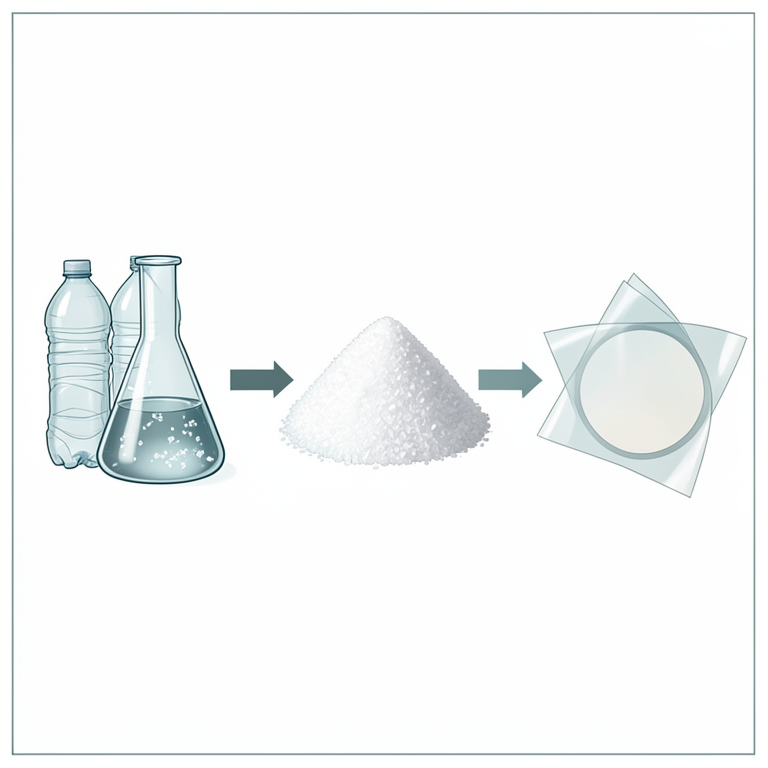
PET Recycling Cycle
AI-generated conceptual illustration (poly(ethylene terephthalate) plastic bottles and chemical monomers). It explains the idea and does not show study data.
View source evidence ↗Figures & tables
From the original paper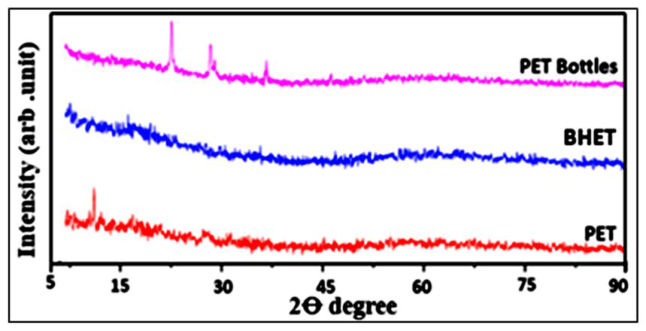 Figure 3
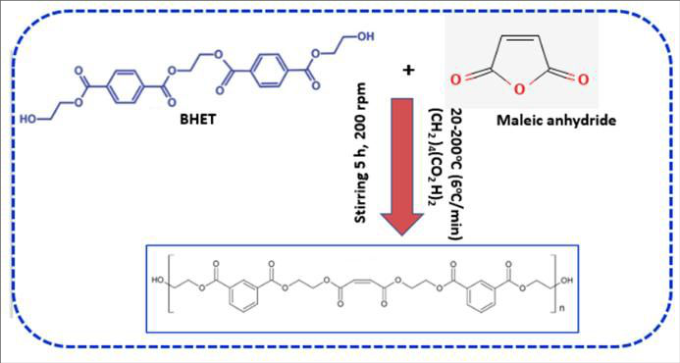 Figure 1
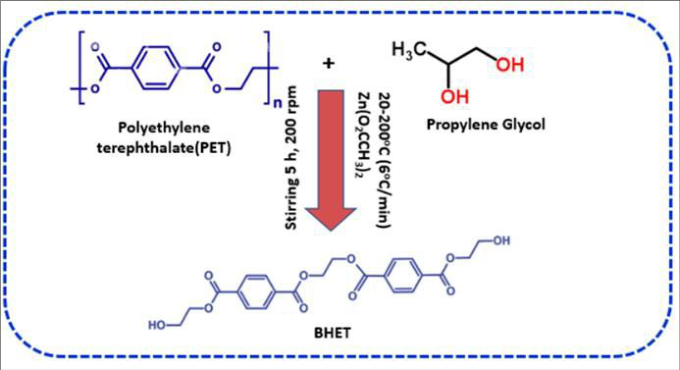 Figure 2
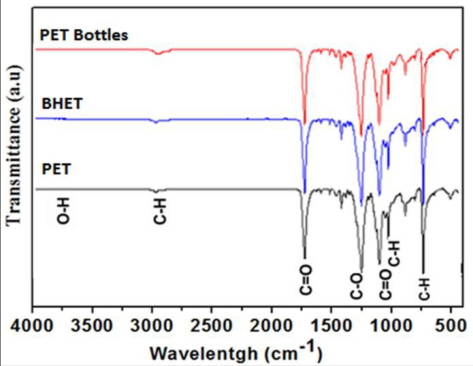 Figure 4
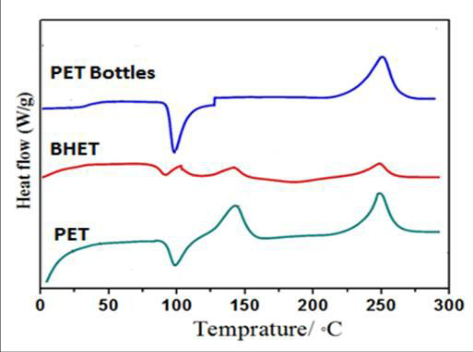 Figure 5
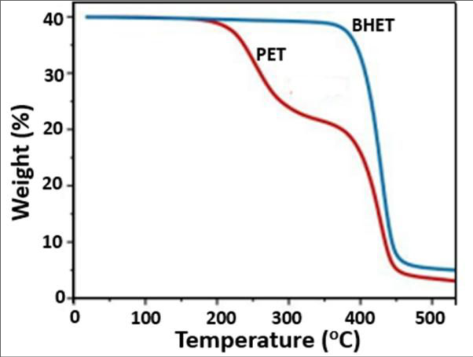 Figure 7
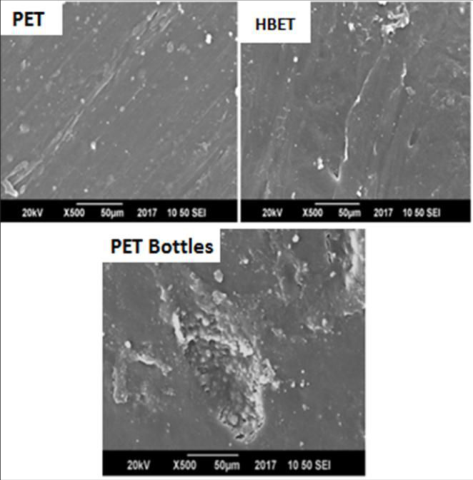 Figure 6
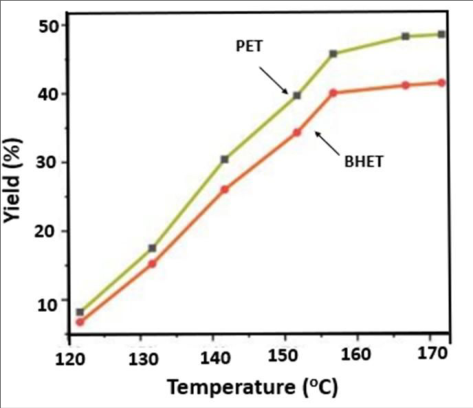 Figure 8
Introduction
In the current era of globalization, plastic is an integral part from our daily life; from brushing your teeth in the morning until dinner table, plastic is everywhere. The development of plastic was started with the use of natural materials [1] . Plastic properties such as shellac and chewing gum followed due to their chemical change over time. However, the first the discovery of fully synthetic plastics was made in 1907 Leo Baekeland. After the discovery of Baekeland, several new one's plastic was developed by polymer researchers a different properties suitable for many applications [2] . Moreover, it was found that with the continuous improvement of synthetic processes and production technology the properties of plastics have greatly improved compared to its predecessors resulting in replacing traditional materials with plastic. This is the main reason for the rapid growth of global plastics for consumption since the middle of the 20 th century [3] . In 2020, around 73 million tons of PET were produced worldwide, while only 9% of PET was recycled. Most of these single-use plastics end up in landfills or as accumulated waste in the oceans, causing significant water damage to the environment, air and land pollution [4] . PET can take several decades to degrade; thus, it is not surprising that bio magnification and bioaccumulation in oceans and other bodies of water have transferred these materials to humans [5] . Recently, researchers from the Free University of Amsterdam reported micrometre-sized plastic particles, including PET, in blood samples taken from healthy individuals. Researchers from the University of Hull reported similar results on lung tissue which increases the C intensity of the process. Therefore, developing technologies that return these materials to the production cycle can reduce both the carbon footprint and environmental pollution. If one ton of plastic waste is recycled, it is possible to save seven barrels of oil. Therefore, developing an effective recycling strategy will reduce energy and oil consumption [7][8][9][10] . However, for economic and ecological reasons, the depolymerisation of PET has attracted the attention of researchers in recent years, which has led to major efforts to recycle PET worldwide [11][12] . Mechanical recycling is one of the options but is limited to a few cycles. The physicochemical properties of mechanical plastics deteriorate over time, which ultimately limits the financial value of the finished product [13][14][15] . Chemical recycling allows the complete recovery of the individual monomers used to make PET, which facilitates the production of clean plastic [16] . Since the cost of virgin PET remains the same, recycling technologies should be economical to produce cheaper PET that can benefit the industry. Synthetic plastics such as polyethylene are widely used for packaging and various industrial and agricultural applications. These plastics are usually inert and resistant to microbial attack, which causes them to accumulate in the environment. The production of biodegradable PE (Polyethylene) requires changing the properties responsible for the resistance of PE to degradation [17] . Poly (Ethylene Terephthalate) (PET) is a semi-crystalline thermoplastic polymer that has been widely used in the packaging, textile and automotive industries due to its excellent mechanical properties and chemical resistance [18] . However, PET has a low heat distortion temperature and its product design is limited at high temperatures. Improving the dimensional thermal stability of PET can be achieved by increasing the level of crystallinity used in the beverage industry in the conventional hot filling process for bottle production [19] . However, PET bottles with high crystallinity are usually produced by extending the crystallization time or using complex machinery, resulting in low productivity and high investment costs. There are four different methods for mechanical and chemical recycling of PET materials: Primary recycling is the reuse of pre-consumed, uncontaminated and clean PET materials; for example, new PET bottles can be made from previously consumed PET bottles. In secondary recycling, the PET materials used in that process are then recycled. Which includes various steps, decontamination, drying and melt reprocessing. Tertiary recycling, or chemical recycling, involves the depolymerization of PET materials into their monomeric units. Chemical recycling can be achieved by pyrolysis or solvolysis. The pyrolysis process involves the depolymerization of PET materials with heat and without oxygen. Solvolysis, on the other hand, is a process in which the PET material is depolymerized with solvents such as water (Hydrolysis), alcohol (Alcoholysis), amines (Aminolysis), ammonia (Ammonolysis), and glycol (Glycolysis). It is important to mention that PET materials are a type of polyester containing ester functional groups that can be cleaved with various reagents. In quaternary recycling, the PET materials consumed in this process are burned and the energy content produced can be recovered. To illustrate this, waste plastic can be burned along with other household waste in advanced incinerators, generating significant heat and steam that can turn turbine blades and generate electricity [20] . Due to its advantages related to operating temperature, mild reaction conditions, yield and scalability, glycolysis is one of the most promising depolymerisation processes in PET chemical recycling. The resulting monomers, which are bis(2)hydroxyethyl)terephthalate (BHET) and ethylene glycol (EG) have different applications. Among the different recycling processes [21] . To overcome this problem, researchers are now focusing on the synthesis and sustainable strategies of new biodegradable synthetic polymers recycle these plastics so that can form a circular economy. Most industry recognized recycling processes reported so far are not competitive and produce plastic having poor physical and chemical properties that eventually leads to shrinking of the circular economy. Currently most used plastic in the world contains polyethylene terephthalate (PET), polyethylene (PE), polypropylene (PP), polyvinyl chloride (PVC), polystyrene (PS), polylactic acid (PLA), polycarbonate (PC), polymethyl methacrylate (PMMA), polyoxymethylene (POM) and nylons (PA). Most of these plastics are non-biodegradable and requires recycling processes [22] . Glycolysis is the most common and oldest PET method recycling the process of glycolysis was first patented in in 1965. It is already well established that glycolysis without catalyst is an extremely slow process and takes a prolonged time to depolymerize the PET with a minimal product yield. Thus, the development of novel catalysts for depolymerization of PET using glycolysis is major research interest among scientists. Until now several types of catalysts have been developed by researchers for glycolysis of PET, which include metal salt-based catalysts, heterogeneous catalysts including zeolites, various nanocatalysts and ionic liquid based catalyst are the most prevalent ones due to their easy availability and low cost compared to others. These metal salts include Zn, Mn, Co and Pb salts. Glycolysis is a kind of solvolysis reaction, using glycol (1, 2-ethane diol) and/or it is derived as the reactive solvent. Glycolysis assisted by catalysts is the most popular and industrially recognised chemical recycling process of PET. Chemically, glycolysis reaction is the "molecular degradation of PET polymer by glycols, in the presence of trans-esterification catalysts, where the ester linkages breaks and replace with hydroxyl terminals. The main products obtained from EG, diethylene glycol, propylene glycol, and dipropylene glycol are bis(2hydroxyethyl) terephthalate (BHET) and other oligomers (PET glycosylates). These products can be used further for manufacturing articles like polyurethane foams, polyesters, hydrophobic dye stuffs, unsaturated resins and acrylic coatings. The produced BHET with fresh BHET can be used for PET production using any of the method based on either DMT or TPA.
Glycolysis involving following steps
1. In initiation step, carbonyl carbon of ester group of the polymer is attacked by the free electron pair present on EG. 2. Hydroxyl ethyl group of EG bonds with carbonyl carbon of PET which breaks long polymer chain into short oligomers with subsequent formation of BHET.
Considerable efforts have been made since then to process improvement and optimization and currently several industries including DuPont, Shell Polyester, Zimmer and Goodyear recycle PET using glycolysis. Glycolysis involves the trans-esterification reaction of PET in the temperature with an excess of glycol 180-240 °C in an inert atmosphere, which leads to the depolymerization of PET and the formation of polyhydric alcohols [23] . Although it is based on the process of glycolysis and the glycol used depolymerization, oligomers with -OH end group can also be obtained. PET glycolysis can be performed with diols such as ethylene glycol (EG), propylene glycol (PG) and diethylene glycol (DG). In the absence of catalysts, the reaction is slow, leading to incomplete depolymerization of PET to BHET monomers. Instead, the formation of byproducts (Oligomers) increases significantly. The low reactivity of PET is related to the high stability of the carboxyl group, because resonance with the aromatic ring increases electron delocalization. Therefore, solid Brønsted acid catalysts are required to activate the carboxyl group and facilitate the electrophilic attack of PG. Solid acid catalysts have advantages over homogeneous acid catalysts because they can be separated from the reaction products by filtration, thus reducing the generation of hazardous waste. Solid acid catalysts are also non-corrosive. Thus, the use of solid acid catalysts as environmentally friendly catalysts in most industrial chemical reactions has become common in recent decades [24] . In this paper, we have presented the synthesis and characterization of recycle PET obtained from the chemical recycling of waste PET bottles by glycolysis method using propylene glycol. Also, the recycle PET were characterized by XRD, FTIR spectra, DSC curve and morphological characterization as SEM.
Materials and Methods
Materials and Methods
Materials
Post-consumer PET bottles were obtaining by waste materials shop, sodium hydroxide (99% purity) from rankem Dimethylformamide (99% purity) from rankem, Maleic anhydride and (99% purity) adipic acid (99.99% purity) rankem propylene glycol (PG) (99.99% purity), zinc acetate (99% purity), styrene (ST), polyacrylonitrile (PAN, Mw =150, 000) and potassium persulphate (KPS) (99.0% purity) purchased from Sigma Aldrich.
Making flakes of post-consumer PET bottles
Post-consumer PET bottles were washed to remove solids from recycled bottles. Labels and rings were also removed to avoid contamination with other polymeric materials.
After that, mechanical processing was carried out to reduce the size and homogenize with a non-standard mill (equipped with a power of five HP and a shearing knife). The process was carried out twice to obtain small flakes less than 1/2. The flakes were washed with a solution containing sodium hydroxide (Soda ash) and 50% water. Finally, the flakes were dried at room temperature for 8 h to remove residues.
Chemical recycling of post-consumer PET bottles
In the first stage of this synthesis, pieces of waste PET bottles (100 g) were mixed with propylene glycol (50 g) 50 wt% and zinc acetate as catalyst (2 g) 0.5 wt% collected in three-neck flask equipped with a magnetic stirrer, a thermometer, and a reflux condenser and heated in a sand bath. Then the temperature increased from 80 to 200 °C at a speed of 6 °C/min and was kept under stirring (200 rpm) for 5 h. The formation of gel material of transparent grey colour was called as BHET monomer, which at room temperature turned into a semi-solid and opaque grey colour. It is important to mention that in the synthesis, we have used Zinc acetate (ZnAc) as catalyst for performing best depolymerization activity, out of various metal acetates catalytic activities follow the trend Zn +2 >Mn +2 >Co +2 >Pb +2 .
In the second stage of this process glycolyzed product (BHET), maleic anhydride (AM) and adipic acid (AA) at a molar ratio of 2.1:0.6:0.6 were placed into the flask. The temperature increased from 200°C to 270 °C at a speed of 8 °C/min and was kept under stirring (300 rpm) for 6 h. The resulting product became semi-solid sample was called as PET. Finally, 30 wt% of styrene in synthesized PET was added as cross-linker agent and to enhance the workability. Depolymerized PET was immediately collected and separated from the liquid phase and washed with distilled water.
Then, the PET was dried and weighed. After that, 200 mL of distilled water was mixed used to wash PET and was added to the reactor's liquid phase while vigorously stirring at 80 °C for 20 min; this was dissolved the remaining BHET and PG. The insoluble part in water was a mixture of the oligomers, which was filtered, collected and dried. Then, the solution (Filtrate) was kept in a cold room (at 6 °C) for 6 h. White crystalline BHET flakes were formed, which were separated and dried in an oven at 80 °C for 1 h. The glycolysis process to convert the PET into its monomers shown in Fig. 1 and2. The depolymerised product was characterised using IR, analyses to confirm the production of the monomer. The yield percentage of the main product was calculated using the following equation: (See in supplementary materials).
Yield of BHET monomer (%) = Actual yield of BHET monomer Theoretical Yield of BHET × 100%
Influence of reaction time and temperature
It can be seen Table S1 entry 6, 7 and 8 that the conversion of PET and the yield of BHET increasingly by prolonging the reaction time. The highest yield of BHET was achieved after 90 min of degradation time, yielding 77% of BHET when the reaction temperature and EG loading were fixed at 180 °C respectively. Increasing the reaction temperature beyond 190 °C results in the augmented formation of a water-insoluble product (see Supplementary Material Table S1).
Results and Discussion
The formation of the RPET after the glycolysis process, was confirmed by XRD, FTIR analysis and SEM Micrographs of post-consumer PET bottles, BHET, and RPET. The following characterization of waste PET bottles, BHET, and synthesized PET as follows:
XRD spectra
The phase purity of formation of the synthesized PET after the glycolysis process was confirmed by XRD spectra shown in Fig. 3. The spectra contain purity of phase and no any impurity was obtained in synthesized PET. Fig. 3 shows some peak shift in same position in PET bottles and synthesized PET.
FTIR spectra
The formation of the synthesized PET after the glycolysis process was confirmed by FTIR analysis. In Fig. 4.present the characteristic bands and their assigned bond vibration corresponding to the waste PET bottles, BHET and PET.
The most characteristic bands of the PET bottles appear in 1720 cm -1 , 1407 cm -1 , 1242 cm -1 , 1100 cm -1 , 1042 cm -1 , 1014 cm -1 , 872 cm -1 and 728 cm -1 . These peaks appear in the other two spectra as well. In 13 C NMR spectra, of purified BHET which indicates that the monomer produced from glycolysis reaction is almost pure BHET (See Fig. S1in supplementary materials) The most important difference between BHET and PET are two bands present at 3420 cm -1 and 2980 cm -1 , shows to the vibration of the O-H and C-H bonds, formed after the glycolysis process was complete. These results clearly present the successful formation of the PET by the glycolysis method.
DSC curve
The DSC curve of waste PET bottles, BHET, and synthesized PET shows Fig. 4, in which an endothermic peak in the 100-110 °C range due to the solvent's evaporations. Furthermore, the endothermic transition around 150 °C and 240 °C is related to degradation temperature of polymeric chain. This raised temperature has been attributed to the change of PET cyclization mechanism due to the glycolysis method.
SEM micrographs
The SEM micrographs of the surfaces of the synthesized PET, BHET and waste PET bottles, samples are shown in Fig. 5. The PET showed a smooth surface and continuous phase that corresponded to its fully amorphous structure and semi-crystalline structure. In BHET and PET bottles image, the phase morphology of despite a slightly rough surface. With temperature raising from 145 ℃ to 170 ℃, the conversion of PET and the yield of BHET increased greatly, from 10.0% to 48.4% and from 8.1% to 38.9%, respectively. When the temperature was over 170 ℃as the conversion of PET and the yield of BHET was 100.0% and 85.8%, the increase tendency was totally retarded. Thus, the temperature of 170 ℃ was chosen to be applied in the other optimum reactions. The yield of glycolysis of PET strongly depends on different variables such as the calcination temperature of the catalyst, reaction time, reaction temperature, and PET/EG ratio. The kinetics of PET glycolysis is affected by many factors, including the molar ratio of PG and PET, the phase of catalysts, the shape and size of PET, and the agitation rate. Poly (Ethylene terephthalate) (PET) glycolysis is a possible way to degrade PET into its monomer bis(hydroxyethyl) terephthalate (BHET), which can be re-polymerized to form new competent PET materials, thus offering opportunities for sustainable recycling. However, most of the reported glycolysis catalysts are metal based, leading to high costs and negative environmental impacts. Glycolysis is a type of chemical recycling method that transforms PET waste into the monomeric bis(hydroxyethyl)terephthalate (BHET) through various chemical reactions. Compared to other recycling methods, the major advantage of glycolysis is that the monomer can be depolymerized into new PET materials under relatively mild reaction conditions and low-volatility solvents [29] .
Conclusion
Here in, we successfully depolymerized the PET from used water bottles into its monomers and oligomers utilizing inexpensive propylene glycol-based catalysts. The synthesized PET synthesis was studied through XRD, FTIR, TGA SEM and DSC. In results reflects, the recycling of PET waste through glycolysis was successfully performed. It is possible to reuse PET waste in a reuse again by synthesis of chemical recycling. Finally, by characterization techniques reflects the properties of synthesized PET is improving thermal properties and mechanical properties as compare to PET-bottles and BHET. The catalyst can be recycled, which makes it promising for the industrial application. The level performance qualifies synthesized PET was a promising candidate to be applied in cementitious materials, textile industry, filters, sensors, etc.
Figures and tables from the paper
References
23 in the original paper- Strain IN, Wu Q, Pourrahimi AM, Hedenqvist MS, Olsson RT, Andersson RL. Electrospinning of recycled PET to generate tough mesomorphic fibre membranes for smoke filtration. J Mater Chem A. 2015;3:1632. DOI:10.1039/C4TA06191H.
- Ge Z, Huang D, Sun R, Gao Z. Properties of plastic mortar made with recycled polyethylene terephthalate. Constr Build Mater. 2014;73:682. DOI:10.1016/j.conbuildmat.2014.10.005.
- Cosnita M, Cazan C, Duta A. The influence of inorganic additive on the water stability and mechanical properties of recycled rubber, polyethylene terephthalate, high-density polyethylene and wood composites. J Clean Prod. 2017;165:630. DOI:10.1016/j.jclepro.2017.07.103.
- George N, Kurian T. Recent developments in the chemical recycling of postconsumer poly(Ethylene terephthalate) waste. Ind Eng Chem Res. 2014;53:14185. DOI:10.1021/ie501995m.
- Siddiqui MN, Redhwi HH, Achilias DS. Recycling of poly(ethylene terephthalate) waste through methanolic pyrolysis in a microwave reactor. J Anal Appl Pyrolysis. 2012;98:214. DOI:10.1016/j.jaap.2012.09.007.
- Chanda M. Chemical aspects of polymer recycling. Adv Ind. Eng Polym Res. 2021;4:133. DOI:10.1016/j.aiepr.2021.06.002.
- Al-Sabagh AM, Yehia FZ, Abdel-Moneim MF, Eissa M, Moustafa ME, Eshaq G, et al. Glycolysis of poly(ethylene terephthalate) catalysed by the Lewis base ionic liquid. Ind Eng Chem Res. 2014;53(48):18443. DOI:10.1021/ie503677w.
- Crespy D, Bozonnet M, Meier M. 100 years of Bakelite, the material of a thousand uses. Angew Chem. 2008;47:3322-3328. DOI:10.1002/anie.200704281.
- Geyer R, Jambeck JR, Law KL. Production, use, and fate of all plastics ever made. Sci Adv. 2017;3. DOI:10.1126/sciadv.1700782.
- Beydoun K, Klankermayer J. Efficient plastic waste recycling to value-added products by integrated biomass processing. Sci Adv. 2020;13:488. DOI:10.1002/cssc.201902880.
- Roungpaisan N, Srisawat N, Rungruangkitkrai N, Chartvivatpornchai N, Boonyarit J, Kittikorn T, et al. Effect of recycling PET fabric and bottle grade on rPET fiber structure. Polymers. 2023;15(10):2330. DOI:10.3390/polym15102330.
- Hiraga K, Taniguchi I, Yoshida S, Kimura Y, Oda K. Biodegradation of waste PET. EMBO Rep. 2020;21(2). DOI:10.15252/embr.201949826.
- Hopewell J, Dvorak R, Kosior E. Plastics recycling: challenges and opportunities. Philos Trans R Soc Lond B Biol Sci. 2009;364(1526):2115-2126. DOI:10.1098/rstb.2008.0311.
- Singh N, Hui D, Singh R, Ahuja I, Feo L, Fraternali F. Recycling of plastic solid waste: A state of art review and future applications. Composites Part B. 2017;115:409-422. DOI:10.1016/j.compositesb.2016.09.013.
- Grigore ME. Methods of recycling, properties, and applications of recycled thermoplastic polymers. Recycling. 2017;2:24. DOI:10.3390/recycling2040024.
- Maurya A, Bhattacharya A, Khare SK. Enzymatic remediation of polyethylene terephthalate (PET)-based polymer for effective management of plastic waste: An overview. Bioprocess Eng. 2020;8:602325. DOI:10.3389/fbioe.2020.602325.
- Mohanan N, Montazer Z, Sharma PK, Levin DB. Microbial and enzymatic degradation of synthetic plastic. Bioprocess Eng. 2020;11:580709. DOI:10.3389/fmicb.2020.580709.
- Yang L, Gao J, Liu Y, Zhuang G, Peng X, Wu WM, et al. Biodegradation of expanded polystyrene and lowdensity polyethylene foams in larvae of Tenebrio molitor Linnaeus (Coleoptera: Tenebrionidae); broad versus limited extent depolymerization and microbedependence versus independence. Chemosphere. 2021;262:127818. DOI:10.1016/j.chemosphere.2020.127818.
- Cassone BJ, Grove HC, Elebute O, Villanueva SMP, LeMoine CM. Role of the intestinal microbiome in lowdensity polyethylene degradation by caterpillar larvae of the greater wax moth, Galleria mellonella. Proc R Soc B. 2020;287:20200112. DOI:10.1098/rspb.2020.0112.
- Santo M, Weitsman R, Sivan A. The role of the copperbinding enzyme laccase in the biodegradation of polyethylene by the actinomycete Rhodococcus ruber. Int. Biodeterior Biodegrad. 2013;84:204. DOI:10.1016/j.ibiod.2012.03.001.
- Ghosal K, Nayak C. Recent advances in chemical recycling of polyethylene terephthalate waste into value-added products for sustainable coating solutionshope vs. hype. Mater Adv. 2022;3:1974. DOI:10.1039/D1MA01112J.
- Vieyra H, Molina-Romero JM, Calderón-Nájera JD, Santana-Díaz A. Engineering, recyclable, and biodegradable plastics in the automotive industry: A review. Polymers. 2022;14:3412. DOI:10.3390/polym14163412.
- Shirazimoghaddam S, Amin I, Albanese JA, Shiju NR. Chemical recycling of used PET by glycolysis using niobia-based catalysts. ACS Eng. Au. 2023;3(1):37. DOI:10.1021/acsengineeringau.2c00029.