
Research article · 2024 · Full text
International Journal of Agriculture and Food ScienceEffect of species and KIN on the formation and multiplication of peppermint plant nodes Mentha sp.
Volume 6(2) · Pages 52–54 · DOI: 10.33545/2664844x.2024.v6.i2a.205 ↗
Research areasGenetic and Environmental Crop StudiesPlant Pathogens and ResistanceFlowering Plant Growth and Cultivation
Abstract
Author-writtenThe study included the cultivation of the tips of mint plant branches for the wild species Mentha pulegium L. and the cultivated species Mentha piperita L. on MS medium supplemented with different concentrations of KIN. The results indicated that the highest rate of branching was 6.00 branchs/plant part from the cultivation of nodes on MS medium supplemented with 0.5 mg/L KIN after 8 weeks of planting for the first species "wild". The highest rate of branching was 7.00 branches/plant part from the cultivation of nodes on MS medium supplemented with 1.0 mg/L KIN after 8 weeks of planting for the second species "cultivated". The highest rate of rooting was 4.00 and 2.50 roots/branch when planted on MS medium supplemented with 2.0 and 1.0 mg/L IAA for the wild and cultivated species, respectively.
Summary
Source-checkedPlain-language reading of the full paper, prepared with AI and checked against the text. Each point links to the authors' own words.
Why it matters
- Tissue culture technology is a critical biotechnology used for the propagation of various plant species. View evidence ↗
- Peppermint is valued for its medicinal properties, including antispasmodic effects and its use in treating various ailments from stomach pain to toothaches. View evidence ↗
- Due to the plant's benefits, there is a clear importance in developing methods to produce peppermint seedlings locally. View evidence ↗
What they did
- The researchers used 0.5 cm nodes from wild (Mentha pulegium L.) and cultivated (Mentha piperita L.) mint plants grown in city gardens. View evidence ↗
- For initiation and multiplication, nodes were planted on MS medium supplemented with KIN concentrations of 0.0, 0.2, 0.5, and 1.0 mg/L. View evidence ↗
- To induce rooting, the resulting branches were transferred to MS medium containing 0.0, 1.0, or 2.0 mg/L of IAA. View evidence ↗
- Data were analyzed using a Complete Randomized Design with ten replications per treatment, and means were compared using Duncan's multiple range test at a 5% significance level. View evidence ↗
What they found
- Wild mint branches achieved a 100% rooting rate, with 4.00 roots per branch and a length of 2.20 cm, when treated with 2.0 mg/L IAA. View evidence ↗
- Cultivated mint branches achieved a 100% rooting rate, with 2.55 roots per branch and a length of 3.11 cm, when treated with 1.0 mg/L IAA. View evidence ↗
What it means
- The authors conclude that KIN increases the number of branches by controlling apical dominance. View evidence ↗
Visual summary
1 visualsIllustrations explain the paper; charts are replotted from the paper's own table values.
Stage of emergence (after 4 weeks ) /... and Stage of multiplication (after 8 weeks ) /...: 0.0 vs 0.5 vs 1.0 vs 2.0
Replotted from a table (page 2) of the original paper. Every bar is the paper's own table value.
View source evidence ↗Figures & tables
From the original paper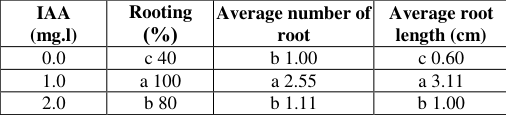 Table 4
Introduction
Tissuei culturei technology is onei of the biotechnologiesi that has playedi, and continues toi play, an important rolei in serving humanity, particularlyi in the fieldi of propagating many plant species. This method is characterized by its advantages, the most important of which is the ability to obtain huge numbers of pathogen-free plantsi that are similari to the motheri plant in a relativelyi shorti time and at anyi time of the year. Additionally, this technology is used in various researchi and applied fields, including planti breedingi and improvementi, the productioni of medicinali compounds and drugs, and rapid clonal propagation, which is one of the significant application carried out byi followingi differenti methodsi of differntiation and morphological formation, suchi as the formation of adventitiousi buds, stimulating the growth of axillaryi buds, and inducing asexuali embryos (somatic embryo), as well as studying the fundamental aspectsi of plant growth, development, and secondaryi metabolismi (Gupta et al., 2006; Kasumi et al., 2004; Ford, 2000; Al-Kanani, 1987) [9,11,8,3] . Peppermint is a green plant with a fragrant aroma that does not grow more than 30 cm above the ground. This plant contains volatile oils, proteins, fibers, vitamins, minerals, organic acids, and a volatile oil whose main components are menthol and menthone. It also contains flavonoids, with important compounds like luteolin and menthoside, and it contains phenolic acids (Al-Akri, 2002; Haikal and Abdul Razak, 1993) [4,2] . Peppermint is considered beneficial in destroying cancer cells, preventing nausea, stomach pains, colic, and acidity, absorbing gases, and is useful in gout, itching, hemorrhoids, clearing phlegm from the chest, and relieving toothaches, with an antispasmodic effect (Carole, 1997) [7] . From the above, the importance of the possibility of producing seedlings locally becomes clear. Therefore, the current study was conducted on two types of mint plants: "wild" and "garden" with the aim of: 1. Stimulating the formation of branches from nodes by planting them in nutrient mediai containing different concentrations of kinetin (KIN). 2. Rooting the resulting branches by planting them in nutrienti media containingi different concentrationsi of indole acetic acid (IAA) and studying its effect on the characteristics of the resulting roots.
Materials and Methods
Fresh plant parts were taken, represented by nodes 0.5 cm in length from Mentha sp. L.
plants, both wild and cultivated, grown in flowerbeds in the city gardens, with growths free from insect and disease infestations. They were then transferred to the laboratory, washed with regular detergent, and left under running water in a strainer for 10-15 minutes. Subsequently, they were moved to the planting table and treated with a 25% sodium hypochlorte (NaOCl) solutioni for 15 minutes (prepared from a commercial bleach solution containing 0.6% sodium hypochlorite). Afterward, they were washed threei times with sterile distilledi water for 5 minutes each time to removei the harmful effectsi of the disinfectant. Once the sterilization process was completed, the parts were transferred to sterile Petri dishes, making them ready for planting. They were then planted in MS medium prepared with different concentration of KIN (0.0, 0.5, 1.0 and 0.2 mg/L) for the initiation and multiplication stages. The branches resulting from multiplication were planted on full MS mediumi supplementedi with 0.0, 1.0, and 2.0 mg/L IAA for rooting. Glass bottles with a capacity of 250 ml were used for planting the plant parts, containing 40 ml of the nutrient medium at pH 5.7, and the mouth of the bottle was covered with aluminum foil. The nutrienti medium was sterilizedi using an autoclavei at a temperature of 121 °C and a pressure of 1. 04 kg/cm² for 20 minutes. After planting the plant parts, the cultures were transferred to a growth room under a light intensityi of 3000 lux, with a daily cycle of 16 hoursi of light followedi by 8 hoursi of darkness, provided by white fluorescent tubes, and at a temperature of 2 5 ± 2 °C. The Complete Randomized Design was used in the analysis of experimental data, and the meansi were comparedi using Duncanâs multiple range test at a significance leveli of 5% (Al-Rawi and Khalaf Allah, 1980) [1] . Each treatment included teni replications, and eachi replication contained one plant part.
Resultsi and Discussion
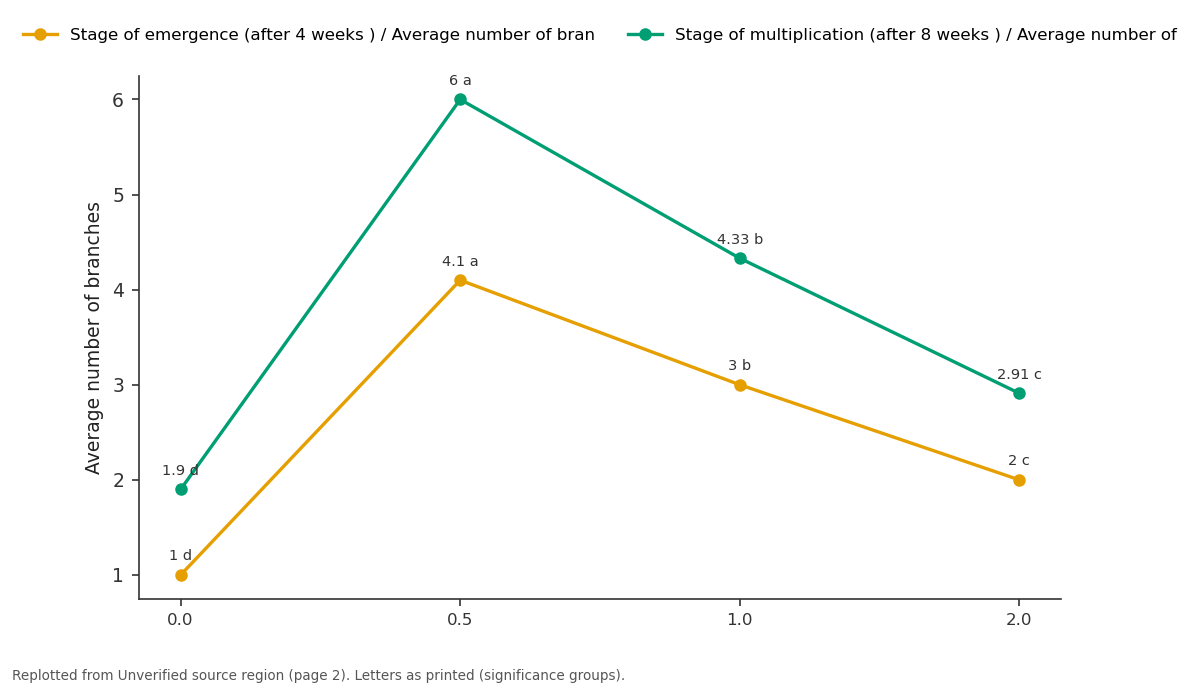
Table (1) showsi that the nodules of the wild mint species cultivated on MS medium with a treatment of 0. 5 mg/L KIN resulted in the highesti ratei of the numberi of branches at 4.10 branches/planti part and the highest rate of the numberi of leaves at 6.13 leaves/plant part. When recultivated for anotheri 4 weeks (multiplication stage) the nodules growni under the same treatment formed the highesti rate of the number of branchesi at 6.00 branches/plant part, significantly surpassing the other treatments, and the highesti rate of the number of leaves at 8.22 leaves/plant part, also significantly surpassing the other treatments.
The results in Table (1) regarding the multiplication of the cultivated parts can be explained based on the fact that KIN is one of the cytokinins that play a role in controllingi apical dominance, thereby increasing the number of branches. As a resulti of achieving a balancei between internal hormonesi and addedi growth regulators, the highest values were obtained, and increasing the concentration leadsi to a reduction in the valuesi for the number of branches as its effect become inverse (Smith, 2000; HopKins and Hiiner, 2004) [14,10] . The increase in lengthi and number of leaves for the different treatments can be attributed to the effecti of cytokininsi on the divisioni and elongation of cells, which in turn reflects on growth characteristics, in addition to its impact on the synthesis of nucleic acids (Wasef, 1995) [6] .
Tableii 1: Effectii of adding KIN on the growth and multiplicationii of the wild type nodes of the mint plant Mentha pulegium L. from its cultivation on solidii MS mediumii after 4 and 8 weeksi of cultivation.
Stage of multiplication (after 8 weeks ) Stage of emergence (after 4 weeks )
Average Numbers with similar letters within the same columni do not differ significantlyi from each other according to Duncani's multiplei range test at a 5% probabilityi leveli Table (2) shows that the mint plant contract for the horticultural type grown in MS mediumi with a treatment of 1.00 mg/L KIN resultedi in thei highesti average number of branches, which was 5.00 branches/plant part, and it gave the highest average numberi of leave, which was 6.00 leaves/plant part, significantly superior to the other treatments. After replanting fori anotheri 4weeks (multiplicationi stage), the plants growni under the same treatment formed the highest average number of branches, which was 7.00 branches/plant part, and the highesti averagei numberi of leaves, which was 8.00 leaves/plant part, significantly superior to the other treatments. The results of Table (2) can be interpreted in light of the results of Table (1). The numbers with similar letters within the same columni do noti differ significantlyi fromi each other according to Duncani's multiplei range test at a 5% probabilityi leveli Table (3) shows the effecti of IAA on thei rooting of branches of thei wild mint plant obtained from tissue culture, where the highest rooting percentage of 100% was achieved at a treatment of 2.0 mg/L IAA. The same treatment also resulted in the best rate of root number at 4.00 roots/branch and the highest root length rate at 2.20, which significantly outperformed the other treatments. These results can be explainedi on the basisi thati IAA is onei of thei auxins that playi an important rolei in activating cell division and increasing their size due to the polarization of nutrients and compounds that aid rooting, leading to the formation of root principles at the bases of the vegetative branch (Mohamed and Al-Rais, 1982) [5] .
Tablee3: Effecti of IAA on the rooting of nodes of the wild mint plant Mentha pulegium L. resultiing from tissue culture grown on solid MS mediumi afteri 4 weeks of plantingi. The numbers with similar letters within the same columni do noti differ significantly from each other according to Duncan's multiple range test at a 5% probability level Table (4) shows the effecti of IAA on the rooting of mint plant branches of the horticultural type produced from tissue culture. The highest rooting percentage of 100% was obtained at a treatment of 1.0 mg/l IAA. Additionally, the treatment at 1.0 mg/L IAA resulted in the best average number of roots at 2.55 roots/branch and the highest average root length of 3.11, which significantly outperformed the other treatment rates. These results are explained in light of what was mentioned in the interpretationi of the results in Table (3).
Figures and tables from the paper
References
14 in the original paper- Al-Rawi KM, Khalaf Allah AAM. Design and analysis of agricultural experiments. Mosul: Dar Al-Kutub Printing and Publishing Press/University of Mosul; 1980. (In Arabic).
- Al-Sayed HM, Abdullah ARO. Medicinal and aromatic plants. Alexandria, Cairo: Manasat Al-Ma'arif; 1993. (In Arabic).
- Al-Kanani FR. Plant tissue and cell culture. Mosul: Directorate of Dar Al-Kutub and Printing/University of Mosul; 1987. (In Arabic).
- Al-Akri AH. Mint. Bahrain: Ministry of Municipalities and Agriculture; 2002.
- Muhammad AA, Al-Rais AH. Plant physiology. Baghdad: Dar Al-Kutub Printing and Publishing; 1982.
- Wasfi IA-DH. Growth regulators and flowers and their use in agriculture. Cairo: The Academy; 1995.
- Saville C. Exotic herbs. New York: Henry Holt and Company; 1997. ISBN: 0-8050-4073-0.
- Ford KG. Biological and biomedical science: Plant science, botany-general. New York: McGraw-Hill; 2000. p. 1-6.
- Gupta S, Dutta A, Kinrakl Y. Plant tissue culture engineering. Vol. 6. The Kinckground. Berlin: Springer; 2006. p. 496.
- Hopkins WG, Huner NPA. Introduction to plant physiology. 3rd ed. New York: John Wiley & Sons, Inc.; 2004.
- Kasumi M, Takatsu Y, Suzuki K, Gonai T, Nogi M, Yamada T, Manabe T. Callus formation and plant regeneration from root explant of Gladiolus (Gladiolus X grandiflora Hort.). J Jpn Soc Hortic Sci. 2004;4(1):47-54.
- Murashige T, Skoog FA. A revised medium for rapid growth and bioassays with tobacco tissue culture. Physiol Plant. 1962;15(3):473-497.
- SAS Institute Inc. SAS/STAT software: Changes and enhancements through release 8.2. Cary, NC: SAS Institute Inc.; 2002.
- Smith RH. Plant tissue culture. San Diego: Academic Press; 2000.